Key Statistics
Key Takeaways
- Gigabit Ethernet PHY Chips is the leading type because Gigabit devices combine a very large installed base with broad enterprise, embedded, industrial and access-network compatibility, and the report page assigns the segment a 55% share.
- 1G and above PHY Chips is the strongest technology-growth theme as AI clusters, cloud fabrics and high-density networking are pushing electrical and optical interfaces toward 100G, 200G, 400G, 800G and 1.6T link architectures with higher per-lane signaling rates.
- Data Centers and Enterprise Networks remains the principal application, where server, switch and enterprise traffic growth raises port counts and link speeds while forcing PHY vendors to manage power, signal integrity, forward-error correction and timing within constrained system budgets.
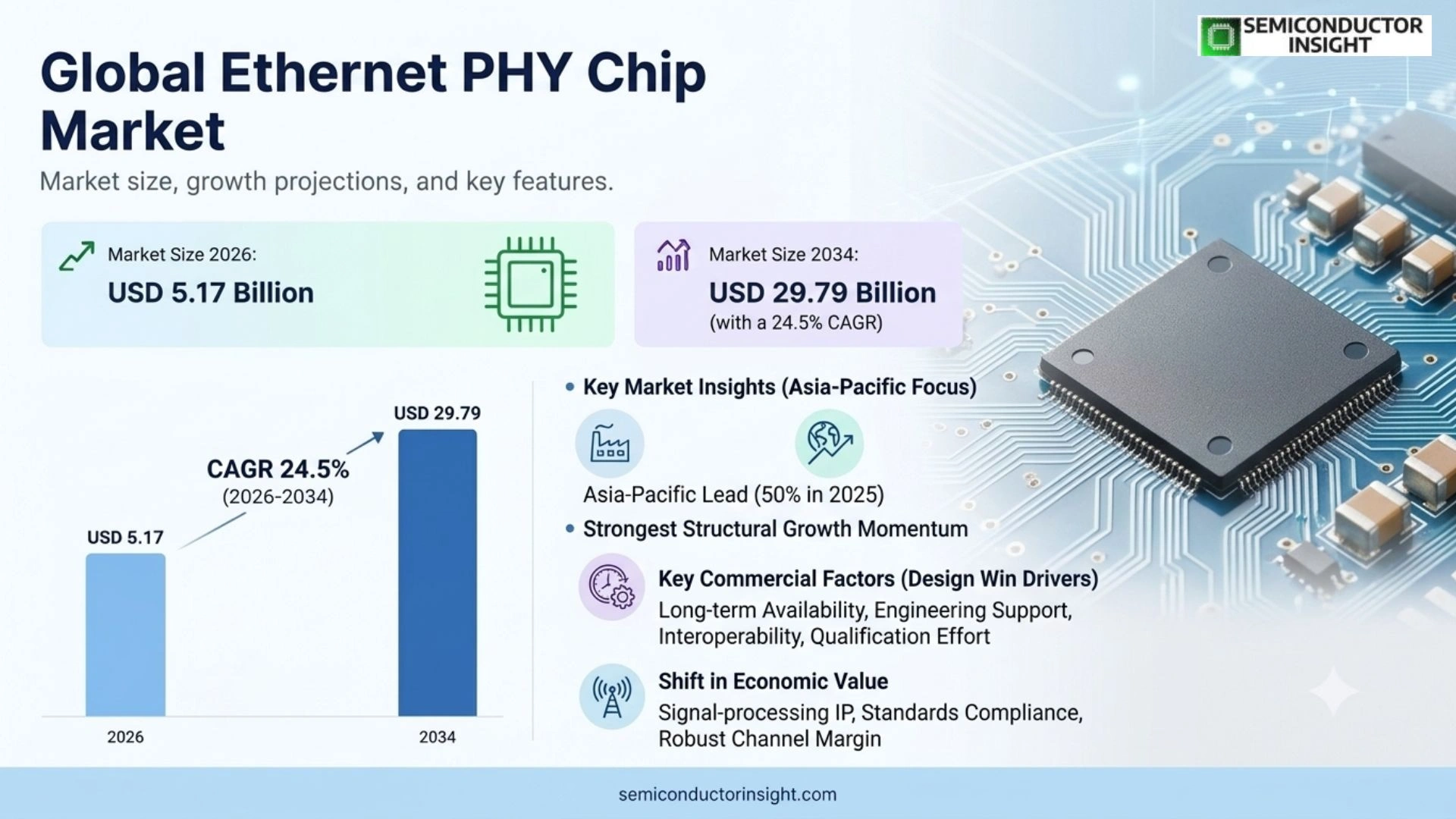
- Asia Pacific (50%) is the largest regional market in 2025, supported by the region combines major networking-IC vendors, electronics manufacturing, telecom equipment production, data-center expansion and the largest share stated on the report page.
- Asia Pacific has the strongest regional growth profile because China, Taiwan, South Korea, Japan and Southeast Asia continue expanding cloud, telecom, automotive and industrial electronics manufacturing, creating new PHY sockets across both high-speed and single-pair Ethernet.
- signal-integrity, power and standards complexity is the main structural restraint, slowing qualification, capacity conversion or supplier switching.
Ethernet PHY Chip Market Overview
Ethernet Phy Chip was valued at USD 4.16 billion in 2025 and is projected to reach USD 29.79 billion by 2034, representing a 24.5% CAGR during 2026–2034. The 2026 estimated market size is USD 5.17 billion. Asia Pacific (50%) is the largest market in 2025, while Asia Pacific shows the strongest structural growth momentum.
An Ethernet PHY chip implements the physical-layer functions that convert digital data from a media-access controller into electrical or optical signaling suitable for the transmission medium, then recover the received signal at the far end. The market spans copper, single-pair and high-speed retimer or transceiver PHY devices used from embedded 10/100/1000 Mbps links to multi-hundred-gigabit data-center interfaces. In ethernet phy chip, commercial decisions also depend on qualification effort, interoperability, long-term availability, engineering support and the cost of a field change after deployment. Suppliers that reduce those risks can protect design wins across multiple system generations, whereas vendors competing only on component price face a more difficult path into applications where revalidation or architecture changes create meaningful cost for the customer.
A PHY sits between the MAC or switch silicon and the channel, performing functions such as line coding, equalization, clock recovery, auto-negotiation, link training, forward-error correction, diagnostics and, in selected devices, MACsec or precision time synchronization. As speeds increase, the economic value shifts toward signal-processing IP, low-power SerDes, standards compliance and robust channel margin rather than simple connectivity.
Demand grows when the number of connected endpoints increases, when existing ports migrate to a higher line rate, or when a new architecture adopts Ethernet in place of a proprietary fieldbus. Cloud and AI systems raise bandwidth per port, automotive networks add single-pair Ethernet, and factories extend deterministic Ethernet to edge devices, so unit demand and silicon value can rise simultaneously across different speed classes.
Segment Analysis: By Type
By type, the ethernet phy chip is segmented into Hundred Megabit, Gigabit, 1G and above. Gigabit Ethernet PHY Chips is the leading segment, while 1G and above PHY Chips has the strongest growth momentum. The distinction reflects different performance, integration, manufacturing and qualification requirements across the published scope. In ethernet phy chip, commercial decisions also depend on qualification effort, interoperability, long-term availability, engineering support and the cost of a field change after deployment. Suppliers that reduce those risks can protect design wins across multiple system generations, whereas vendors competing only on component price face a more difficult path into applications where revalidation or architecture changes create meaningful cost for the customer.
| Type | Technical / purchasing role | Market position |
|---|---|---|
| Hundred Megabit | 100 Mbps PHYs remain important in cost-sensitive industrial, building, embedded and automotive edge links where deterministic behavior, long cable reach and low power matter more than raw throughput. Mature standards and broad interoperability reduce design risk, so the segment persists even as premium networking moves to much higher rates. | Mature installed-base segment. Volume is sustained by embedded and control applications, but revenue growth is slower because faster devices increasingly absorb new designs where bandwidth headroom justifies the additional silicon and system cost. |
| Gigabit | Gigabit PHYs address mainstream enterprise, consumer, industrial and automotive networking with a strong balance of bandwidth, cable compatibility and component cost. The report page identifies Gigabit Ethernet PHY Chips as the largest type with a 55% share, making this segment the commercial anchor of the current market structure. | Largest type. The value proposition is broad compatibility and a deep installed base rather than frontier performance, and vendors defend share through power efficiency, diagnostics, package integration and long product availability. |
| 1G and above | Multi-gigabit and high-density PHYs cover 2.5G, 5G, 10G, 25G, 50G, 100G, 200G, 400G and 800G-class interfaces and associated retimer or gearbox functions. These devices require increasingly sophisticated SerDes, equalization, FEC and clocking as the channel budget tightens at higher symbol rates. | Strongest growth theme. Ethernet Alliance and IEEE roadmaps extend the ecosystem to 800G, 1.6T and work on 400 Gb/s-per-lane signaling, concentrating R&D value in the highest-speed physical-layer devices. |
Speed migration, reach and power efficiency
The Ethernet Alliance 2025 and 2026 roadmaps show Ethernet spanning 10 Mb/s through 1.6 Tb/s, with 3.2 Tb/s on the future path, while IEEE 802.3 work continues on 800 Gb/s, 1.6 Tb/s and 400 Gb/s-per-lane signaling. That progression expands PHY opportunity but makes each speed transition harder: channel loss, equalization complexity, package escape, FEC latency and energy per bit increasingly determine whether a solution is commercially viable.
Segment Analysis: By Application
By application, the market is segmented into Data Centers and Enterprise Networks, Industrial Automation, Consumer Electronics, Auto, Communication, Others. Data Centers and Enterprise Networks represents the most important demand pool, while Automotive Ethernet has the strongest structural momentum as customers adopt new architectures and raise performance, reliability or manufacturing requirements. In ethernet phy chip, commercial decisions also depend on qualification effort, interoperability, long-term availability, engineering support and the cost of a field change after deployment. Suppliers that reduce those risks can protect design wins across multiple system generations, whereas vendors competing only on component price face a more difficult path into applications where revalidation or architecture changes create meaningful cost for the customer.
| Application | Demand characteristics |
|---|---|
| Data Centers and Enterprise Networks | The report page assigns this application the largest share at 22%. Cloud, AI and enterprise networks require dense switch-to-server and switch-to-switch connectivity, where higher line rates increase the value of retimer, gearbox, DSP and security functions while making power per bit and signal integrity decisive purchasing criteria. |
| Industrial Automation | Factories are moving from proprietary fieldbus and serial networks toward standard Ethernet, time-sensitive networking and single-pair Ethernet. PHYs must tolerate industrial temperature, noise and cable conditions while offering diagnostics and precise timing, so qualification focuses on deterministic behavior, ruggedness and interoperability with the wider control architecture. |
| Consumer Electronics | Gaming consoles, televisions, set-top boxes, gateways and other connected devices use Ethernet where wired reliability and sustained throughput are preferred to wireless-only operation. Unit volumes can be high, but price pressure is intense, favoring highly integrated PHYs and SoCs that reduce board area and external component count. |
| Auto | Automotive Ethernet is the clearest structural expansion area as vehicles consolidate cameras, sensors, infotainment, domain controllers and zonal architectures onto single-pair links. Microchip and Texas Instruments offer 1000BASE-T1 devices with automotive qualification and time-sensitive networking features, illustrating the shift from proprietary in-vehicle links toward standardized Ethernet. |
| Communication | Carrier and access infrastructure uses PHYs across fronthaul, backhaul, routers, gateways and optical modules. The opportunity spans both high-speed data-plane links and management or access interfaces, with carrier buyers placing heavy weight on standards compliance, interoperability, timing and field reliability. |
| Others | Security systems, instrumentation, embedded compute and specialty equipment create fragmented demand across many speeds and media types. These niches can favor suppliers with broad portfolios because customers value pin-compatible families, diagnostics, temperature range and long availability more than peak benchmark performance. |
Regional Analysis
Asia Pacific (50%) leads the ethernet phy chip in 2025, while Asia Pacific has the strongest growth outlook. Regional demand differs because manufacturing concentration, infrastructure investment, standards adoption, local engineering ecosystems and customer qualification practices vary materially by geography. In ethernet phy chip, commercial decisions also depend on qualification effort, interoperability, long-term availability, engineering support and the cost of a field change after deployment. Suppliers that reduce those risks can protect design wins across multiple system generations, whereas vendors competing only on component price face a more difficult path into applications where revalidation or architecture changes create meaningful cost for the customer.
How does regional demand differ across the ethernet phy chip?
Asia Pacific leads because it combines electronics manufacturing, networking-equipment production, telecom deployment and large consumer and automotive supply chains. North America is the technology center for cloud and AI networking and contains Broadcom, Marvell, Microchip, Texas Instruments and Qualcomm. Europe is especially important in automotive and industrial Ethernet, while South America and the Middle East & Africa are more deployment-led than semiconductor-production-led.
| Region | Position | Growth outlook | Demand profile | What decides supplier selection |
|---|---|---|---|---|
| Asia Pacific | Largest (50%) | Highest | Electronics manufacturing, telecom, cloud and automotive | Local supply, price, power, standards support and design engineering |
| North America | Major high-value market | Strong | AI/data-center and networking silicon led | Leading-edge SerDes performance, standards leadership, security and support |
| Europe | Established | Strong in automotive/industrial | Automotive Ethernet and factory automation | Functional safety, TSN, EMC, lifecycle and automotive qualification |
| South America | Emerging | Selective | Enterprise, carrier and industrial deployment | Landed cost, distributor support and compatibility with installed networks |
| Middle East & Africa | Emerging | Selective | Telecom, data-center and smart-infrastructure deployment | Availability, power efficiency, support and project qualification |
Competitive Landscape
Competition is concentrated among companies with deep analog, mixed-signal and SerDes IP because physical-layer performance is difficult to reproduce quickly. The report page identifies Broadcom, Marvell and Realtek as the top three players with a combined 73% share, while Texas Instruments, Microchip, Qualcomm, Motorcomm and JLSemi broaden competition across automotive, industrial, enterprise and regional networking segments. In ethernet phy chip, commercial decisions also depend on qualification effort, interoperability, long-term availability, engineering support and the cost of a field change after deployment. Suppliers that reduce those risks can protect design wins across multiple system generations, whereas vendors competing only on component price face a more difficult path into applications where revalidation or architecture changes create meaningful cost for the customer.
At the high end, suppliers compete on signal integrity, equalization, forward-error correction, MACsec, timing and power per bit. Broadcom and Marvell offer high-density PHY, retimer and gearbox portfolios that reach 400G and 800G classes, while new IEEE work extends the performance envelope further. Winning a data-center socket therefore requires close co-design with switch ASICs, optics, PCB channels and system firmware rather than a standalone transceiver specification.
Automotive and industrial Ethernet create a different competitive model. Microchip and Texas Instruments emphasize 100BASE-T1 and 1000BASE-T1, diagnostics, TSN-ready timing, low-power sleep modes and automotive temperature qualification. The design win can remain in production for years, making lifecycle support and functional-safety documentation more important than being first to the newest data-center speed. In ethernet phy chip, commercial decisions also depend on qualification effort, interoperability, long-term availability, engineering support and the cost of a field change after deployment. Suppliers that reduce those risks can protect design wins across multiple system generations, whereas vendors competing only on component price face a more difficult path into applications where revalidation or architecture changes create meaningful cost for the customer.
Realtek, Motorcomm and JLSemi add price and regional competition in mainstream Ethernet, especially where PC, gateway, consumer and embedded volumes are high. Their presence limits pricing power in mature speeds, encouraging larger suppliers to differentiate through security, multi-port density, power optimization and integration with broader networking portfolios. In ethernet phy chip, commercial decisions also depend on qualification effort, interoperability, long-term availability, engineering support and the cost of a field change after deployment. Suppliers that reduce those risks can protect design wins across multiple system generations, whereas vendors competing only on component price face a more difficult path into applications where revalidation or architecture changes create meaningful cost for the customer.
Tier structure
| Competitive tier | Representative participants | How suppliers compete |
|---|---|---|
| Tier 1 diversified PHY leaders | Broadcom; Marvell; Realtek | Broad portfolios, scale, standards participation, leading SerDes IP and global OEM relationships support positions across enterprise, data-center and embedded networking. |
| Automotive & industrial specialists | Texas Instruments; Microchip; Qualcomm | Competition centers on single-pair Ethernet, timing, diagnostics, low power, functional safety and long lifecycle rather than only raw line rate. |
| Regional and value challengers | Motorcomm Electronic; JLSemi | These suppliers compete on cost, domestic support and targeted portfolios in mainstream networking and embedded applications, while qualification depth determines access to premium designs. |
Key companies profiled
Companies profiled in the report include Broadcom; Marvell; Realtek; Texas Instruments; Microchip; Qualcomm; Motorcomm Electronic; JLSemi. Competitive position varies by technical domain and customer qualification depth. Scale supports global availability, while specialist suppliers can retain strong positions where standards knowledge, process integration, low-power design, materials expertise or field support are more important than component price alone. In ethernet phy chip, commercial decisions also depend on qualification effort, interoperability, long-term availability, engineering support and the cost of a field change after deployment. Suppliers that reduce those risks can protect design wins across multiple system generations, whereas vendors competing only on component price face a more difficult path into applications where revalidation or architecture changes create meaningful cost for the customer.
Production Capacity Analysis
Ethernet PHY production combines highly specialized circuit design with outsourced wafer fabrication, packaging and test. High-speed DSP PHYs increasingly use advanced CMOS to reduce energy per bit, while automotive and industrial devices may prioritize mature mixed-signal processes, wide temperature capability and long qualification life. Capacity therefore depends on both foundry node availability and the supplier’s ability to maintain validated analog performance across manufacturing changes.
Asia Pacific contains much of the world’s semiconductor foundry, assembly and electronics manufacturing capacity, giving the region structural importance even when PHY design IP is owned by U.S. or European companies. Networking chips also require advanced package and substrate capability as lane counts rise, so back-end capacity and test coverage can become as important as front-end wafer starts for the newest devices.
High-speed PHY yield is sensitive to process variation, SerDes margin and package parasitics. Suppliers use extensive characterization across voltage, temperature and channel conditions before releasing a device to system customers. That qualification work reduces the practical interchangeability of competing PHYs and can constrain short-term supply when a new speed generation first enters volume production. In ethernet phy chip, commercial decisions also depend on qualification effort, interoperability, long-term availability, engineering support and the cost of a field change after deployment. Suppliers that reduce those risks can protect design wins across multiple system generations, whereas vendors competing only on component price face a more difficult path into applications where revalidation or architecture changes create meaningful cost for the customer.
Automotive Ethernet has a different capacity profile because AEC qualification, change control and long production commitments matter as much as wafer volume. Vendors need stable manufacturing processes and product-change discipline over vehicle program lifecycles, which can favor established suppliers even when lower-cost alternatives exist in the broader industrial market. In ethernet phy chip, commercial decisions also depend on qualification effort, interoperability, long-term availability, engineering support and the cost of a field change after deployment. Suppliers that reduce those risks can protect design wins across multiple system generations, whereas vendors competing only on component price face a more difficult path into applications where revalidation or architecture changes create meaningful cost for the customer.
Ethernet PHY Chip Market Dynamics: Drivers, Restraints and Opportunities
The market is expanding on two fronts at once: very high speed Ethernet for AI, cloud and telecom infrastructure, and rugged single-pair Ethernet for vehicles and machines. Both increase PHY value, but each imposes different design constraints. The result is a market where standards evolution creates opportunity while simultaneously raising R&D cost, interoperability requirements and the risk of product obsolescence.
MARKET DRIVERS
Drivers Impact Analysis*
| Factor | Relative impact* | Commercial mechanism |
|---|---|---|
| AI and cloud bandwidth growth | High | 800G and 1.6T architectures increase high-end PHY content and reward lower energy per bit. |
| Automotive single-pair Ethernet | High | 100/1000BASE-T1 replaces multiple legacy links and expands Ethernet sockets per vehicle. |
| Industrial Ethernet migration | Medium-High | TSN and SPE extend Ethernet deeper into deterministic factory and process networks. |
| Enterprise multi-gig refresh | Medium | 2.5G/5G/10G migration increases PHY value while preserving copper cabling investments. |
AI cluster bandwidth scales physical-layer value
AI fabrics move more traffic between accelerators, NICs and switches, creating demand for 400G, 800G and 1.6T-class links. As per-lane rates increase, physical-layer DSP, FEC and retiming become essential to preserve signal integrity. Broadcom’s 200G-per-lane devices and IEEE work on 400G-per-lane signaling show how rapidly the value of PHY technology is moving upward. In ethernet phy chip, commercial decisions also depend on qualification effort, interoperability, long-term availability, engineering support and the cost of a field change after deployment. Suppliers that reduce those risks can protect design wins across multiple system generations, whereas vendors competing only on component price face a more difficult path into applications where revalidation or architecture changes create meaningful cost for the customer.
Single-pair Ethernet expands automotive sockets
Vehicle architectures are consolidating cameras, sensors, infotainment and controllers onto Ethernet to reduce wiring weight and support higher data rates. 100BASE-T1 and 1000BASE-T1 devices deliver standardized links over a single twisted pair while adding timing and diagnostic functions that help automakers build zonal architectures and deterministic networks. In ethernet phy chip, commercial decisions also depend on qualification effort, interoperability, long-term availability, engineering support and the cost of a field change after deployment. Suppliers that reduce those risks can protect design wins across multiple system generations, whereas vendors competing only on component price face a more difficult path into applications where revalidation or architecture changes create meaningful cost for the customer.
Industrial automation adopts standard Ethernet
Factories and process plants want one interoperable network from controllers to edge devices. Single-pair Ethernet, time-sensitive networking and precise clock synchronization allow Ethernet to reach sensors and machines that previously used fieldbus or proprietary links. This transition expands the addressable market for rugged PHYs with industrial temperature, diagnostics and long lifecycle support. In ethernet phy chip, commercial decisions also depend on qualification effort, interoperability, long-term availability, engineering support and the cost of a field change after deployment. Suppliers that reduce those risks can protect design wins across multiple system generations, whereas vendors competing only on component price face a more difficult path into applications where revalidation or architecture changes create meaningful cost for the customer.
Energy efficiency becomes a purchase criterion
Data-center and vehicle systems both operate under power constraints. At high data rates, the PHY can consume a meaningful share of link power, while battery and standby requirements matter in vehicles. Vendors therefore compete on low-power SerDes, sleep modes, shorter electrical paths and integrated DSP that delivers the required margin without excessive cooling or energy cost. In ethernet phy chip, commercial decisions also depend on qualification effort, interoperability, long-term availability, engineering support and the cost of a field change after deployment. Suppliers that reduce those risks can protect design wins across multiple system generations, whereas vendors competing only on component price face a more difficult path into applications where revalidation or architecture changes create meaningful cost for the customer.
MARKET RESTRAINTS
Restraints Impact Analysis*
| Factor | Relative impact* | Commercial mechanism |
|---|---|---|
| High mixed-signal development cost | High | Each new line-rate generation requires expensive SerDes, DSP, package and test development. |
| Standards and interoperability burden | Medium-High | Compliance across IEEE, automotive and industrial profiles extends qualification cycles. |
| Power and thermal limits | Medium-High | Higher lane rates increase energy and cooling pressure, especially in dense AI systems. |
| Strong incumbent concentration | Medium | Large installed bases and qualified customer relationships make displacement difficult. |
High-speed SerDes development requires sustained R&D
A competitive high-speed PHY requires analog front ends, clocking, equalization, DSP, FEC, package design and deep channel modeling. Those capabilities take years to build and must be validated at each new process node. Smaller suppliers can compete in mature or regional segments, but the cost of entering 400G, 800G or 1.6T classes creates a durable barrier to the top of the market.
Interoperability must survive a fragmented channel environment
Ethernet standards define the link, but real systems include connectors, cables, PCB traces, optics, switches and software from many vendors. A marginal PHY may pass a laboratory test yet fail in a production channel with different loss or noise. OEMs therefore demand extensive compliance and interoperability evidence, lengthening the time required for a new device to convert into revenue.
Energy per bit limits practical speed scaling
Higher data rates increase DSP complexity and the power required to overcome channel loss. In AI clusters, the same rack already faces severe power and cooling limits; in vehicles, thermal headroom and battery draw are tightly controlled. PHY architectures that cannot improve energy efficiency may lose sockets even when they meet the nominal bandwidth target. In ethernet phy chip, commercial decisions also depend on qualification effort, interoperability, long-term availability, engineering support and the cost of a field change after deployment. Suppliers that reduce those risks can protect design wins across multiple system generations, whereas vendors competing only on component price face a more difficult path into applications where revalidation or architecture changes create meaningful cost for the customer.
Long-lived embedded markets slow supplier switching
Industrial and automotive customers often keep a qualified PHY for many years because changing it can alter EMC, timing, cable diagnostics or functional-safety behavior. This protects incumbents but also slows adoption of technically superior alternatives, especially when the existing speed still meets application requirements. In ethernet phy chip, commercial decisions also depend on qualification effort, interoperability, long-term availability, engineering support and the cost of a field change after deployment. Suppliers that reduce those risks can protect design wins across multiple system generations, whereas vendors competing only on component price face a more difficult path into applications where revalidation or architecture changes create meaningful cost for the customer.
MARKET OPPORTUNITIES
400 Gb/s-per-lane signaling
IEEE began formal work in 2026 on 400 Gb/s-per-lane electrical and optical signaling. If standardized and commercialized, this step could reduce lane counts for 800G and 1.6T links and establish the physical foundation for even higher Ethernet rates. Vendors with advanced SerDes, DSP and channel IP can capture outsized value because the engineering barrier rises faster than unit volume.
Automotive zonal networking
Vehicle architectures are moving toward centralized compute and zonal controllers connected by Ethernet. That creates opportunities for 1000BASE-T1 and higher-speed automotive PHYs with TSN, diagnostics, sleep/wake and functional-safety readiness. Suppliers that provide a family spanning multiple speeds can win more sockets per vehicle and reduce OEM qualification effort. In ethernet phy chip, commercial decisions also depend on qualification effort, interoperability, long-term availability, engineering support and the cost of a field change after deployment. Suppliers that reduce those risks can protect design wins across multiple system generations, whereas vendors competing only on component price face a more difficult path into applications where revalidation or architecture changes create meaningful cost for the customer.
Industrial single-pair Ethernet
SPE extends Ethernet over a single twisted pair to field devices and longer industrial reaches. The opportunity is not merely replacing one transceiver: it can collapse gateways and proprietary protocols into a common Ethernet architecture, increasing the value of PHYs that combine robust signaling, precise timing, diagnostics and low-power operation. In ethernet phy chip, commercial decisions also depend on qualification effort, interoperability, long-term availability, engineering support and the cost of a field change after deployment. Suppliers that reduce those risks can protect design wins across multiple system generations, whereas vendors competing only on component price face a more difficult path into applications where revalidation or architecture changes create meaningful cost for the customer.
Secure and time-aware PHY integration
MACsec, IEEE 1588 and TSN functions are increasingly integrated into the PHY or adjacent networking silicon. Embedding these functions can reduce system complexity and improve determinism or security, allowing vendors to defend premium pricing in industrial, telecom and enterprise applications where a basic transceiver would otherwise become commoditized. In ethernet phy chip, commercial decisions also depend on qualification effort, interoperability, long-term availability, engineering support and the cost of a field change after deployment. Suppliers that reduce those risks can protect design wins across multiple system generations, whereas vendors competing only on component price face a more difficult path into applications where revalidation or architecture changes create meaningful cost for the customer.
Ethernet PHY Chip Supply Chain Analysis
Standards & PHY IP
Standards work sets the technical boundary that commercial PHY vendors must meet. Suppliers convert those rules into SerDes, DSP, FEC, timing and diagnostic IP, and early participation can reduce development risk by aligning silicon roadmaps with the interfaces OEMs are most likely to adopt. In ethernet phy chip, commercial decisions also depend on qualification effort, interoperability, long-term availability, engineering support and the cost of a field change after deployment. Suppliers that reduce those risks can protect design wins across multiple system generations, whereas vendors competing only on component price face a more difficult path into applications where revalidation or architecture changes create meaningful cost for the customer.
Wafer fabrication
High-speed devices may use advanced nodes to lower power and integrate more DSP, while automotive and industrial products can favor mature, stable processes with long availability. Foundry capacity, process variation and qualification therefore influence both cost and achievable channel margin. In ethernet phy chip, commercial decisions also depend on qualification effort, interoperability, long-term availability, engineering support and the cost of a field change after deployment. Suppliers that reduce those risks can protect design wins across multiple system generations, whereas vendors competing only on component price face a more difficult path into applications where revalidation or architecture changes create meaningful cost for the customer.
Packaging, test & characterization
Package parasitics and board escape become more critical at higher lane rates, so back-end design is part of the link rather than a passive enclosure. Automotive products add temperature and reliability screening, while high-speed devices require complex compliance and bit-error-rate testing before release. In ethernet phy chip, commercial decisions also depend on qualification effort, interoperability, long-term availability, engineering support and the cost of a field change after deployment. Suppliers that reduce those risks can protect design wins across multiple system generations, whereas vendors competing only on component price face a more difficult path into applications where revalidation or architecture changes create meaningful cost for the customer.
OEM & network deployment
The final customer validates the PHY with actual cables, connectors, PCB materials and software. Once the link is qualified, switching devices can trigger renewed signal-integrity and compliance work, giving successful suppliers durable design wins and recurring demand across the equipment lifecycle. In ethernet phy chip, commercial decisions also depend on qualification effort, interoperability, long-term availability, engineering support and the cost of a field change after deployment. Suppliers that reduce those risks can protect design wins across multiple system generations, whereas vendors competing only on component price face a more difficult path into applications where revalidation or architecture changes create meaningful cost for the customer.
Recent Developments in the Ethernet PHY Chip Market
Recent standards and product announcements show Ethernet PHY value moving simultaneously toward much higher data-center lane rates and wider use of single-pair links in vehicles and industry. The common theme is that physical-layer engineering is becoming more important, not less: every speed transition raises signal-integrity and power challenges, while each new application adds qualification, timing or environmental requirements.
IEEE 802.3 documented project material for 400 Gb/s-per-lane electrical and single-mode optical signaling after the study group was chartered in March 2026. The work points to another doubling in per-lane capability beyond current 200G-class designs, raising the future value of advanced SerDes and PHY DSP technology. In ethernet phy chip, commercial decisions also depend on qualification effort, interoperability, long-term availability, engineering support and the cost of a field change after deployment. Suppliers that reduce those risks can protect design wins across multiple system generations, whereas vendors competing only on component price face a more difficult path into applications where revalidation or architecture changes create meaningful cost for the customer.
The 2026 roadmap highlights 1.6 Tb/s interfaces and Ethernet’s expanding role in AI, cloud, automotive, manufacturing and edge computing. For PHY suppliers, the roadmap confirms that growth is not confined to one end market and that multiple speed classes will coexist for years. In ethernet phy chip, commercial decisions also depend on qualification effort, interoperability, long-term availability, engineering support and the cost of a field change after deployment. Suppliers that reduce those risks can protect design wins across multiple system generations, whereas vendors competing only on component price face a more difficult path into applications where revalidation or architecture changes create meaningful cost for the customer.
Broadcom introduced Sian3 and Sian2M DSP PHY products aimed at 800G and 1.6T optical interconnects, with a focus on low power and AI-cluster connectivity. The launch illustrates how higher bandwidth raises the commercial importance of physical-layer DSP and energy efficiency. In ethernet phy chip, commercial decisions also depend on qualification effort, interoperability, long-term availability, engineering support and the cost of a field change after deployment. Suppliers that reduce those risks can protect design wins across multiple system generations, whereas vendors competing only on component price face a more difficult path into applications where revalidation or architecture changes create meaningful cost for the customer.
Microchip launched LAN887x devices supporting 100 Mbps and 1 Gbps over a single pair, including extended reach to 40 meters and automotive or industrial qualification. The family demonstrates the parallel expansion of Ethernet into vehicles, robotics and automation alongside data-center speed growth. In ethernet phy chip, commercial decisions also depend on qualification effort, interoperability, long-term availability, engineering support and the cost of a field change after deployment. Suppliers that reduce those risks can protect design wins across multiple system generations, whereas vendors competing only on component price face a more difficult path into applications where revalidation or architecture changes create meaningful cost for the customer.
REPORT SCOPE & SEGMENTATION
The report scope covers the ethernet phy chip across its published type, application and additional segmentation axes, with regional analysis spanning North America, Europe, Asia Pacific, South America, and the Middle East & Africa. It profiles the companies listed below and standardizes the market series to a 2025 base year, 2026 estimated year and 2034 forecast endpoint. In ethernet phy chip, commercial decisions also depend on qualification effort, interoperability, long-term availability, engineering support and the cost of a field change after deployment. Suppliers that reduce those risks can protect design wins across multiple system generations, whereas vendors competing only on component price face a more difficult path into applications where revalidation or architecture changes create meaningful cost for the customer.
| Report attribute | Coverage |
|---|---|
| Market | Ethernet PHY Chip |
| Base year | 2025 |
| Estimated year | 2026 |
| Forecast period | 2026–2034 |
| 2025 market size | USD 4.16 billion |
| 2034 forecast size | USD 29.79 billion |
| CAGR | 24.5% during 2026–2034 |
| Largest market in 2025 | Asia Pacific (50%) |
| By Type | Hundred Megabit; Gigabit; 1G and above |
| By Application | Data Centers and Enterprise Networks; Industrial Automation; Consumer Electronics; Auto; Communication; Others |
| Additional segmentation | The report includes revenue, sales, manufacturer pricing and regional country analysis, with the published leading shares of Gigabit PHY at 55%, Data Centers and Enterprise Networks at 22%, and Asia Pacific at 50%. |
| Regions | North America; Europe; Asia Pacific; South America; Middle East & Africa |
| Companies profiled | Broadcom; Marvell; Realtek; Texas Instruments; Microchip; Qualcomm; Motorcomm Electronic; JLSemi |
Frequently Asked Questions
What is the ethernet phy chip size in 2025?
The global ethernet phy chip is valued at USD 4.16 billion in 2025. This base-year value is used consistently with the 2034 endpoint of USD 29.79 billion and the 24.5% CAGR for 2026–2034. The figure provides the common reference point for comparing segment, regional and competitive conditions throughout the overview. In ethernet phy chip, commercial decisions also depend on qualification effort, interoperability, long-term availability, engineering support and the cost of a field change after deployment. Suppliers that reduce those risks can protect design wins across multiple system generations, whereas vendors competing only on component price face a more difficult path into applications where revalidation or architecture changes create meaningful cost for the customer.
What is the projected ethernet phy chip size by 2034?
The global ethernet phy chip is projected to reach USD 29.79 billion by 2034. Growth is supported by AI and cloud bandwidth growth, enterprise refresh cycles, automotive single-pair Ethernet, industrial automation, 5G transport and the migration to higher Ethernet rates, while adoption rates still depend on system qualification, standards, manufacturing availability and total deployment cost across the end markets addressed in the published report scope.
What CAGR is expected for the ethernet phy chip during 2026–2034?
The standardized market series corresponds to a 24.5% CAGR during 2026–2034. That rate is derived from the report page market-size anchors rather than copied from a conflicting printed percentage, which keeps the 2025, 2026 and 2034 values mathematically consistent across the article and workbook. In ethernet phy chip, commercial decisions also depend on qualification effort, interoperability, long-term availability, engineering support and the cost of a field change after deployment. Suppliers that reduce those risks can protect design wins across multiple system generations, whereas vendors competing only on component price face a more difficult path into applications where revalidation or architecture changes create meaningful cost for the customer.
Which region is the largest ethernet phy chip market in 2025?
Asia Pacific (50%) is treated as the largest market in 2025 based on the published regional evidence and the underlying concentration of relevant production, deployment or customer activity. Regional leadership matters because engineering support, qualification channels, logistics and manufacturing proximity influence supplier selection alongside the product specification itself. In ethernet phy chip, commercial decisions also depend on qualification effort, interoperability, long-term availability, engineering support and the cost of a field change after deployment. Suppliers that reduce those risks can protect design wins across multiple system generations, whereas vendors competing only on component price face a more difficult path into applications where revalidation or architecture changes create meaningful cost for the customer.
Which product type leads the ethernet phy chip?
Gigabit Ethernet PHY Chips is the leading type identified in the market structure. Its position reflects the installed base, performance-to-cost balance and broad application fit, while 1G and above PHY Chips represents the strongest technology-growth theme where newer architectures demand greater bandwidth, integration density, process control or system efficiency. In ethernet phy chip, commercial decisions also depend on qualification effort, interoperability, long-term availability, engineering support and the cost of a field change after deployment. Suppliers that reduce those risks can protect design wins across multiple system generations, whereas vendors competing only on component price face a more difficult path into applications where revalidation or architecture changes create meaningful cost for the customer.
Which application is most important in the ethernet phy chip?
Data Centers and Enterprise Networks is the principal application in the published segmentation. Purchasing is driven by server, switch and enterprise traffic growth raises port counts and link speeds while forcing PHY vendors to manage power, signal integrity, forward-error correction and timing within constrained system budgets. Suppliers gain the strongest position when their products shorten qualification, improve system reliability or enable a performance target that cannot be met economically with an older architecture.
What is the fastest-growing area of the ethernet phy chip?
Automotive Ethernet and 1G and above PHY Chips represent the clearest high-growth themes. Their momentum reflects single-pair Ethernet, zonal vehicle architectures and time-sensitive networking are replacing multiple legacy in-vehicle links with standardized Ethernet while reducing cable weight and network complexity. Growth is therefore concentrated where customers are willing to adopt new architectures because the performance, density, efficiency or manufacturing benefit outweighs qualification and switching costs.
What are the main growth drivers for the ethernet phy chip?
The main drivers are AI and cloud bandwidth growth, enterprise refresh cycles, automotive single-pair Ethernet, industrial automation, 5G transport and the migration to higher Ethernet rates. These forces increase either the number of systems deployed or the technical content required per system, creating more value for qualified suppliers. The commercial upside is strongest where a vendor can convert a one-time technology transition into a repeatable platform across multiple customer programs.
What are the main restraints on the ethernet phy chip?
The main restraints are high mixed-signal development cost, fast standards evolution, power and thermal limits at higher lane rates, interoperability testing and strong concentration among established vendors. These constraints can lengthen design cycles, raise capital needs, reduce the number of qualified suppliers and make buyers reluctant to change a working solution. Strong quality systems, standards compliance, documentation and predictable lifecycle support therefore remain central competitive requirements.
Which companies are profiled in the ethernet phy chip?
The report profiles Broadcom; Marvell; Realtek; Texas Instruments; Microchip; Qualcomm; Motorcomm Electronic; JLSemi. The competitive set combines large platform vendors and specialist participants, so market position depends on more than scale. Product breadth, process knowledge, standards participation, local support and the ability to maintain qualified supply can all determine whether a vendor retains a design win. In ethernet phy chip, commercial decisions also depend on qualification effort, interoperability, long-term availability, engineering support and the cost of a field change after deployment. Suppliers that reduce those risks can protect design wins across multiple system generations, whereas vendors competing only on component price face a more difficult path into applications where revalidation or architecture changes create meaningful cost for the customer.
Research Sources & Evidence Base
Get Sample Report PDF for Exclusive Insights
Report Sample Includes
- Table of Contents
- List of Tables & Figures
- Charts, Research Methodology, and more...