800G Ethernet PHY chip for hyperscale data center switch Market Insights
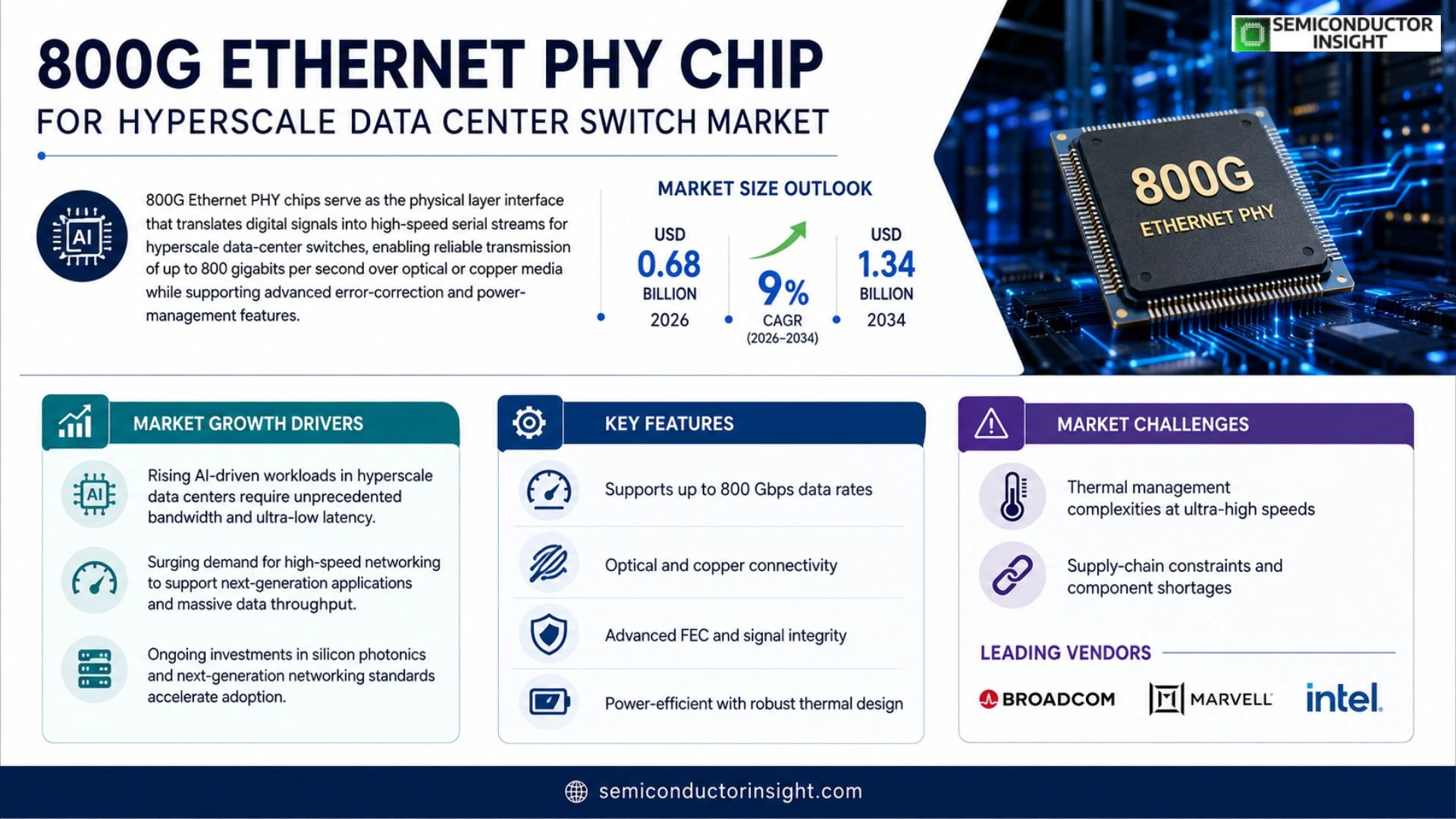
800G Ethernet PHY chip for hyperscale data center switch market size was valued at USD 0.62 billion in 2025. The market is projected to grow from USD 0.68 billion in 2026 to USD 1.34 billion by 2034, exhibiting a CAGR of 9 % during the forecast period.
800G Ethernet PHY chips serve as the physical layer interface that translates digital signals into high‑speed serial streams for hyperscale data‑center switches, enabling reliable transmission of up to 800 gigabits per second over optical or copper media while supporting advanced error‑correction and power‑management features.
The market is experiencing rapid growth because hyperscale operators are scaling AI‑driven workloads that demand unprecedented bandwidth and low latency; however, challenges such as thermal management and supply‑chain constraints persist. Furthermore, ongoing investments in silicon photonics and the rollout of next‑generation networking standards are driving adoption, while leading vendors,including Broadcom, Marvell Technology Group and Intel,continue to expand their portfolios with integrated solutions.
MARKET DRIVERS
Rising Data Traffic Demands
The exponential growth of cloud services, AI workloads, and video streaming is pushing hyperscale data centers to adopt higher‑capacity interconnects. 800G Ethernet PHY chip for hyperscale data center switch Market delivers the bandwidth needed to sustain multi‑petabyte traffic without compromising latency.
Energy‑Efficient Architecture
Modern PHY designs incorporate low‑power signaling and advanced power‑management techniques, enabling operators to reduce OPEX while scaling throughput. 800G Ethernet PHY chip for hyperscale data center switch Market offers up to 30% lower power per gigabit compared with legacy 400G solutions.
➤ Industry analysts note that the move to 800G will become a baseline requirement for new hyperscale deployments by 2028.
Furthermore, the convergence of compute and networking on a single silicon platform simplifies supply chains and accelerates time‑to‑market. 800G Ethernet PHY chip for hyperscale data center switch Market thus serves as a strategic enabler for rapid service rollout.
MARKET CHALLENGES
Manufacturing Complexity
Producing 800G PHY chips involves advanced node processes and rigorous testing, which can strain fabs and increase cycle times. 800G Ethernet PHY chip for hyperscale data center switch Market faces bottlenecks in wafer yields, especially when integrating high‑speed serdes and advanced error‑correction.
Other Challenges
Standardization Pace
The finalization of IEEE 802.3bs amendments and alignment with emerging Open Compute Project specifications are still in progress, creating uncertainty for early adopters.
MARKET RESTRAINTS
Capital Investment Constraints
Upgrading to 800G infrastructure requires substantial capital outlay for both silicon and supporting optical modules. Many operators prioritize incremental upgrades to 400G, delaying full migration to 800G Ethernet PHY chip for hyperscale data center switch Market.
Additionally, legacy equipment compatibility issues compel data centers to run parallel architectures, increasing operational complexity and cost.
MARKET OPPORTUNITIES
Emerging AI‑Driven Workloads
The surge in AI training and inference workloads demands ultra‑high‑bandwidth, low‑latency links. 800G Ethernet PHY chip for hyperscale data center switch Market is uniquely positioned to meet these requirements, opening avenues for premium pricing and long‑term contracts.
Furthermore, the rollout of 5G and edge computing creates a distributed demand for high‑speed backhaul, where 800G PHY solutions can provide a competitive edge for service providers seeking to differentiate their offerings.
800G Ethernet PHY chip for hyperscale data center switch Market Trends
AI‑Driven Bandwidth Demand Accelerates Adoption
800G Ethernet PHY chip for hyperscale data center switch Market is being propelled by exponential growth in AI‑centric workloads. Operators are consolidating compute resources, which forces a shift toward ultra‑high‑speed interconnects capable of sustaining 800 Gbps per lane while preserving sub‑microsecond latency. Recent product releases emphasize advanced forward error correction, dynamic power scaling, and multi‑mode optical compatibility to meet the stringent reliability requirements of large‑scale AI clusters. These technical enhancements are directly linked to the need for real‑time data exchange across distributed training nodes, making the PHY layer a critical enabler of next‑generation cloud services.
Other Trends
Thermal Management and Supply‑Chain Constraints
Despite performance gains, 800G Ethernet PHY chip for hyperscale data center switch Market faces practical barriers. High data rates generate significant heat, prompting vendors to adopt innovative cooling solutions such as integrated heat spreaders and adaptive thermal throttling algorithms. Concurrently, global component shortages have elongated lead times for silicon photonic modules, compelling manufacturers to prioritize design‑for‑manufacturability and diversify sourcing strategies. These operational pressures underline the importance of robust engineering practices to sustain growth without compromising product availability.
Silicon Photonics Integration Expands Portfolio
Strategic investment in silicon photonics is reshaping the competitive landscape. Leading suppliers, including Broadcom, Marvell Technology Group, and Intel, are delivering monolithic PHY solutions that combine electrical and optical functions on a single die. This integration reduces board count, improves signal integrity, and lowers overall power consumption, aligning with the sustainability goals of hyperscale data centers. As standards evolve toward higher aggregate bandwidth, 800G Ethernet PHY chip for hyperscale data center switch Market is expected to benefit from these technology convergences, delivering more compact and energy‑efficient networking fabrics.
COMPETITIVE LANDSCAPE
Key Industry Players
800G Ethernet PHY Chip Market Competitive Overview
Broadcom remains the de‑facto market leader in the 800 Gbit/s Ethernet PHY segment, leveraging its extensive silicon‑photonic portfolio and deep relationships with hyperscale cloud operators. Its integrated PHY‑MAC solutions dominate the top‑tier switch designs, where economies of scale and aggressive pricing pressure smaller rivals. The market structure is therefore oligopolistic, with a handful of multimillion‑dollar vendors capturing the bulk of revenue while competing on power efficiency, thermal performance, and support for emerging PI (Physical Interface) standards. Broadcom’s aggressive roadmap, coupled with strategic acquisitions, reinforces its incumbency and creates high entry barriers for new entrants.
Beyond the dominant players, a diverse set of niche innovators are carving out specialized footholds. Marvell Technology Group and Intel supply high‑performance PHYs that target AI‑driven workloads, while NVIDIA (through its Mellanox acquisition) focuses on ASIC‑centric solutions for GPU‑centric data‑center fabrics. Smaller but technically strong firms such as Lattice Semiconductor, Netronome, and Analog Devices differentiate through low‑power, programmable PHY blocks for edge‑to‑core interconnects. Asian powerhouses,including Texas Instruments, Renesas, NXP Semiconductors, and Qualcomm,are expanding their silicon‑photonic offerings to capture cost‑sensitive segments. Lastly, emerging silicon‑photonic startups like Aurrion and Acacia Communications (now part of Cisco) provide niche optical‑PHY modules that complement the larger silicon‑based ecosystem.
List of Key 800G Ethernet PHY Companies Profiled
- Broadcom Inc.
- Marvell Technology Group Ltd.
- Intel Corporation
- NVIDIA Corporation (Mellanox)
- Lattice Semiconductor Corp.
- Netronome Systems Inc.
- Analog Devices, Inc.
- Texas Instruments Incorporated
- Renesas Electronics Corporation
- NXP Semiconductors N.V.
- Qualcomm Incorporated
- Acacia Communications (Cisco)
- Aurrion (Silica)
- AMD (Xilinx)
- Marvell Technology Group Ltd.
Segment Analysis:
| Segment Category | Sub-Segments | Key Insights |
| By Type |
|
ASIC PHYs
|
| By Application |
|
Core networking fabric
|
| By End User |
|
Hyperscale cloud providers
|
| By Technology |
|
Silicon‑photonic PHY
|
| By Deployment Scenario |
|
Greenfield data‑center builds
|
Regional Analysis: North America
The United States represents the largest single market within North America for 800G Ethernet PHY chips. Its well-established data center ecosystem and strong presence of hyperscale cloud providers drive significant demand. The adoption of 800G technology is closely linked to the expansion of cloud computing services and the increasing data-intensive applications. Government initiatives supporting technological innovation also contribute to market growth in this region.
Canada’s data center market is experiencing steady growth, with increasing adoption of advanced networking solutions. The country’s strong telecommunications infrastructure and supportive government policies are key drivers for the 800G Ethernet PHY chip market. While smaller than the US market, Canada presents a promising growth opportunity due to its expanding digital economy and focus on innovation.
Mexico’s data center sector is emerging as a significant player in the North American market. The increasing demand for digital services and the growth of cloud adoption are fueling the need for high-speed networking technologies. The 800G Ethernet PHY chip market in Mexico is expected to witness substantial growth in the coming years, driven by investments in data center infrastructure and the expanding digital economy.
Puerto Rico’s data center industry serves as a crucial hub for cloud services and data processing. The region’s strategic location and favorable tax policies have attracted significant investments in data center infrastructure. This has resulted in a growing demand for advanced networking components like 800G Ethernet PHY chips, making it a notable market within North America.
Europe
Europe is witnessing a robust and steadily growing market for 800G Ethernet PHY chip for hyperscale data center switch Market. Key drivers include the increasing adoption of cloud services, the rise of AI and big data analytics, and the ongoing modernization of data center infrastructure across the continent. Several European countries are leading the way in adopting 800G technology, driven by government initiatives promoting digital transformation and investments in high-performance computing. The focus on energy efficiency and sustainable data center operations is also influencing the development and deployment of advanced networking solutions. The competitive landscape in Europe is characterized by the presence of both established and emerging players.
Asia-Pacific
Asia-Pacific represents a rapidly expanding market for 800G Ethernet PHY chip for hyperscale data center switch Market. The region’s burgeoning digital economy, coupled with the rapid growth of data centers in countries like China, Japan, and South Korea, is driving significant demand. The increasing adoption of cloud computing, the rise of 5G networks, and the growing deployment of edge computing infrastructure are further fueling market growth. Government support for technological innovation and substantial investments in infrastructure development are key factors contributing to the expansion of the 800G Ethernet PHY chip market in Asia-Pacific.
South America
South America’s market for 800G Ethernet PHY chip for hyperscale data center switch Market is in its nascent stages but holds significant potential for future growth. The increasing adoption of cloud services and the growing demand for high-bandwidth connectivity are driving initial investment in data center infrastructure. The region’s economic development and the expanding digital economy are expected to fuel demand for advanced networking technologies in the coming years. However, infrastructure limitations and economic uncertainties pose some challenges to market growth in the short term.
Middle East & Africa
The Middle East & Africa region represents an emerging market for 800G Ethernet PHY chip for hyperscale data center switch Market. The region’s growing digital economy, increasing investments in data center infrastructure, and the expanding adoption of cloud services are creating a favorable environment for market growth. Governments across the region are actively promoting digital transformation initiatives, which are driving demand for high-bandwidth networking solutions. While the market is relatively small currently, it is expected to witness significant growth in the coming years.
Report Scope
This market research report provides a comprehensive analysis of the 800G Ethernet PHY chip for hyperscale data center switch Market , covering the forecast period 2026–2034. It offers detailed insights into market dynamics, technological advancements, competitive landscape, and key trends shaping the industry.
Key focus areas of the report include:
- Market Overview: The report begins with an overview outlining its current market scenario, key growth indicators, and industry transformation drivers. It discusses macroeconomic factors, demand–supply balance, regulatory landscape, and the strategic role of semiconductors in powering advancements across industries such as automotive, telecommunications, consumer electronics, and industrial automation.
- Market Size & Forecast: Historical data and future projections for revenue, unit shipments, and market value across major regions and segments.
- Segmentation Analysis: Detailed breakdown by product type, technology, application, and end-user industry to identify high-growth segments and investment opportunities.
- Regional Insights: Insights into market performance across North America, Europe, Asia-Pacific, Latin America, and the Middle East & Africa, including country-level analysis where relevant.
- Competitive Landscape: Profiles of leading market participants, including their product offerings, R&D focus, manufacturing capacity, pricing strategies, and recent developments such as mergers, acquisitions, and partnerships.
- Technology Trends & Innovation: Assessment of emerging technologies, integration of AI/IoT, semiconductor design trends, fabrication techniques, and evolving industry standards.
- Market Drivers & Restraints: Evaluation of factors driving market growth along with challenges, supply chain constraints, regulatory issues, and market-entry barriers.
- Stakeholder Insights: Insights for component suppliers, OEMs, system integrators, investors, and policymakers regarding the evolving ecosystem and strategic opportunities.
Primary and secondary research methods are employed, including interviews with industry experts, data from verified sources, and real-time market intelligence to ensure the accuracy and reliability of the insights presented.
FREQUENTLY ASKED QUESTIONS:
What is the current market size of 800G Ethernet PHY chip for hyperscale data center switch Market?
-> 800G Ethernet PHY chip for hyperscale data center switch market size is projected to grow from USD 0.68 billion in 2026 to USD 1.34 billion by 2034.
Which key companies operate in 800G Ethernet PHY chip for hyperscale data center switch Market?
-> Key players include Broadcom, Marvell Technology Group, and Intel, among others.
What are the key growth drivers?
-> Key growth drivers include AI‑driven workload expansion, demand for unprecedented bandwidth and low latency, investments in silicon photonics, and rollout of next‑generation networking standards.
Which region dominates the market?
-> Global adoption is strong across North America, Europe, and Asia‑Pacific, with no single region singled out as dominant in the provided data.
What are the emerging trends?
-> Emerging trends include silicon photonics integration, next‑generation networking standards, and integrated PHY solutions from leading vendors.
Get Sample Report PDF for Exclusive Insights
Report Sample Includes
- Table of Contents
- List of Tables & Figures
- Charts, Research Methodology, and more...