Key Statistics
Key Takeaways
- UDIMM is the broad-volume client segment, while RDIMM and LR-DIMM capture higher value in servers through greater capacity, reliability and electrical loading control.
- Computers remain the largest application in the report segmentation, with computing systems accounting for 52% of demand and server applications representing a major high-value share.
- North America is the largest market reference used in this overview, supported by a USD 3.45 billion U.S. market in 2024, hyperscale data centers, enterprise servers and high-value workstation demand.
- DDR5 is the main technology transition, raising bandwidth, moving power management onto the module and supporting higher capacities for current server and workstation platforms.
- AI servers are lifting capacity per module. Micron sampled 256GB DDR5 RDIMMs in 2026 with speeds up to 9,200 MT/s and advanced 3DS/TSV packaging.
- MRDIMM is changing the bandwidth ceiling. Innodisk introduced a 12,800 MT/s MRDIMM in 2026, showing that next-generation DIMM growth is increasingly tied to bandwidth per socket rather than simple unit shipments.
Dual in-line Memory Module (DIMM) Market Overview
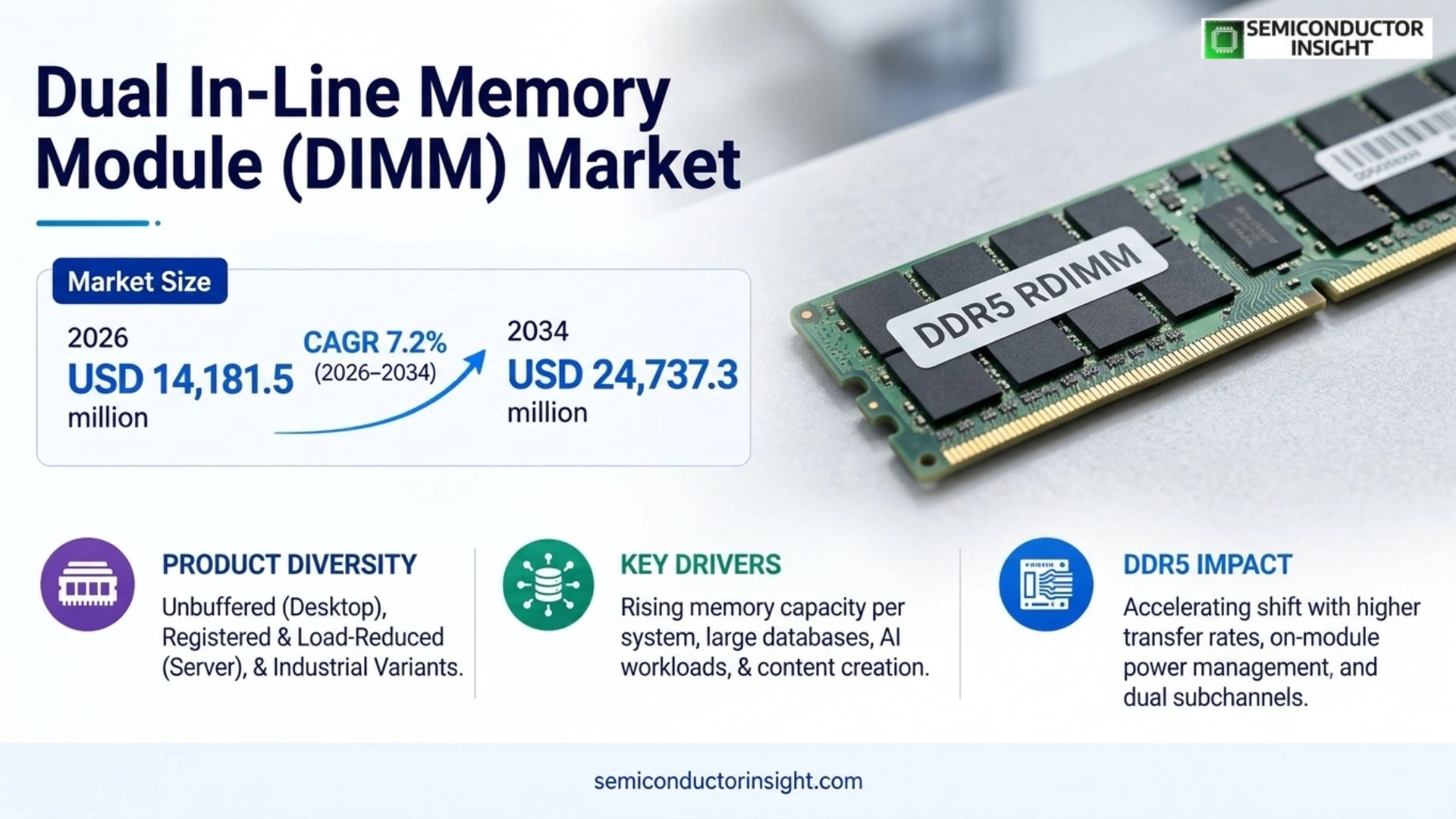
Dual in-line Memory Module market is valued at USD 13,228.8 million in 2025, is estimated at USD 14,181.5 million in 2026, and is projected to reach USD 24,737.3 million by 2034, representing a CAGR of 7.2% during 2026–2034. North America is the 2025 market-position reference used in this overview.
Base year: 2025 · Estimated year: 2026 · Forecast period: 2026–2034 · Values in USD million unless otherwise stated
A dual in-line memory module is a standardized printed circuit board populated with DRAM devices and designed to connect directly to a computer or server memory bus. DIMMs convert DRAM components into replaceable system memory with defined mechanical, electrical and SPD characteristics. Product families include unbuffered modules for desktops, registered and load-reduced modules for servers, and specialized industrial variants with ECC, extended temperature and long-lifecycle support.
The market is growing because memory capacity per system continues to rise. Enterprise servers host more virtual machines and larger databases, AI workloads increase memory bandwidth pressure, and professional desktops and workstations use larger memory footprints for simulation, content creation and local AI. DDR5 is accelerating this shift by increasing transfer rates and adding on-module power management and dual subchannels.
The module market is also becoming more differentiated. Consumer and gaming products compete on frequency, latency and aesthetics, while server memory competes on capacity, signal integrity, ECC, reliability and platform validation. Industrial users place more weight on controlled bills of materials and long-term availability. This allows specialized module vendors to maintain value even when underlying DRAM pricing is cyclical.
Segment Analysis: By Type
By type, the market is segmented into UDIMM, FB-DIMM, RDIMM, LR-DIMM, and Other. UDIMM remains the broad client-volume format, while RDIMM and LR-DIMM dominate the high-value server segment.
| Segment Category | Sub-Segments | Key Insights |
|---|---|---|
| By Type | UDIMM | Unbuffered memory connects DRAM directly to the memory controller and is widely used in desktop PCs, workstations and entry systems. |
| By Type | FB-DIMM | Fully buffered DIMM is a legacy server architecture that serialized memory traffic through an advanced memory buffer and now serves mainly installed-base replacement demand. |
| By Type | RDIMM | Registered DIMM buffers command and address signals to improve electrical loading, allowing servers to support more memory and higher capacity per channel. |
| By Type | LR-DIMM | Load-reduced DIMM adds more buffering to reduce electrical loading and support very high-capacity server configurations. |
| By Type | Other | Includes industrial ECC modules, CUDIMM, MRDIMM and other specialized form factors designed for higher bandwidth, clocking, ruggedness or platform-specific use. |
Why are registered server DIMMs gaining value faster than client modules?
Server CPUs expose more cores and memory channels, while AI and virtualization increase capacity requirements per socket. Registered modules allow the memory bus to scale to more ranks and higher capacities without overwhelming the processor’s electrical load. New 3DS and MRDIMM designs add another layer of value by stacking DRAM dies or multiplexing ranks to raise capacity and bandwidth beyond standard client-module limits.
Segment Analysis: By Application
By application, the market covers Computers, Server, Industrial, Aerospace and Defense, and Manufaturing. Computers lead broad unit demand, while Server is the most important value-growth application because cloud and AI platforms use high-capacity registered memory.
| Application | Demand characteristics | Key Insights |
|---|---|---|
| Computers | Desktop PCs and professional workstations use UDIMM memory across office, gaming, engineering and creator workloads. | The largest broad application by demand, supported by installed-base upgrades and DDR5 platform replacement. |
| Server | Enterprise and hyperscale servers use RDIMM, LR-DIMM and MRDIMM to increase capacity, reliability and bandwidth per socket. | The strongest high-value growth application, driven by AI, virtualization, databases and cloud infrastructure. |
| Industrial | Factory PCs, edge systems and embedded computers require ECC, extended temperature and long-term module availability. | A resilient segment with lower unit volume but attractive lifecycle margins. |
| Aerospace and Defense | Mission computers, simulation platforms and secure systems require qualified memory with traceability and long support windows. | A premium niche where ruggedization and stable supply matter more than commodity pricing. |
| Manufaturing | Semiconductor tools, inspection equipment, robotics and production systems use DIMMs in industrial controllers and workstations. | Steady demand linked to automation, machine vision and local data processing. |
Why does AI increase DIMM value even when accelerators use HBM?
HBM sits close to accelerators, but AI servers still need large pools of CPU-attached DRAM for operating systems, databases, preprocessing, orchestration, inference memory and host-side workloads. Higher-core-count CPUs also need more bandwidth per core. This keeps RDIMM and MRDIMM strategically important even as HBM captures the most bandwidth-sensitive accelerator memory tier.
Regional Analysis
North America is the largest market reference used in this DIMM overview, supported by a large U.S. installed base of enterprise servers, cloud infrastructure, workstations and gaming PCs. Asia Pacific is the principal manufacturing and fastest-scaling supply region.
Why can North America lead value while Asia Pacific leads manufacturing?
North America contains many hyperscale data centers, enterprise customers and premium workstation users, creating a high-value module mix. Asia Pacific hosts DRAM production, module assembly and PC/server manufacturing, giving it the strongest supply-chain scale. Europe is significant in enterprise and industrial computing, while South America and Middle East & Africa are more import dependent.
| Region | Position | Growth outlook | Demand profile | What decides supplier selection |
|---|---|---|---|---|
| North America | Largest value reference | Strong | Hyperscale, enterprise and workstations | Capacity, reliability, validation and supply assurance |
| Asia Pacific | Manufacturing & fast-scaling region | Very strong | DRAM, module assembly, servers and PCs | Cost, manufacturing scale and DDR5 transition |
| Europe | Enterprise & industrial market | Moderate to strong | Data centers, industrial and professional computing | ECC, efficiency and lifecycle support |
| South America | Developing import market | Selective | Consumer, enterprise and industrial | Price, distribution and platform compatibility |
| Middle East & Africa | Emerging data-center market | Selective high growth | Cloud, public IT and enterprise | Imported supply, reliability and local support |
Competitive Landscape
Key companies include Kingston, Ramaxel, ADATA, Micron (Crucial), Transend, MA Labs, Tigo, Apacer, Corsair, Team Group, Kingmax Semiconductor and Innodisk.
Kingston, Micron and large module brands compete through server validation, broad distribution and access to current DRAM technology. Micron also manufactures the underlying DRAM, giving it direct control over new die generations and high-capacity packaging.
ADATA, Transcend, Apacer, Team Group, Kingmax and Innodisk are important Asian module specialists. Their product strategies span gaming, industrial, embedded and server memory, with differentiation through thermal design, speed binning, extended temperature and controlled BOMs.
Competition is increasingly segmented by workload. Client memory still competes heavily on price and performance, while server products require platform qualification and industrial products require lifecycle discipline. These differences reduce direct substitutability even when modules share the same DDR generation.
| Competitive tier | Representative companies | Commercial basis |
|---|---|---|
| Global module leaders | Kingston; Micron | Large distribution, server validation, DRAM technology access and high-capacity memory. |
| Asian diversified specialists | ADATA; Transcend; Apacer; Team Group; Innodisk; Kingmax | Gaming, industrial, embedded and server memory with rapid product cycles. |
| OEM / regional suppliers | Ramaxel; MA Labs; Tigo; Corsair | Client, gaming and system-OEM channels with price and brand differentiation. |
Key Participants
Kingston, Ramaxel, ADATA, Micron (Crucial), Transend, MA Labs, Tigo, Apacer, Corsair, Team Group, Kingmax Semiconductor, Innodisk.
Production Capacity Analysis
DIMM manufacturing combines DRAM sourcing, multilayer module PCB fabrication, SMT assembly, SPD programming, thermal design and high-speed electrical validation. Server modules add RCD, PMIC, SPD hub and temperature-sensing components, while 3DS products stack DRAM dies using TSVs.
DRAM devices are the largest value input and drive module capacity, speed and power. Module suppliers either purchase DRAM on the merchant market or use captive DRAM, exposing margins to memory price cycles.
DDR5 raises PCB and support-IC complexity. On-module power management, higher data rates and registered clocking require tighter signal-integrity design and more extensive validation than older DDR4 modules.
Final test includes functional memory screening, speed binning, SPD programming and platform compatibility. Industrial and server products can add burn-in, locked component bills, extended-temperature testing and formal change control.
| Capacity layer | Where it concentrates | Commercial constraint |
|---|---|---|
| DRAM wafer & package supply | South Korea, United States, Taiwan and China | DRAM node, density, price, yield and long-term allocation. |
| Module PCB & support ICs | Taiwan, China and global electronics hubs | Signal integrity, RCD/PMIC availability and PCB quality. |
| Assembly & test | Asia Pacific, United States and global module plants | SPD programming, speed binning, ECC validation and yield. |
| Platform qualification | Server OEMs, motherboard vendors and industrial customers | Compatibility, controlled BOM and long-term reliability. |
Market Dynamics
DIMM demand is driven by higher memory content per system and the DDR5 transition. Revenue remains exposed to DRAM pricing, but AI servers and high-capacity registered memory are increasing the value of the premium product mix.
Market Drivers
| Factor | Directional impact | Why it matters |
|---|---|---|
| AI and cloud servers | High | More CPU cores and larger host-memory pools increase capacity per socket. |
| DDR5 platform refresh | High | New CPUs migrate client and server systems away from DDR4. |
| Workstation and gaming upgrades | Medium-High | Professional and enthusiast users adopt faster and higher-capacity modules. |
| Industrial edge computing | Medium | Local analytics and machine vision raise embedded memory requirements. |
AI expands host memory alongside accelerator memory
Large models and orchestration tasks require CPU-attached DRAM for preprocessing, databases, KV cache offload and system software. This supports high-capacity RDIMM even when HBM is the accelerator’s primary memory.
DDR5 raises bandwidth and module content
DDR5 increases transfer rates and adds PMIC and dual-subchannel architecture, increasing both performance and the complexity of finished modules.
Professional users upgrade capacity faster than basic office PCs
Engineering, simulation, media and local AI workloads can use 64GB, 128GB or more, supporting premium desktop and workstation DIMMs.
Industrial systems need more data locally
Machine vision and edge inference raise memory footprints while factories still require controlled BOMs and extended availability.
Market Restraints
| Factor | Directional impact | Why it matters |
|---|---|---|
| DRAM price cyclicality | High | Module ASPs move with underlying DRAM supply-demand cycles. |
| Long client replacement cycles | Medium-High | PC users can keep systems and memory for several years. |
| Platform incompatibility | High | RDIMM, UDIMM and different DDR generations are not interchangeable. |
| Alternative memory form factors | Medium | SOCAMM2, CXL and other architectures can shift some server capacity away from standard DIMMs. |
DRAM cycles create inventory risk
Module makers can buy memory at high prices and then face rapid ASP declines. Inventory discipline is therefore as important as product design in commodity segments.
Memory upgrades do not always require frequent replacement
DIMMs are reliable and reusable, and many users upgrade only when applications exceed current capacity or a platform changes DDR generation.
Compatibility creates fragmented demand
A server board designed for RDIMM cannot accept ordinary UDIMM, and DDR5 modules are mechanically and electrically incompatible with DDR4. Suppliers must manage many validated SKUs.
New memory architectures can compete for high-value workloads
Low-power modular server memory and CXL expansion can move some capacity outside conventional DIMM channels, especially in AI infrastructure.
Market Opportunities
256GB DDR5 RDIMM
High-capacity modules allow AI servers to scale memory per socket and reduce slot count.
12,800 MT/s MRDIMM
Multiplexed rank architectures can relieve CPU memory-bandwidth bottlenecks.
Industrial DDR5
Rugged and long-lifecycle DDR5 can serve edge AI, automation and embedded servers.
High-capacity workstation memory
Engineering and local AI workloads support premium desktop module demand.
Supply Chain Analysis
DRAM Supply. Underlying DRAM availability and pricing set the largest part of module cost. Suppliers with captive memory or long-term supply agreements can reduce volatility.
Module PCB & Design. High-speed DDR5 requires tight routing, power integrity and support-IC coordination. Registered server modules add more design complexity than standard client DIMMs.
Assembly & Validation. Testing verifies memory cells, signal timing and SPD configuration. Server and industrial products need more extensive qualification than retail gaming memory.
OEM / Channel Distribution. Server memory moves through validated OEM ecosystems, while client modules use retail and e-commerce channels. The commercial model therefore differs sharply by application.
Recent Developments in the Dual in-line Memory Module (DIMM) Market
Developments tracked to September 2026. Entries use official publication dates where available.
-
30 July 2026BandwidthInnodisk introduced DDR5 12,800 MT/s MRDIMM for AI, LLM and robotics workloads. The MRCD/MDB architecture delivers 60% more bandwidth than DDR5-8000 RDIMM.
-
May 2026AI memoryMicron highlighted its 256GB DDR5 RDIMM and broader AI memory portfolio at COMPUTEX 2026. The portfolio emphasizes higher capacity, speed and power efficiency for data-center workloads.
-
12 May 2026CapacityMicron sampled 256GB DDR5 RDIMMs using 1-gamma DRAM and 3DS TSV packaging. The modules support speeds up to 9,200 MT/s and target next-generation AI and HPC servers.
-
3 March 2026Alternative moduleMicron sampled 256GB LPDRAM SOCAMM2 for data-center infrastructure. The lower-power form factor shows that modular server memory is diversifying beyond conventional RDIMM.
-
30 October 2025Industrial DDR5Innodisk launched DDR5-7200 RDIMM for advanced AI workloads with capacities up to 64GB. The product combines higher data rate with industrial validation and edge-server reliability.
Report Scope & Segmentation
| Attribute | Coverage |
|---|---|
| Report title | Dual in-line Memory Module (DIMM) Market Emerging Trends, Technological Advancements, and Business Strategies (2024-2030) |
| Base Year | 2025 |
| Estimated Year | 2026 |
| Forecast Period | 2026–2034 |
| By Type | UDIMM; FB-DIMM; RDIMM; LR-DIMM; Other |
| By Application | Computers; Server; Industrial; Aerospace and Defense; Manufaturing |
| Regions | North America; Europe; Asia Pacific; South America; Middle East & Africa |
| Companies | Kingston; Ramaxel; ADATA; Micron (Crucial); Transend; MA Labs; Tigo; Apacer; Corsair; Team Group; Kingmax Semiconductor; Innodisk |
| Customization scope | Country, segment, company, application, technology, production and competitive-detail customization available within the study scope. |
Frequently Asked Questions
What is the size of the Dual in-line Memory Module market?
The market is valued at USD 13,228.8 million in 2025, is estimated at USD 14,181.5 million in 2026, and is projected to reach USD 24,737.3 million by 2034, representing a 7.2% CAGR during 2026–2034. This point remains commercially relevant because qualification, lifecycle support, supply continuity and system-level performance can materially affect supplier selection during the 2026–2034 forecast period. For the Dual in-line Memory Module (DIMM) market, this also affects supplier qualification, product positioning and purchasing decisions across the 2026–2034 forecast period.
Which region leads the DIMM market?
North America is the largest market reference used in this overview, supported by the reported U.S. market size, hyperscale data centers and enterprise server demand. This point remains commercially relevant because qualification, lifecycle support, supply continuity and system-level performance can materially affect supplier selection during the 2026–2034 forecast period. Buyers therefore evaluate lifecycle support, technical fit, application performance and supply continuity alongside the headline device or system specification.
Which DIMM type leads by broad volume?
UDIMM remains the broad client-volume type, while RDIMM and LR-DIMM capture higher value in servers. This point remains commercially relevant because qualification, lifecycle support, supply continuity and system-level performance can materially affect supplier selection during the 2026–2034 forecast period. This remains commercially important because successful design-in decisions can persist for several product generations once performance, reliability and availability are validated. For the Dual in-line Memory Module (DIMM) market, this also affects supplier qualification, product positioning and purchasing decisions across the 2026–2034 forecast period.
Which application is largest?
Computers remain the largest application in the report segmentation, while Server is the strongest high-value growth segment. This point remains commercially relevant because qualification, lifecycle support, supply continuity and system-level performance can materially affect supplier selection during the 2026–2034 forecast period. For the Dual in-line Memory Module (DIMM) market, this also affects supplier qualification, product positioning and purchasing decisions across the 2026–2034 forecast period. Buyers therefore evaluate lifecycle support, technical fit, application performance and supply continuity alongside the headline device or system specification.
Why is DDR5 important?
DDR5 raises memory bandwidth, reduces operating voltage, adds on-module power management and supports higher capacities, making it the central technology transition across new client and server platforms. This point remains commercially relevant because qualification, lifecycle support, supply continuity and system-level performance can materially affect supplier selection during the 2026–2034 forecast period. Buyers therefore evaluate lifecycle support, technical fit, application performance and supply continuity alongside the headline device or system specification.
What is MRDIMM?
MRDIMM uses multiplexed registering and data-buffer architecture to access ranks more efficiently and raise effective memory bandwidth for high-core-count server processors. This point remains commercially relevant because qualification, lifecycle support, supply continuity and system-level performance can materially affect supplier selection during the 2026–2034 forecast period. This remains commercially important because successful design-in decisions can persist for several product generations once performance, reliability and availability are validated.
What are the main restraints?
DRAM price cyclicality, long replacement cycles, platform incompatibility and competing memory architectures such as SOCAMM2 and CXL are the main restraints. This point remains commercially relevant because qualification, lifecycle support, supply continuity and system-level performance can materially affect supplier selection during the 2026–2034 forecast period. For the Dual in-line Memory Module (DIMM) market, this also affects supplier qualification, product positioning and purchasing decisions across the 2026–2034 forecast period.
Who are the major DIMM companies?
Major companies include Kingston, Ramaxel, ADATA, Micron, Transend, Apacer, Corsair, Team Group, Kingmax and Innodisk. This point remains commercially relevant because qualification, lifecycle support, supply continuity and system-level performance can materially affect supplier selection during the 2026–2034 forecast period. Buyers therefore evaluate lifecycle support, technical fit, application performance and supply continuity alongside the headline device or system specification. This remains commercially important because successful design-in decisions can persist for several product generations once performance, reliability and availability are validated.
Why are 256GB RDIMMs important for AI?
Larger modules increase CPU-attached memory per socket without consuming additional DIMM slots, helping AI and HPC servers scale capacity while controlling power and platform complexity. This point remains commercially relevant because qualification, lifecycle support, supply continuity and system-level performance can materially affect supplier selection during the 2026–2034 forecast period. This remains commercially important because successful design-in decisions can persist for several product generations once performance, reliability and availability are validated.
Where are the strongest opportunities?
The strongest opportunities are in high-capacity DDR5 RDIMM, MRDIMM, industrial DDR5 and premium workstation memory. This point remains commercially relevant because qualification, lifecycle support, supply continuity and system-level performance can materially affect supplier selection during the 2026–2034 forecast period. For the Dual in-line Memory Module (DIMM) market, this also affects supplier qualification, product positioning and purchasing decisions across the 2026–2034 forecast period. Buyers therefore evaluate lifecycle support, technical fit, application performance and supply continuity alongside the headline device or system specification.
Research Sources & Evidence Base
Get Sample Report PDF for Exclusive Insights
Report Sample Includes
- Table of Contents
- List of Tables & Figures
- Charts, Research Methodology, and more...
 Download Sample Report PDF