Display Driver IC (DDI) for OLED Smartphones Market Insights
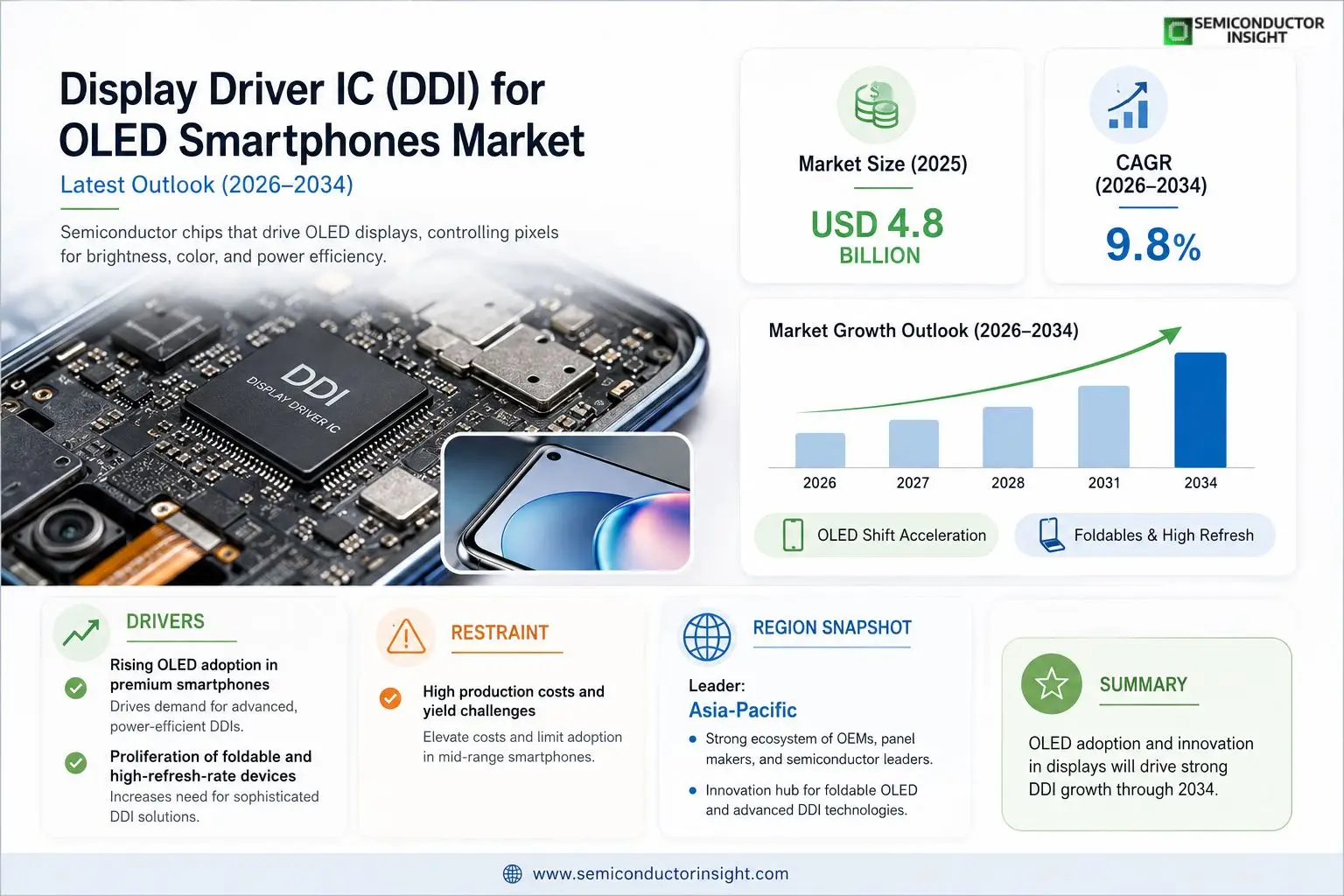
Global Display Driver IC (DDI) for OLED Smartphones market size was valued at USD 4.8 billion in 2025. The market is projected to grow from USD 5.2 billion in 2026 to USD 11.2 billion by 2034, exhibiting a CAGR of 9.8% during the forecast period.
Display Driver ICs (DDIs) for OLED smartphones are specialized semiconductor components that control the electrical signals delivered to individual pixels in organic light-emitting diode displays. These integrated circuits manage critical functions including pixel activation, brightness adjustment, color accuracy, refresh rates, and power efficiency. They enable the superior contrast ratios, deep blacks, and vibrant visuals that define modern OLED panels while optimizing battery life in premium and mid-range smartphones.
The market is experiencing robust growth due to several factors, including the accelerating global shift from LCD to OLED displays in smartphones, rising consumer demand for higher resolution screens with fast refresh rates, and continuous advancements in flexible and foldable device architectures. Furthermore, the integration of advanced features such as variable refresh rate technology, always-on displays, and under-panel sensors requires increasingly sophisticated driver solutions. Initiatives by key players in the market are also expected to fuel the market growth. For instance, leading suppliers continue to innovate in low-power, high-performance designs tailored for next-generation mobile OLED panels. Samsung Electronics, Novatek Microelectronics, Synaptics, and Himax Technologies are some of the key players that operate in the market with a wide range of portfolios.
MARKET DRIVERS
Rising Adoption of OLED Displays in Premium Smartphones
Display Driver IC (DDI) for OLED Smartphones Market is propelled by the accelerating shift from LCD to OLED panels in flagship and mid-to-premium smartphones. OLED technology delivers superior contrast ratios, true blacks, and energy efficiency, driving demand for advanced DDIs capable of managing variable refresh rates from 1Hz to 120Hz while minimizing power consumption. LTPO backplanes further enhance this trend, offering 5-15% power savings and becoming standard in high-end devices.
Proliferation of Foldable and High-Refresh-Rate Devices
Growing consumer preference for immersive visual experiences in gaming and multimedia applications requires sophisticated DDI solutions supporting high-resolution, bend-tolerant, and ultra-thin OLED panels. Innovations like Samsung’s 0.6 mm-thin OLED panels scheduled for production in 2026 demand drivers with enhanced gate compensation and touch integration to maintain performance in flexible form factors.
➤ Apple’s planned 2026 foldable iPhone and increasing adoption of adaptive refresh rate technologies across major brands continue to boost demand for specialized OLED DDI solutions.
Overall market expansion is supported by steady OLED penetration growth, with panel makers requiring more complex driver ICs to address power efficiency and display uniformity challenges in next-generation smartphones.
MARKET CHALLENGES
Supply Chain Constraints and Foundry Capacity Limitations
Display Driver IC (DDI) for OLED Smartphones Market faces ongoing challenges from chronic foundry capacity tightness, particularly for advanced nodes below 40nm. This limits production scalability for high-performance DDIs needed in premium OLED smartphones, leading to potential supply shortages amid rising demand.
Other Challenges
Technological Complexity in Uniformity and Compensation
OLED panels require precise pixel-level compensation circuits in DDIs to address variations in transistor characteristics and light-emitting efficiency, increasing design complexity and development timelines for manufacturers.
Intensifying Competition and Vertical Integration
Panel manufacturers pursuing vertical integration of DDI production creates margin pressure and market share challenges for independent DDI suppliers serving the OLED smartphone segment.
MARKET RESTRAINTS
High Production Costs and Yield Challenges
Advanced OLED DDI manufacturing involves significant capital expenditure and faces yield issues in chip-on-film (COF) packaging for ultra-thin bezel designs. These factors elevate costs and restrain broader adoption, particularly in cost-sensitive mid-range smartphone segments where LCD alternatives remain competitive.
Geopolitical and Supply Chain Vulnerabilities
Heavy reliance on concentrated semiconductor foundries in specific regions exposes Display Driver IC (DDI) for OLED Smartphones Market to risks from trade restrictions, export controls, and geopolitical tensions, potentially disrupting stable supply for smartphone OEMs.
MARKET OPPORTUNITIES
Expansion into Emerging Foldable and AI-Optimized Displays
Display Driver IC (DDI) for OLED Smartphones Market presents substantial opportunities through the rapid growth of foldable smartphones and integration of AI-driven adaptive display technologies. These advancements require next-generation DDIs with enhanced power management, high-bandwidth interfaces, and real-time compensation capabilities to support evolving panel architectures.
Growth in Premium and Emerging Market Segments
Increasing OLED adoption in upper-mid-range devices across Asia-Pacific and North America, combined with demand for energy-efficient solutions in 5G-enabled and gaming smartphones, offers pathways for DDI innovation and market expansion. Continued advancements in materials and manufacturing processes are expected to improve cost structures and open new revenue streams.
Display Driver IC (DDI) for OLED Smartphones Market Trends
Accelerating Transition from LCD to OLED Displays Driving DDI Demand
Display Driver IC (DDI) for OLED Smartphones Market continues to evolve as manufacturers worldwide accelerate the shift from traditional LCD panels to advanced OLED technology. Display Driver ICs (DDIs) for OLED smartphones serve as specialized semiconductor components that precisely control electrical signals to individual pixels in organic light-emitting diode displays. These integrated circuits effectively manage pixel activation, brightness adjustment, color accuracy, refresh rates, and power efficiency across premium and mid-range devices.
Other Trends
Rising Integration of Sophisticated Display Features
Display Driver IC (DDI) for OLED Smartphones Market is experiencing strong momentum from consumer demand for higher resolution screens with fast refresh rates. Continuous advancements in flexible and foldable device architectures further support this growth. The integration of advanced capabilities such as variable refresh rate technology, always-on displays, and under-panel sensors requires increasingly sophisticated driver solutions to maintain optimal performance.
Innovations in Low-Power and High-Performance Designs
Leading suppliers in Display Driver IC (DDI) for OLED Smartphones Market focus on developing low-power, high-performance designs tailored for next-generation mobile OLED panels. These innovations enable the superior contrast ratios, deep blacks, and vibrant visuals that characterize modern OLED displays while optimizing battery life in smartphones. Key players including Samsung Electronics, Novatek Microelectronics, Synaptics, and Himax Technologies maintain wide-ranging portfolios that address diverse requirements across the smartphone ecosystem. Their ongoing research and development efforts ensure that Display Driver IC (DDI) solutions keep pace with rapid advancements in OLED panel architectures and emerging mobile form factors. This collaborative industry approach strengthens the overall technology roadmap for high-quality visual experiences in future smartphone generations.
COMPETITIVE LANDSCAPE
Key Industry Players
Analysis of the Competitive Landscape in Display Driver IC (DDI) for OLED Smartphones Market
Display Driver IC (DDI) Market for OLED smartphones is led by Samsung Electronics, whose System LSI division commands a dominant position through vertical integration with its own AMOLED panel production. This integration enables optimized performance, power efficiency, and rapid innovation cycles tailored to flagship devices, setting high barriers for competitors in the premium segment. The market structure features a mix of captive suppliers and fabless specialists, with intense competition focused on advanced features such as variable refresh rates, high-resolution support, and low-power architectures essential for foldable and high-end smartphones.
Other significant players include Novatek Microelectronics, Synaptics, Himax Technologies, and a growing cohort of specialized firms addressing mid-tier and niche requirements. These companies differentiate through targeted innovations in touch-display integration (TDDI), cost-effective solutions for Chinese panel makers, and specialized drivers for flexible OLED implementations. The competitive dynamics are shaped by technological advancements in power management and the accelerating adoption of OLED across global smartphone tiers.
List of Key Display Driver IC (DDI) for OLED Smartphones Companies Profiled
- Samsung Electronics
- Novatek Microelectronics
- Synaptics Incorporated
- Himax Technologies
- Silicon Works Co., Ltd.
- Raydium Semiconductor Corporation
- MagnaChip Semiconductor
- LX Semicon
- Sitronix Technology
- FocalTech Systems
- Chipone Technology
- OmniVision Technologies
- Solomon Systech
- AnaPass Inc.
- Shanghai New Vision Microelectronics
Segment Analysis:
| Segment Category | Sub-Segments | Key Insights |
| By Type |
|
Integrated DDIs represent the dominant approach in advanced OLED smartphone implementations due to their ability to combine multiple functions into a single compact chip. This integration facilitates superior signal synchronization across the display panel while minimizing power consumption during complex image rendering. Manufacturers favor these solutions for their streamlined design that supports high-speed data transmission and precise voltage control essential for vibrant color reproduction and deep contrast in OLED technology. They also enable better thermal management in slim smartphone form factors and provide enhanced compatibility with evolving display architectures. |
| By Application |
|
Flagship Smartphones drive innovation in DDI technology with their demand for exceptional visual performance. These applications require DDIs capable of supporting ultra-high refresh rates and variable refresh technologies for smooth scrolling and gaming experiences. The chips must deliver pixel-level precision to achieve perfect blacks and infinite contrast ratios inherent to OLED displays. Integration with under-display sensors further pushes the boundaries of driver circuit complexity while maintaining power efficiency during always-on functionality. |
| By End User |
|
Premium Smartphone Brands lead adoption of cutting-edge DDI solutions to differentiate their products through superior display quality. These users prioritize chips that offer exceptional color accuracy and rapid response times critical for immersive multimedia consumption. Their focus on seamless integration with advanced processors demands highly sophisticated driver ICs that optimize battery life without compromising visual excellence. This segment continually influences industry standards by pushing for innovations in low-latency driving and adaptive brightness control. |
| By Technology |
|
Low Power Consumption Designs have become increasingly vital as smartphone users expect all-day battery performance alongside stunning OLED visuals. These technologies focus on intelligent power gating and dynamic voltage scaling to reduce energy use during static content display. They enable always-on display features without significant drain while preserving the fast response times OLED panels are known for. Such designs also support efficient thermal distribution which is essential for maintaining consistent performance in compact devices. |
| By Panel Type |
|
Flexible OLED Panels demand highly adaptable DDI solutions that can withstand mechanical stress while delivering unwavering image quality. Driver ICs in this category excel at maintaining signal integrity across curved and bending surfaces. They incorporate specialized compensation circuits to ensure uniform brightness and color consistency even when the panel shape changes. This capability is fundamental for next-generation devices that combine portability with expansive viewing experiences. |
Regional Analysis: Display Driver IC (DDI) for OLED Smartphones Market
Asia-Pacific
The region’s tightly knit network of suppliers and manufacturers enables seamless development of Display Driver IC solutions optimized for next-generation OLED panels. Collaborative initiatives focus on refining power management and pixel control algorithms that enhance display performance while addressing the unique requirements of foldable and rollable smartphone designs prevalent in the market.
Established semiconductor and display manufacturing clusters provide unmatched advantages in scaling production of high-performance DDIs. Strategic partnerships ensure stable material flows and quick iteration on design specifications, supporting consistent quality and timely delivery to major smartphone assemblers across the region.
Market leaders pursue differentiation through proprietary driver architectures that deliver enhanced brightness control and faster response times. Business approaches prioritize intellectual property development and customized solutions that align with flagship device roadmaps, strengthening positioning in the premium OLED smartphone segment.
Continued emphasis on energy-efficient designs and advanced integration techniques will sustain leadership. Stakeholders are gearing up for broader adoption of sophisticated OLED technologies, with strategies centered on sustainable manufacturing and adaptive driver solutions for evolving consumer preferences.
North America
North America maintains a significant presence in Display Driver IC (DDI) for OLED Smartphones Market through its focus on design innovation and premium consumer segments. The region excels in software-hardware co-development that optimizes driver performance for high-end devices, emphasizing user experience enhancements such as adaptive refresh rates and precise color calibration. Companies here adopt strategies centered on intellectual property creation and strategic alliances with global fabricators to incorporate advanced features. Demand stems from tech-savvy consumers seeking cutting-edge displays, encouraging investment in R&D for power optimization and thermal solutions tailored to flagship smartphones. Collaborative ecosystems between semiconductor firms and device makers support the integration of sophisticated DDI technologies that differentiate products in competitive markets.
Europe
Europe plays a crucial role in Display Driver IC (DDI) for OLED Smartphones Market with strong emphasis on sustainability and regulatory compliance. Regional strategies highlight eco-friendly manufacturing processes and energy-efficient driver designs that reduce overall power consumption in OLED panels. The market benefits from robust research institutions driving advancements in display control systems compatible with diverse smartphone architectures. European manufacturers focus on quality assurance and precision engineering, appealing to consumers who value durability and performance consistency. Business approaches often involve partnerships that facilitate technology transfer while addressing stringent environmental standards, positioning the region as an important contributor to responsible innovation in premium display driver solutions.
South America
South America is gradually expanding its footprint in Display Driver IC (DDI) for OLED Smartphones Market, primarily through increasing smartphone adoption and local assembly operations. The region shows growing interest in cost-effective yet capable driver solutions that support mid-range OLED devices popular among emerging consumers. Strategies revolve around building distribution networks and fostering technical training to enhance local capabilities in display technologies. Market dynamics reflect rising demand for visually impressive smartphones, prompting investments in infrastructure that can accommodate advanced DDI integration. While still developing, the area presents opportunities for global players to establish presence through tailored offerings that balance performance with affordability in diverse economic contexts.
Middle East & Africa
The Middle East and Africa region demonstrates emerging potential in Display Driver IC (DDI) for OLED Smartphones Market fueled by expanding digital infrastructure and youthful demographics. Demand centers on reliable driver ICs that enable vibrant OLED displays in smartphones suited for varied usage environments. Business strategies focus on localization efforts and partnerships that introduce advanced display technologies to new markets. Stakeholders are exploring opportunities to develop service ecosystems supporting sophisticated smartphone features. The region’s growth trajectory involves adapting global innovations to local preferences, with emphasis on durability and efficiency that align with expanding connectivity initiatives across urban and rural areas.
Report Scope
This market research report provides a comprehensive analysis of the Display Driver IC (DDI) for OLED Smartphones Market , covering the forecast period 2026–2034. It offers detailed insights into market dynamics, technological advancements, competitive landscape, and key trends shaping the industry.
Key focus areas of the report include:
- Market Overview: The report begins with an overview outlining its current market scenario, key growth indicators, and industry transformation drivers. It discusses macroeconomic factors, demand–supply balance, regulatory landscape, and the strategic role of semiconductors in powering advancements across industries such as automotive, telecommunications, consumer electronics, and industrial automation.
- Market Size & Forecast: Historical data and future projections for revenue, unit shipments, and market value across major regions and segments.
- Segmentation Analysis: Detailed breakdown by product type, technology, application, and end-user industry to identify high-growth segments and investment opportunities.
- Regional Insights: Insights into market performance across North America, Europe, Asia-Pacific, Latin America, and the Middle East & Africa, including country-level analysis where relevant.
- Competitive Landscape: Profiles of leading market participants, including their product offerings, R&D focus, manufacturing capacity, pricing strategies, and recent developments such as mergers, acquisitions, and partnerships.
- Technology Trends & Innovation: Assessment of emerging technologies, integration of AI/IoT, semiconductor design trends, fabrication techniques, and evolving industry standards.
- Market Drivers & Restraints: Evaluation of factors driving market growth along with challenges, supply chain constraints, regulatory issues, and market-entry barriers.
- Stakeholder Insights: Insights for component suppliers, OEMs, system integrators, investors, and policymakers regarding the evolving ecosystem and strategic opportunities.
Primary and secondary research methods are employed, including interviews with industry experts, data from verified sources, and real-time market intelligence to ensure the accuracy and reliability of the insights presented.
FREQUENTLY ASKED QUESTIONS:
What is the current market size of Display Driver IC (DDI) for OLED Smartphones Market?
-> Display Driver IC (DDI) for OLED Smartphones Market was valued at USD 4.8 billion in 2025 and is expected to reach USD 11.2 billion by 2034.
Which key companies operate in Display Driver IC (DDI) for OLED Smartphones Market?
-> Key players include Samsung Electronics, Novatek Microelectronics, Synaptics, and Himax Technologies, among others.
What are the key growth drivers?
-> Key growth drivers include accelerating global shift from LCD to OLED displays in smartphones, rising consumer demand for higher resolution screens with fast refresh rates, and continuous advancements in flexible and foldable device architectures.
Which region dominates the market?
-> Asia-Pacific is the fastest-growing region and remains a dominant market.
What are the emerging trends?
-> Emerging trends include variable refresh rate technology, always-on displays, under-panel sensors, and low-power high-performance designs for next-generation mobile OLED panels.

Get Sample Report PDF for Exclusive Insights
Report Sample Includes
- Table of Contents
- List of Tables & Figures
- Charts, Research Methodology, and more...
 Download Sample Report PDF