DDR4 RAM Market, Emerging Trends, Technological Advancements, and Business Strategies 2026-2034

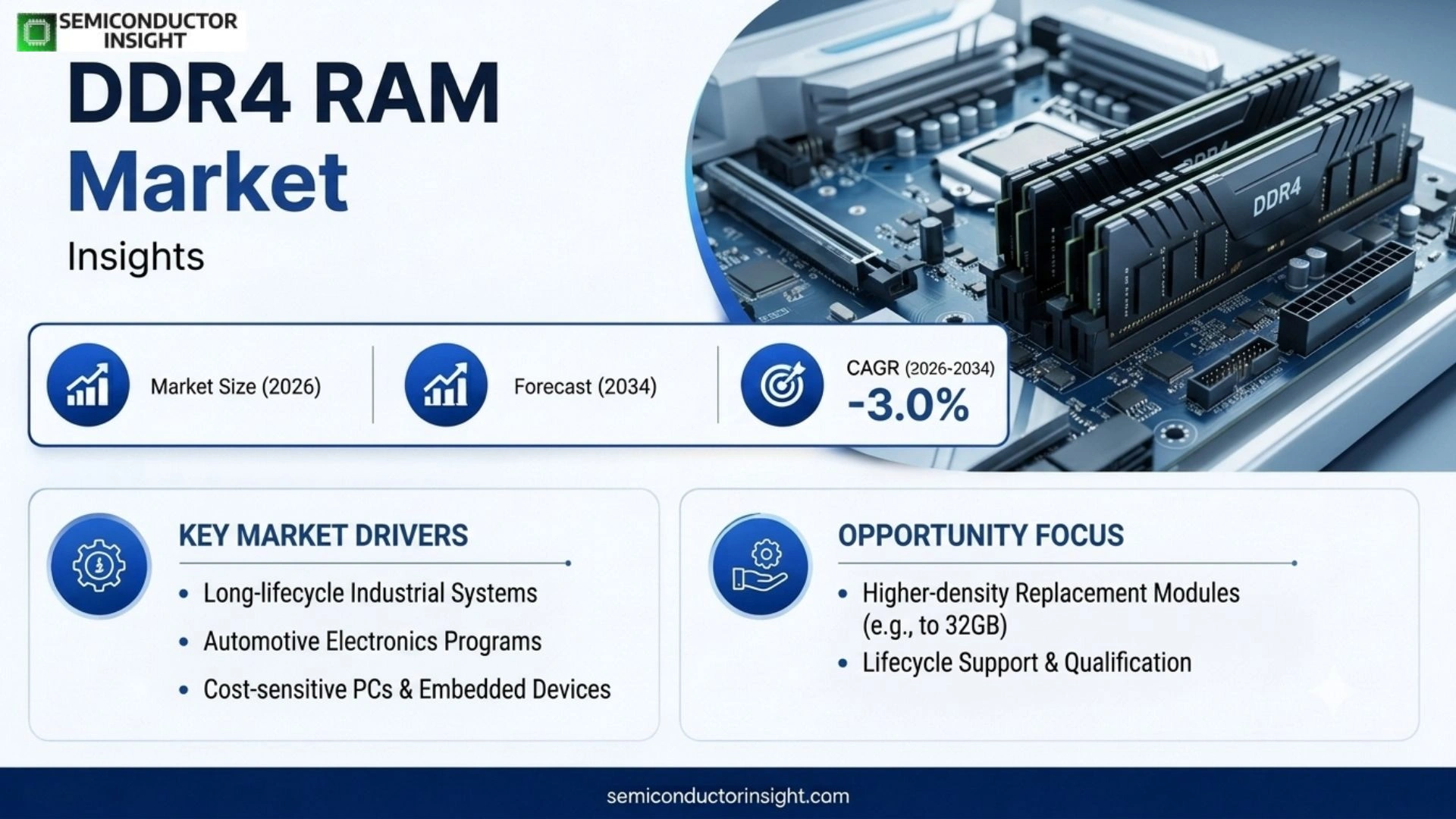
DDR4 RAM Market is estimated at USD 22,377.5 million in 2026, and is projected to reach USD 17,488.3 million by 2034, representing a CAGR of -3.0% during 2026–2034. Asia Pacific is the largest regional market in 2025, while the commercial growth mechanism is increasingly shaped by long-lifecycle industrial and automotive demand, mature server and consumer installed bases, domestic memory capacity, and continued use of 3200 Mbps DDR4 in cost-sensitive systems.

PDF Icon Download Sample Report PDF
  • Quick Dispatch

    All Orders

  • Secure Payment

    100% Secure Payment

Price range: $1,500.00 through $4,250.00

Clear

Key Statistics

2025 Market Size
USD 23,077.8 million
2026 Estimated Size
USD 22,377.5 million
2034 Projected Size
USD 17,488.3 million
CAGR (2026–2034)
-3.0%
Largest Market in 2025
Asia Pacific

Key Takeaways

  • 32G modules lead the market within the report segmentation because workstations, servers and memory-intensive systems increasingly use higher-capacity configurations even as the overall DDR4 market declines.
  • Consumer Electronics remains the largest application because PCs, smart devices, televisions and connected products still maintain a very large DDR4 installed base.
  • Asia Pacific leads through memory manufacturing and electronics production in South Korea, China and Taiwan, supported by Samsung, SK hynix, Nanya, Winbond, PSMC and CXMT.
  • The market is in managed decline as DDR5 adoption expands in new high-performance PCs and servers, but long qualification cycles keep DDR4 relevant in industrial, automotive, medical and networking applications.
  • Long-lifecycle supply is strategically important. Micron is adding 1α DDR4 output in Virginia for automotive, defense, industrial, networking and medical customers that cannot migrate platforms quickly.
  • 3200 Mbps remains a key commercial speed grade, with current product portfolios from Samsung, Nanya, Winbond and Longsys supporting broad embedded and industrial use.

DDR4 RAM Market Overview

DDR4 RAM Market was valued at USD 23,077.8 million in 2025, is estimated at USD 22,377.5 million in 2026, and is projected to reach USD 17,488.3 million by 2034, representing a CAGR of -3.0% during 2026–2034. Asia Pacific is the largest regional market in 2025, while the commercial growth mechanism is increasingly shaped by long-lifecycle industrial and automotive demand, mature server and consumer installed bases, domestic memory capacity, and continued use of 3200 Mbps DDR4 in cost-sensitive systems.

Base year: 2025 · Estimated year: 2026 · Forecast period: 2026–2034 · Values in USD million unless otherwise stated

DDR4 RAM is the fourth generation of double-data-rate synchronous DRAM used in PCs, servers, industrial computers, medical systems, automotive electronics and embedded devices. Mainstream DDR4 devices operate at 1.2 V and support data rates up to 3200 Mbps, offering a well-established balance of bandwidth, cost and power. The ecosystem includes bare DRAM devices, UDIMMs, SODIMMs, ECC modules and application-specific memory assemblies.

The market is transitioning rather than disappearing. DDR5 is taking share in new high-performance PCs, servers and next-generation platforms, which reduces long-term DDR4 revenue. At the same time, many industrial, automotive, networking and medical systems have long qualification and support cycles and continue to require DDR4 for years after consumer platforms migrate. These applications value continuity, compatibility and proven reliability more than leading-edge bandwidth.

Supply strategy is therefore bifurcating. Large memory manufacturers allocate leading-edge investment toward DDR5 and HBM while maintaining selected DDR4 nodes for long-life customers. Micron’s 2026 Virginia expansion is a clear example, using 1α DRAM technology to support DDR4 and LP4 demand in critical industries. Nanya, Winbond and regional suppliers also maintain active DDR4 portfolios, creating a competitive market even as total revenue trends downward.

Segment Analysis: By Type

By type, the market includes 32G, 16G, 8G, and 4G DDR4 RAM products. The 32G segment holds the leading position within the report scope because higher-capacity systems increasingly standardize on larger module configurations, while 8G and 16G remain widely used in industrial and mainstream computing.

Type Technical role Market position
32G High-capacity DDR4 products support workstations, servers, industrial systems and memory-intensive applications that need greater capacity without changing the platform generation. The leading value segment in the report scope. Higher capacity can extend the useful life of mature DDR4 systems and reduce the number of modules required.
16G A mainstream capacity used across PCs, industrial computers, networking equipment and embedded systems. A broad-volume segment with strong compatibility and wide supplier availability.
8G Widely deployed in cost-sensitive PCs, industrial devices, networking and embedded applications. A mature high-volume segment that benefits from low cost and established qualification.
4G Serves lower-memory embedded and legacy systems where application software and operating requirements remain modest. A declining but persistent segment supported by long-lifecycle industrial and consumer devices.

Why can higher DDR4 density remain attractive during a DDR5 transition?

Upgrading an existing DDR4 platform with higher-capacity memory can extend system life without redesigning the processor board or validating a new memory interface. Industrial PCs, medical equipment and enterprise systems often stay in service for many years, making a 16GB or 32GB DDR4 module economically attractive even when DDR5 offers higher bandwidth. This supports higher-density DDR4 demand after lower-capacity consumer products begin fading.

Segment Analysis: By Application

By application, the market covers Industrial Computer, Medical, Automotive, and Consumer Electronics. Consumer electronics remains the largest application by installed volume, while industrial, automotive and medical systems provide more durable long-lifecycle demand.

Application Demand characteristics
Consumer Electronics Desktop PCs, laptops, smart TVs, set-top boxes and connected devices use DDR4 across a large installed base. New premium systems are shifting toward DDR5, but replacement and value segments remain significant. The largest application by broad installed volume, but also the main source of structural decline as platform transitions accelerate.
Industrial Computer Factory PCs, edge gateways, control systems and embedded computing often require long availability and extended-temperature operation. A resilient segment because redesign and requalification costs encourage continued use of established DDR4 platforms.
Automotive Infotainment, ADAS, digital cockpits and gateways use DRAM under wide temperature and reliability requirements. A durable value segment with longer qualification cycles and strong emphasis on continuity.
Medical Imaging, diagnostics and clinical systems require stable memory supply and predictable platform support over long equipment lifecycles. A smaller but high-value segment where form-fit-function continuity is important.

Why does long-lifecycle demand matter more as the total market declines?

Consumer and enterprise customers can migrate to DDR5 relatively quickly when they buy a new system. Automotive, industrial and medical customers cannot. A memory change can trigger firmware, signal-integrity and full-system requalification. Suppliers that guarantee DDR4 availability over a long period can therefore maintain pricing power and customer loyalty even while total market revenue contracts.
DDR4 RAM Market Growth

Regional Analysis

Asia Pacific leads the DDR4 RAM market because South Korea, China and Taiwan host most of the world’s DRAM production and a large share of electronics manufacturing. North America remains important through Micron and enterprise demand, while Europe has stable automotive and industrial consumption.

How does the DDR4 transition differ by region?

Asia Pacific combines production scale with consumer and industrial demand, so it experiences both the fastest technology transition and the largest remaining volume. North America is moving aggressively to DDR5 in servers while preserving DDR4 for long-lifecycle industrial and critical applications. Europe has persistent automotive and industrial demand. South America and the Middle East use DDR4 longer in cost-sensitive systems because mature platforms remain economically attractive.

Region Position Growth outlook Demand profile What decides supplier selection
Asia Pacific Largest Declining gradually Memory manufacturing and electronics scale Cost, supply continuity and mature-platform demand
North America High-value lifecycle market Declining with resilient niches Enterprise, industrial, defense and medical Longevity, qualification and local supply
Europe Automotive & industrial specialist Stable to gradual decline Automotive, industrial and medical Reliability and long-term availability
South America Price-sensitive mature market Gradual decline PCs, servers and public-sector IT Affordability and module availability
Middle East & Africa Emerging installed-base market Mixed Data centers, public IT and consumer systems Price, import supply and compatibility
Asia Pacific LARGEST MARKET

Why does Asia Pacific lead DDR4 supply and demand?

South Korea, China and Taiwan combine global DRAM production with large PC, consumer-electronics and industrial manufacturing ecosystems. Samsung and SK hynix retain broad portfolios, while Nanya, Winbond, CXMT, PSMC and Longsys support regional supply and mature-platform demand.

Market positionLargest region
Growth outlookGradual decline
Demand profileManufacturing and broad installed base
Market access gateSupply continuity and price
Country / market Position in region Evidence-led demand logic
South Korea Global DRAM production center Samsung and SK hynix provide scale, process technology and module ecosystems serving global customers.
Taiwan Specialty and module supply hub Nanya and Winbond maintain active DDR4 products for commercial and industrial systems.
China Large electronics and domestic-memory market CXMT and Longsys support local production and module supply across PCs, embedded and industrial devices.
Japan Industrial and enterprise consumption Stable demand remains in long-life electronics and systems requiring qualified memory.
2026 – Nanya maintains active DDR4 portfolio

Nanya lists 4Gb and higher DDR4 products plus UDIMM and SODIMM modules at 3200 Mbps.

Market relevance: Active product availability supports industrial and embedded customers that continue using DDR4.

2026 – Winbond continues DDR4 development

Winbond states it is committed to DDR4 and is developing higher-density and higher-speed solutions alongside 4Gb products.

Market relevance: Specialty suppliers help extend lifecycle coverage as larger DRAM vendors prioritize newer generations.

2025–2026 – DDR5 expands in premium systems

PC and server platforms continue moving toward DDR5.

Market relevance: DDR4 demand becomes more concentrated in value and long-lifecycle segments.

Full-report coverage: Country-level revenue, sales, supplier positioning and forecast detail are retained in the full study; this overview highlights the countries with the clearest, independently supportable demand mechanisms.
North America LONG-LIFECYCLE SUPPLY MARKET

Why is North America strategically important to DDR4?

The United States combines Micron’s DRAM manufacturing with enterprise, industrial, aerospace, defense and medical demand. These sectors value secure supply and long product lifecycles, making continued DDR4 production strategically important even as consumer markets migrate.

Market positionHigh-value lifecycle market
Growth outlookResilient niches
Demand profileIndustrial and critical applications
Market access gateLongevity and local supply
Country / market Position in region Evidence-led demand logic
United States Primary regional market Micron supports industrial, automotive, defense, networking and medical customers while data-center buyers increasingly adopt DDR5.
Canada Industrial and enterprise niche Long-life systems and public infrastructure maintain demand for qualified DDR4 modules.
Mexico Electronics and automotive assembly Manufacturing plants consume DDR4 within industrial and vehicle electronics qualified for North American programs.
22 May 2026 – Micron starts 1α DDR4 manufacturing in Virginia

Micron began 1α DRAM production in Manassas and plans to quadruple DDR4 wafer supply at the site.

Market relevance: Domestic DDR4 capacity supports critical industries that need long-lifecycle memory and secure supply.

2026 – Micron targets qualified production by year-end

The company expects qualified 1α DRAM production from Manassas by the end of calendar 2026.

Market relevance: Long-lifecycle customers gain a clearer supply roadmap despite the broader transition to DDR5.

2026 – U.S. memory investment continues

Micron is expanding a wider U.S. memory manufacturing footprint in parallel with Virginia DDR4 production.

Market relevance: Regional manufacturing reduces dependence on imported memory for critical systems.

Full-report coverage: Country-level revenue, sales, supplier positioning and forecast detail are retained in the full study; this overview highlights the countries with the clearest, independently supportable demand mechanisms.
Europe AUTOMOTIVE & INDUSTRIAL LIFECYCLE MARKET

Why does Europe retain DDR4 longer?

European automotive, industrial and medical systems often remain in production for many years. Platform changes require extensive validation, so DDR4 can persist well after consumer PCs move to DDR5. The market therefore emphasizes quality, extended temperature and supplier continuity.

Market positionSpecialist lifecycle market
Growth outlookStable to gradual decline
Demand profileAutomotive and industrial
Market access gateReliability and qualification
Country / market Position in region Evidence-led demand logic
Germany Automotive and industrial anchor Vehicle electronics, automation and medical systems sustain long-life DDR4 use.
France Industrial and public infrastructure Qualified systems maintain mature memory platforms for extended periods.
Italy Industrial electronics market Automation and embedded systems use stable DDR4 modules where lifecycle matters more than peak bandwidth.
2025–2026 – automotive platform cycles sustain DDR4

Vehicle programs remain in production across multiple years.

Market relevance: Memory suppliers benefit from predictable qualified demand even as new designs migrate.

2025–2026 – industrial PCs maintain mature platforms

Factory equipment favors proven processor and memory combinations.

Market relevance: DDR4 remains economical when redesign adds no operational benefit.

2026 – lifecycle programs gain importance

Memory vendors emphasize extended support for long-life products.

Market relevance: Customers can avoid costly requalification caused by premature component discontinuation.

Full-report coverage: Country-level revenue, sales, supplier positioning and forecast detail are retained in the full study; this overview highlights the countries with the clearest, independently supportable demand mechanisms.
South America PRICE-SENSITIVE MATURE MARKET

Why does DDR4 remain relevant in South America?

PC, public-sector IT and enterprise systems often prioritize acquisition cost and compatibility, supporting mature DDR4 platforms. Brazil is the largest regional market, while local assembly relies heavily on imported memory modules and devices.

Market positionPrice-sensitive market
Growth outlookGradual decline
Demand profilePC and enterprise installed base
Market access gateAffordability and import availability
Country / market Position in region Evidence-led demand logic
Brazil Largest regional market Local computer assembly, banking and enterprise IT support DDR4 replacement and value-system demand.
Argentina Smaller PC and public-sector market Mature systems remain in use longer due to cost sensitivity.
Chile Enterprise and data-center niche Existing DDR4 servers and workstations create replacement demand.
2025–2026 – PC replacement remains cost sensitive

Value systems continue using DDR4-compatible processors and boards.

Market relevance: Lower module cost extends the commercial life of mature platforms.

2025–2026 – refurbished server market persists

Secondary enterprise hardware remains important in some markets.

Market relevance: DDR4 modules remain necessary for installed server generations.

2026 – imported supply shapes pricing

Regional buyers depend on global DRAM and module vendors.

Market relevance: Distributor inventory and exchange rates can influence replacement cycles.

Full-report coverage: Country-level revenue, sales, supplier positioning and forecast detail are retained in the full study; this overview highlights the countries with the clearest, independently supportable demand mechanisms.
Middle East & Africa MIXED TRANSITION MARKET

What sustains DDR4 demand in the Middle East and Africa?

New hyperscale systems are moving to DDR5 and newer memory, but government IT, telecom, enterprise and value consumer systems still contain large DDR4 installed bases. Gulf markets transition faster at the high end, while broader African markets retain mature platforms longer.

Market positionMixed transition market
Growth outlookMixed
Demand profileEnterprise, public IT and consumer
Market access gatePrice and platform compatibility
Country / market Position in region Evidence-led demand logic
United Arab Emirates Fast-transition enterprise market New data-center systems use newer memory, while installed enterprise and edge systems continue requiring DDR4.
Saudi Arabia Public and enterprise IT market Digital infrastructure upgrades create both new-generation systems and ongoing support for mature installed bases.
South Africa Value and enterprise market Cost-sensitive PCs, servers and industrial systems maintain DDR4 demand.
2025–2026 – new AI systems accelerate DDR5 adoption

Modern accelerator and server platforms use newer memory generations.

Market relevance: DDR4 becomes concentrated in existing infrastructure and embedded systems.

2025–2026 – government IT maintains mixed generations

Public-sector hardware refresh occurs gradually.

Market relevance: Replacement memory remains needed for systems that stay in service.

2026 – industrial and telecom equipment sustains mature memory

Network and control platforms often have longer lifecycles than consumer devices.

Market relevance: DDR4 persists where qualification and compatibility outweigh bandwidth gains.

Full-report coverage: Country-level revenue, sales, supplier positioning and forecast detail are retained in the full study; this overview highlights the countries with the clearest, independently supportable demand mechanisms.

Competitive Landscape

Key companies include Samsung Electronics, SK hynix, Micron Technology, Nanya Technology, Winbond Electronics, Powerchip Semiconductor Manufacturing, ChangXin Memory Technologies and Longsys. Competition is increasingly based on lifecycle strategy as leading-edge investment shifts to DDR5 and HBM.

Samsung and SK hynix remain major global DRAM manufacturers with broad process and module capability. Their scale gives them strong cost positions, but capital allocation is increasingly focused on DDR5 and HBM, which changes the supply balance for legacy generations.

Micron is differentiating through long-lifecycle support and domestic U.S. DDR4 manufacturing. Its 1α Virginia expansion is aimed at automotive, defense, industrial, networking and medical customers where long support windows are critical.

Nanya, Winbond, PSMC, CXMT and Longsys remain important to specialty and regional demand. Active product catalogs at 3200 Mbps and industrial temperature grades provide alternatives as the market becomes less attractive to suppliers focused only on leading-edge memory.

Competitive tier Representative companies Commercial basis
Global DRAM leaders Samsung Electronics; SK hynix; Micron Technology Scale manufacturing, advanced process technology, broad module portfolios and global OEM relationships.
Taiwan specialty suppliers Nanya Technology; Winbond Electronics; PSMC Commercial and industrial DDR4, regional supply and long-lifecycle applications.
China memory and module suppliers CXMT; Longsys Domestic production, module integration and cost-competitive supply for local and global device markets.

Key Market Participants

Samsung Electronics, SK hynix, Micron Technology, Nanya Technology, Winbond Electronics, Powerchip Semiconductor Manufacturing Corp., ChangXin Memory Technologies, Shenzhen Longsys Electronics.

Production Capacity Analysis

DDR4 production combines DRAM wafer fabrication, packaging, module PCB assembly, SPD programming and final test. As the market declines, the key supply question is not total fab capacity but how much qualified legacy production manufacturers choose to maintain while reallocating leading-edge equipment toward DDR5 and HBM.

DRAM wafer fabrication requires advanced lithography, deposition, etch and capacitor structures optimized for memory density and power. Mature DDR4 can be produced on established process nodes with high yields, but keeping a node active carries opportunity cost when the same factory could support newer products.

Packaging and module assembly remain highly standardized. Bare DRAM dies are packaged in BGA formats and mounted on UDIMM, SODIMM or other module PCBs with SPD devices and quality testing. Industrial and ECC modules add stronger screening and traceability.

Lifecycle management becomes a production capability in its own right. Suppliers must forecast demand years ahead, qualify process transitions and communicate discontinuation schedules. Micron’s product lifecycle programs and Virginia investment show how memory companies can monetize continuity in critical markets.

Capacity layer Where it concentrates Commercial constraint
DRAM wafer fabrication South Korea, United States, Taiwan and China Node allocation, yield, capacitor scaling and long-term process support.
DRAM packaging Asia Pacific and global assembly hubs BGA yield, test coverage and device binning.
Module assembly China, Taiwan, South Korea and global memory-module plants PCB quality, SPD programming, ECC support and thermal design.
Lifecycle qualification Global OEM and industrial customer sites Form-fit-function stability, reliability testing and change control.

Market Dynamics

DDR4 is a declining market in aggregate, but the decline is moderated by long-lived systems and cost-sensitive platforms. The strongest commercial opportunities lie in lifecycle support, industrial grades and higher-density replacement modules rather than new premium consumer designs.

Market Drivers

Factor Directional impact Why it matters
Long-lifecycle industrial systems High within mature segment Qualification costs keep DDR4 in service for years.
Automotive electronics Medium-High Vehicle programs require reliable, long-supported memory.
Cost-sensitive PCs and embedded devices Medium Mature platforms remain attractive at lower system cost.
Replacement and upgrade demand Medium Higher-density DDR4 modules extend installed system life.

Industrial qualification slows migration

Factory, medical and network equipment can remain deployed for a decade. Replacing DDR4 with DDR5 may require a new processor platform and full system requalification, so customers continue purchasing mature memory when performance remains sufficient.

Automotive programs create durable demand

Vehicle platforms stay in production for years and must meet strict reliability requirements. Once DDR4 is qualified, manufacturers prefer continuity unless a new architecture provides a clear benefit.

Mature platforms offer compelling cost

DDR4 controller IP, motherboards and modules are widely available and well understood. Cost-sensitive PCs and embedded devices can therefore remain economically attractive long after premium systems migrate.

Capacity upgrades extend system life

Moving from 8GB or 16GB to 32GB DDR4 can improve application performance without replacing the complete computer. This supports higher-density module demand within a declining overall market.

Market Restraints

Factor Directional impact Why it matters
DDR5 substitution High New high-performance PCs and servers increasingly use DDR5.
Supplier capacity reallocation High Manufacturers prioritize HBM and newer DRAM generations.
Price volatility Medium-High Legacy supply changes can create sharp ASP movements.
Platform obsolescence Medium Older processors and chipsets eventually limit DDR4 demand.

DDR5 removes the fastest-growing applications

New server and premium PC platforms are designed around DDR5, reducing DDR4 participation in the highest-performance systems. This structural transition drives the negative long-term revenue trend.

Memory makers face opportunity cost

Fab equipment and engineering resources devoted to DDR4 cannot be used for HBM or newer DRAM. Suppliers therefore maintain only the capacity needed to serve profitable long-lifecycle customers.

Legacy supply can become volatile

When producers reduce output faster than customer demand declines, DDR4 prices can rise temporarily even in a shrinking market. Buyers respond with safety inventory and longer supply agreements.

Installed platforms eventually retire

Replacement demand cannot continue indefinitely. As processors, boards and operating systems reach end of support, customers migrate the entire platform and DDR4 demand falls with it.

Market Opportunities

Long-lifecycle industrial DDR4

Extended availability programs can support customers that need 7–10+ years of compatibility.

Automotive and defense memory

Critical systems value secure supply, temperature range and qualification more than leading-edge bandwidth.

32GB replacement modules

Higher-density modules can extend workstation and server life at low upgrade cost.

Regional legacy supply

Nanya, Winbond, CXMT and Longsys can capture niches as larger suppliers rationalize mature products.

Supply Chain Analysis

Wafer FabricationDRAM cells and peripheral circuits are fabricated on memory-optimized semiconductor processes.
Packaging & TestMemory dies are packaged, binned and tested for speed, voltage and temperature.
Module AssemblyDDR4 devices are mounted on UDIMM, SODIMM or specialized module PCBs.
OEM Qualification & LifecyclePC, industrial, automotive and medical customers validate compatibility and long-term supply.

Wafer Fabrication. DRAM manufacturing is capital intensive and highly concentrated. Mature DDR4 nodes benefit from high yield, but suppliers must balance legacy demand against more profitable HBM and DDR5 opportunities.

Packaging & Test. Testing verifies timing, retention and reliability across speed grades. Industrial and automotive products may require wider temperature screening and longer qualification.

Module Assembly. Module suppliers combine DRAM, PCB, SPD and sometimes ECC support into standardized form factors. Signal integrity and PCB quality are essential at 3200 Mbps.

OEM Qualification & Lifecycle. Customers validate memory with CPUs, chipsets and firmware. Once qualified, changing devices can be expensive, making lifecycle communication and supply continuity key commercial advantages.

Recent Developments in the DDR4 RAM Market

Developments tracked to September 2026. Entries are dated to the official publication date where available.

  • 22 May 2026 Capacity
    Micron began 1α DRAM manufacturing at its Manassas, Virginia fab and said the expansion will quadruple DDR4 wafer supply at the site. The output is aimed at long-lifecycle automotive, defense, industrial, networking and medical markets. Source
  • 10 July 2026 Market conditions
    Nanya Technology reported a sharp increase in DRAM average selling prices in the second quarter of 2026. Legacy-memory supply changes can create pricing volatility even as technology migration continues. Source
  • 2026 Product availability
    Nanya continues listing DDR4 UDIMM and SODIMM modules at up to 3200 Mbps, including industrial and ECC configurations. Source
  • 2026 Product strategy
    Winbond states it is committed to DDR4 development, including higher-density and higher-speed solutions. Specialty suppliers can extend mature-memory availability as leading vendors shift capacity to newer generations. Source
  • 2025–2026 Industrial memory
    Longsys continues offering industrial DDR4 DIMMs and SODIMMs at 3200 Mbps with extended-temperature configurations. Industrial modules support applications that prioritize lifecycle and rugged operation. Source

Report Scope & Segmentation

Attribute Coverage
Report title DDR4 RAM Market, Emerging Trends, Technological Advancements, and Business Strategies 2026-2034
Base / estimate / forecast 2025 base year; 2026 estimated year; 2034 forecast end year; CAGR measured for 2026–2034.
By Type 32G; 16G; 8G; 4G
By Application Industrial Computer; Medical; Automotive; Consumer Electronics
Regions North America, Europe, Asia-Pacific, South America, and Middle East & Africa, with country-level analysis across the principal national markets.
Companies Samsung Electronics, SK hynix, Micron Technology, Nanya Technology, Winbond Electronics, Powerchip Semiconductor Manufacturing Corp., ChangXin Memory Technologies, Shenzhen Longsys Electronics
Customization Scope Free report customization (equivalent to up to 4 analyst working days) with purchase. Addition or alteration to country, regional and segment scope.

Frequently Asked Questions

What is the size of the DDR4 RAM market?

The global DDR4 RAM market is valued at USD 23,077.8 million in 2025, is estimated at USD 22,377.5 million in 2026, and is projected to reach USD 17,488.3 million by 2034, representing a -3.0% CAGR during 2026–2034.

Which region leads the DDR4 RAM market?

Asia Pacific leads because South Korea, China and Taiwan combine major DRAM manufacturing with the world’s largest electronics production base.

Which DDR4 capacity segment leads?

32G leads within the report segmentation because workstations, servers and higher-memory systems increasingly use larger DDR4 configurations.

Which application is largest?

Consumer Electronics remains the largest application by installed volume, while industrial, automotive and medical markets provide more durable lifecycle demand.

Why is the DDR4 market declining?

DDR5 is taking share in new servers and premium PCs, reducing DDR4 participation in the fastest-growing computing platforms.

Why does DDR4 remain important?

Industrial, automotive, medical and networking systems have long qualification cycles and often continue using DDR4 for years because redesign costs exceed the benefit of migration.

What speed remains common in DDR4?

3200 Mbps is a widely available mainstream speed grade across current products from Samsung, Nanya, Winbond and module suppliers.

Who are the major DDR4 RAM companies?

Key companies include Samsung Electronics, SK hynix, Micron Technology, Nanya Technology, Winbond Electronics, PSMC, CXMT and Longsys.

What is changing in DDR4 supply?

Major suppliers are reallocating leading-edge investment toward DDR5 and HBM while maintaining selected DDR4 capacity for long-lifecycle customers.

Where are the strongest DDR4 opportunities?

The strongest opportunities are in industrial lifecycle supply, automotive and defense memory, 32GB replacement modules, and regional specialty production.

Research Sources & Evidence Base
View research sources used for this overview
  1. Micron Technology. Virginia DDR4 Manufacturing Expansion, 1α DDR4 production and long-lifecycle U.S. supply..
  2. Micron Technology. Product Lifecycle Solutions, Long-term support and lifecycle programs for memory customers..
  3. Samsung Semiconductor. DDR4 Product Overview, DDR4 performance, reliability and power characteristics..
  4. Nanya Technology. DDR4 Products, Current DDR4 device speeds, densities and industrial grades..
  5. Nanya Technology. DDR4 Modules, UDIMM and ECC module availability..
  6. Winbond Electronics. DDR4 SDRAM, Industrial DDR4 positioning and continued development..
  7. Longsys. Industrial DDR4 DIMM, Industrial DDR4 3200 Mbps module configurations..
DDR4 RAM Market, Emerging Trends, Technological Advancements, and Business Strategies 2026-2034

Get Sample Report PDF for Exclusive Insights

Report Sample Includes

  • Table of Contents
  • List of Tables & Figures
  • Charts, Research Methodology, and more...

PDF Icon Download Sample Report PDF

Download Sample Report

Table of Content

1 Introduction to Research & Analysis Reports
1.1 DDR4 RAM Market Definition
1.2 Market Segments
1.2.1 Segment by Type
1.2.2 Segment by Application
1.3 Global DDR4 RAM Market Overview
1.4 Features & Benefits of This Report
1.5 Methodology & Sources of Information
1.5.1 Research Methodology
1.5.2 Research Process
1.5.3 Base Year
1.5.4 Report Assumptions & Caveats
2 Global DDR4 RAM Overall Market Size
2.1 Global DDR4 RAM Market Size: 2024 VS 2032
2.2 Global DDR4 RAM Market Size, Prospects & Forecasts: 2020-2032
2.3 Global DDR4 RAM Sales: 2020-2032
3 Company Landscape
3.1 Top DDR4 RAM Players in Global Market
3.2 Top Global DDR4 RAM Companies Ranked by Revenue
3.3 Global DDR4 RAM Revenue by Companies
3.4 Global DDR4 RAM Sales by Companies
3.5 Global DDR4 RAM Price by Manufacturer (2020-2025)
3.6 Top 3 and Top 5 DDR4 RAM Companies in Global Market, by Revenue in 2024
3.7 Global Manufacturers DDR4 RAM Product Type
3.8 Tier 1, Tier 2, and Tier 3 DDR4 RAM Players in Global Market
3.8.1 List of Global Tier 1 DDR4 RAM Companies
3.8.2 List of Global Tier 2 and Tier 3 DDR4 RAM Companies
4 Sights by Product
4.1 Overview
4.1.1 Segment by Type – Global DDR4 RAM Market Size Markets, 2024 & 2032
4.1.2 32G
4.1.3 16G
4.1.4 8G
4.1.5 4G
4.2 Segment by Type – Global DDR4 RAM Revenue & Forecasts
4.2.1 Segment by Type – Global DDR4 RAM Revenue, 2020-2025
4.2.2 Segment by Type – Global DDR4 RAM Revenue, 2026-2032
4.2.3 Segment by Type – Global DDR4 RAM Revenue Market Share, 2020-2032
4.3 Segment by Type – Global DDR4 RAM Sales & Forecasts
4.3.1 Segment by Type – Global DDR4 RAM Sales, 2020-2025
4.3.2 Segment by Type – Global DDR4 RAM Sales, 2026-2032
4.3.3 Segment by Type – Global DDR4 RAM Sales Market Share, 2020-2032
4.4 Segment by Type – Global DDR4 RAM Price (Manufacturers Selling Prices), 2020-2032
5 Sights by Application
5.1 Overview
5.1.1 Segment by Application – Global DDR4 RAM Market Size, 2024 & 2032
5.1.2 Industrial Computer
5.1.3 Medical
5.1.4 Automotive
5.1.5 Consumer Electronics
5.2 Segment by Application – Global DDR4 RAM Revenue & Forecasts
5.2.1 Segment by Application – Global DDR4 RAM Revenue, 2020-2025
5.2.2 Segment by Application – Global DDR4 RAM Revenue, 2026-2032
5.2.3 Segment by Application – Global DDR4 RAM Revenue Market Share, 2020-2032
5.3 Segment by Application – Global DDR4 RAM Sales & Forecasts
5.3.1 Segment by Application – Global DDR4 RAM Sales, 2020-2025
5.3.2 Segment by Application – Global DDR4 RAM Sales, 2026-2032
5.3.3 Segment by Application – Global DDR4 RAM Sales Market Share, 2020-2032
5.4 Segment by Application – Global DDR4 RAM Price (Manufacturers Selling Prices), 2020-2032
6 Sights by Region
6.1 By Region – Global DDR4 RAM Market Size, 2024 & 2032
6.2 By Region – Global DDR4 RAM Revenue & Forecasts
6.2.1 By Region – Global DDR4 RAM Revenue, 2020-2025
6.2.2 By Region – Global DDR4 RAM Revenue, 2026-2032
6.2.3 By Region – Global DDR4 RAM Revenue Market Share, 2020-2032
6.3 By Region – Global DDR4 RAM Sales & Forecasts
6.3.1 By Region – Global DDR4 RAM Sales, 2020-2025
6.3.2 By Region – Global DDR4 RAM Sales, 2026-2032
6.3.3 By Region – Global DDR4 RAM Sales Market Share, 2020-2032
6.4 North America
6.4.1 By Country – North America DDR4 RAM Revenue, 2020-2032
6.4.2 By Country – North America DDR4 RAM Sales, 2020-2032
6.4.3 United States DDR4 RAM Market Size, 2020-2032
6.4.4 Canada DDR4 RAM Market Size, 2020-2032
6.4.5 Mexico DDR4 RAM Market Size, 2020-2032
6.5 Europe
6.5.1 By Country – Europe DDR4 RAM Revenue, 2020-2032
6.5.2 By Country – Europe DDR4 RAM Sales, 2020-2032
6.5.3 Germany DDR4 RAM Market Size, 2020-2032
6.5.4 France DDR4 RAM Market Size, 2020-2032
6.5.5 U.K. DDR4 RAM Market Size, 2020-2032
6.5.6 Italy DDR4 RAM Market Size, 2020-2032
6.5.7 Russia DDR4 RAM Market Size, 2020-2032
6.5.8 Nordic Countries DDR4 RAM Market Size, 2020-2032
6.5.9 Benelux DDR4 RAM Market Size, 2020-2032
6.6 Asia
6.6.1 By Region – Asia DDR4 RAM Revenue, 2020-2032
6.6.2 By Region – Asia DDR4 RAM Sales, 2020-2032
6.6.3 China DDR4 RAM Market Size, 2020-2032
6.6.4 Japan DDR4 RAM Market Size, 2020-2032
6.6.5 South Korea DDR4 RAM Market Size, 2020-2032
6.6.6 Southeast Asia DDR4 RAM Market Size, 2020-2032
6.6.7 India DDR4 RAM Market Size, 2020-2032
6.7 South America
6.7.1 By Country – South America DDR4 RAM Revenue, 2020-2032
6.7.2 By Country – South America DDR4 RAM Sales, 2020-2032
6.7.3 Brazil DDR4 RAM Market Size, 2020-2032
6.7.4 Argentina DDR4 RAM Market Size, 2020-2032
6.8 Middle East & Africa
6.8.1 By Country – Middle East & Africa DDR4 RAM Revenue, 2020-2032
6.8.2 By Country – Middle East & Africa DDR4 RAM Sales, 2020-2032
6.8.3 Turkey DDR4 RAM Market Size, 2020-2032
6.8.4 Israel DDR4 RAM Market Size, 2020-2032
6.8.5 Saudi Arabia DDR4 RAM Market Size, 2020-2032
6.8.6 UAE DDR4 RAM Market Size, 2020-2032
7 Manufacturers & Brands Profiles
7.1 Samsung
7.1.1 Samsung Company Summary
7.1.2 Samsung Business Overview
7.1.3 Samsung DDR4 RAM Major Product Offerings
7.1.4 Samsung DDR4 RAM Sales and Revenue in Global (2020-2025)
7.1.5 Samsung Key News & Latest Developments
7.2 SK Hynix
7.2.1 SK Hynix Company Summary
7.2.2 SK Hynix Business Overview
7.2.3 SK Hynix DDR4 RAM Major Product Offerings
7.2.4 SK Hynix DDR4 RAM Sales and Revenue in Global (2020-2025)
7.2.5 SK Hynix Key News & Latest Developments
7.3 Intel
7.3.1 Intel Company Summary
7.3.2 Intel Business Overview
7.3.3 Intel DDR4 RAM Major Product Offerings
7.3.4 Intel DDR4 RAM Sales and Revenue in Global (2020-2025)
7.3.5 Intel Key News & Latest Developments
7.4 Micron Technology
7.4.1 Micron Technology Company Summary
7.4.2 Micron Technology Business Overview
7.4.3 Micron Technology DDR4 RAM Major Product Offerings
7.4.4 Micron Technology DDR4 RAM Sales and Revenue in Global (2020-2025)
7.4.5 Micron Technology Key News & Latest Developments
7.5 Nanya Technology
7.5.1 Nanya Technology Company Summary
7.5.2 Nanya Technology Business Overview
7.5.3 Nanya Technology DDR4 RAM Major Product Offerings
7.5.4 Nanya Technology DDR4 RAM Sales and Revenue in Global (2020-2025)
7.5.5 Nanya Technology Key News & Latest Developments
7.6 Winbond
7.6.1 Winbond Company Summary
7.6.2 Winbond Business Overview
7.6.3 Winbond DDR4 RAM Major Product Offerings
7.6.4 Winbond DDR4 RAM Sales and Revenue in Global (2020-2025)
7.6.5 Winbond Key News & Latest Developments
7.7 PSMC
7.7.1 PSMC Company Summary
7.7.2 PSMC Business Overview
7.7.3 PSMC DDR4 RAM Major Product Offerings
7.7.4 PSMC DDR4 RAM Sales and Revenue in Global (2020-2025)
7.7.5 PSMC Key News & Latest Developments
7.8 CXMT
7.8.1 CXMT Company Summary
7.8.2 CXMT Business Overview
7.8.3 CXMT DDR4 RAM Major Product Offerings
7.8.4 CXMT DDR4 RAM Sales and Revenue in Global (2020-2025)
7.8.5 CXMT Key News & Latest Developments
7.9 Longsys
7.9.1 Longsys Company Summary
7.9.2 Longsys Business Overview
7.9.3 Longsys DDR4 RAM Major Product Offerings
7.9.4 Longsys DDR4 RAM Sales and Revenue in Global (2020-2025)
7.9.5 Longsys Key News & Latest Developments
8 Global DDR4 RAM Production Capacity, Analysis
8.1 Global DDR4 RAM Production Capacity, 2020-2032
8.2 DDR4 RAM Production Capacity of Key Manufacturers in Global Market
8.3 Global DDR4 RAM Production by Region
9 Key Market Trends, Opportunity, Drivers and Restraints
9.1 Market Opportunities & Trends
9.2 Market Drivers
9.3 Market Restraints
10 DDR4 RAM Supply Chain Analysis
10.1 DDR4 RAM Industry Value Chain
10.2 DDR4 RAM Upstream Market
10.3 DDR4 RAM Downstream and Clients
10.4 Marketing Channels Analysis
10.4.1 Marketing Channels
10.4.2 DDR4 RAM Distributors and Sales Agents in Global
11 Conclusion
12 Appendix
12.1 Note
12.2 Examples of Clients
12.3 DisclaimerList of Tables
Table 1. Key Players of DDR4 RAM in Global Market
Table 2. Top DDR4 RAM Players in Global Market, Ranking by Revenue (2024)
Table 3. Global DDR4 RAM Revenue by Companies, (US$, Mn), 2020-2025
Table 4. Global DDR4 RAM Revenue Share by Companies, 2020-2025
Table 5. Global DDR4 RAM Sales by Companies, (K Units), 2020-2025
Table 6. Global DDR4 RAM Sales Share by Companies, 2020-2025
Table 7. Key Manufacturers DDR4 RAM Price (2020-2025) & (US$/Unit)
Table 8. Global Manufacturers DDR4 RAM Product Type
Table 9. List of Global Tier 1 DDR4 RAM Companies, Revenue (US$, Mn) in 2024 and Market Share
Table 10. List of Global Tier 2 and Tier 3 DDR4 RAM Companies, Revenue (US$, Mn) in 2024 and Market Share
Table 11. Segment by Type – Global DDR4 RAM Revenue, (US$, Mn), 2024 & 2032
Table 12. Segment by Type – Global DDR4 RAM Revenue (US$, Mn), 2020-2025
Table 13. Segment by Type – Global DDR4 RAM Revenue (US$, Mn), 2026-2032
Table 14. Segment by Type – Global DDR4 RAM Sales (K Units), 2020-2025
Table 15. Segment by Type – Global DDR4 RAM Sales (K Units), 2026-2032
Table 16. Segment by Application – Global DDR4 RAM Revenue, (US$, Mn), 2024 & 2032
Table 17. Segment by Application – Global DDR4 RAM Revenue, (US$, Mn), 2020-2025
Table 18. Segment by Application – Global DDR4 RAM Revenue, (US$, Mn), 2026-2032
Table 19. Segment by Application – Global DDR4 RAM Sales, (K Units), 2020-2025
Table 20. Segment by Application – Global DDR4 RAM Sales, (K Units), 2026-2032
Table 21. By Region – Global DDR4 RAM Revenue, (US$, Mn), 2025-2032
Table 22. By Region – Global DDR4 RAM Revenue, (US$, Mn), 2020-2025
Table 23. By Region – Global DDR4 RAM Revenue, (US$, Mn), 2026-2032
Table 24. By Region – Global DDR4 RAM Sales, (K Units), 2020-2025
Table 25. By Region – Global DDR4 RAM Sales, (K Units), 2026-2032
Table 26. By Country – North America DDR4 RAM Revenue, (US$, Mn), 2020-2025
Table 27. By Country – North America DDR4 RAM Revenue, (US$, Mn), 2026-2032
Table 28. By Country – North America DDR4 RAM Sales, (K Units), 2020-2025
Table 29. By Country – North America DDR4 RAM Sales, (K Units), 2026-2032
Table 30. By Country – Europe DDR4 RAM Revenue, (US$, Mn), 2020-2025
Table 31. By Country – Europe DDR4 RAM Revenue, (US$, Mn), 2026-2032
Table 32. By Country – Europe DDR4 RAM Sales, (K Units), 2020-2025
Table 33. By Country – Europe DDR4 RAM Sales, (K Units), 2026-2032
Table 34. By Region – Asia DDR4 RAM Revenue, (US$, Mn), 2020-2025
Table 35. By Region – Asia DDR4 RAM Revenue, (US$, Mn), 2026-2032
Table 36. By Region – Asia DDR4 RAM Sales, (K Units), 2020-2025
Table 37. By Region – Asia DDR4 RAM Sales, (K Units), 2026-2032
Table 38. By Country – South America DDR4 RAM Revenue, (US$, Mn), 2020-2025
Table 39. By Country – South America DDR4 RAM Revenue, (US$, Mn), 2026-2032
Table 40. By Country – South America DDR4 RAM Sales, (K Units), 2020-2025
Table 41. By Country – South America DDR4 RAM Sales, (K Units), 2026-2032
Table 42. By Country – Middle East & Africa DDR4 RAM Revenue, (US$, Mn), 2020-2025
Table 43. By Country – Middle East & Africa DDR4 RAM Revenue, (US$, Mn), 2026-2032
Table 44. By Country – Middle East & Africa DDR4 RAM Sales, (K Units), 2020-2025
Table 45. By Country – Middle East & Africa DDR4 RAM Sales, (K Units), 2026-2032
Table 46. Samsung Company Summary
Table 47. Samsung DDR4 RAM Product Offerings
Table 48. Samsung DDR4 RAM Sales (K Units), Revenue (US$, Mn) and Average Price (US$/Unit) & (2020-2025)
Table 49. Samsung Key News & Latest Developments
Table 50. SK Hynix Company Summary
Table 51. SK Hynix DDR4 RAM Product Offerings
Table 52. SK Hynix DDR4 RAM Sales (K Units), Revenue (US$, Mn) and Average Price (US$/Unit) & (2020-2025)
Table 53. SK Hynix Key News & Latest Developments
Table 54. Intel Company Summary
Table 55. Intel DDR4 RAM Product Offerings
Table 56. Intel DDR4 RAM Sales (K Units), Revenue (US$, Mn) and Average Price (US$/Unit) & (2020-2025)
Table 57. Intel Key News & Latest Developments
Table 58. Micron Technology Company Summary
Table 59. Micron Technology DDR4 RAM Product Offerings
Table 60. Micron Technology DDR4 RAM Sales (K Units), Revenue (US$, Mn) and Average Price (US$/Unit) & (2020-2025)
Table 61. Micron Technology Key News & Latest Developments
Table 62. Nanya Technology Company Summary
Table 63. Nanya Technology DDR4 RAM Product Offerings
Table 64. Nanya Technology DDR4 RAM Sales (K Units), Revenue (US$, Mn) and Average Price (US$/Unit) & (2020-2025)
Table 65. Nanya Technology Key News & Latest Developments
Table 66. Winbond Company Summary
Table 67. Winbond DDR4 RAM Product Offerings
Table 68. Winbond DDR4 RAM Sales (K Units), Revenue (US$, Mn) and Average Price (US$/Unit) & (2020-2025)
Table 69. Winbond Key News & Latest Developments
Table 70. PSMC Company Summary
Table 71. PSMC DDR4 RAM Product Offerings
Table 72. PSMC DDR4 RAM Sales (K Units), Revenue (US$, Mn) and Average Price (US$/Unit) & (2020-2025)
Table 73. PSMC Key News & Latest Developments
Table 74. CXMT Company Summary
Table 75. CXMT DDR4 RAM Product Offerings
Table 76. CXMT DDR4 RAM Sales (K Units), Revenue (US$, Mn) and Average Price (US$/Unit) & (2020-2025)
Table 77. CXMT Key News & Latest Developments
Table 78. Longsys Company Summary
Table 79. Longsys DDR4 RAM Product Offerings
Table 80. Longsys DDR4 RAM Sales (K Units), Revenue (US$, Mn) and Average Price (US$/Unit) & (2020-2025)
Table 81. Longsys Key News & Latest Developments
Table 82. DDR4 RAM Capacity of Key Manufacturers in Global Market, 2023-2025 (K Units)
Table 83. Global DDR4 RAM Capacity Market Share of Key Manufacturers, 2023-2025
Table 84. Global DDR4 RAM Production by Region, 2020-2025 (K Units)
Table 85. Global DDR4 RAM Production by Region, 2026-2032 (K Units)
Table 86. DDR4 RAM Market Opportunities & Trends in Global Market
Table 87. DDR4 RAM Market Drivers in Global Market
Table 88. DDR4 RAM Market Restraints in Global Market
Table 89. DDR4 RAM Raw Materials
Table 90. DDR4 RAM Raw Materials Suppliers in Global Market
Table 91. Typical DDR4 RAM Downstream
Table 92. DDR4 RAM Downstream Clients in Global Market
Table 93. DDR4 RAM Distributors and Sales Agents in Global Market

List of Figures
Figure 1. DDR4 RAM Product Picture
Figure 2. DDR4 RAM Segment by Type in 2024
Figure 3. DDR4 RAM Segment by Application in 2024
Figure 4. Global DDR4 RAM Market Overview: 2024
Figure 5. Key Caveats
Figure 6. Global DDR4 RAM Market Size: 2024 VS 2032 (US$, Mn)
Figure 7. Global DDR4 RAM Revenue: 2020-2032 (US$, Mn)
Figure 8. DDR4 RAM Sales in Global Market: 2020-2032 (K Units)
Figure 9. The Top 3 and 5 Players Market Share by DDR4 RAM Revenue in 2024
Figure 10. Segment by Type – Global DDR4 RAM Revenue, (US$, Mn), 2024 & 2032
Figure 11. Segment by Type – Global DDR4 RAM Revenue Market Share, 2020-2032
Figure 12. Segment by Type – Global DDR4 RAM Sales Market Share, 2020-2032
Figure 13. Segment by Type – Global DDR4 RAM Price (US$/Unit), 2020-2032
Figure 14. Segment by Application – Global DDR4 RAM Revenue, (US$, Mn), 2024 & 2032
Figure 15. Segment by Application – Global DDR4 RAM Revenue Market Share, 2020-2032
Figure 16. Segment by Application – Global DDR4 RAM Sales Market Share, 2020-2032
Figure 17. Segment by Application -Global DDR4 RAM Price (US$/Unit), 2020-2032
Figure 18. By Region – Global DDR4 RAM Revenue, (US$, Mn), 2025 & 2032
Figure 19. By Region – Global DDR4 RAM Revenue Market Share, 2020 VS 2024 VS 2032
Figure 20. By Region – Global DDR4 RAM Revenue Market Share, 2020-2032
Figure 21. By Region – Global DDR4 RAM Sales Market Share, 2020-2032
Figure 22. By Country – North America DDR4 RAM Revenue Market Share, 2020-2032
Figure 23. By Country – North America DDR4 RAM Sales Market Share, 2020-2032
Figure 24. United States DDR4 RAM Revenue, (US$, Mn), 2020-2032
Figure 25. Canada DDR4 RAM Revenue, (US$, Mn), 2020-2032
Figure 26. Mexico DDR4 RAM Revenue, (US$, Mn), 2020-2032
Figure 27. By Country – Europe DDR4 RAM Revenue Market Share, 2020-2032
Figure 28. By Country – Europe DDR4 RAM Sales Market Share, 2020-2032
Figure 29. Germany DDR4 RAM Revenue, (US$, Mn), 2020-2032
Figure 30. France DDR4 RAM Revenue, (US$, Mn), 2020-2032
Figure 31. U.K. DDR4 RAM Revenue, (US$, Mn), 2020-2032
Figure 32. Italy DDR4 RAM Revenue, (US$, Mn), 2020-2032
Figure 33. Russia DDR4 RAM Revenue, (US$, Mn), 2020-2032
Figure 34. Nordic Countries DDR4 RAM Revenue, (US$, Mn), 2020-2032
Figure 35. Benelux DDR4 RAM Revenue, (US$, Mn), 2020-2032
Figure 36. By Region – Asia DDR4 RAM Revenue Market Share, 2020-2032
Figure 37. By Region – Asia DDR4 RAM Sales Market Share, 2020-2032
Figure 38. China DDR4 RAM Revenue, (US$, Mn), 2020-2032
Figure 39. Japan DDR4 RAM Revenue, (US$, Mn), 2020-2032
Figure 40. South Korea DDR4 RAM Revenue, (US$, Mn), 2020-2032
Figure 41. Southeast Asia DDR4 RAM Revenue, (US$, Mn), 2020-2032
Figure 42. India DDR4 RAM Revenue, (US$, Mn), 2020-2032
Figure 43. By Country – South America DDR4 RAM Revenue Market Share, 2020-2032
Figure 44. By Country – South America DDR4 RAM Sales, Market Share, 2020-2032
Figure 45. Brazil DDR4 RAM Revenue, (US$, Mn), 2020-2032
Figure 46. Argentina DDR4 RAM Revenue, (US$, Mn), 2020-2032
Figure 47. By Country – Middle East & Africa DDR4 RAM Revenue, Market Share, 2020-2032
Figure 48. By Country – Middle East & Africa DDR4 RAM Sales, Market Share, 2020-2032
Figure 49. Turkey DDR4 RAM Revenue, (US$, Mn), 2020-2032
Figure 50. Israel DDR4 RAM Revenue, (US$, Mn), 2020-2032
Figure 51. Saudi Arabia DDR4 RAM Revenue, (US$, Mn), 2020-2032
Figure 52. UAE DDR4 RAM Revenue, (US$, Mn), 2020-2032
Figure 53. Global DDR4 RAM Production Capacity (K Units), 2020-2032
Figure 54. The Percentage of Production DDR4 RAM by Region, 2024 VS 2032
Figure 55. DDR4 RAM Industry Value Chain
Figure 56. Marketing Channels