Compound Semiconductor Foundry (GaN, SiC) Market Insights
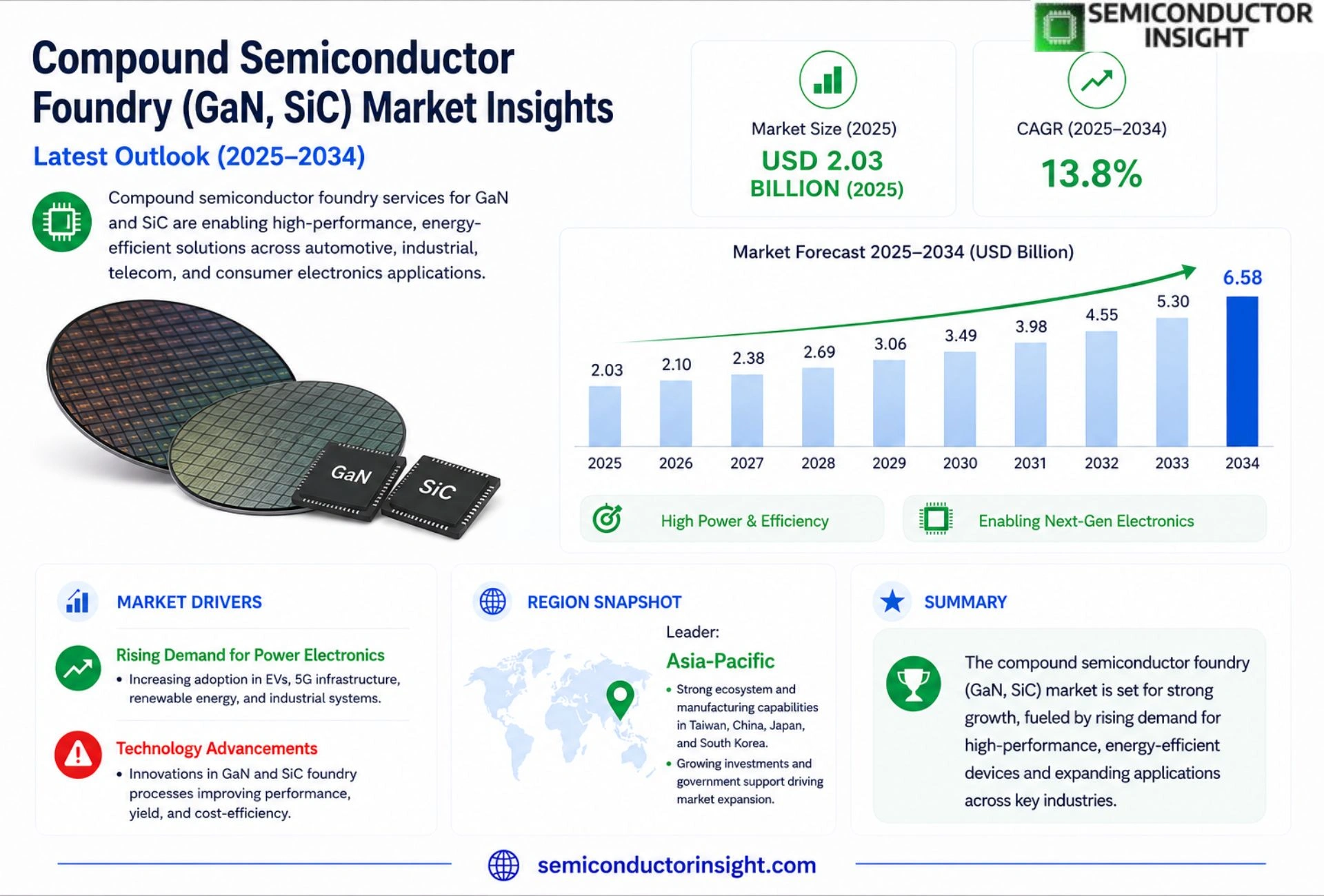
Global Compound Semiconductor Foundry (GaN, SiC) market size was valued at USD 2.03 billion in 2025. The market is projected to grow from USD 2.10 billion in 2026 to USD 6.58 billion by 2034, exhibiting a CAGR of 13.8% during the forecast period.
Compound semiconductor foundries specialize in the fabrication of gallium nitride (GaN) and silicon carbide (SiC) wafers, enabling high‑efficiency power devices, RF components, and optoelectronic modules. These substrates offer superior electron mobility and thermal conductivity compared with silicon, making them essential for next‑generation energy‑saving applications.
The market is accelerating because automotive electrification, renewable‑energy converters, and 5G infrastructure demand higher performance power electronics; meanwhile substantial capital infusion from investors and strategic alliances,such as the recent joint venture between GlobalFoundries and Wolfspeed,are expanding capacity and driving cost reductions.
MARKET DRIVERS
Rising Demand in Power Electronics
Compound Semiconductor Foundry (GaN, SiC) market is being propelled by the rapid adoption of electric vehicles, data‑center infrastructure, and renewable‑energy converters. GaN and SiC devices offer higher efficiency and frequency performance, which translates into 30‑40% lower system losses compared with traditional silicon solutions. This efficiency gain drives OEMs to source more chips from specialized foundries, accelerating market expansion.
Policy Support and Capital Investment
Governments across North America, Europe, and Asia‑Pacific have introduced subsidies and tax incentives for high‑efficiency power converters, directly benefiting the GaN and SiC supply chain. In addition, venture capital and corporate R&D budgets have surged, with more than $2 billion allocated to scaling up wafer‑size capabilities in the last two years.
➤ Analysts estimate that the foundry capacity for SiC wafers will increase by roughly 25 % annually through 2028, positioning the sector for sustained growth.
These drivers collectively create a robust pipeline of orders for specialized foundries, ensuring that Compound Semiconductor Foundry (GaN, SiC) market remains a focal point of the broader semiconductor renaissance.
MARKET CHALLENGES
Manufacturing Yield and Cost Pressures
Achieving high yields on GaN and SiC substrates remains technically demanding due to defect density and thermal‑stress management. The cost premium for these materials, often 2‑3× that of silicon, constrains price‑sensitive applications and can delay adoption in lower‑margin segments.
Other Challenges
Supply Chain Constraints
Limited availability of high‑purity epitaxial wafers and specialized equipment creates bottlenecks, leading to longer lead times for customers and necessitating strategic inventory management.
MARKET RESTRAINTS
High Capital Expenditure
Establishing a full‑scale GaN or SiC fab requires multi‑billion‑dollar investments in cleanroom infrastructure, advanced lithography, and high‑temperature processing tools. This financial barrier limits the entry of new players and concentrates capability within a few large incumbents, restraining competitive dynamics.
MARKET OPPORTUNITIES
Emerging Applications in 5G and Aerospace
The rollout of 5G networks and the growth of satellite‑based communications present sizable opportunities for GaN power amplifiers, leveraging their high‑frequency performance and thermal efficiency. Simultaneously, aerospace programs are prioritizing SiC power modules for their radiation tolerance and weight‑saving benefits, creating a niche yet rapidly expanding demand segment for specialized foundries.
Trends
Rising Demand from Automotive Electrification
The shift toward electric vehicles is prompting OEMs to require power modules that can operate at higher voltages while maintaining compact form factors. Gallium nitride and silicon carbide substrates provide the electron mobility and thermal performance needed to meet these specifications, allowing manufacturers to reduce inverter weight and improve vehicle range. As fleets expand globally, the need for reliable, high‑efficiency converters is accelerating the adoption of these compound semiconductors across powertrain architectures. This trend is reinforced by government incentives for low‑emission transport, which are driving suppliers to prioritize GaN and SiC foundry capabilities.
Other Trends
Strategic Partnerships Expanding Capacity
Recent joint ventures, such as the collaboration between GlobalFoundries and Wolfspeed, illustrate how leading players are pooling resources to scale production volumes and lower unit costs. These alliances combine advanced epitaxial growth expertise with mature manufacturing footprints, enabling faster rollout of high‑volume wafers for both automotive and communications sectors. Capital infusions from private equity and government programs are further supporting the construction of new fab lines, which in turn improves supply chain resilience for downstream device manufacturers.
Advances in Device Efficiency
Improvements in substrate quality are translating into power devices with markedly lower on‑resistance and reduced switching losses. For RF applications, the high breakdown field of SiC and the high frequency capability of GaN are meeting the stringent performance targets of 5G base stations and satellite links. These efficiency gains are driving broader adoption in renewable‑energy converters, where higher thermal conductivity enables compact, high‑power density inverters for wind and solar installations. Collectively, these technical advances reinforce the strategic importance of Compound Semiconductor Foundry (GaN, SiC) market as a cornerstone of next‑generation energy and communications infrastructure.
COMPETITIVE LANDSCAPE
Key Industry Players
Competitive Landscape of the Global Compound Semiconductor Foundry (GaN, SiC) Market
The market is currently dominated by a handful of vertically integrated foundries that combine high‑volume wafer production with advanced device prototyping. GlobalFoundries, following its joint venture with Wolfspeed, commands a sizable share of both GaN and SiC capacity, leveraging mature silicon processes to accelerate ramp‑up. Wolfspeed itself remains a technology leader in SiC epitaxy, supplying power modules to automotive OEMs and renewable‑energy converters. These leaders benefit from deep capital investment, extensive R&D pipelines, and strategic partnerships that lower entry barriers for downstream device manufacturers.
Beyond the top tier, a cluster of specialist manufacturers and diversified semiconductor groups enriches the competitive fabric. IQE offers custom epitaxial services to niche RF and optoelectronic customers, while STMicroelectronics and Infineon integrate GaN/SiC substrates into their broader power‑device portfolios. Regional players such as Mitsubishi Electric, Sumitomo Electric, and ROHM Semiconductor provide tailored solutions for automotive and industrial markets. Additional innovators,including NXP Semiconductors, ON Semiconductor, Power Integrations, Skyworks Solutions, MACOM Technology Solutions, and Samsung Electronics,contribute to a vibrant ecosystem that supports rapid technology adoption across 5G, electric‑vehicle, and grid‑modernization applications.
List of Key Compound Semiconductor Foundry Companies Profiled
- GlobalFoundries
- Wolfspeed (Cree)
- IQE plc
- STMicroelectronics
- Infineon Technologies
- NXP Semiconductors
- ON Semiconductor
- Mitsubishi Electric
- Sumitomo Electric
- Power Integrations
- ROHM Semiconductor
- Skyworks Solutions
- MACOM Technology Solutions
- Samsung Electronics
- TSMC
Segment Analysis:
| Segment Category | Sub-Segments | Key Insights |
| By Type |
|
GaN Wafer Segment is emerging as the primary growth driver because of its superior electron mobility and thermal performance, enabling designers to create ultra‑compact power converters.
|
| By Application |
|
Power Electronics dominates the application landscape as system architects seek efficiency gains in converters and inverters.
|
| By End User |
|
Automotive is the leading end‑user because electric‑vehicle powertrains demand high‑efficiency, high‑temperature capable devices.
|
| By Power Tier |
|
High‑Power Segment commands attention as system designers push performance envelopes in traction inverters and grid‑scale converters.
|
| By Market Vertical |
|
Electric Vehicles stand out as the most compelling vertical, driving demand for both GaN and SiC solutions across powertrain and charging subsystems.
|
Regional Analysis: North America
North America is driving innovation in GaN and SiC technologies, with significant investments in materials science and device engineering. This focus on cutting-edge research leads to the development of more efficient and powerful semiconductor devices.
The increasing demand for power electronics in EVs, renewable energy, and industrial applications is a primary driver. Government support for advanced manufacturing and R&D further bolsters market growth.
The North American foundry market is characterized by a mix of established players and emerging specialists, all vying for a share of the growing demand for GaN and SiC foundry services. Strategic partnerships and collaborations are becoming increasingly common.
The development of advanced packaging technologies and the integration of GaN and SiC devices into complex systems are key trends shaping the market in North America. Focus on reducing power consumption and improving system efficiency.
Europe
Europe represents a significant and steadily growing market for Compound Semiconductor Foundry (GaN, SiC) technology. Driven by stringent environmental regulations and a strong commitment to sustainable energy solutions, the region is witnessing increasing demand for high-efficiency power electronics. The automotive industry in Europe, with its aggressive push towards electrification and autonomous driving, is a major force propelling the adoption of GaN and SiC in power inverters and on-board chargers. Furthermore, the robust industrial sector, particularly in Germany and the UK, is developing advanced power conversion systems for various applications. Government initiatives promoting green technology and energy efficiency are further bolstering market growth. The focus on miniaturization and integration of power electronics also presents opportunities for foundry service providers in Europe.
Asia-Pacific
Asia-Pacific is poised to become the largest and fastest-growing market for Compound Semiconductor Foundry (GaN, SiC) market. This growth is primarily attributed to the burgeoning electronics manufacturing hubs in countries like China, Japan, South Korea, and Taiwan. The rapid expansion of the electric vehicle (EV) market in China, coupled with significant investments in renewable energy infrastructure, is driving substantial demand for GaN and SiC power semiconductors. The region’s strong manufacturing base and supportive government policies are further accelerating market growth. South Korea and Japan are particularly active in R&D and high-end applications. The increasing adoption of 5G networks and the growth of the industrial automation sector are additional factors contributing to the market’s expansion.
South America
South America presents a relatively nascent but promising market for Compound Semiconductor Foundry (GaN, SiC) market. The increasing adoption of electric vehicles, particularly in Brazil and Chile, is expected to drive demand for GaN and SiC power semiconductors. The growth of the renewable energy sector, especially solar and wind power, also contributes to the market’s potential. The industrial sector in countries like Argentina and Colombia is gradually adopting advanced power electronics for improved efficiency. While the market is currently smaller compared to North America and Asia-Pacific, the long-term growth prospects are considerable, driven by increasing investments in infrastructure and technological advancements.
Middle East & Africa
The Middle East & Africa region represents a growing market for Compound Semiconductor Foundry (GaN, SiC) technology, driven by investments in renewable energy projects, particularly solar power, and the expansion of the automotive sector. Countries like Saudi Arabia and the UAE are actively promoting the development of sustainable energy initiatives, which are fueling the demand for high-efficiency power electronics. The increasing adoption of electric vehicles and the growth of industrial infrastructure in the region are also contributing to market growth. While currently a smaller market compared to other regions, the long-term potential for Compound Semiconductor Foundry in this area is significant, supported by government initiatives and increasing investments in technology.
Report Scope
This market research report provides a comprehensive analysis of the Compound Semiconductor Foundry (GaN, SiC) Market , covering the forecast period 2026–2034. It offers detailed insights into market dynamics, technological advancements, competitive landscape, and key trends shaping the industry.
Key focus areas of the report include:
- Market Overview: The report begins with an overview outlining its current market scenario, key growth indicators, and industry transformation drivers. It discusses macroeconomic factors, demand–supply balance, regulatory landscape, and the strategic role of semiconductors in powering advancements across industries such as automotive, telecommunications, consumer electronics, and industrial automation.
- Market Size & Forecast: Historical data and future projections for revenue, unit shipments, and market value across major regions and segments.
- Segmentation Analysis: Detailed breakdown by product type, technology, application, and end-user industry to identify high-growth segments and investment opportunities.
- Regional Insights: Insights into market performance across North America, Europe, Asia-Pacific, Latin America, and the Middle East & Africa, including country-level analysis where relevant.
- Competitive Landscape: Profiles of leading market participants, including their product offerings, R&D focus, manufacturing capacity, pricing strategies, and recent developments such as mergers, acquisitions, and partnerships.
- Technology Trends & Innovation: Assessment of emerging technologies, integration of AI/IoT, semiconductor design trends, fabrication techniques, and evolving industry standards.
- Market Drivers & Restraints: Evaluation of factors driving market growth along with challenges, supply chain constraints, regulatory issues, and market-entry barriers.
- Stakeholder Insights: Insights for component suppliers, OEMs, system integrators, investors, and policymakers regarding the evolving ecosystem and strategic opportunities.
Primary and secondary research methods are employed, including interviews with industry experts, data from verified sources, and real-time market intelligence to ensure the accuracy and reliability of the insights presented.
FREQUENTLY ASKED QUESTIONS:
What is the current market size of Compound Semiconductor Foundry (GaN, SiC) Market?
-> Compound Semiconductor Foundry (GaN, SiC) market size was valued at USD 2.03 billion in 2025. The market is projected to grow from USD 2.10 billion in 2026 to USD 6.58 billion by 2034, exhibiting a CAGR of 13.8% during the forecast period.
Which key companies operate Compound Semiconductor Foundry (GaN, SiC) market?
-> Key players include GlobalFoundries, Wolfspeed (Cree), Infineon Technologies, ON Semiconductor, and STMicroelectronics, among others.
What are the key growth drivers?
-> Key growth drivers include automotive electrification, renewable‑energy power converters, and 5G infrastructure demand.
Which region dominates the market?
-> Asia‑Pacific is emerging as the fastest‑growing region, while North America currently holds the largest revenue share.
What are the emerging trends?
-> Emerging trends include strategic joint ventures, capacity expansion, and cost‑reduction initiatives in GaN/SiC wafer production.

Get Sample Report PDF for Exclusive Insights
Report Sample Includes
- Table of Contents
- List of Tables & Figures
- Charts, Research Methodology, and more...
 Download Sample Report PDF