Key Statistics
Key Takeaways
- Authentication gains value: Battery Security ICs represent USD 758.6 million of global revenue in 2025 and a USD 1,688.9 million outlook by 2034. Growth at 9.3% is linked to battery-pack authenticity, secure replacement components and greater integration of protection with identification in portable electronics, while not implying that every battery-management chip belongs in the category.
- Compact packages dominate: WSON accounts for an estimated ~43% of the type mix, SOT packages ~35% and other housings ~22%. The preferred footprint depends on available board area, wire routing, assembly volume, thermal behavior and whether the authentication function shares a die with sensing and switching-control circuitry.
- Lithium chemistry is central: Li-Ion applications lead with an estimated ~57% of revenue, followed by Li-Po at ~27%, NiMH at ~9% and other chemistries at ~7%. The split concerns the security device within each pack or host architecture, not the value of cells, battery minerals, battery charging hardware or finished consumer goods.
- Asia-Pacific retains the lead: Asia-Pacific represents an estimated ~43% of the 2025 market through dense assembly ecosystems for smartphones, wearables and electronic accessories. North America has about ~25% and Europe ~22%, each reflecting demand for controlled component sourcing, product support and secure replacement practices beyond the place where a semiconductor die is fabricated.
- Protection and cryptography differ: Texas Instruments documents SHA-1 and SHA-256 pack authentication functions, while Analog Devices supplies an ECDSA P-256 authenticator and STMicroelectronics offers certificate-based accessory identification. Authentication does not itself prevent overheating or short circuits; a complete safe battery pack also requires suitable electrical protection, sensing and verified charger behavior.
Battery Security ICs Market Overview
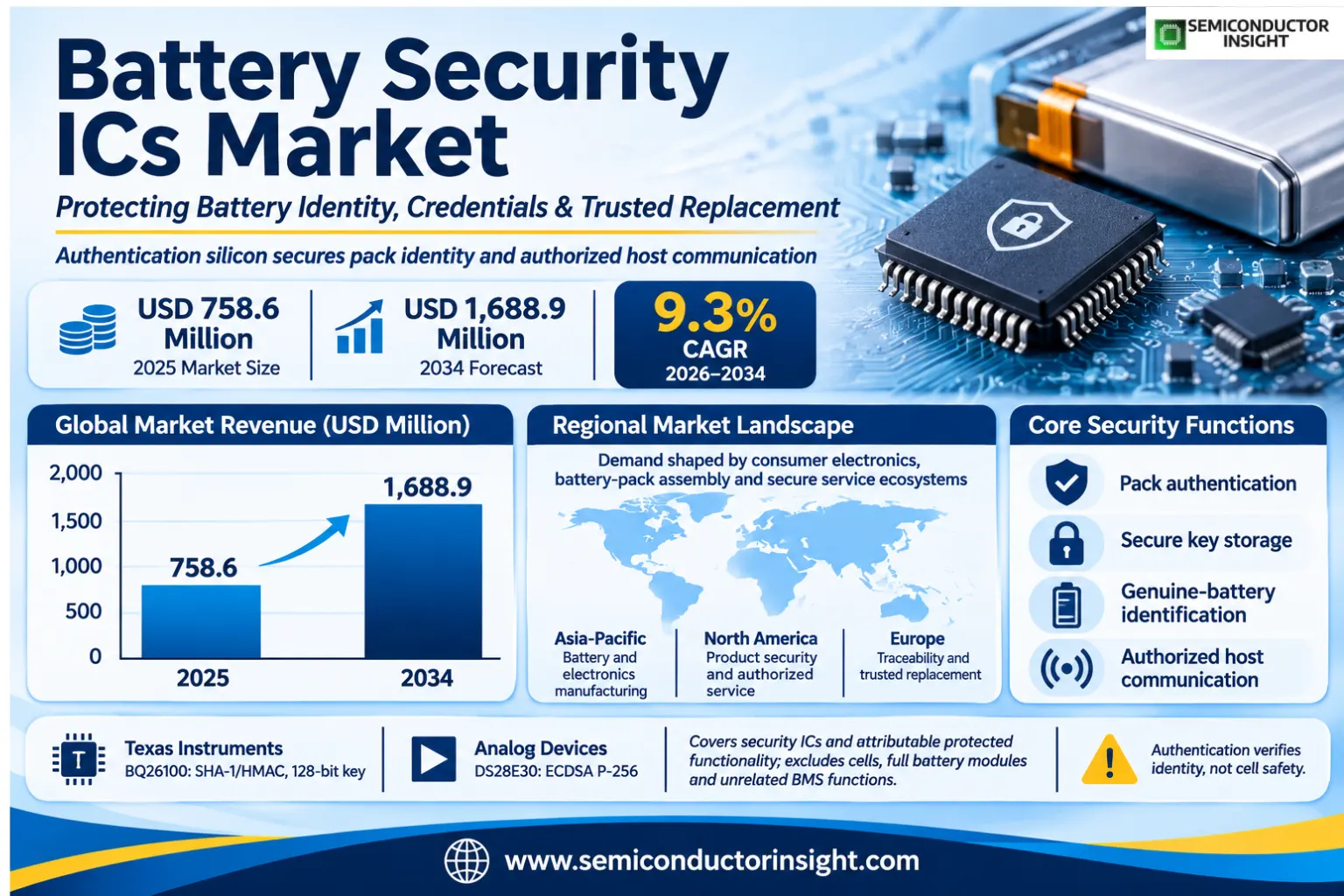
Battery security ICs market is estimated at USD 758.6 million in 2025 and is projected to reach USD 1,688.9 million in 2034, with 9.3% compound annual growth. Authentication silicon, secure key storage and dedicated security functions embedded alongside pack gauging or protection support product integrity and controlled replacement-battery use.
Battery security IC revenue covers devices and attributable protected functionality that recognize genuine packs, safeguard product credentials and support authorized communication between a battery pack and its host. The scope may include integrated gauge-and-authentication chips where the market definition encompasses that mix. It excludes raw cells, full battery modules, general chargers, unrelated microcontrollers and the entire battery management system unless a device is specifically part of the security boundary. A cell-level safety standard does not certify the security of an individual authenticator.
The published headline anchors span 2023–2030 and imply a steady increase across the 2025–2034 working horizon. Portable consumer devices use challenge-response identification to detect unauthorized replacement packs, but a successful cryptographic exchange does not prove that the underlying cell was manufactured safely. In 2026 procurement reviews increasingly need to examine both electronic identity and the independent protective measures that interrupt unsafe voltage, temperature or current conditions.
Security implementations vary substantially. Texas Instruments BQ26100 uses SHA-1/HMAC and a stored 128-bit key, while its newer integrated gauge products support SHA-256 or elliptic-curve authentication. Analog Devices DS28E30 offers ECDSA with P-256 public-key methods and a 64-bit identification number. Each choice has different key-provisioning and host-software requirements. A device maker evaluating a 2028 replacement architecture must plan for credentials, debug modes and future service access rather than treating authentication as a one-time component selection.
Supply relationships also affect the market. Battery pack assemblers must obtain secure components from trusted sources and manage programmed keys through factories, repair channels and authorized aftermarket programs. By 2032 a host product may have been serviced multiple times, increasing the importance of secure replacement procedures. Demand growth is not a projection of the volume of battery cells manufactured or the total sales value of electric vehicles, which use broader and often different protection architectures.
Segment Analysis: By Type
WSON is the leading package category at an estimated ~43% of 2025 revenue, followed by SOT at ~35% and Others at ~22%. These are physical assembly classes rather than cryptographic strength categories. A manufacturer choosing a 6-pin housing or compact wafer-level form considers PCB density, solder reliability, interface routing and pack assembly constraints. Authentication security still depends on the selected device family, the key lifecycle and the host’s ability to reject an invalid response safely.
| Type | Function | Market position |
|---|---|---|
| WSON | Wafer-level and no-lead surface-mount footprints provide compact integration options for security or multifunction pack chips where PCB area is tight. Designers need stable mechanical attachment, suitable inspection methods and an electrical pinout compatible with a pack connector. A WSON designation does not specify whether a chip runs SHA-256, SHA-1 or ECDSA; those decisions belong to the underlying product and software security architecture. | WSON comprises an estimated ~43% of type revenue. The footprint can appeal to mobile accessories, wearables and tightly packaged rechargeable products. A 2026 design review should compare 2 package dimensions with pin count, solder fillet visibility and assembly yield rather than assume the smallest outline offers the lowest total delivered cost over the product life. |
| SOT | Small-outline transistor-style packaging is familiar to many assembly operations and can support security devices that need few external connections. Its relevance is the compatibility of a compact component with established pick-and-place equipment and battery pack board layouts. Host firmware, key storage and unique identifiers determine whether the component performs useful authentication. Packaging convenience must not be confused with attack resistance or the safety rating of the battery cell. | The SOT category holds an estimated ~35% of the mix. A procurement group might prefer a 5-pin or 6-pin outline for a standardized assembly line even when a smaller part exists. Through 2029–2031 the tradeoff may depend on replacement-pack volume and component traceability rather than a universal preference for the most integrated authentication engine. |
| Others | Other form factors include ball-grid, wafer-level chip-scale and supplier-specific small-outline variants as well as package choices associated with integrated fuel-gauge designs. TI lists a 15-ball DSBGA for a modern integrated protector and gauge, illustrating that security capability need not appear in a dedicated authentication die. Device selection must still match required temperature range, production test access and the physical limits of the pack assembly. | Other packages account for an estimated ~22% of present demand. A 2027 battery system may use an integrated chip to reduce the number of external devices, whereas a serviceable industrial pack may retain a separate authenticator. The comparison should cover 3 cost components: board space, test labor and long-run supply availability, without counting the whole system revenue twice. |
Segment Analysis: By Application
Li-Ion applications hold an estimated ~57% of revenue, Li-Po contributes ~27%, NiMH ~9% and other chemistries ~7%. This grouping follows the battery chemistry supported by a embedded security device or compatible host interface. Portable rechargeables account for the larger opportunities because replacement packs are widely distributed and brand integrity affects both operating reliability and aftersales support. Chemistry alone does not identify the cryptographic scheme or guarantee compliance with battery safety requirements.
| Application | Demand characteristics |
|---|---|
| Li-Ion | Lithium-ion battery packs are common in portable electronics and many industrial products that require identification of approved replacement parts. A secure chip can respond to a host challenge and store credentials, while separate measurements monitor pack voltage, current and temperature. TI integrated solutions cover single-cell Li-ion systems with authentication and protective features. A purchasing decision must confirm whether the security component is dedicated or included in a broader gauge design. |
| Li-Po | Lithium-polymer rechargeable packs often occupy thin or unusual mechanical envelopes in personal electronics and wearables. Secure identification can protect service policies and limit use of counterfeit replacement assemblies. In 2026 the engineering challenge is to fit the desired security device and protection circuit into the available pack board without increasing standby current unnecessarily. The polymer packaging does not determine whether the implementation should use a keyed hash or public-key signature. |
| NiMH | Nickel-metal hydride batteries remain relevant in selected industrial, portable and legacy products where operational continuity matters more than the newest energy-density target. Authentication may be used to recognize a replacement assembly and maintain compatible charger operation, but adoption is more selective than for mainstream rechargeable lithium packs. The IEC 62133-1:2026 standard addresses nickel battery safety requirements; it should not be interpreted as a new certification of individual security chips. |
| Others | Other chemistries include specialized rechargeable configurations and accessory designs where electronic identity or secure replacement control has commercial value. These projects often vary in voltage, connector arrangement and host interface constraints. Security functions are only useful when they are supported by genuine production provisioning and a device-side verification policy. The market analysis therefore does not equate each specialty cell shipment with a security IC sale. |
Application demand reflects the installed consumer-device base as well as service and replacement practices. In 2026 lithium systems remain central to the commercial opportunity, but authenticated 2-wire and 1-wire designs impose different electrical and software burdens. A repairable product with a 5-year support plan must manage key rotation and the continued availability of compatible replacement packs. A buyer should evaluate security and battery safety as related yet separate requirements.
Regional Analysis
Asia-Pacific leads the 2025 battery security IC market at an estimated ~43%, followed by North America at ~25%, Europe at ~22%, South and Central America at ~6% and the Middle East and Africa at ~4%. The division reflects pack assembly, OEM device design and authorized replacement demand. It does not imply that every security IC consumed in a region was fabricated there, nor that large battery production hubs earn all their component value domestically.
Where is battery authentication semiconductor demand concentrated?
The Asian electronics manufacturing network has a leading position because portable device and battery-pack assembly is concentrated around established production clusters. North America and Europe also influence IC purchasing through branded device programs, security specifications and aftersales policy even when physical assembly occurs abroad. Growing repair activity and electronic accessory supply chains could lift smaller regions through 2034. Differences in enforcement, pack chemistry and key provisioning mean that units assembled and revenue booked need not follow an identical geographic pattern.
| Region | Position | Growth outlook | Demand profile | What decides supplier selection |
|---|---|---|---|---|
| Asia-Pacific | Largest; estimated ~43% share | ~9.6% CAGR outlook | Pack assembly, smartphones and wearables | Trusted factory key loading and compact packaging |
| North America | Second; estimated ~25% share | ~9.0% CAGR outlook | OEM authorization and accessories | Product liability, secure identity and long-term service |
| Europe | Third; estimated ~22% share | ~8.8% CAGR outlook | Industrial electronics and device repair | Component traceability and safety-related procurement |
| South and Central America | Emerging; estimated ~6% share | ~10.1% CAGR outlook | Imported devices and regional pack assembly | Authorized aftermarket support and cost |
| Middle East and Africa | Emerging; estimated ~4% share | ~10.3% CAGR outlook | Mobile electronics and equipment maintenance | Reliable replacement sourcing and service ecosystem |
Key Battery Security ICs Manufacturers and Competitive Landscape
Battery security IC competition spans dedicated cryptographic authenticators and broader energy-management chips that incorporate identification functions. Texas Instruments offers battery-specific SHA-based devices; Analog Devices sells one-wire secure authenticators inherited partly from Maxim; Infineon has battery-focused OPTIGA products; and STMicroelectronics documents STSAFE-L010 for consumables and battery accessories. A product listing verifies technical participation but does not disclose each company’s revenue share within the defined market.
Dedicated products compete on cryptographic robustness, host interface and provisioning cost. The TI BQ26100 uses SHA-1 and HMAC, an older approach that a contemporary designer may compare with SHA-256 or ECDSA alternatives. Analog Devices DS28E30 supports ECDSA P-256 and device identifiers; the former Maxim brand is part of Analog Devices rather than an independently listed modern supplier. Customers should test replacement workflows, not treat algorithm names alone as a complete threat assessment.
Integration is another route. TI BQ27Z746 and BQ27Z855 combine pack gauging, protective functions and authentication, potentially reducing bill-of-material complexity for a single-cell product. An integrated chip may replace several components, yet warranty, firmware maintenance and independent protection analysis still matter. A manufacturer should determine the extent to which a multifunction device’s sales value is attributable to the security market boundary before comparing it with a standalone authenticator.
STMicroelectronics positions STSAFE-L010 for authenticating consumables, batteries and peripherals using certificates; Infineon markets OPTIGA Authenticate On for anti-counterfeit mobile batteries. These offers illustrate different deployment ecosystems and device interfaces. From 2027–2030, competition may be decided by secure key injection at scale, backward compatibility and supply continuity. Companies with a wide semiconductor portfolio should not be credited with security-IC share merely because they sell unrelated power-management products.
Tier structure
| Tier | Companies | Basis of competition |
|---|---|---|
| Dedicated authentication | Texas Instruments BQ26100, Analog Devices DS28E30 | Pack identity, key storage and cryptographic exchanges |
| Integrated security and protection | Texas Instruments BQ27Z746 and BQ27Z855 | Authentication within measurement and protective battery control |
| Accessory secure devices | Infineon OPTIGA, STMicroelectronics STSAFE-L010 | Certificate-backed validation and aftermarket protection |
Key companies profiled
- (‘Texas Instruments’, ‘Battery authentication’, ‘Standalone SHA/HMAC and integrated gauge/authentication components’)
- (‘Analog Devices’, ‘Secure accessory ICs’, ‘ECDSA authenticators including the former Maxim DS28E30 portfolio’)
- (‘Infineon Technologies’, ‘Embedded trust’, ‘OPTIGA battery and accessory identity product families’)
- (‘STMicroelectronics’, ‘Security microelectronics’, ‘STSAFE-L010 used for branded consumables and batteries’)
Battery Security ICs Production Capacity Analysis
Production capacity for battery security ICs depends on semiconductor foundry supply, secure credential provisioning, package assembly and high-volume electrical test. A product’s available stock does not prove annual global output, and an IC supplier may use more than 1 contract-manufacturing route. Secure factory personalization adds a manufacturing-control requirement that ordinary passive battery components do not face. The sale occurs in the security semiconductor value chain, not at the level of total battery gigawatt-hours.
A dedicated authentication chip requires functional testing and secure programming before shipment. TI’s BQ26100 product data describe a 6-lead VSON device that can operate from a 1-wire power and communications arrangement. The factory must avoid exposing secret keys during provisioning; a single duplicated credential could defeat a host’s intended genuine-part check. This requirement means manufacturing capacity cannot be evaluated solely by wafers processed or automated test throughput.
Integration can change assembly economics. Modern battery-control ICs contain current sensing, temperature measurement, protection switching and cryptographic support on one small die. TI lists a 15-ball DSBGA package and SHA-256 for BQ27Z746, alongside several low-power modes. A 2028 high-volume design should qualify firmware updates and board attachment reliability together. When authentication is embedded, the system manufacturer must still validate that electrical fault thresholds meet its pack specification.
The ability to replace a component in an active consumer product is a commercial constraint through 2034. An OEM may need security chips and keys for a new model and for older authorized spare packs. Long-term production plans should include revision compatibility and traceable key custody. Neither a 2026 firmware announcement nor a published package specification establishes the supplier’s worldwide security IC wafer capacity, revenue or uncommitted inventory.
Battery Security ICs Market Dynamics: Drivers, Restraints and Opportunities
Demand for authenticated packs, secure repair and compact integration supports this market, while legacy algorithm transitions, provisioning costs and resistance to closed accessory ecosystems can restrain adoption. The two contribution tables express relative influence over three forecast periods and describe commercial drivers rather than a measured security assurance level. Protection, authentication and battery chemistry affect different parts of the engineering decision.
MARKET DRIVERS
Drivers Impact Analysis*
| Market Drivers | Impact Rank | CAGR Contribution (%) | 2026–2028 | 2029–2031 | 2032–2034 |
|---|---|---|---|---|---|
| Portable battery authenticity requirements | High | +5.00% | High | High | Medium |
| Integrated fuel-gauge and secure identity designs | Medium-High | +4.10% | High | High | High |
| Authorized replacement and repair programs | Medium | +2.80% | Medium | High | High |
| More robust cryptographic device options | Low-Medium | +2.40% | High | Medium | Medium |
| Others (connected device growth) | Low | +1.60% | Medium | Medium | Low |
OEM control over genuine battery packs
An authenticator allows a host system to challenge a replacement battery and decide whether the credential is recognized. This can discourage unauthorized packs and support predictable repair channels, although no identification result establishes chemical safety or cell quality by itself. As portable devices age into 2029–2031, OEMs may choose chips with durable identity management to support parts supplied through legitimate service partners.
Consolidated pack electronics
Pack designers can select a multifunction chip that combines gauging, protection, and SHA-256 or ECC-based authentication. Fewer standalone parts may simplify board assembly in a 1-cell wearable, yet the system still needs rigorous protection and firmware validation. TI’s 2026 BQ27Z855 product description is evidence of this design direction; it does not quantify the total addressable market for every pack semiconductor.
Security-aware maintenance
A manufacturer selling a device for several years may need compatible replacement batteries after the initial production cycle. Secure keys, tracking of approved contractors and controlled service tools create reasons to maintain authentication components beyond one product launch. The challenge is avoiding a system that makes legitimate repair impossible while still resisting counterfeit packs that could be electrically unsuitable.
Improved host authentication choices
Device families now range from older SHA-1/HMAC methods to SHA-256 and public-key ECDSA P-256 solutions. An OEM can evaluate message sizes, key provisioning and resistance to credential duplication under its actual threat assumptions. Security advances create engineering work in both pack electronics and host firmware. Their value depends on testable implementation details rather than broad marketing claims that a particular hash makes every battery safe.
MARKET RESTRAINTS
Restraints Impact Analysis*
| Market Restraints | Impact Rank | CAGR Contribution (%) | 2026–2028 | 2029–2031 | 2032–2034 |
|---|---|---|---|---|---|
| Secure provisioning and audit expense | High | -2.40% | High | High | Medium |
| Compatibility and repair restrictions | Medium-High | -2.10% | Medium | High | High |
| Legacy cryptography transition cost | Medium | -1.40% | High | Medium | Low |
| Others (commodity price pressure) | Low | -0.70% | Medium | Low | Low |
Factory key handling can be difficult
Security provisioning introduces controlled secrets or certificates to a battery pack manufacturing line. A supplier needs procedures for 2 distinct events: authenticating the chip and securely associating it with an authorized pack. When contract assemblers change, ensuring that credentials are not duplicated or lost adds time and cost. Breaches could undermine both aftermarket protection and consumer trust despite properly functioning semiconductor hardware.
Incompatible systems harm serviceability
A device that rejects all alternative packs may frustrate legitimate repairers or customers who need spare batteries after a model is discontinued. Security and repairability need an explicit balance, including authorized replacement routes and recoverable service procedures. Across 2032–2034, customers may judge manufacturers by how well they preserve safe maintenance rather than by the sophistication of a closed authentication protocol alone.
Security migration increases engineering effort
An older SHA-1 design may not meet the expectations for a new long-life device, yet replacement with SHA-256 or ECDSA affects both pack and host software. Engineering teams should analyze provisioning, secure key memory and response timing before switching components. A 2027 revision that changes its security engine can also alter test equipment and the number of authorized parts supported in the field.
MARKET OPPORTUNITIES
Authenticated industrial replacement packs
Industrial instruments and medical accessories may require reliable identification of a replacement battery and a record of its service history. A dedicated device with a 64-bit identifier or secure counter can support structured fleet maintenance. Buyers must still ensure that product and sector regulations are satisfied independently; cryptographic identity is not equivalent to clinical or functional-safety approval.
Protectors with security integration
Integrated battery gauges provide a path for the host to observe electrical condition and authenticate the pack using fewer external ICs. A successful offering must preserve protected memory, manage charging hazards and communicate through a compatible 1-wire or I2C interface. These devices can reduce board complexity in a tight enclosure, although bundling broad measurement features may change price comparison with a dedicated security-only chip.
Managed credentials for aftermarket channels
Manufacturers could develop secure credential provisioning and authorized replacement programs with traceability from the factory to a later service shop. A 2029 design plan should define ownership of certificates and procedures for retired product lines. This creates a commercial role for security components that support field maintenance without treating every aftermarket battery sale as an incremental semiconductor shipment.
Battery Security ICs Supply Chain Analysis
The battery security semiconductor supply chain includes silicon design and fabrication, protected key programming, component assembly, battery-pack integration and OEM firmware verification. A failure in any one phase can compromise product identity even when the IC’s cryptographic engine functions correctly. Manufacturers therefore assess trusted programming infrastructure alongside conventional package cost, electrical qualification and test yield.
Chip and interface design. The system engineer chooses between standalone identification and multifunction gauge/protector devices. A 6-pin part may save interface overhead, while a 15-ball integrated solution can reduce external component count. Host communication through SDQ, 1-Wire or I2C must be compatible with physical cabling and wake-up behavior. The design must also reserve an explicit response when a pack fails validation.
Secure production programming. Programming is not simply writing a public serial number into memory. The facility may need to inject protected keys, validate certificates and record the origin of each assembled board under controlled access. In 2026 a supplier should demonstrate how keys are rotated and how discarded devices are handled. Weak factory controls can negate stronger cryptography embedded in an otherwise well-designed authenticator.
Battery assembly and test. Pack factories integrate cells, electrical safety components and the identity IC into a physical unit. Security test may verify the digital exchange, while a separate suite checks overcurrent, short circuit, voltage and temperature behavior. For a lithium-polymer pack, mechanical constraints add pressure to minimize board area. Traceability should survive repair and warranty transactions without assuming that the security IC alone ensures safe energy storage.
Service and end-of-life support. After a product launch, replacement-pack procurement and software maintenance determine whether authentication remains usable. An older host may recognize only 1 algorithm or a specific class of certificates, so design documentation must record these dependencies. During 2030–2034 the ability to provision replacement batteries responsibly can influence customer loyalty. Security suppliers may compete on long-run software support as much as on initial chip pricing.
Recent Developments in the Battery Security ICs Market
- 3 June 2026 Integrated authentication firmware
Texas Instruments published BQ27Z855 firmware information describing gas gauging, protection, current limiting and SHA-1, SHA-256 and ECC-related authentication features. The update indicates continued integration of pack identity with broader battery electronics. It does not demonstrate market-wide shipment volumes, nor should the entire sales value of any host product be assigned to a security IC market. Source - 12 February 2026 Single-cell gauge documentation
TI updated the BQ27Z746 datasheet for a compact 15-ball integrated gauge and protection component supporting SHA-256 authentication. Product attributes include safety monitoring functions and low-power operation, useful to pack developers balancing multiple requirements. The published device specification verifies capability, not the number of batteries sold in the year or its share of global authentication-chip revenue. Source - 17 January 2025 Temperature and security convergence
The TI TMP1827 technical material was revised in January 2025, documenting SHA-256 authentication, 2Kb EEPROM and precision temperature monitoring. A shared interface can reduce the need for separate identity and sensing devices in selected applications. Users still must examine the host verification flow and package environment; the presence of an authentication algorithm is not independent evidence of battery safety certification. Source - 22 January 2025 Secure accessory implementation
Analog Devices lists a January 2025 security user guide for the DS28E30, a 1-Wire ECDSA P-256 secure authenticator that supports battery identification and charge-cycle applications. The product uses secure storage and a unique factory identifier. A customer can evaluate certificates and counters as part of service traceability, but device availability does not establish future market size. Source - 2026 Battery identification interface
STMicroelectronics described STSAFE-L010 as a secure device for consumables, batteries and peripherals, using certificate-based authentication through I2C or ST1Wire. The function helps distinguish genuine accessories without assuming that every selected device includes complete cell protection. The announcement provides portfolio evidence for accessory authentication rather than an independently disclosed battery security IC market total. Source - 2026 Mobile battery anti-counterfeit devices
Infineon product documentation identifies OPTIGA Authenticate On for mobile battery replacement identification. The device represents a dedicated embedded security alternative in a small package, not a standalone battery management system. OEM adoption still depends on secure credential administration, factory provisioning and a maintenance policy that permits appropriately authorized replacements over the product lifetime. Source
REPORT SCOPE & SEGMENTATION
| Attribute | Details |
|---|---|
| Market Name | Battery Security ICs |
| Market Geography | Global |
| Base Year | 2025 |
| Estimated Year | 2026 |
| Forecast Year | 2034 |
| Original Headline Window | 2023–2030 |
| Reported Value Unit | USD million |
| Revenue Boundary | Battery pack authentication and security ICs, including attributable functions within integrated gauge/protector devices |
| Headline Reference | USD 635 million in 2023 and USD 1,183.35 million in 2030; rebased USD 758.6 million in 2025, USD 1,688.9 million in 2034, 9.3% annual growth |
| Primary 2025 Demand | Li-Ion authentication applications |
| Largest 2025 Region | Asia-Pacific (~43%) |
| By Type | SOT · WSON · Others |
| By Application | Li-Ion · Li-Po · NiMH · Others |
| By Region | Security IC revenue is not total battery production, pack value or energy management hardware. Asia-PacificChina, Japan, South Korea North AmericaUnited States, Canada, Mexico EuropeGermany, France, United Kingdom South and Central AmericaBrazil, Argentina, Chile Middle East and AfricaUnited Arab Emirates, South Africa, Saudi Arabia |
| Key Companies Profiled | Texas Instruments (standalone authentication and integrated gauges); Analog Devices (former Maxim secure authentication); Infineon Technologies (OPTIGA); STMicroelectronics (STSAFE-L010) |
| Customization Scope | Selected-device research can assess provisioning risk, battery chemistry suitability, key storage, firmware compatibility, package selection and authorized repair channels. |
Frequently Asked Questions
What is the battery security IC market forecast?
The global category is USD 758.6 million for 2025 and USD 1,688.9 million by 2034, representing a 9.3% yearly growth rate. These values follow a 2023–2030 anchor series extended into a common 2025–2034 comparison. The boundary covers relevant authentication chips and security functions within pack control devices, not the complete sale price of rechargeable batteries or chargers.
Which region holds the largest share?
Asia-Pacific represents an estimated ~43% of 2025 revenue because of the concentration of portable-device production and battery assembly. North America contributes about ~25%, and Europe approximately ~22%, influenced by device specifications, original-equipment brands and aftermarket control. The regional shares describe semiconductor demand and must not be interpreted as portions of global battery energy-storage capacity.
Why is WSON a large package category?
WSON and related compact surface-mount housings represent roughly ~43% of security IC type revenue in this segmentation. Their appeal is board space and compatibility with high-volume battery pack assembly. Package selection should consider available pins, assembly inspection and thermal operating limits. A small housing alone does not specify the strength of credential storage or the host’s authentication procedure.
Which battery chemistry generates the most demand?
Li-Ion accounts for an estimated ~57% of application value, supported by many portable rechargeable devices that need authorized battery identification. Li-Po follows near ~27%, while NiMH remains a smaller segment around ~9%. Actual chip adoption varies by device design and service policy; security IC revenue should not be derived by multiplying battery cell shipments by an assumed universal component price.
What is the difference between authentication and electrical protection?
Authentication uses secrets or certificates to identify a pack or accessory. Electrical protection interrupts dangerous voltage, temperature or current behavior using appropriate circuits and controls. One component may implement both functions, as with some integrated TI fuel-gauge designs, but successful authentication does not prevent a short circuit. Product safety requires separate testing of pack behavior and compatible charging hardware.
Which semiconductor companies supply this function?
Texas Instruments documents SHA-based pack authentication and integrated gauge products, Analog Devices offers the DS28E30 ECDSA device, Infineon lists OPTIGA authentication parts, and STMicroelectronics has the STSAFE-L010 accessory solution. A supplier’s technical catalog does not disclose its percentage of this market. Former Maxim products now belong to Analog Devices, so the two names should not be treated as separate current vendors.
How do SHA and ECDSA approaches differ?
SHA-1 and SHA-256 HMAC designs usually depend on the host and pack protecting related secret material. ECDSA P-256 schemes use public-key signatures and can support certificate-based identification with different provisioning arrangements. Selecting a cryptographic standard also affects memory, host software and lifecycle support. Engineering teams must verify an actual protocol implementation rather than relying on the hash or curve name alone.
Can a security IC prevent counterfeit batteries completely?
A secure device can make unauthorized packs harder to impersonate when keys are protected and the host verifies responses correctly. It cannot by itself stop every physical counterfeit, detect every unsafe cell or guarantee product quality. Fraud resistance also depends on controlled contract manufacturing, secure programming, service records and an authorized way for customers to obtain compatible replacement assemblies.
Why are integrated fuel gauges relevant?
Some contemporary integrated devices measure current and voltage, control protective switching and authenticate the battery through the same semiconductor. TI’s 2026 BQ27Z855 description shows this convergence. Integration can simplify a small pack board but creates firmware and test dependencies. Market calculations should identify the portion of multifunction IC activity attributable to security rather than treating every power-management function as an additional sale.
What could alter the market through 2034?
The volume of rechargeable consumer products, legitimate repair policies, adoption of stronger credentials and compact device design will shape purchases. Factory key management cost, service compatibility and competition from low-cost parts can slow adoption. A provider able to support old and new host protocols during replacement cycles could gain customer trust, provided its authentication components remain available and electrically suitable for the intended product.
Research Sources & Evidence Base

Get Sample Report PDF for Exclusive Insights
Report Sample Includes
- Table of Contents
- List of Tables & Figures
- Charts, Research Methodology, and more...
 Download Sample Report PDF