MARKET INSIGHTS
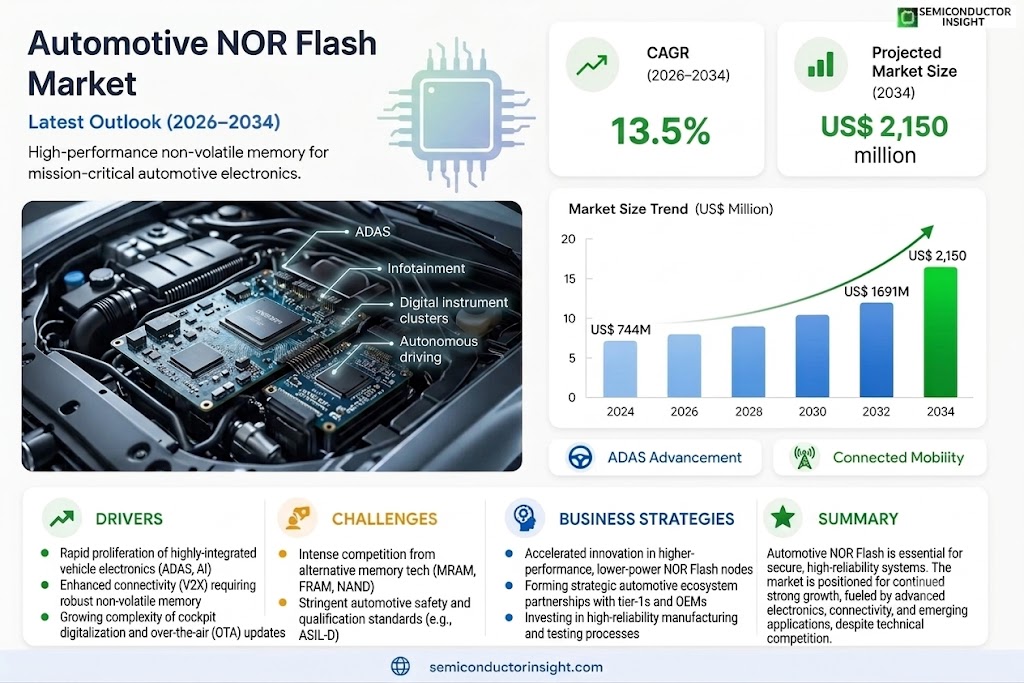
The global Automotive NOR Flash Market was valued at 744 million in 2024 and is projected to reach US$ 1691 million by 2032, at a CAGR of 12.7% during the forecast period.
Automotive NOR Flash refers to a specialized type of non-volatile memory designed for the rigorous demands of vehicle electronics. Unlike traditional flash memory, NOR Flash offers faster read speeds and superior reliability, making it ideal for critical automotive applications such as advanced driver-assistance systems (ADAS), infotainment units, and telematics control modules. Its architecture allows direct code execution, a feature essential for real-time automotive systems.
The market is driven by increasing vehicle electrification and stringent safety regulations mandating reliable data storage solutions. The shift toward autonomous vehicles is further accelerating demand, as these systems require robust memory for firmware and over-the-air updates. Key players like Infineon Technologies and Micron are expanding production capacity to meet this growing need, with the 3.3V segment emerging as the dominant voltage specification due to its compatibility with automotive power systems.
MARKET DYNAMICS
MARKET DRIVERS
Rising Demand for Automotive Electronics to Accelerate NOR Flash Adoption
The rapid advancement in automotive electronics is a primary driver for the Automotive NOR Flash market. Modern vehicles increasingly incorporate advanced driver-assistance systems (ADAS), infotainment units, digital instrument clusters, and autonomous driving technologies, all of which rely on high-performance memory solutions. NOR Flash memory is preferred for these applications due to its fast read speeds, reliability, and deterministic execution capabilities, which are critical for real-time systems. With the automotive electronics market projected to grow substantially over the next decade, demand for specialized NOR Flash solutions is expected to surge in parallel.
Transition to Connected and Autonomous Vehicles Creates Memory Demand
The automotive industry’s shift toward connected and autonomous vehicles presents significant growth opportunities for NOR Flash memory. These vehicles require robust data storage solutions for over-the-air (OTA) updates, sensor fusion processing, and instant boot-up capabilities for safety-critical systems. Current industry trends indicate autonomous vehicles may need up to 1TB of storage capacity to process and store the massive amounts of data generated by LiDAR, radar, and camera systems. NOR Flash plays an essential role in this ecosystem by providing the non-volatile storage needed for firmware, boot code, and configuration data with minimal latency.
Furthermore, government mandates for enhanced vehicle safety features across major automotive markets are accelerating adoption of these technologies.
➤ For instance, recent regulations in the European Union now require all new cars to be equipped with advanced safety systems including autonomous emergency braking, making NOR Flash memory a critical component in compliant vehicles.
The increasing electrification of vehicles also contributes to market growth, as electric vehicles typically incorporate more electronic control units (ECUs) than traditional internal combustion engine vehicles, each requiring reliable memory storage.
MARKET RESTRAINTS
Stringent Automotive Certification Requirements Increase Development Costs
The automotive industry’s rigorous qualification standards present significant challenges for NOR Flash memory suppliers. Components must meet stringent AEC-Q100 qualification standards and often require specialized designs to withstand extreme temperatures, vibrations, and long operational lifetimes of up to 15 years. These heightened requirements lead to extended development cycles and increased certification costs, which can deter some memory manufacturers from entering the automotive market. Furthermore, the need for ISO 26262 functional safety compliance adds another layer of complexity and expense to product development.
Other Restraints
Supply Chain Vulnerabilities
The automotive NOR Flash market faces ongoing challenges from semiconductor supply chain disruptions that have impacted the broader automotive industry in recent years. Allocation constraints and extended lead times for automotive-grade components continue to create bottlenecks for vehicle manufacturers, potentially slowing adoption of new memory technologies.
Technical Limitations
While NOR Flash offers excellent reliability and fast read performance, its relatively lower density and higher cost-per-bit compared to NAND Flash create trade-offs for system designers working within strict automotive cost constraints.
MARKET CHALLENGES
Intense Competition from Alternative Memory Technologies
The Automotive NOR Flash market faces growing competition from emerging non-volatile memory technologies such as MRAM (Magnetoresistive RAM) and FRAM (Ferroelectric RAM). These alternatives offer potential advantages in terms of write speed, endurance, and power consumption, particularly for applications requiring frequent data logging. While NOR Flash remains the preferred solution for code storage due to its reliability and deterministic performance, memory suppliers must continually innovate to maintain their competitive position in the automotive sector.
Additionally, the need to balance performance improvements with rigorous automotive reliability standards creates ongoing development challenges for semiconductor manufacturers.
Another significant challenge involves managing the transition to advanced process nodes while maintaining the exceptional quality and reliability demanded by automotive applications.
MARKET OPPORTUNITIES
Growth of Vehicle Electrification and ADAS Creates New Memory Requirements
The accelerating adoption of electric vehicles and advanced driver assistance systems represents a substantial growth opportunity for the Automotive NOR Flash market. These technologies create demand for specialized memory solutions capable of supporting safety-critical functions while operating in harsh automotive environments. The increasing complexity of vehicle architectures, including domain and zonal controller implementations, is driving the need for higher-density NOR Flash solutions that can store and rapidly access larger firmware images. Industry projections suggest that memory content per vehicle could increase by over 300% in the next five years as these technologies become standard across vehicle segments.
The development of next-generation NOR Flash solutions tailored for automotive artificial intelligence applications presents another significant opportunity, as edge processing of sensor data becomes increasingly important for autonomous driving systems.
Strategic partnerships between memory suppliers and automotive OEMs are expected to play a crucial role in developing the specialized solutions needed for future vehicle architectures.
AUTOMOTIVE NOR FLASH MARKET TRENDS
Rising Demand for Advanced Driver Assistance Systems (ADAS) Drives NOR Flash Adoption
As vehicles become increasingly digitalized, NOR Flash memory is gaining critical importance in the automotive sector due to its high reliability and fast read speeds, which are essential for Advanced Driver Assistance Systems (ADAS) and infotainment systems. The global automotive NOR Flash market is projected to grow from $744 million in 2024 to $1.69 billion by 2032, with a robust CAGR of 12.7%. The surge in autonomous driving technologies and stringent safety regulations are accelerating the adoption of NOR Flash solutions. Automakers are embedding NOR Flash in electronic control units (ECUs) to ensure real-time data processing, a critical factor in collision avoidance and lane-keeping systems.
Other Trends
Transition to Electric and Connected Vehicles
The shift toward electric vehicles (EVs) and connected cars is further propelling the demand for NOR Flash memory. EV manufacturers rely heavily on NOR Flash for firmware storage in battery management systems, powertrain controls, and over-the-air (OTA) updates. As connected vehicles continue to integrate telematics and V2X (vehicle-to-everything) communication, the need for high-performance, low-latency memory solutions is intensifying. Analysts estimate that EVs could account for over 30% of automotive NOR Flash demand by 2030.
Expansion of In-Vehicle Infotainment (IVI) Systems
Another key driver for the NOR Flash market is the rising consumer demand for advanced in-vehicle infotainment (IVI) systems. Modern vehicles now feature high-resolution touch displays, voice recognition, and navigation systems—all of which require non-volatile memory for seamless performance. The increasing integration of AI-driven applications, such as virtual assistants and augmented reality (AR) dashboards, necessitates fast boot times and high endurance storage, positioning NOR Flash as a preferred choice. The global IVI market is witnessing an annual growth rate of approximately 8%, further boosting NOR Flash utilization.
COMPETITIVE LANDSCAPE
Key Industry Players
Semiconductor Giants Compete for Dominance in the Expanding Automotive NOR Flash Market
The global Automotive NOR Flash market features a highly competitive environment dominated by semiconductor powerhouses investing heavily in automotive-grade memory solutions. Infineon Technologies leads the pack with its robust portfolio of reliable NOR Flash memory chips specifically optimized for automotive safety systems, ADAS, and in-vehicle networking applications. Their strong partnerships with major automakers solidify their position as a market leader in 2024.
Micron Technology and Macronix hold substantial market shares thanks to their technological advancements in high-temperature resistant NOR Flash memory with fast read speeds. These capabilities make their products ideal for harsh automotive operating conditions, from engine control units to instrument clusters.
The competitive intensity is further heightened by strategic moves such as Winbond’s recent expansion of its automotive-qualified NOR Flash production capacity in Taiwan, addressing growing electric vehicle demand. Similarly, GigaDevice has been strengthening its position through aggressive pricing strategies for mid-range automotive applications in emerging markets.
Meanwhile, Microchip Technology and Ingenic Semiconductor are carving out specialized niches – Microchip focusing on ultra-reliable solutions for safety-critical systems, while Ingenic targets cost-sensitive applications. Both companies are expanding their R&D efforts to gain technical advantages in this high-growth sector.
List of Key Automotive NOR Flash Manufacturers
- Infineon Technologies (Germany)
- Macronix (Taiwan)
- Micron Technology (U.S.)
- Winbond (Taiwan)
- GigaDevice (China)
- Ingenic Semiconductor (China)
- Microchip Technology (U.S.)
Segment Analysis:
By Type
3.3V Segment Dominates Due to High Compatibility with Automotive Electronic Systems
The market is segmented based on type into:
- 3.3V
- 1.8V
- Others
By Application
Passenger Cars Segment Leads Due to Increased Demand for Advanced Vehicle Electronics
The market is segmented based on application into:
- Passenger Cars
- Commercial Cars
By Vehicle Type
Electric Vehicles Segment Shows Strong Growth Due to Transition to Electrification
The market is segmented based on vehicle type into:
- Internal Combustion Engine Vehicles
- Hybrid Electric Vehicles
- Battery Electric Vehicles
By Function
Infotainment Systems Segment Leads Due to Increasing Consumer Demand for Advanced Features
The market is segmented based on function into:
- Infotainment Systems
- Advanced Driver Assistance Systems (ADAS)
- Digital Instrument Clusters
- Telematics
- Others
Regional Analysis: Automotive NOR Flash Market
Asia-Pacific
The Asia-Pacific region dominates the global Automotive NOR Flash market, driven by robust automotive production and the rapid adoption of advanced vehicle electronics. China leads the regional market due to its strong semiconductor manufacturing ecosystem and government initiatives to promote electric vehicles (EVs) and autonomous driving technologies. Japan and South Korea also contribute significantly, with leading memory chip manufacturers such as Winbond and Macronix expanding production capacities to meet rising demand. The increasing focus on automotive infotainment systems, ADAS, and telematics is accelerating NOR Flash adoption across passenger and commercial vehicles. However, supply chain disruptions and geopolitical tensions pose challenges to sustained growth.
North America
North America remains a key market for Automotive NOR Flash, fueled by stringent automotive safety regulations and the proliferation of electric and autonomous vehicles. The U.S. accounts for the majority of regional demand, with automakers increasingly integrating high-performance NOR Flash for firmware storage in EVs and connectivity modules. Key players like Micron and Microchip Technology are investing in R&D to enhance memory solutions tailored for automotive applications. The region’s strong foothold in AI-driven automotive technologies further supports NOR Flash adoption, though higher costs compared to NAND Flash remain a restraining factor.
Europe
Europe’s Automotive NOR Flash market is bolstered by strict automotive safety standards and the accelerating shift toward electrification. Germany, as the region’s automotive hub, drives demand, particularly for ADAS and in-vehicle networking applications. Infineon Technologies, headquartered in Germany, plays a pivotal role in supplying NOR Flash for European automakers. The EU’s push for greener mobility and digitalization in vehicles is expected to sustain long-term growth. However, competition from alternative memory solutions and fluctuating raw material costs could temper market expansion.
South America
The Automotive NOR Flash market in South America is emerging, supported by gradual improvements in vehicle production and modernization efforts in Brazil and Argentina. The region’s focus on upgrading fleet management systems in commercial vehicles presents growth opportunities for NOR Flash suppliers. Nevertheless, economic instability, currency fluctuations, and lower purchasing power limit widespread adoption of high-end automotive electronics, keeping demand below that of more developed markets.
Middle East & Africa
The Middle East & Africa region shows moderate growth potential, driven by increasing automotive sales in Gulf Cooperation Council (GCC) countries and South Africa. While the market remains relatively underpenetrated, initiatives to enhance vehicle connectivity and telematics are expected to raise NOR Flash usage. Challenges such as limited local semiconductor production and reliance on imports hinder faster adoption, but partnerships with global suppliers could pave the way for future expansion.
Report Scope
This market research report provides a comprehensive analysis of the global Automotive NOR Flash market, covering the forecast period 2024–2032. It offers detailed insights into market dynamics, technological advancements, competitive landscape, and key trends shaping the industry.
Key focus areas of the report include:
- Market Size & Forecast: Historical data and future projections for revenue, unit shipments, and market value across major regions and segments. The global Automotive NOR Flash market was valued at USD 744 million in 2024 and is projected to reach USD 1691 million by 2032, growing at a CAGR of 12.7%.
- Segmentation Analysis: Detailed breakdown by product type (3.3V, 1.8V, Others), application (Passenger Cars, Commercial Cars), and end-user industry to identify high-growth segments and investment opportunities.
- Regional Outlook: Insights into market performance across North America, Europe, Asia-Pacific, Latin America, and the Middle East & Africa, including country-level analysis where relevant. The U.S. market size is estimated at USD million in 2024, while China is expected to reach USD million.
- Competitive Landscape: Profiles of leading market participants, including Infineon Technologies, Macronix, Micron, Winbond, GigaDevice, Ingenic Semiconductor, and Microchip Technology, their product offerings, R&D focus, manufacturing capacity, pricing strategies, and recent developments.
- Technology Trends & Innovation: Assessment of emerging technologies, integration of AI/IoT in automotive memory solutions, semiconductor design trends, and evolving industry standards for NOR Flash applications.
- Market Drivers & Restraints: Evaluation of factors driving market growth such as increasing vehicle electrification and ADAS adoption, along with challenges like supply chain constraints and regulatory compliance.
- Stakeholder Analysis: Insights for component suppliers, automotive OEMs, memory manufacturers, investors, and policymakers regarding the evolving ecosystem and strategic opportunities.
Primary and secondary research methods are employed, including interviews with industry experts, data from verified sources, and real-time market intelligence to ensure the accuracy and reliability of the insights presented.
FREQUENTLY ASKED QUESTIONS:
What is the current market size of Global Automotive NOR Flash Market?
-> Automotive NOR Flash Market was valued at 744 million in 2024 and is projected to reach US$ 1691 million by 2032, at a CAGR of 12.7% during the forecast period.
Which key companies operate in Global Automotive NOR Flash Market?
-> Key players include Infineon Technologies, Macronix, Micron, Winbond, GigaDevice, Ingenic Semiconductor, and Microchip Technology, among others.
What are the key growth drivers?
-> Key growth drivers include increasing vehicle electrification, rising adoption of ADAS systems, and growing demand for in-vehicle infotainment systems.
Which region dominates the market?
-> Asia-Pacific is the fastest-growing region, driven by automotive production in China and Japan, while North America remains a significant market due to advanced vehicle technologies.
What are the emerging trends?
-> Emerging trends include higher density NOR Flash solutions, automotive-grade memory certifications, and integration with vehicle-to-everything (V2X) technologies.

Get Sample Report PDF for Exclusive Insights
Report Sample Includes
- Table of Contents
- List of Tables & Figures
- Charts, Research Methodology, and more...
 Download Sample Report PDF