Key Statistics
Key Takeaways
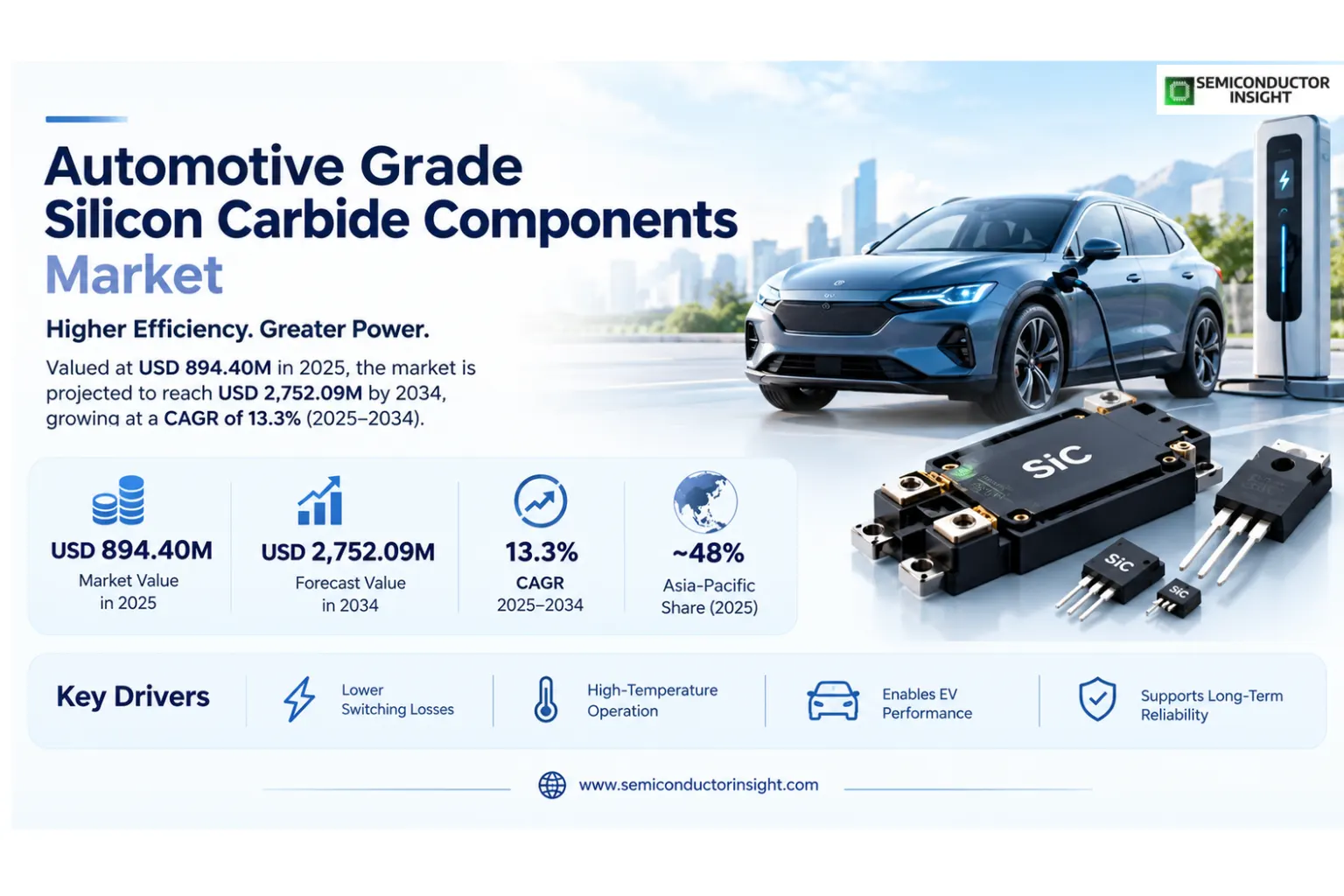
- Market trajectory: The market stood at USD 894.40 million in 2025, with USD 1,013.38 million estimated for 2026 and USD 2,752.09 million forecast for 2034. Its 13.3% CAGR reflects the migration of automotive power conversion from silicon devices toward higher-efficiency silicon carbide components, rather than revenue from finished electric vehicles.
- Type leadership: SiC FET devices represented an estimated ~55% of 2025 component revenue, supported by high-voltage switching in traction electronics. SiC diodes held ~23%, silicon carbide triodes ~14% and other components ~8%; these are modeled allocations aligned with the product groups shown in the publisher segmentation.
- Application mix: Main inverters accounted for an estimated ~59% of 2025 demand, ahead of vehicle chargers at ~29% and auxiliary or other automotive applications at ~12%. Qualification cycles, cooling design, switching losses and package reliability influence component selection more strongly than vehicle production alone.
- Geographic structure: Asia-Pacific led with an estimated ~48% of 2025 revenue, followed by North America (~24%) and Europe (~20%). South America (~5%) and the Middle East and Africa (~3%) remain smaller markets, although both have a growing role in charging infrastructure and local vehicle assembly.
- Competitive landscape: Device makers and automotive module specialists compete through electrical efficiency, long-term supply agreements, qualification documentation and package integration. Wolfspeed, STMicroelectronics, Infineon, ROHM, WeEn, StarPower and Semikron Danfoss serve different layers of the supply chain, so their consolidated company revenue should not be treated as this market.
Automotive Grade Silicon Carbide Components Market Overview
Automotive grade silicon carbide components market was valued at USD 894.40 million in 2025, is estimated at USD 1,013.38 million in 2026 and is projected to reach USD 2,752.09 million by 2034, advancing at a CAGR of 13.3% from 2025 to 2034. Asia-Pacific was the largest regional market in the base year, with an estimated ~48% share, reflecting automotive electronics production and semiconductor supply networks.
Automotive-grade silicon carbide components are high-voltage semiconductor building blocks used to control electrical energy in vehicles. The covered mix includes SiC diodes, silicon carbide triodes as identified in the publisher taxonomy, SiC field-effect transistors and other qualifying automotive components, including packaged power assemblies where the vendor product mix encompasses them. This definition captures component sales rather than the value of a complete traction inverter, onboard charger, battery pack or vehicle. Bare SiC substrates, epitaxial wafers, deposition equipment and unrelated industrial power electronics are outside the boundary.
Silicon carbide permits lower switching losses and high-temperature operation relative to many conventional silicon power devices, enabling power conversion systems to reduce cooling burden or operate at higher switching frequencies. The practical benefit depends on gate-drive tuning, electromagnetic compatibility, package parasitics and operating voltage. In a main traction inverter, the switching devices convert battery direct current into controlled alternating current for the motor. In a vehicle charger, the component mix is different: rectification, power-factor correction and isolated conversion each place distinct stresses on diodes and transistor packages.
The publisher reported USD 789.4 million for 2024 and USD 1.67 billion for 2030. Those monetary endpoints imply 13.3017% annual growth over six years, consistent with its displayed percentage. Extending the same annual growth rate yields the 2025 base and 2034 forecast shown above; the later-year value is a mathematical extension of the headline anchors, not an independently measured industry total. Regional and segment percentages are modeled estimates grounded in the application mix and manufacturing evidence, rather than supplier-audited revenue disclosures.
Automotive customers qualify semiconductor parts over long development cycles because power stages must survive thermal cycling, high humidity, vibration and years of load variation. This process gives suppliers with proven automotive quality systems an advantage, but it also lengthens the time between an announced design win and recurring shipments. Manufacturers increasingly offer discrete devices alongside half-bridge, six-pack and other integrated power module formats, allowing automakers to trade packaging flexibility against assembly complexity and thermal performance.
The market does not move in lockstep with global electric-car registrations. Battery voltage, the share of hybrid vehicles, inverter topology, semiconductor content per vehicle and the balance between discrete and module packaging all affect revenue. In 2025 the International Energy Agency estimated that electric car sales exceeded 20 million worldwide, a useful downstream indicator but not a direct measure of SiC component purchases. A mature hybrid platform can continue buying qualified silicon devices, while a newer high-voltage battery-electric platform may introduce more SiC content per traction and charging system.
Segment Analysis: By Type
By type, the market comprises SiC Diodes, Silicon Carbide Triode, SiC FET and Other products. SiC FET led with an estimated ~55% of 2025 revenue and modeled ~14.4% CAGR, followed by diodes (~23%, ~11.6% CAGR), triodes (~14%, ~12.4%) and other components (~8%, ~11.3%). The triode category is retained as named in the publisher taxonomy rather than silently merged into FETs.
| Type | Device function | Automotive commercial position |
|---|---|---|
| SiC FET | Field-effect transistors form the controlled switching stage in high-efficiency inverters, onboard chargers and DC/DC converters. Gate voltage limits, short-circuit withstand time, body-diode behavior and switching energy determine the suitability of a specific die or package. Designers may select a discrete part for board-level flexibility or a qualified module for a higher-current power stage. | Largest type (~55% in 2025; ~14.4% modeled CAGR). High-voltage traction platforms support demand for SiC MOSFET and related FET implementations, especially where a powertrain requires tight thermal control and rapid switching. The opportunity is not equal to total module revenue: only automotive-grade silicon carbide component content belongs in this product market. |
| SiC Diodes | Silicon carbide Schottky diodes provide fast recovery and low switching losses in rectifier and converter stages, including onboard charging and auxiliary vehicle power. Device selection depends on surge current, junction temperature, reverse voltage and automotive qualification. Some inverter topologies rely less on stand-alone diodes as transistor body-diode performance and synchronous switching improve. | Second type (~23% in 2025; ~11.6% modeled CAGR). Rectification remains important where designers prioritize power density and switching frequency, and qualified parts are available across several voltage classes. Competition involves leakage current, thermal resistance and the economics of placing a diode beside a transistor rather than using a more integrated switching architecture. |
| Silicon Carbide Triode | The publisher separately identifies silicon carbide triodes, and this analysis preserves that label as a distinct category. It is not assumed to cover every SiC MOSFET or every three-terminal switch in the industry. The category is treated as a specialized component group whose demand depends on the supplier definition, automotive operating conditions and qualification of the relevant circuit topology. | Specialized segment (~14% in 2025; ~12.4% modeled CAGR). Because vendor terminology varies, revenue is modeled conservatively rather than inferred from an unrelated semiconductor family. Design engineers assess gate-drive requirements, switching stability and packaging reliability before replacing established components, making this group more dependent on project-specific qualification than the larger FET class. |
| Other | The residual group contains qualifying automotive SiC component configurations not separately identified by the three principal product labels. It may include specialized rectification or packaged switching implementations sold at the component level, but it does not expand the boundary to finished inverters, charging stations or raw semiconductor materials. Its composition can change as vendors revise catalog classification. | Residual type (~8% in 2025; ~11.3% modeled CAGR). This share accommodates smaller product niches without assigning unsupported precision to individual device variants. Buyers typically evaluate these parts for a defined thermal or electrical constraint, while suppliers face lower order volumes and longer application engineering cycles than for mainstream inverter transistors. |
Type mix and component-level packaging
The 2025 modeled split is SiC FET ~55%, SiC Diodes ~23%, Silicon Carbide Triode ~14% and Other ~8%, totaling the full type allocation. These are mutually exclusive categories for the purpose of this report, even though a finished power module may incorporate multiple device technologies. Module integration changes the purchasing interface, but it does not justify counting the same semiconductor value again as a separate finished automotive system.
A supplier that sells both bare die and integrated assemblies can appear at several points in an automotive bill of materials. Analysts therefore distinguish device characteristics from the commercial form in which a customer buys the component. Automotive qualification, junction temperature, package insulation and thermal interface design determine which route wins a platform nomination, and these decisions affect pricing more directly than nominal die count alone.
Segment Analysis: By Application
By application, the automotive SiC component market is segmented into Main Inverter, Vehicle Charger and Other. Main Inverter was largest at an estimated ~59% of 2025 revenue with modeled ~14.2% annual growth; Vehicle Charger represented ~29% and Other ~12%. These figures describe semiconductor component value allocated to end uses, not revenue from assembled vehicle systems.
| Application | Demand characteristics |
|---|---|
| Main Inverter | Largest application (~59% in 2025; ~14.2% modeled CAGR). The traction inverter translates battery energy into the waveforms required by the motor, and high switching currents create substantial thermal and efficiency demands. SiC FET devices and integrated power assemblies can reduce switching losses, but the commercial decision depends on battery voltage, cooling system cost, software controls and long-duration reliability. Qualification with a vehicle maker often determines revenue several years after the first laboratory prototype. |
| Vehicle Charger | Second application (~29% in 2025; ~12.1% modeled CAGR). Onboard chargers combine rectification, power-factor correction and isolated conversion, creating distinct opportunities for SiC diodes and transistors. Vehicle architecture and regional charging standards influence the power stage design. An announced charger module does not mean every model in a vehicle line will use the same SiC content; adoption depends on cost targets, package availability and validated electromagnetic performance. |
| Other | Remaining application (~12% in 2025; ~11.4% modeled CAGR). Auxiliary DC/DC conversion, battery management support and selected vehicle power distribution circuits account for smaller component sockets. These uses often operate at lower power than the main traction inverter, making conventional silicon a viable competitor. Suppliers can nevertheless gain orders where high-temperature tolerance, compact packaging or faster switching resolves a specific system constraint. |
The application allocation follows where the qualified part is installed, not where a company books consolidated revenue. A packaged SiC module supplied for a traction drive remains in Main Inverter even if the same manufacturer also sells devices for charging. Conversely, a SiC diode specified for a charger belongs to Vehicle Charger regardless of whether the vehicle is battery-electric or plug-in hybrid. This avoids counting the same order in multiple end-use categories.
Regional Analysis
Asia-Pacific held the largest 2025 share at an estimated ~48%, supported by vehicle assembly clusters and a deep semiconductor manufacturing base. North America followed at ~24%, Europe at ~20%, South America at ~5% and the Middle East and Africa at ~3%. The modeled regional growth rates range from ~12.2% to ~15.8% CAGR and reconcile with the global 2034 endpoint.
How do regional automotive power electronics requirements differ?
Regional demand depends on the location of vehicle production, design qualification and purchasing contracts, which do not always coincide. Asian factories make a large share of traction electronics; European engineering teams influence package standards and system efficiency; and North American vehicle programs emphasize supply continuity and local qualification. Emerging assembly regions purchase components through global tier-one suppliers, making import channels and certification support especially important. The regional shares below are modeled market allocations, not published country-level supplier revenues.
| Region | Position | Growth outlook | Demand profile | What decides supplier selection |
|---|---|---|---|---|
| Asia-Pacific | Largest (~48%) | ~13.1% CAGR | Vehicle manufacturing and semiconductor integration | OEM nomination, die supply and automotive-grade traceability |
| North America | Second (~24%) | ~12.2% CAGR | Battery-electric platforms and qualification | Long-term contracts, reliability and domestic sourcing options |
| Europe | Third (~20%) | ~14.2% CAGR | Powertrain engineering and high-voltage conversion | Thermal design, lifecycle assurance and module interoperability |
| South America | Emerging (~5%) | ~15.1% CAGR | Imported power electronics and localized assembly | Distributor service, landed cost and approved parts lists |
| Middle East & Africa | Smaller (~3%) | ~15.8% CAGR | Fleet electrification and selected assembly projects | Heat tolerance, field support and channel qualification |
Automotive Grade Silicon Carbide Components Competitive Landscape
Competition spans merchant semiconductor manufacturers, integrated device-and-module suppliers and automotive power assembly specialists. Wolfspeed, STMicroelectronics, Infineon and ROHM have broad silicon carbide product programs; WeEn and selected Asian suppliers address qualified device niches; Semikron Danfoss emphasizes integrated power modules. Corporate revenue across these businesses is not a proxy for automotive SiC component sales, because many also supply industrial, renewable-energy and other markets.
The key commercial barrier is automotive qualification rather than access to a nominal transistor specification. Vehicle manufacturers expect documented reliability under thermal cycling, high humidity and high-voltage stress, together with stable package characteristics over the production life of a platform. A supplier may win an initial engineering evaluation but still face an extended interval before series production. This gives established component makers leverage when customers prioritize predictable deliveries and traceable manufacturing lots.
Device companies compete on the trade-off between on-state resistance, switching energy, gate-drive robustness and cost. Module specialists add value through low-inductance layouts, insulation, cooling interfaces and packaging that simplifies inverter assembly. A firm supplying a bare SiC die is not automatically competing for the same invoice as a vendor delivering a fully integrated automotive module. The market boundary counts qualifying component content and avoids double-counting finished powertrains.
Wolfspeed supplies SiC device technology and upstream materials, but its substrate operations are adjacent to this automotive component definition. STMicroelectronics and Infineon offer qualified discrete devices and integrated packaging options; ROHM markets traction and charging module products; StarPower and other Asian manufacturers serve power-electronics integration requirements. Semikron is treated under the current Semikron Danfoss identity rather than as a separate independent vendor.
Supplier rankings are sensitive to the level of integration and to the vehicle architecture. An OEM that uses a 1200V traction module may value thermal-cycle endurance and package compatibility more than the lowest die price, whereas a charger designer can optimize several independent SiC devices around a different circuit. Competitive positions should therefore be interpreted by product capability, automotive customer qualification and available manufacturing capacity rather than unsupported global share claims.
Tier structure
| Tier | Companies | Basis of competition |
|---|---|---|
| Integrated device leaders | Wolfspeed, STMicroelectronics, Infineon Technologies, ROHM | These companies combine silicon carbide semiconductor design with established automotive application engineering, qualified device families and routes to integrated power assemblies. Their competitive advantage comes from a broad technology roadmap and the ability to support a vehicle platform through multiple design revisions. |
| Automotive power assembly specialists | Semikron Danfoss, StarPower Semiconductor, Shenzhen BASiC Semiconductor | These suppliers compete through module architecture, thermal interfaces and power-stage integration, often supplying automotive customers that prefer a qualified package over separate device procurement. Their addressable revenue depends on how much component content is included in a particular commercial assembly. |
| Device and ecosystem participants | WeEn Semiconductors, Sanan Optoelectronics, Wingtech Technology, Shanghai Hestia Power | Companies in this group bring varying levels of semiconductor production, packaging and regional customer access. They should not all be assumed to sell the same automotive SiC component mix, and an upstream material or adjacent electronics business is not counted as merchant device revenue without evidence. |
Key companies profiled
- Wolfspeed
- STMicroelectronics
- WeEn Semiconductors
- ROHM
- Infineon Technologies
- Shenzhen BASiC Semiconductor
- Sanan Optoelectronics
- StarPower Semiconductor
- Wingtech Technology
- Shanghai Hestia Power
- Semikron Danfoss
Automotive Grade Silicon Carbide Components Production Capacity Analysis
Automotive SiC production links crystal growth and wafer processing with device fabrication, package assembly and qualification testing. A 200mm materials capability may eventually improve device economics, but it does not by itself establish available automotive-grade output. Qualified yields, manufacturing consistency and the packaging mix determine how much nominal capacity can serve vehicle programs, and suppliers must synchronize those steps before increasing committed shipments.
Upstream silicon carbide materials have historically constrained the cost and yield of power devices because crystal defects can affect breakdown performance and usable die output. Wolfspeed announced a commercial 200mm SiC materials portfolio in September 2025, an upstream capacity development that can support future device scaling. The event should be understood as substrate and epitaxy progress, not as direct evidence of an equivalent increase in automotive component revenue or a completed vehicle nomination.
At the fabrication stage, manufacturers must control oxide interface quality, leakage behavior and wafer uniformity while producing devices that meet automotive electrical limits. The transition to larger wafers can increase potential die count, yet capital equipment, process stability and defect density influence the realized cost per qualified device. A supplier can therefore expand nominal wafer capacity while still experiencing a gradual automotive ramp as its packages and reliability data complete customer review.
Packaging and final test form a separate bottleneck. High-current modules require repeatable die attachment, substrate bonding, encapsulation and thermal management, followed by validation under realistic power cycling. Assembly can occur in a different country from wafer fabrication, so production geography cannot be inferred from a brand name alone. Automakers often seek a second qualified source or a long supply commitment because an inverter package change can trigger extensive re-engineering.
Automotive Grade Silicon Carbide Components Market Dynamics: Drivers, Restraints and Opportunities
The principal growth forces are adoption of SiC switching in traction inverters, higher-power charging circuits, increased semiconductor content in electrified platforms and improvements in qualified packaging. They are offset by material defects, costly validation, competing silicon technologies and uncertain vehicle-model ramp schedules. The contribution table is an analytical decomposition of the modeled headline growth rate, not a set of independently measured causal coefficients.
MARKET DRIVERS
Drivers Impact Analysis*
| Market Drivers | Impact Rank | CAGR Contribution (%) | 2025–2027 | 2028–2030 | 2031–2034 |
|---|---|---|---|---|---|
| Traction inverter electrification and SiC penetration | High | +5.40% | High | High | High |
| Onboard charging efficiency and voltage migration | High | +4.20% | High | Medium | High |
| Automotive module integration and packaging redesign | Medium-High | +3.10% | Medium | High | High |
| Qualified supply expansion and manufacturing learning | Medium | +2.20% | Medium | High | Medium |
| Thermal efficiency and power density requirements | Low-Medium | +1.50% | Medium | Medium | High |
| Others (auxiliary converters, platform refreshes, hybrid use) | Low | +0.90% | Low | Medium | Medium |
Traction inverter designs favor lower switching losses
A traction inverter can use silicon carbide switching to improve conversion efficiency, reduce thermal losses and create room for a more compact power stage. These benefits matter when automakers are optimizing range, cooling and battery voltage together, but the economic case must survive system-level testing. Suppliers gain the largest revenue opportunity when an approved SiC component becomes standard on a high-volume vehicle platform rather than remaining an engineering option.
Onboard chargers need efficient high-voltage stages
Charging electronics contain rectification and switching functions with different device requirements from a motor inverter. SiC diodes can reduce recovery losses, while transistors can enable higher-frequency converter designs and smaller passive components. Automotive suppliers evaluate these advantages against electromagnetic interference, gate-drive complexity and long-term component availability. A charger design win can provide recurring orders even when the vehicle retains conventional silicon in another power stage.
Integrated modules shorten some assembly steps
Automakers and tier-one manufacturers increasingly compare qualified power modules with discrete-device implementations. A module can combine semiconductor dies, electrical interconnections and thermal interfaces into a controlled package, reducing assembly variation at the inverter factory. This benefit has a price: the package may restrict customization and require a new cooling interface. Suppliers that can support both integration routes can address more programs without assuming every buyer uses the same module.
Manufacturing experience improves usable yield
Larger wafer formats and more consistent device processes can reduce cost per qualified SiC component when defect density and packaging yield improve together. Capacity announcements are only one part of that equation, because automotive customers require production traceability and stable electrical distributions. Suppliers that demonstrate repeatable performance across manufacturing lots can turn technical progress into approved orders, while immature lines may face longer qualification cycles despite nominal output growth.
High-temperature performance creates differentiated sockets
Silicon carbide can offer useful efficiency and thermal characteristics in vehicle circuits exposed to demanding duty cycles. The value is greatest when a designer can reduce cooling complexity or fit a converter into a constrained installation space. However, device advantages must be verified with the actual gate driver, busbar, insulation system and control strategy. This engineering dependency rewards application support and can prevent commoditization in specialized vehicle programs.
MARKET RESTRAINTS
Restraints Impact Analysis*
| Market Restraints | Impact Rank | CAGR Contribution (%) | 2025–2027 | 2028–2030 | 2031–2034 |
|---|---|---|---|---|---|
| Substrate defects and qualified-die manufacturing cost | High | -1.60% | High | High | Medium |
| Lengthy automotive validation and platform cycles | Medium-High | -1.10% | High | Medium | Medium |
| Competitive silicon technologies and system redesign | Medium | -0.80% | Medium | Medium | High |
| Others (supply allocation, package thermal limits, program delays) | Low | -0.50% | Low | Medium | Medium |
Material quality remains a cost constraint
Defects in SiC crystals and variation in wafer processing can lower the number of dies that satisfy automotive electrical limits. This raises effective cost even when nominal wafer throughput improves, particularly for high-voltage components that must withstand demanding operating conditions. Producers need yield improvements across growth, epitaxy, device fabrication and final test; progress in just one stage may not translate into lower prices for qualified automotive parts.
Vehicle qualification delays revenue realization
An automaker may evaluate a semiconductor technology long before selecting it for series production. Reliability testing, software calibration, electromagnetic compatibility work and package validation can extend the process, and a change in vehicle program timing can postpone component shipments. This creates a gap between announcements and recognized revenue, making it risky to convert every technology launch or design-win headline directly into a market-size increment.
Silicon alternatives remain economically competitive
Conventional silicon IGBTs and other power devices still meet the requirements of many lower-voltage and cost-sensitive automotive platforms. Even where SiC offers a technical efficiency advantage, redesign of the gate drive, cooling system and inverter controls can offset part of the benefit. Customers therefore assess total vehicle-system economics, and SiC suppliers cannot assume an automatic substitution across all hybrid and battery-electric models.
Package and sourcing changes create hidden costs
A high-performance SiC die may require new busbars, insulation clearances or thermal interfaces before it can be installed in a vehicle power stage. Automakers also prefer predictable supply over several model years, so a single-source component can create procurement risk. Additional engineering and second-source qualification costs may slow adoption, especially for smaller vehicle programs with limited development budgets.
MARKET OPPORTUNITIES
Platform-specific charger components
Onboard charging offers multiple component positions with different current and switching requirements. Vendors that provide automotive-qualified diodes and transistors alongside application notes can address designs that do not require a full traction module. A modular portfolio allows engineers to choose the device form that fits their converter, while suppliers can build relationships with charger integrators before a vehicle maker commits to a complete powertrain redesign.
Thermally optimized power module formats
Packaging innovation can make silicon carbide more valuable by reducing parasitic inductance and improving heat removal under repeated power cycling. Suppliers with qualified half-bridge and multi-switch configurations can compete for integrated inverter programs where installation space is limited. The commercial opportunity depends on proving performance under the customer’s real cooling conditions, not on publishing a higher laboratory current rating.
Automotive-grade supply diversification
Vehicle manufacturers increasingly scrutinize where wafers are fabricated, where packages are assembled and whether alternative qualified lines exist. Suppliers that can demonstrate traceability and stable quality across locations may win programs seeking lower disruption risk. Such resilience can support longer supply agreements, although the added cost of redundant qualification must be weighed against price and electrical performance.
Selective growth in emerging assembly markets
Automotive production networks in South America, India and selected Middle Eastern countries create opportunities for approved SiC component distributors and power-electronics integrators. The most practical entry point is often a qualified assembly used on a global vehicle platform rather than an entirely new local semiconductor design. Technical service, customs predictability and replacement stock can differentiate suppliers in markets without extensive domestic SiC fabrication.
Automotive Grade Silicon Carbide Components Supply Chain Analysis
The value chain starts with SiC crystal growth and epitaxy, moves through semiconductor device processing, then passes to package assembly, automotive qualification and integration into vehicle power electronics. Suppliers can operate across several steps, but a material shipment, a device sale and an inverter invoice must not be added together as if they were separate demand for the same component. Commercial value is assigned at the defined automotive component boundary.
Upstream materials. SiC crystal growth and epitaxy determine the defect environment inherited by a device maker. Larger wafer programs can improve potential economics, but only when fabrication and packaging achieve automotive-grade yield. Materials producers may supply several device manufacturers, so upstream revenue cannot be counted again as finished component sales. Long-term supply agreements are especially valuable where a specific crystal quality or wafer format has been qualified.
Device manufacturing. Fabrication adds the semiconductor structures that create controlled switching and rectification behavior. Automotive process control must limit variation in threshold voltage, leakage and breakdown characteristics across lots, and wafer test separates usable dies before packaging. The distinction between an automotive-qualified part and a general industrial device is commercially meaningful because vehicle customers require documented reliability and stable part identification over extended production periods.
Packaging and distribution. Assembly combines dies with substrates, interconnects and thermal structures, while authorized distributors or tier-one suppliers manage delivery to vehicle programs. Integrated modules may be sourced as complete qualified units, whereas some converters use separate devices placed on a circuit board. The same silicon carbide die should not be counted both at the semiconductor supplier and again at the module assembler when estimating the defined component market.
Downstream integration. Automotive engineers select power devices around the operating voltage, current, thermal duty cycle and software control of the target converter. A part that works in a laboratory inverter still requires qualification within the finished vehicle system. Series production schedules, service obligations and design changes determine order timing, while finished vehicles and charging infrastructure remain downstream applications rather than products inside this component revenue definition.
Recent Developments in Automotive Grade Silicon Carbide Components
- 9 December 2025 Automotive selection
Wolfspeed announced that its silicon carbide MOSFETs had been selected for onboard charging applications in Toyota electric vehicle platforms. The announcement provides a concrete example of a component qualification moving into a vehicle program, rather than a generic forecast of technology adoption. Revenue timing still depends on the automaker’s manufacturing schedule and the design of the final charger assembly. Source - 17 November 2025 Product launch
Wolfspeed introduced a 1200V six-pack SiC power module for electric mobility propulsion, highlighting a claimed threefold power-cycling improvement and higher inverter current in its stated comparison. The product illustrates how thermal endurance and integrated packaging can shape automotive sourcing decisions. These supplier-reported performance comparisons should not be read as audited market-wide improvements or evidence of a particular sales share. Source - 10 September 2025 Materials expansion
Wolfspeed announced commercial availability of its 200mm silicon carbide materials portfolio, covering substrate and epitaxial capabilities intended to support manufacturing scale. The relevance for automotive components is upstream: larger wafers may improve device cost and capacity when qualified yields mature. This is not a direct shipment figure for automotive-grade switches, and the material product itself sits outside the report’s component revenue boundary. Source - 24 July 2025 Design collaboration
Onsemi and Schaeffler described an expanded collaboration involving EliteSiC technology for a plug-in hybrid vehicle platform. The agreement shows that SiC adoption is not restricted to battery-electric vehicles and that tier-one powertrain integrators influence the semiconductor selection. A design announcement establishes application relevance but does not quantify annual automotive SiC component purchases across the entire market. Source - 29 April 2025 Technology update
Infineon announced a 750V CoolSiC G2 automotive discrete MOSFET generation, extending options for efficient high-voltage switching in vehicle power electronics. The development is important because discrete devices remain attractive for some converters even as integrated power modules gain traction. Engineering teams still need to verify thermal cycling, gate-drive behavior and circuit-level losses before a new device family can enter a production platform. Source - 26 February 2025 Product portfolio
SemiQ presented next-generation 1200V and 1700V silicon carbide MOSFET products aimed at automotive and industrial applications around APEC 2025. Broader voltage choices allow power electronics designers to evaluate different converter architectures, but a supplier’s product announcement does not mean every voltage option is automotive-qualified for every vehicle program. Customer-specific testing and production traceability remain necessary before large recurring orders. Source - 22 January 2025 Device roadmap
Wolfspeed launched its fourth-generation SiC MOSFET technology platform, describing 750V, 1200V and 2300V product options for demanding power applications. The roadmap indicates continued competition on switching performance and ruggedness, but the highest-voltage industrial use cases are not automatically part of automotive demand. Only components qualified and sold into the covered vehicle applications contribute to the revenue model. Source - 28 April 2023 Module architecture
Infineon detailed the HybridPACK Drive G2 family, offering automotive traction-module configurations for 750V and 1200V applications with different semiconductor technologies. The announcement demonstrates how module architecture can accommodate changing vehicle voltage and device choices. It is used here as historical technical evidence, not as a recent market-size observation or a claim that all such modules contain silicon carbide. Source
REPORT SCOPE & SEGMENTATION
| Attribute | Details |
|---|---|
| Study Period | 2020–2034 |
| Base Year | 2025 |
| Estimated Year | 2026 |
| Forecast Period | 2025–2034 |
| Historical Period | 2020–2024 |
| Market Size 2025 | USD 894.40 million |
| Market Size 2026 | USD 1,013.38 million |
| Market Size 2034 | USD 2,752.09 million |
| Growth Rate | CAGR of 13.3% from 2025–2034 |
| Unit | Value in USD million |
| Segmentation | By Type, By Application, and By Region |
| By Type | SiC Diodes · Silicon Carbide Triode · SiC FET · Other |
| By Application | Main Inverter · Vehicle Charger · Other |
| By Region | Five global regions assessed by product type, application and automotive purchasing geography North AmericaUnited States, Canada, Mexico EuropeGermany, France, United Kingdom, Italy, Spain, Rest of Europe Asia-PacificChina, Japan, South Korea, India, Australia, Southeast Asia, Rest of Asia-Pacific South AmericaBrazil, Argentina, Chile, Rest of South America Middle East & AfricaSaudi Arabia, UAE, South Africa, Rest of Middle East & Africa |
| Key Companies Profiled | Wolfspeed, STMicroelectronics, WeEn Semiconductors, ROHM, Infineon Technologies, Shenzhen BASiC Semiconductor, Sanan Optoelectronics, StarPower Semiconductor, Wingtech Technology, Shanghai Hestia Power, Semikron Danfoss |
| Customization Scope | Country-level and device-specific scope extensions may be commissioned to examine vehicle voltage architecture, module packaging, customer qualification and local component sourcing. |
Frequently Asked Questions
What is the size of the automotive grade silicon carbide components market?
The global automotive grade silicon carbide components market was valued at USD 894.40 million in 2025, is estimated at USD 1,013.38 million in 2026 and is projected to reach USD 2,752.09 million by 2034. The implied growth rate is 13.3% across the 2025–2034 period. These figures reflect the publisher’s monetary anchors extended to the requested reporting window, rather than an independently audited device sales census.
Which silicon carbide component type has the largest share?
SiC FET was the largest type with a modeled ~55% of base-year revenue, followed by SiC Diodes at ~23%, Silicon Carbide Triode at ~14% and Other at ~8%. The distinct triode label is retained from the publisher taxonomy. These allocations describe the relative component mix and are not presented as a supplier-reported product revenue breakdown.
Which vehicle application leads demand for SiC components?
Main Inverter led with an estimated ~59% of 2025 revenue because high-current traction conversion creates demanding switching and thermal requirements. Vehicle Charger represented ~29%, while Other automotive applications accounted for ~12%. These shares classify components by their intended vehicle use and exclude the total invoice value of a completed traction inverter or onboard charging system.
Why does Asia-Pacific account for the largest regional market?
Asia-Pacific held an estimated ~48% share in the base year, reflecting a combination of electric-vehicle assembly, power electronics integration and semiconductor manufacturing. Regional demand includes components installed in vehicle programs, not every SiC wafer exported by Asian factories. North America and Europe remain influential through vehicle platform engineering and automotive reliability qualification.
What distinguishes automotive-grade SiC devices from general industrial parts?
Automotive customers typically require stringent reliability evidence, production traceability and stable electrical behavior over long model lifetimes. A semiconductor that meets an industrial data-sheet specification may still need further thermal cycling, humidity and system-level testing before use in a vehicle. Package interfaces and gate-drive performance also matter because qualification is completed within the converter architecture.
Do the figures include complete power inverters and electric vehicles?
No. The defined market covers automotive silicon carbide semiconductor components and qualifying component-level packaged power assemblies. Complete traction inverters, onboard chargers, finished vehicles, bare substrates and epitaxial wafers are excluded as separate revenue objects. A supplier that sells both devices and integrated assemblies must not have the same component content counted twice in the market total.
How do SiC diodes support vehicle charging electronics?
SiC Schottky diodes can reduce reverse-recovery losses in rectification and conversion stages, helping designers improve efficiency at suitable switching frequencies. Their adoption depends on the voltage class, surge-current requirement, leakage behavior and system cost. In some converter designs, synchronized transistor switching reduces the need for a separate diode, so charger demand is not a fixed quantity per vehicle.
What limits faster penetration of silicon carbide in automotive systems?
Material defects, qualified-die cost, extended platform testing and the expense of changing inverter packaging can delay adoption. Silicon devices remain competitive in many lower-voltage or price-sensitive applications. Even where SiC improves electrical efficiency, the vehicle manufacturer must validate the full power stage, including its cooling system, electromagnetic compatibility and control software.
Which manufacturers participate in this market?
The competitive field includes Wolfspeed, STMicroelectronics, Infineon Technologies, ROHM, WeEn Semiconductors, StarPower Semiconductor and several Asian power-electronics companies. Semikron Danfoss participates through automotive power-module integration. The roles are not identical: a materials supplier, merchant discrete-device maker and module assembler operate at different levels of the value chain. Their consolidated corporate turnover also includes products outside the specified automotive component scope.
What period and segmentation does the study cover?
The analysis uses 2025 as its base year, 2026 as the estimate and 2034 as the forecast endpoint. Product segmentation covers SiC Diodes, Silicon Carbide Triode, SiC FET and Other; applications comprise Main Inverter, Vehicle Charger and Other. Five global regions are analyzed, with numerical shares modeled to reconcile to the headline monetary forecast.
Research Sources & Evidence Base

Get Sample Report PDF for Exclusive Insights
Report Sample Includes
- Table of Contents
- List of Tables & Figures
- Charts, Research Methodology, and more...
 Download Sample Report PDF