Key Statistics
Key Takeaways
- Single Modal AFIS is a leading product category because it addresses the largest current application base.
- Criminal is a major application, with demand shaped by performance, reliability and system integration.
- North America leads current market value, while Asia Pacific provides the strongest growth profile.
- Cloud-native afis, multimodal search and higher-accuracy large-scale matching is the main technology direction influencing new design wins.
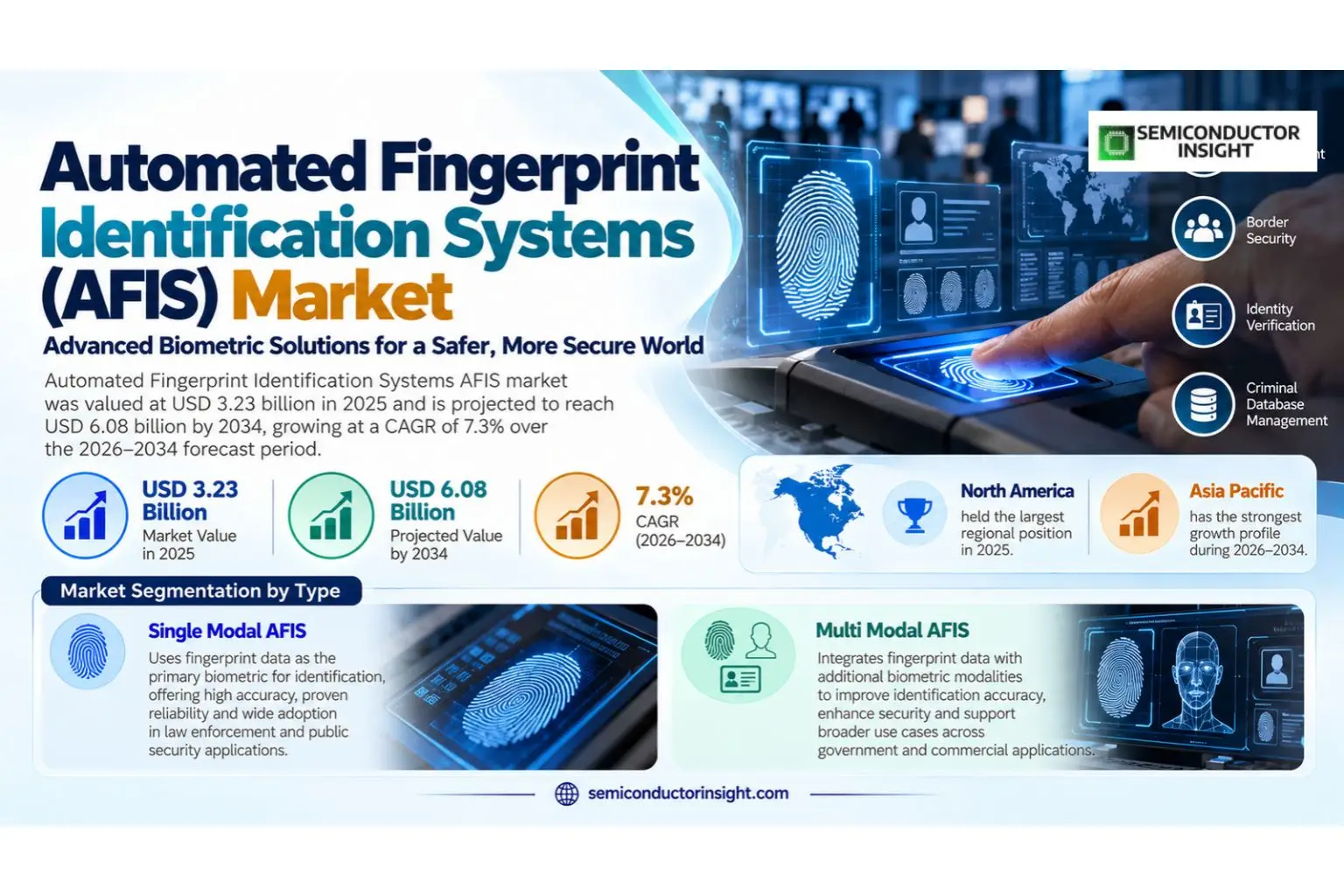
- Market size and growth: USD 3.23 billion in 2025 is projected to reach USD 6.08 billion by 2034 at a 7.3% CAGR during 2026–2034.
Automated Fingerprint Identification Systems (AFIS) Market Overview
Automated Fingerprint Identification Systems AFIS market was valued at USD 3.23 billion in 2025 and is projected to reach USD 6.08 billion by 2034, growing at a CAGR of 7.3% over the 2026–2034 forecast period. North America held the largest regional position in 2025, while Asia Pacific has the strongest growth profile.
The Automated Fingerprint Identification Systems AFIS market automated Fingerprint Identification Systems store, search and compare fingerprint and palmprint records at scale, supporting criminal investigations, national identity, border control and civil identity verification. Commercial decisions in the Automated Fingerprint Identification Systems (AFIS) market therefore depend on system integration, qualification effort, reliability, lifecycle support and measurable operating value rather than on one specification alone.
The client evidence values the market at USD 3.227 billion in 2025 and projects USD 5.209 billion by 2033 at a 7.3% CAGR. Multi-modal systems hold more than half of current demand, while criminal identification remains the largest application. Supplier selection also reflects manufacturing consistency, regional technical support, product availability and the ability to sustain qualified designs through multi-year customer programs.
NEC announced in March 2026 that its fingerprint identification technology ranked first in a recent NIST evaluation, while IDEMIA’s MBSS platform combines fingerprint, palmprint, iris, face and other biometric search functions for large-scale identification. Buyers increasingly compare total system impact, implementation complexity and long-term service requirements alongside component price, which creates room for technically differentiated suppliers.
Segment Analysis: By Type
By type, the Automated Fingerprint Identification Systems AFIS market is segmented into Single Modal AFIS, Multi Modal AFIS. Each category has a distinct functional role and commercial position, so the analysis emphasizes use case, integration and competitive relevance rather than repeating a single market statistic across every row. Adoption varies by customer architecture and replacement cycle, so demand is strongest where the technology solves a clear performance, reliability or integration problem.
| Type | Function | Market position |
|---|---|---|
| Single Modal AFIS | Single Modal AFIS addresses a distinct architecture or performance requirement within the Automated Fingerprint Identification Systems (AFIS) market. | Commercial demand depends on application fit, qualification, cost and lifecycle requirements rather than a single headline statistic. |
| Multi Modal AFIS | Multi Modal AFIS addresses a distinct architecture or performance requirement within the Automated Fingerprint Identification Systems (AFIS) market. | Commercial demand depends on application fit, qualification, cost and lifecycle requirements rather than a single headline statistic. |
Pricing by type
Software and services carry increasing value because matching algorithms, database management, workflow integration and support determine practical system performance. Hardware remains essential for enrollment and latent-print capture, but it is less differentiated than the core search platform. That market structure favors suppliers able to combine product performance with stable supply, application engineering and documented quality across the intended operating environment.
Segment Analysis: By Application
By application, the market is segmented into Criminal, Civil. Application economics differ by qualification, lifecycle, reliability and system-level value, so each row below uses context specific to that application rather than mechanically repeating headline evidence. Commercial decisions in the Automated Fingerprint Identification Systems (AFIS) market therefore depend on system integration, qualification effort, reliability, lifecycle support and measurable operating value rather than on one specification alone.
| Application | Demand characteristics |
|---|---|
| Criminal | Criminal creates demand where Automated Fingerprint Identification Systems AFIS improves integration, performance, reliability or system economics. |
| Civil | Civil creates demand where Automated Fingerprint Identification Systems AFIS improves integration, performance, reliability or system economics. |
Regional Analysis
North America is the largest Automated Fingerprint Identification Systems market, supported by U.S. law-enforcement infrastructure, the FBI Next Generation Identification system and broad government use of fingerprint identification. Asia Pacific has the strongest growth outlook through national identity and border-control programs. Supplier selection also reflects manufacturing consistency, regional technical support, product availability and the ability to sustain qualified designs through multi-year customer programs.
How does regional demand differ across the Automated Fingerprint Identification Systems AFIS market?
North America has the deepest installed law-enforcement infrastructure, Asia Pacific has the largest expansion opportunity in civil identity and national databases, and Europe emphasizes privacy, interoperability and border-security integration. Buyers increasingly compare total system impact, implementation complexity and long-term service requirements alongside component price, which creates room for technically differentiated suppliers.
| Region | Position | Growth outlook | Demand profile | What decides supplier selection |
|---|---|---|---|---|
| Asia Pacific | Fastest-growing | High | National ID/civil led | Scale, accuracy and local integration |
| North America | Largest | High | Law-enforcement led | Accuracy, security and interoperability |
| Europe | Large | Moderate-high | Border/security led | Privacy and interoperability |
| South America | Emerging | Moderate-high | Civil ID/law enforcement led | Budget and integration |
| Middle East & Africa | Emerging | High from smaller base | National ID/border led | Project funding and integration |
Key Automated Fingerprint Identification Systems (AFIS) Manufacturers and Competitive Landscape
The competitive landscape includes NEC Corporation, IDEMIA, HID Global, Suprema, DERMALOG, Fujitsu, Crossmatch, M2SYS Technology, Afix Technologies, Papillon Systems. Adoption varies by customer architecture and replacement cycle, so demand is strongest where the technology solves a clear performance, reliability or integration problem. That market structure favors suppliers able to combine product performance with stable supply, application engineering and documented quality across the intended operating environment.
Competition centers on cloud-native AFIS, multimodal search and higher-accuracy large-scale matching, customer qualification, manufacturing consistency and application support. Once a product is designed into a long-lifecycle system, switching costs can protect incumbent positions but also raise the importance of roadmap continuity. Commercial decisions in the Automated Fingerprint Identification Systems (AFIS) market therefore depend on system integration, qualification effort, reliability, lifecycle support and measurable operating value rather than on one specification alone.
Tier structure
| Tier | Companies | Basis of competition |
|---|---|---|
| Tier 1 | NEC Corporation, IDEMIA, HID Global, Suprema | Global scale, broad customer qualification and advanced technology portfolios. |
| Tier 2 | DERMALOG, Fujitsu, Crossmatch, M2SYS Technology | Strong specialist capability, regional design wins and application-focused portfolios. |
| Tier 3 | Regional and niche suppliers | Cost competition, customization and specialized customer support. |
Key companies profiled
- NEC Corporation
- IDEMIA
- HID Global
- Suprema
- DERMALOG
- Fujitsu
- Crossmatch
- M2SYS Technology
- Afix Technologies
- Papillon Systems
Automated Fingerprint Identification Systems (AFIS) Production Capacity Analysis
Production capacity in the Automated Fingerprint Identification Systems (AFIS) market is shaped by the underlying manufacturing process, qualification burden and customer-specific configuration. Suppliers must balance equipment utilization with quality control because high-volume output only creates value when yield, reliability and traceability remain stable. Supplier selection also reflects manufacturing consistency, regional technical support, product availability and the ability to sustain qualified designs through multi-year customer programs.
Capacity additions tend to follow customer program ramps rather than headline market growth alone. Regional supply resilience is becoming more important, particularly where customers require second-source planning, long product lifecycles or shorter engineering-response times. Buyers increasingly compare total system impact, implementation complexity and long-term service requirements alongside component price, which creates room for technically differentiated suppliers.
The practical bottleneck is often qualified output rather than nominal installed capacity. Manufacturing, assembly, test and application support must scale together to avoid creating capacity that cannot be used in production programs. Adoption varies by customer architecture and replacement cycle, so demand is strongest where the technology solves a clear performance, reliability or integration problem.
Automated Fingerprint Identification Systems (AFIS) Market Dynamics: Drivers, Restraints and Opportunities
The Automated Fingerprint Identification Systems (AFIS) market is shaped by growth is driven by law-enforcement modernization, national id programs, border security, background checks and civil identity verification requiring faster and more accurate large-database matching. At the same time, growth is constrained by high implementation cost, biometric privacy requirements, legacy database integration, data-sovereignty concerns and long government procurement cycles. The strongest commercial opportunities are concentrated in cloud-native afis, multimodal identity search, mobile field identification and civil digital-identity platforms create the strongest opportunities.
MARKET DRIVERS
Drivers Impact Analysis*
| Driver | (~) % impact on CAGR forecast | Geographic relevance | Impact timeline |
|---|---|---|---|
| Technology upgrade cycle | +1.6% | Global; strongest in leading adopter markets | Near to medium term |
| End-market expansion | +1.2% | Application-specific | Near term |
| Higher value per system | +0.8% | Premium and advanced systems | Medium term |
Technology adoption expands addressable demand
Growth is driven by law-enforcement modernization, national ID programs, border security, background checks and civil identity verification requiring faster and more accurate large-database matching. This demand is strongest where customers can measure a clear improvement in system performance, footprint, energy efficiency, reliability or operating cost. That market structure favors suppliers able to combine product performance with stable supply, application engineering and documented quality across the intended operating environment.
End-market modernization increases content per system
The technology upgrade cycle supports replacement and redesign activity as OEMs move to higher-performance architectures. New designs typically create the best opportunity because suppliers can influence specifications before qualification is locked. Commercial decisions in the Automated Fingerprint Identification Systems (AFIS) market therefore depend on system integration, qualification effort, reliability, lifecycle support and measurable operating value rather than on one specification alone.
Higher-value architectures support premium mix
Expanding end markets also increase content per system, creating value growth even when unit shipments grow more slowly. Suppliers that combine engineering support with reliable supply are better positioned to capture those design transitions. Supplier selection also reflects manufacturing consistency, regional technical support, product availability and the ability to sustain qualified designs through multi-year customer programs.
MARKET RESTRAINTS
Restraints Impact Analysis*
| Restraint | (~) % impact on CAGR forecast | Geographic relevance | Impact timeline |
|---|---|---|---|
| Qualification and integration burden | -0.7% | Global | Ongoing |
| Price and substitution pressure | -0.5% | Cost-sensitive applications | Ongoing |
| Supply-chain or process complexity | -0.4% | Global | Medium term |
Qualification burden slows supplier switching
Growth is constrained by high implementation cost, biometric privacy requirements, legacy database integration, data-sovereignty concerns and long government procurement cycles. These constraints are most significant where customers have qualified alternatives or where the technology must prove a clear system-level advantage over lower-cost incumbent solutions. Buyers increasingly compare total system impact, implementation complexity and long-term service requirements alongside component price, which creates room for technically differentiated suppliers.
Price competition limits margin expansion
Qualification and integration can extend sales cycles because customers must validate performance, reliability and compatibility in their own system environment. That makes early engineering engagement important for new suppliers. Adoption varies by customer architecture and replacement cycle, so demand is strongest where the technology solves a clear performance, reliability or integration problem.
Alternative technologies constrain selected use cases
Supply-chain complexity can also limit growth when specialized materials, tooling, test or regional support are required. Customers increasingly evaluate resilience alongside price when choosing long-lifecycle suppliers. That market structure favors suppliers able to combine product performance with stable supply, application engineering and documented quality across the intended operating environment. Commercial decisions in the Automated Fingerprint Identification Systems (AFIS) market therefore depend on system integration, qualification effort, reliability, lifecycle support and measurable operating value rather than on one specification alone.
MARKET OPPORTUNITIES
Advanced integration creates premium opportunities
Cloud-native AFIS, multimodal identity search, mobile field identification and civil digital-identity platforms create the strongest opportunities. The most attractive opportunities are where customers are redesigning systems rather than simply replacing like-for-like components. Supplier selection also reflects manufacturing consistency, regional technical support, product availability and the ability to sustain qualified designs through multi-year customer programs.
Regional capacity and supply resilience
Cloud-native afis, multimodal search and higher-accuracy large-scale matching can create premium value when it lowers system complexity, improves performance or supports a new product architecture that is difficult to achieve with incumbent approaches. Buyers increasingly compare total system impact, implementation complexity and long-term service requirements alongside component price, which creates room for technically differentiated suppliers.
Application engineering deepens customer value
Regional engineering support and application-specific customization provide another route to growth because customers increasingly expect suppliers to support qualification, transition planning and lifecycle management. Adoption varies by customer architecture and replacement cycle, so demand is strongest where the technology solves a clear performance, reliability or integration problem. That market structure favors suppliers able to combine product performance with stable supply, application engineering and documented quality across the intended operating environment.
Automated Fingerprint Identification Systems (AFIS) Supply Chain Analysis
Upstream. Fingerprint scanners, palmprint devices, secure servers or cloud infrastructure, biometric algorithms, database software, network security and systems-integration services form the supply chain. Supply quality at this stage directly affects downstream yield, reliability and cost. Commercial decisions in the Automated Fingerprint Identification Systems (AFIS) market therefore depend on system integration, qualification effort, reliability, lifecycle support and measurable operating value rather than on one specification alone.
Manufacturing. Core production combines process control, assembly, inspection and test, with product-specific qualification used to verify performance before customer shipment. Supplier selection also reflects manufacturing consistency, regional technical support, product availability and the ability to sustain qualified designs through multi-year customer programs. Buyers increasingly compare total system impact, implementation complexity and long-term service requirements alongside component price, which creates room for technically differentiated suppliers.
Distribution. High-value programs are typically won through direct OEM, Tier-1 or design-house engagement, while distributors serve prototypes, regional customers and lower-volume applications. Adoption varies by customer architecture and replacement cycle, so demand is strongest where the technology solves a clear performance, reliability or integration problem. That market structure favors suppliers able to combine product performance with stable supply, application engineering and documented quality across the intended operating environment.
Downstream. End users integrate the product into systems where switching costs rise after qualification, making lifecycle support and supply continuity commercially important. Commercial decisions in the Automated Fingerprint Identification Systems (AFIS) market therefore depend on system integration, qualification effort, reliability, lifecycle support and measurable operating value rather than on one specification alone.
Downstream. Panel builders and machine OEMs are the primary specifying customers, followed by electrical contractors working on building services and by facility maintenance teams handling replacement. The specification decision is usually made once, at panel design, and then repeats for the life of the design — which makes design-in position considerably more valuable than any individual transaction.
Recent Developments in the Automated Fingerprint Identification Systems (AFIS) Market
Developments tracked through September 2026. Items are selected for direct relevance to product technology, deployment or standards. Supplier selection also reflects manufacturing consistency, regional technical support, product availability and the ability to sustain qualified designs through multi-year customer programs. Buyers increasingly compare total system impact, implementation complexity and long-term service requirements alongside component price, which creates room for technically differentiated suppliers.
- 2026 Benchmark
NEC ranks first in NIST fingerprint identification evaluation NEC announced top performance in a NIST one-to-many fingerprint identification benchmark, including tests against databases containing millions of identities. Source - 2026 Current
IDEMIA multi-biometric identification platform IDEMIA’s MBSS platform combines fingerprint and palmprint search with iris, face and other biometric modalities for large-scale identification. Source - 2026 Current
HID fingerprint biometrics HID continues offering fingerprint solutions for law enforcement, civil government, banking, healthcare and enterprise identity verification. Source
REPORT SCOPE & SEGMENTATION
| Attribute | Details |
|---|---|
| Study Period | 2021–2034 |
| Base Year | 2025 |
| Estimated Year | 2026 |
| Forecast Period | 2026–2034 |
| Historical Period | 2021–2025 |
| Market Size 2025 | USD 3.23 billion |
| Market Size 2034 | USD 6.08 billion |
| Growth Rate | CAGR of 7.3% from 2026–2034 |
| Unit | Value (USD Million) |
| Segmentation | By Type, By Application, By System Component, By Deployment, and By Region |
| By Type | Single Modal AFIS · Multi Modal AFIS |
| By Application | Criminal · Civil |
| By Deployment | On-Premise · Cloud-Based · Hybrid |
| By System Component | Hardware · Software · Services |
| By Region | Each region analysed by Type, Application and Country North AmericaU.S., Canada, Mexico EuropeGermany, France, U.K., Italy, Russia, Nordic Countries, Benelux AsiaChina, Japan, South Korea, India, Southeast Asia South AmericaBrazil, Argentina, Rest of South America Middle East & AfricaTurkey, Israel, Saudi Arabia, UAE, Rest of MEA |
| Key Companies Profiled | NEC Corporation, IDEMIA, HID Global, Suprema, DERMALOG, Fujitsu, Crossmatch, M2SYS Technology, Afix Technologies, Papillon Systems |
| Customization Scope | Free report customization (equivalent to up to 4 analyst working days) with purchase. Addition or alteration to country, regional and segment scope. |
Frequently Asked Questions
What is the current size of the Automated Fingerprint Identification Systems (AFIS) market?
The market is valued at USD 3.23 billion in 2025 and is projected to reach USD 6.08 billion by 2034, expanding at a 7.3% CAGR during 2026–2034.
Which companies lead the Automated Fingerprint Identification Systems (AFIS) market?
Key participants include NEC Corporation, IDEMIA, HID Global, Suprema, DERMALOG, Fujitsu, Crossmatch, M2SYS Technology.
What is Automated Fingerprint Identification Systems (AFIS)?
Automated Fingerprint Identification Systems store, search and compare fingerprint and palmprint records at scale, supporting criminal investigations, national identity, border control and civil identity verification.
What are the main product types?
The market includes Single Modal AFIS, Multi Modal AFIS.
What are the key applications?
The principal applications are Criminal, Civil.
Which region leads the market?
North America leads current market value, while Asia Pacific has the strongest growth profile.
What drives market growth?
Growth is driven by law-enforcement modernization, national ID programs, border security, background checks and civil identity verification requiring faster and more accurate large-database matching.
What are the main challenges?
Growth is constrained by high implementation cost, biometric privacy requirements, legacy database integration, data-sovereignty concerns and long government procurement cycles.
Research Sources & Evidence Base

Get Sample Report PDF for Exclusive Insights
Report Sample Includes
- Table of Contents
- List of Tables & Figures
- Charts, Research Methodology, and more...
 Download Sample Report PDF