MARKET INSIGHTS
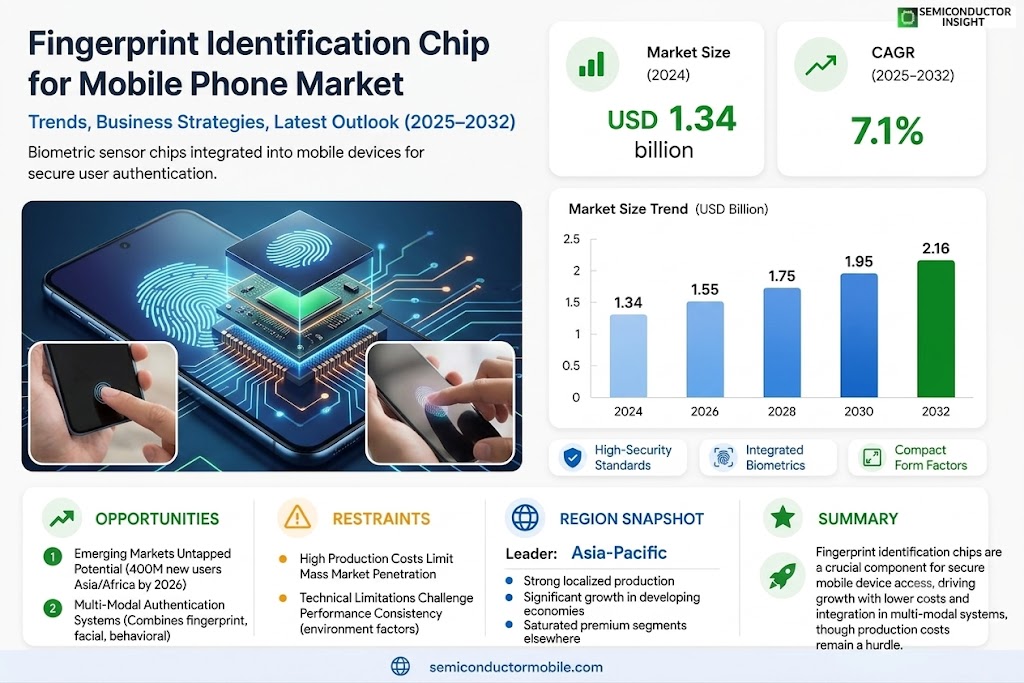
The global Fingerprint Identification Chip for Mobile Phone Market size was valued at US$ 1.34 billion in 2024 and is projected to reach US$ 2.16 billion by 2032, at a CAGR of 7.1% during the forecast period 2025-2032.
Fingerprint identification chips are specialized semiconductor components that enable biometric authentication in mobile devices. These chips utilize various sensing technologies including capacitive, optical, and ultrasonic methods to capture and process fingerprint data for security applications. The capacitive technology dominates the market with over 65% share due to its cost-effectiveness and reliability, while ultrasonic solutions are gaining traction for their superior performance under challenging conditions.
The market growth is driven by increasing smartphone adoption, rising security concerns, and the integration of biometric authentication in mid-range devices. While capacitive sensors remain prevalent, optical and ultrasonic technologies are seeing accelerated adoption in flagship smartphones. The Asia-Pacific region accounts for nearly 60% of global demand, reflecting the concentration of smartphone manufacturing in China and other Asian countries. Key players like Qualcomm, Shenzhen Goodix Technology, and FPC continue to innovate, with recent developments focusing on under-display fingerprint solutions and multi-modal biometric systems.
 MARKET DRIVERS
Rising Smartphone Security Needs Accelerate Fingerprint Chip Adoption
The global smartphone market continues to witness exponential growth in security requirements, with fingerprint identification emerging as the most preferred biometric authentication method. Over 85% of premium smartphones now incorporate fingerprint sensors either under-display or as physical buttons. This massive adoption is driven by increasing concerns about data security and mobile payments safety, coupled with user demand for seamless authentication experiences. The global mobile payment transaction value is projected to exceed $12 trillion by 2027, further accelerating biometric security integration in smartphones.
Technological Advancements in Ultrasonic Sensors Fuel Market Expansion
Recent breakthroughs in ultrasonic fingerprint technology are revolutionizing the mobile security landscape. Compared to traditional capacitive solutions, ultrasonic sensors offer superior performance with the ability to scan through various materials including tempered glass and thin metal sheets. Major manufacturers have revealed that third-generation ultrasonic sensors now achieve authentication speeds under 100ms with near-perfect accuracy rates of 99.8%. Such technological leaps are prompting smartphone OEMs to prioritize ultrasonic solutions for their flagship devices, with market penetration expected to double within the next three years.
Government Regulations and Standardization Push Market Growth
Stringent data protection regulations across regions are mandating stronger authentication mechanisms in mobile devices. Several countries have implemented biometric standards that fingerprint sensors must comply with for financial applications and government services. These regulatory frameworks are compelling device manufacturers to integrate higher-grade security chips. Furthermore, the establishment of universal biometric authentication standards by international bodies is creating a more structured market environment, encouraging wider adoption across price segments.
MARKET RESTRAINTS
High Production Costs Limit Mass Market Penetration
Despite growing demand, advanced fingerprint chips remain prohibitively expensive for budget smartphone segments. Ultrasonic sensor modules currently cost 3-4 times more than conventional capacitive solutions, creating a significant price barrier for widespread adoption. Manufacturing these chips requires specialized fabrication processes and rare materials, with yield rates still below 70% for cutting-edge ultrasonic designs. This translates to higher BOM costs that many manufacturers are reluctant to absorb, particularly in price-sensitive emerging markets.
Technical Limitations Challenge Performance Consistency
Fingerprint sensors face inherent technical constraints that impact reliability across different usage scenarios. Environmental factors like extreme temperatures, moisture, or screen protectors can degrade recognition accuracy by up to 40% in some implementations. Additionally, certain fingerprint technologies struggle with diverse fingerprint patterns, particularly with aging populations or manual laborers. These performance inconsistencies lead to higher false rejection rates, creating user frustration and limiting commercial acceptance in critical applications.
MARKET OPPORTUNITIES
Emerging Markets Present Untapped Growth Potential
Developing economies represent a significant growth frontier as smartphone penetration rates continue climbing. With over 400 million new smartphone users expected across Asia and Africa by 2026, manufacturers are strategically positioning cost-optimized fingerprint solutions for these markets. Localized production and regional partnerships are enabling suppliers to offer competitive pricing structures while complying with regional security requirements. This geographical expansion is creating new revenue streams beyond saturated premium segments.
Multi-Modal Authentication Systems Create New Demand
The convergence of fingerprint technology with other biometric modalities presents compelling innovation opportunities. Leading smartphone brands are increasingly adopting hybrid authentication systems that combine fingerprint, facial recognition, and behavioral biometrics. This trend is driving demand for system-on-chip solutions that integrate multiple sensors while maintaining compact form factors. Recent prototypes demonstrate 30% faster authentication speeds when combining fingerprint and proximity sensing, suggesting significant performance advantages for multi-modal approaches.
MARKET CHALLENGES
Intellectual Property Disputes Hinder Market Development
The fingerprint sensor market faces ongoing patent disputes among key technology providers. These legal battles create uncertainty for OEMs regarding technology adoption and may delay product launches. Some manufacturers report spending up to 15% of their R&D budgets on IP-related evaluations and workarounds. The complexity of global patent landscapes forces companies to maintain expensive legal teams specifically for biometric technology, diverting resources from actual product development.
Other Challenges
Supply Chain Vulnerabilities
Geopolitical tensions and semiconductor shortages have exposed critical vulnerabilities in the fingerprint chip supply chain. Certain specialized materials and fabrication processes remain concentrated in specific regions, creating potential bottlenecks. The average lead time for advanced sensor modules has increased from 8 weeks to over 22 weeks in recent quarters, significantly impacting production schedules.
Security Threats
Sophisticated spoofing techniques continue evolving alongside security improvements. While liveness detection has advanced, researchers demonstrate new attack vectors every quarter requiring continuous firmware updates. This arms race between security providers and hackers forces manufacturers to maintain extensive cybersecurity teams, adding to operational costs.
FINGERPRINT IDENTIFICATION CHIP FOR MOBILE PHONE MARKET TRENDS
Shift to Under-Display and Ultrasonic Sensors Dominating Market Growth
The fingerprint identification chip market is undergoing a significant transformation as smartphone manufacturers increasingly adopt under-display sensors for sleek, bezel-less designs. While traditional capacitive sensors currently hold over 65% market share, ultrasonic technology is gaining traction with major brands due to superior security and moisture resistance. Leading manufacturers are now integrating 3D ultrasonic sensors that capture fingerprint ridges at deeper layers, achieving error rates below 0.002% – making them nearly impossible to spoof with artificial prints. This technological leap is particularly crucial as mobile payment adoption grows, requiring foolproof authentication methods.
Other Trends
AI-Enhanced Matching Algorithms
Artificial intelligence is revolutionizing fingerprint authentication speeds, with next-gen chips processing verification in under 100 milliseconds. Neural network implementations have improved recognition accuracy by 40% for partial or dirty fingerprints compared to conventional pattern matching. These advancements are critical as Android manufacturers implement always-on authentication features, where the system continuously verifies authorized users without explicit scans. Major chipset vendors are now packaging fingerprint solutions with dedicated AI processors to handle these complex computations efficiently.
Emerging Applications Beyond Smartphone Unlocking
The functionality of fingerprint sensors is expanding well beyond device access control. Automotive manufacturers are integrating the same chips into vehicle start systems, while financial institutions deploy them for ATM authentication. This diversification creates new growth avenues as the technology becomes standardized across industries. Interestingly, healthcare applications are emerging where fingerprint sensors verify patient identity before dispensing medication through connected IoT devices. These peripheral uses could account for 15-20% of fingerprint chip demand by 2030, reducing the market’s dependence on smartphone cycles.
Regional Manufacturing Shifts Reshaping Supply Chains
Geopolitical factors are causing notable production shifts, with Southeast Asian nations capturing 35% of fingerprint chip manufacturing previously concentrated in China. This redistribution aims to mitigate tariff impacts and ensure supply continuity amid trade tensions. Simultaneously, Indian manufacturers are emerging as key players, leveraging government incentives under the Product Linked Incentive (PLI) scheme to capture 8-10% of global output within five years. These geographical realignments are prompting chip designers to develop more localized production specifications tailored to regional smartphone preferences and security regulations.
COMPETITIVE LANDSCAPE
Key Industry Players
Security Biometrics Drive Innovation in Mobile Fingerprint Chip Technology
The fingerprint identification chip market for mobile phones is characterized by intense competition among global semiconductor firms and specialized biometric solution providers. Shenzhen Goodix Technology has emerged as a dominant player, capturing over 30% of the global market share due to its advanced capacitive fingerprint sensors that power flagship smartphones across China and Europe.
Qualcomm‘s ultrasonic fingerprint technology and FPC‘s (Fingerprint Cards AB) optical solutions also command significant market presence, particularly in premium Android devices. The growth of these companies stems from partnerships with major OEMs and continuous R&D investments, with Qualcomm spending approximately $7 billion annually on semiconductor innovation.
Market dynamics show that Chinese manufacturers like MicroArray and Sileadinc are rapidly gaining traction by offering cost-competitive alternatives without compromising accuracy. Their success reflects the broader industry shift toward under-display fingerprint solutions, which grew 65% year-over-year in 2023.
While established players like Synaptics maintain strong positions in North American markets through patented designs, emerging contenders such as VKANSEE are disrupting the sector with novel contactless scanning technologies. The competitive intensity is further heightened by vertical integration strategies from smartphone manufacturers developing in-house solutions.
List of Key Fingerprint Identification Chip Companies
- Shenzhen Goodix Technology (China)
- MicroArray (China)
- Sileadinc (China)
- Qualcomm (U.S.)
- FPC (Sweden)
- Shanghai Luoji Technology (China)
- VKANSEE (U.S.)
- Synaptics (U.S.)
- FocalTech (Taiwan)
- AuthenTec (U.S.)
- Shanghai FingerTech (China)
- SunWave (China)
- Beijing Chichuang North Technology (China)
- BYQ (China)
- Suzhou Mindray Microelectronics (China)
Segment Analysis:
By Type
Capacitive Fingerprint Identification Dominates the Market Due to its Widespread Adoption and Cost-Effectiveness
The market is segmented based on technology type into:
- Capacitive Fingerprint Identification
- Optical Fingerprint Identification
- Ultrasonic Fingerprint Identification
By Application
Android System Segment Leads Due to High Smartphone Penetration Globally
The market is segmented based on operating system compatibility into:
- Mac OS
- Android System
By Integration Method
Under-Display Sensors Gaining Traction Due to Smartphone Design Trends
The market is segmented based on sensor integration method into:
- Side-mounted Sensors
- Rear-mounted Sensors
- Under-Display Sensors
By Security Level
3D Authentication Systems Emerging as Premium Security Solution
The market is segmented based on security capability into:
- 2D Authentication Systems
- 3D Authentication Systems
Regional Analysis: Fingerprint Identification Chip for Mobile Phone Market
North America
The North American market for fingerprint identification chips is driven by high smartphone penetration (over 85% as of 2023) and stringent security requirements in financial and enterprise applications. Major chip manufacturers like Qualcomm and Synaptics dominate the regional supply chain, with ultrasonic fingerprint technology gaining traction in flagship devices. The market is characterized by early adoption of advanced biometric solutions, particularly in the U.S. where mobile payment systems such as Apple Pay and Google Wallet demand secure authentication methods. Recent industry developments include the integration of under-display fingerprint sensors in premium smartphones, with increasing R&D investments in AI-powered biometric recognition.
Europe
Europe exhibits steady growth in fingerprint chip adoption, supported by GDPR compliance requirements and the region’s focus on data privacy. The market favors capacitive fingerprint sensors due to their balance of cost and performance, though optical solutions are gaining market share in mid-range devices. Germany and the UK lead in implementation, with automotive applications (for vehicle access systems) presenting new growth avenues. Strict regulatory frameworks regarding biometric data storage and processing have pushed manufacturers to develop secure enclave technologies, with European chip designers emphasizing energy efficiency and multi-factor authentication capabilities to differentiate their offerings.
Asia-Pacific
As the largest and fastest-growing regional market, Asia-Pacific accounts for over 60% of global fingerprint chip demand, driven by massive smartphone production in China and rapid adoption in India’s price-sensitive market. Chinese firms like Goodix Technology and FocalTech dominate local supply chains, offering cost-competitive capacitive solutions. While ultrasonic technology remains limited to premium segments, optical fingerprint sensors have achieved significant penetration in mid-range devices (under $300 price bracket). Southeast Asian markets show particular growth potential as governments implement national digital ID programs incorporating mobile biometrics, though IP protection concerns and intense price competition present ongoing challenges for manufacturers.
South America
The South American market demonstrates moderate but consistent growth, with Brazil and Argentina as key adoption centers. Economic constraints have led to prevalence of entry-level capacitive solutions in budget smartphones, though banking sector modernization is driving demand for more secure authentication. Market development is hampered by currency volatility and dependence on imports (over 80% of components originate from Asia), but local assembly initiatives in Mexico and Brazil are gradually improving supply chain resilience. Recent fintech expansion has created opportunities for biometric payment solutions, with fingerprint chips increasingly incorporated in POS devices alongside mobile applications.
Middle East & Africa
This emerging market shows divergent adoption patterns, with Gulf Cooperation Council (GCC) countries leading in premium device penetration and ultrasonic sensor adoption, while Sub-Saharan Africa relies predominantly on cost-effective capacitive solutions. The UAE and Saudi Arabia have implemented ambitious smart city initiatives incorporating mobile biometrics, driving demand for advanced fingerprint chips. In contrast, African markets are seeing growth through Chinese-brand budget smartphones featuring basic fingerprint authentication. Regional challenges include inconsistent power infrastructure affecting device charging patterns (impacting sensor performance) and cultural sensitivities around biometric data collection, though mobile banking expansion continues to stimulate market growth.
Report Scope
This market research report provides a comprehensive analysis of the global and regional Fingerprint Identification Chip for Mobile Phone markets, covering the forecast period 2025–2032. It offers detailed insights into market dynamics, technological advancements, competitive landscape, and key trends shaping the industry.
Key focus areas of the report include:
- Market Size & Forecast: Historical data and future projections for revenue, unit shipments, and market value across major regions and segments.
- Segmentation Analysis: Detailed breakdown by product type (capacitive, optical, ultrasonic), technology, application (Android, iOS), and end-user industry to identify high-growth segments and investment opportunities.
- Regional Outlook: Insights into market performance across North America, Europe, Asia-Pacific, Latin America, and the Middle East & Africa, including country-level analysis where relevant.
- Competitive Landscape: Profiles of leading market participants, including their product offerings, R&D focus, manufacturing capacity, pricing strategies, and recent developments such as mergers, acquisitions, and partnerships.
- Technology Trends & Innovation: Assessment of emerging biometric technologies, integration with AI/ML algorithms, semiconductor design trends, and evolving security standards in mobile devices.
- Market Drivers & Restraints: Evaluation of factors driving market growth along with challenges, supply chain constraints, regulatory issues, and market-entry barriers.
- Stakeholder Analysis: Insights for component suppliers, smartphone OEMs, system integrators, investors, and policymakers regarding the evolving ecosystem and strategic opportunities.
Primary and secondary research methods are employed, including interviews with industry experts, data from verified sources, and real-time market intelligence to ensure the accuracy and reliability of the insights presented.
FREQUENTLY ASKED QUESTIONS:
What is the current market size of Global Fingerprint Identification Chip for Mobile Phone Market?
->Fingerprint Identification Chip for Mobile Phone Market size was valued at US$ 1.34 billion in 2024 and is projected to reach US$ 2.16 billion by 2032, at a CAGR of 7.1% during the forecast period 2025-2032.
Which key companies operate in Global Fingerprint Identification Chip Market?
-> Key players include Qualcomm, Synaptics, FPC, Goodix Technology, and Shenzhen Silead, collectively holding over 65% of the market share.
What are the key growth drivers?
-> Key growth drivers include increasing smartphone penetration, demand for enhanced security features, and adoption of under-display fingerprint technology in premium smartphones.
Which region dominates the market?
-> Asia-Pacific dominates with 58% market share, driven by smartphone manufacturing hubs in China, South Korea, and Vietnam, followed by North America and Europe.
What are the emerging trends?
-> Emerging trends include ultrasonic fingerprint technology, multi-biometric authentication systems, and AI-powered spoof detection in flagship smartphones.

Get Sample Report PDF for Exclusive Insights
Report Sample Includes
- Table of Contents
- List of Tables & Figures
- Charts, Research Methodology, and more...