Server Processor Market, Trends, Business Strategies 2025-2032

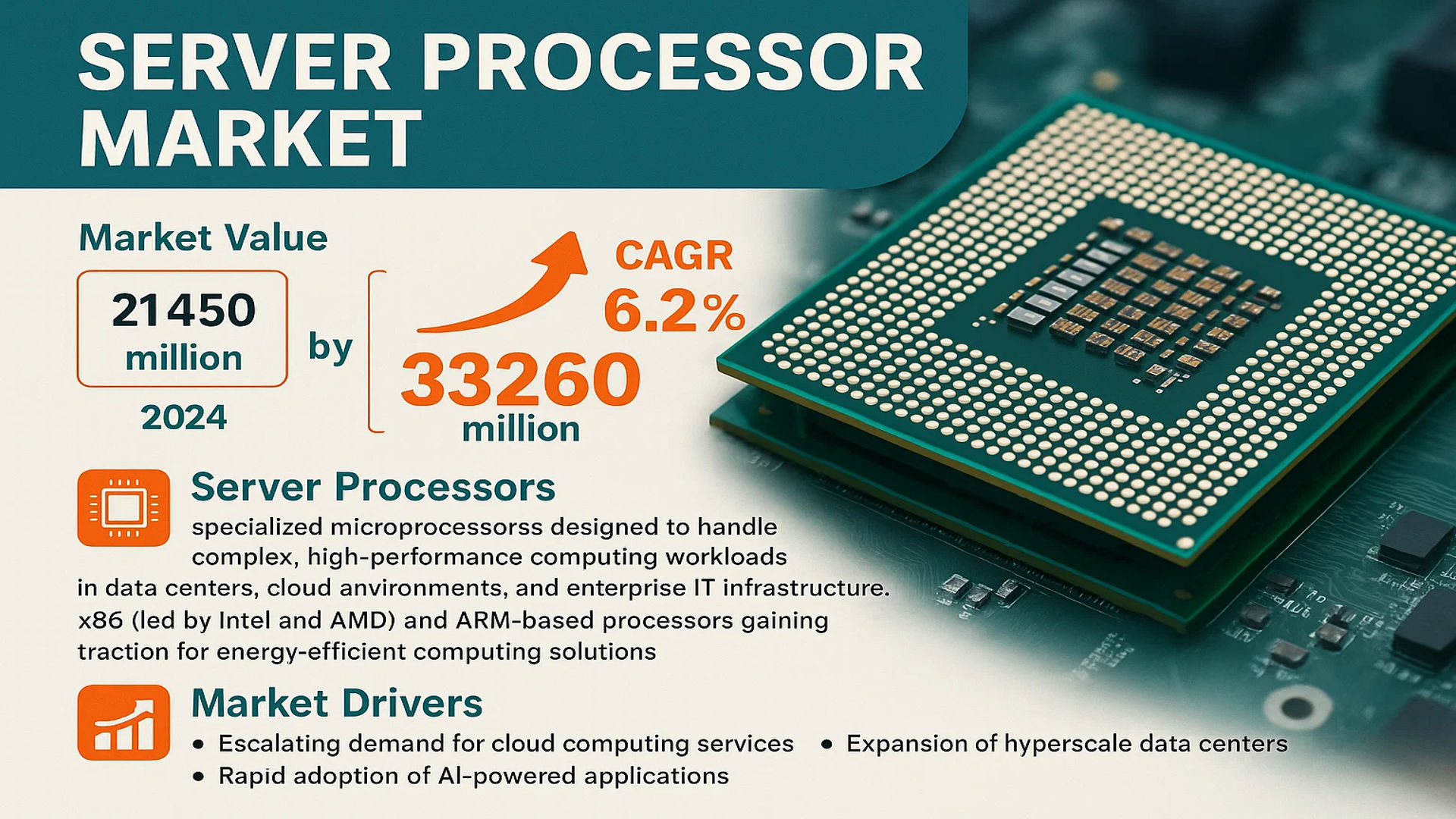
Server Processor Market was valued at 21450 million in 2024 and is projected to reach US$ 33260 million by 2032, at a CAGR of 6.2% during the forecast period

PDF Icon Download Sample Report PDF
  • Quick Dispatch

    All Orders

  • Secure Payment

    100% Secure Payment

Price range: $1,500.00 through $4,250.00

Clear

MARKET INSIGHTS

The global Server Processor Market was valued at 21450 million in 2024 and is projected to reach US$ 33260 million by 2032, at a CAGR of 6.2% during the forecast period.

Server processors are specialized microprocessors designed to handle complex, high-performance computing workloads in data centers, cloud environments, and enterprise IT infrastructure. These processors differ from consumer-grade CPUs by offering higher core counts, enhanced reliability features, and superior multi-threading capabilities to support mission-critical applications such as virtualization, AI workloads, and large-scale database management. The two primary architectures dominating the market are x86 (led by Intel and AMD) and ARM-based processors, which are gaining traction for energy-efficient computing solutions.

The market growth is driven by escalating demand for cloud computing services, expansion of hyperscale data centers, and the rapid adoption of AI-powered applications. Intel currently maintains market leadership with its Xeon processors, holding over 70% revenue share, while AMD’s EPYC series has been gaining significant traction due to its competitive performance-per-dollar ratio. Emerging players like Ampere Computing and Huawei’s Kunpeng processors are also contributing to market diversification through ARM-based solutions tailored for specific workloads.
Server Processor Market

MARKET DRIVERS

Explosive Growth of Data Centers and Cloud Computing Fueling Server Processor Demand

The global server processor market is experiencing robust growth driven by the exponential expansion of data centers and cloud computing infrastructure. With digital transformation accelerating across industries, enterprises are increasingly shifting workloads to cloud environments, necessitating powerful server processors to handle demanding compute tasks. The hyperscale cloud service provider segment alone accounts for over 40% of all server processor purchases, with continued strong demand expected as cloud adoption grows at approximately 20% annually. Recent advancements in processor architectures specifically optimized for cloud-native applications are further driving refresh cycles and upgrades in data center infrastructure.

AI and Machine Learning Workloads Creating Specialized Processor Requirements

Artificial intelligence applications are transforming processor requirements, with specialized AI server processors seeing rapid adoption. The AI server market is projected to grow at nearly 30% CAGR through 2032, demanding processors with enhanced capabilities for parallel processing and matrix operations. Both major x86 manufacturers have introduced AI-optimized processor lines, with features like built-in AI accelerators and support for high-bandwidth memory. Edge AI deployments are creating additional demand for efficient server processors that can handle inference workloads outside traditional data centers.

Furthermore, the development of generative AI models requires unprecedented processing power. Single large language model training runs can utilize thousands of server processors working in parallel, creating sustained demand for high-performance compute resources. This trend shows no signs of slowing as AI adoption expands across industries.

MARKET RESTRAINTS

Supply Chain Constraints and Geopolitical Factors Limiting Market Growth

The server processor market faces significant challenges from ongoing supply chain disruptions and geopolitical tensions affecting semiconductor production. The global chip shortage that began in 2020 continues to impact the availability of advanced server processors, with lead times for some components extending beyond 12 months. Fab capacity constraints and the concentration of advanced semiconductor manufacturing in specific geographical regions create vulnerabilities in the supply chain that can constrain market growth.

Additionally, increasing trade restrictions and export controls on high-performance computing technologies between major economic powers are creating market fragmentation. These restrictions limit the ability of manufacturers to serve global markets uniformly and may lead to duplicated R&D efforts as companies develop region-specific processor architectures to comply with regulations.

While new fabrication facilities are being constructed to alleviate these constraints, the capital-intensive nature of semiconductor manufacturing means these investments will take years to significantly impact market availability.

MARKET CHALLENGES

Power Consumption and Thermal Management Creating Design Constraints

As server processors become more powerful, managing power consumption and heat dissipation presents growing challenges. High-performance server processors can now consume over 500 watts each, creating significant power delivery and cooling requirements at data center scale. With energy costs rising and sustainability becoming a priority, processor manufacturers face pressure to improve power efficiency while continuing to deliver performance improvements.

Other Challenges

Performance Plateaus
Moore’s Law slowdown is making it increasingly difficult to deliver consistent generational performance gains. While architectural improvements and specialized accelerators help mitigate this, fundamental physics limitations are raising costs for continued performance scaling.

Software Optimization
The shift to heterogeneous computing architectures requires extensive software optimization to realize performance benefits. The lack of standardized programming models for new processor features creates adoption barriers and increases development costs.

MARKET OPPORTUNITIES

Emerging Alternative Architectures Creating New Market Segments

While x86 maintains market dominance, ARM-based and RISC-V server processors are creating new opportunities in specialized workloads. Cloud providers are increasingly adopting ARM processors for scale-out workloads where power efficiency is paramount, with adoption growing at over 40% annually. The open-source RISC-V architecture is seeing growing interest for customization opportunities in specialized computing environments.

Additionally, processor accelerators optimized for specific workloads like AI, cryptography, or video processing are creating new market segments. These specialized processors offer significant performance advantages for targeted applications and are increasingly being integrated into mainstream server platforms.

The rapid growth of edge computing is also creating opportunities for server processors optimized for distributed environments. These processors must balance performance with constraints like power efficiency, physical size, and environmental ruggedness, creating specialized requirements that established vendors are now addressing.

SERVER PROCESSOR MARKET TRENDS

Increased Demand for High-Performance Computing (HPC) Accelerates Server Processor Innovation

The rapid expansion of cloud computing, artificial intelligence (AI), and data-intensive workloads has propelled the need for powerful server processors that can handle complex tasks efficiently. Intel’s Xeon Scalable processors and AMD’s EPYC series have emerged as dominant players in the market, delivering enhanced multi-core performance to meet the demands of modern data centers. AMD, in particular, has gained significant traction by offering up to 96 cores per processor, significantly improving parallel processing capabilities. Meanwhile, Intel has responded with advanced thermal management and AI acceleration features, maintaining its stronghold in enterprise environments.

Other Trends

Growth of Arm-Based Server Processors

While x86 processors continue to dominate, Arm-based architectures are gaining momentum, particularly in power-efficient and hyperscale data center applications. Amazon’s Graviton series, leveraging Arm’s energy-efficient design, has demonstrated substantial adoption among cloud service providers due to its superior performance-per-watt ratio. Similarly, Huawei’s Kunpeng processors are expanding in China’s domestic market, supported by government initiatives that promote localized semiconductor development.

AI and Machine Learning Workloads Drive Specialized Processor Adoption

The increasing deployment of AI workloads has created a surge in demand for server processors optimized for neural network training and inference. Both Intel and AMD have introduced dedicated AI accelerators alongside their general-purpose CPUs, while hybrid architectures integrating CPUs with GPUs and FPGAs are becoming mainstream. Nvidia’s foray into Arm-based server CPUs, coupled with its AI-centric GPU solutions, signals a shift towards heterogeneous computing, where multiple processor types work in tandem to maximize efficiency.

Emerging players like Ampere Computing are also making strides with cloud-native processors designed specifically for scalable computing, targeting SaaS providers and large-scale enterprises. The market is witnessing a growing emphasis on software-hardware co-design, ensuring that processor architectures align with evolving AI frameworks and cloud orchestration tools.

COMPETITIVE LANDSCAPE

Key Industry Players

Innovation Drives Market Share in the Server Processor Industry

The global server processor market remains highly competitive, dominated by x86 architecture players while witnessing growing competition from ARM-based solutions. The market continues to evolve with the increasing demand for high-performance computing, cloud services, and AI workloads, forcing manufacturers to continuously innovate their product offerings.

Intel Corporation maintains its market leadership with over 70% share in 2024, primarily driven by its Xeon processor family. However, the company faces growing pressure from competitors as it transitions to new manufacturing processes. Its dominance stems from decades of ecosystem development and compatibility with enterprise software stacks.

AMD has made significant strides in recent years with its EPYC processors, capturing an estimated 20% market share in 2024. The company’s success comes from delivering strong multi-core performance at competitive price points, particularly appealing to hyperscalers and cloud service providers.

While the market appears concentrated among these two giants, several other players are gaining traction. Organizations across industries are investing heavily in R&D to develop processors optimized for specific workloads such as AI inference, edge computing, and high-performance databases.

Emerging competitors like Ampere Computing and Google’s Axion processors are challenging the status quo with cloud-native designs. These developments indicate the market may shift toward more specialized architectures in the coming years, particularly for data center applications.

List of Key Server Processor Companies Profiled

  • Intel Corporation (U.S.)
  • AMD (U.S.)
  • HiSilicon (China)
  • Ampere Computing (U.S.)
  • IBM (U.S.)
  • Google Axion (U.S.)
  • Phytium Technology (China)
  • Chengdu Sunway Technologies (China)
  • Montage Technology (China)
  • Hygon Information Technology (China)

Segment Analysis:

By Type

x86 CPU Segment Dominates the Market Due to Widespread Adoption in Data Centers and Cloud Computing

The market is segmented based on type into:

  • x86 CPU
    • Subtypes: Intel Xeon, AMD EPYC, and others
  • Arm-based CPU
    • Subtypes: Kunpeng (Huawei), Ampere Altra, and others
  • RISC-V CPU
  • Others

By Application

AI Server Segment Shows Strong Growth Potential Due to Rising Demand for Machine Learning Workloads

The market is segmented based on application into:

  • AI Server
  • General Purpose Server
  • Edge Computing Server
  • High Performance Computing (HPC) Server
  • Others

By Core Count

Multi-core Processors Lead as Enterprises Seek Higher Parallel Processing Capabilities

The market is segmented based on core count into:

  • Below 8 cores
  • 8-16 cores
  • 16-32 cores
  • Above 32 cores

By Power Consumption

Energy-efficient Processors Gain Traction for Sustainability and Operational Cost Savings

The market is segmented based on power consumption into:

  • Below 65W
  • 65W-150W
  • 150W-250W
  • Above 250W

Regional Analysis: Server Processor Market

North America
North America remains the dominant region in the global server processor market, driven by robust demand from hyperscale data centers and enterprise cloud adoption. The U.S. accounts for the majority of market share, with companies like Intel and AMD leveraging strong supply chains and R&D ecosystems. x86 architecture processors dominate due to their compatibility with existing infrastructure, though ARM-based solutions are gaining traction among tech giants like Google. Major cloud providers are pushing for energy-efficient processors to meet sustainability goals while maintaining high-performance computing capabilities. The region’s sophisticated AI server segment is accelerating demand for specialized processors that can handle machine learning workloads.

Asia-Pacific
Asia-Pacific is the fastest-growing server processor market, led by China’s expanding cloud computing sector and India’s emerging digital economy. Chinese vendors like Huawei (Kunpeng) and Phytium Technology are making strategic advancements in ARM-based server processors, supported by government initiatives for technology independence. While x86 still maintains dominance, local alternatives are gaining share in government and telecom sectors. Japan and South Korea continue to be important markets for high-performance computing processors, with significant investments in AI infrastructure. The region benefits from massive hyperscale data center construction and rapid adoption of 5G technologies that require efficient edge computing solutions.

Europe
Europe’s server processor market is characterized by strict data sovereignty regulations and growing emphasis on energy efficiency. Germany and the UK lead in data center expansions, with increasing demand for processors that can deliver performance while minimizing power consumption. The EU’s focus on technological sovereignty is driving interest in alternative architectures beyond x86, though adoption remains measured. Cloud service providers and research institutions are key demand drivers, particularly for processors capable of handling complex AI workloads. The region shows promising growth in edge computing applications, creating opportunities for specialized processors in telecom and industrial IoT segments.

Middle East & Africa
The MEA server processor market is experiencing gradual growth, with Gulf nations leading in hyperscale data center investments. Countries like UAE and Saudi Arabia are attracting global cloud providers, driving demand for efficient server processors capable of handling regional workloads. While x86 dominates, there’s emerging interest in ARM-based solutions for their power efficiency advantages in hot climates. Africa’s market remains nascent but shows potential with increasing digital transformation initiatives. The region faces challenges in infrastructure and technical expertise, though growing investments in smart city projects present long-term opportunities for server processor suppliers.

South America
South America’s server processor market is developing steadily, with Brazil as the primary demand center. Adoption is primarily driven by increasing cloud service penetration and digital transformation across industries. Economic volatility and infrastructure limitations have slowed hyperscale data center growth compared to other regions. However, the market shows potential as telecommunications upgrades and increasing Internet penetration create demand for efficient server infrastructure. Both x86 and ARM architectures are present, though cost sensitivity makes value-oriented solutions particularly attractive in this region.

Report Scope

This market research report provides a comprehensive analysis of the global Server Processor market, covering the forecast period 2024–2032. It offers detailed insights into market dynamics, technological advancements, competitive landscape, and key trends shaping the industry.

Key focus areas of the report include:

  • Market Size & Forecast: Historical data and future projections for revenue, unit shipments, and market value across major regions and segments. The global Server Processor market was valued at USD 21,450 million in 2024 and is projected to reach USD 33,260 million by 2032, growing at a CAGR of 6.2%.
  • Segmentation Analysis: Detailed breakdown by processor architecture (x86, ARM-based), application (AI Servers, General Purpose Servers), and end-user industry to identify high-growth segments and investment opportunities.
  • Regional Outlook: Insights into market performance across North America, Europe, Asia-Pacific, Latin America, and the Middle East & Africa. Asia-Pacific currently leads in market share due to expanding data center infrastructure.
  • Competitive Landscape: Profiles of leading market participants including Intel (70% market share), AMD, HiSilicon, and emerging players, covering product portfolios, technological innovations, and strategic developments.
  • Technology Trends & Innovation: Assessment of AI-optimized processors, chiplet designs, advanced node fabrication (5nm and below), and energy-efficient architectures driving market evolution.
  • Market Drivers & Restraints: Evaluation of cloud computing expansion, 5G deployment, AI workloads, alongside challenges like supply chain constraints and geopolitical factors affecting semiconductor production.
  • Stakeholder Analysis: Strategic insights for cloud service providers, data center operators, chip manufacturers, and investors navigating the competitive processor landscape.

The research methodology combines primary interviews with industry leaders and analysis of verified market data from financial reports, trade associations, and technology white papers to ensure accuracy and reliability.

FREQUENTLY ASKED QUESTIONS:

What is the current market size of Global Server Processor Market?

-> Server Processor Market was valued at 21450 million in 2024 and is projected to reach US$ 33260 million by 2032, at a CAGR of 6.2% during the forecast period.

Which key companies dominate the Server Processor Market?

-> Intel leads with 70% market share, followed by AMD with 20%. Emerging players include HiSilicon, Ampere Computing, and IBM Power processors.

What are the key growth drivers?

-> Major drivers include cloud computing expansion (projected 14% CAGR), AI server deployments, and 5G infrastructure growth requiring edge computing solutions.

Which processor architecture dominates currently?

-> x86 architecture holds 85% market share, though ARM-based processors are gaining traction in hyperscale data centers with 12% growth YoY.

What are the emerging technology trends?

-> Emerging trends include chiplet-based designs, 3D stacking technology, AI-accelerated processors, and advanced cooling solutions for high-density computing.

Server Processor Market, Trends, Business Strategies 2025-2032

Get Sample Report PDF for Exclusive Insights

Report Sample Includes

  • Table of Contents
  • List of Tables & Figures
  • Charts, Research Methodology, and more...

PDF Icon Download Sample Report PDF

Download Sample Report

Table of Content

1 Introduction to Research & Analysis Reports
1.1 Server Processor Market Definition
1.2 Market Segments
1.2.1 Segment by Type
1.2.2 Segment by Application
1.3 Global Server Processor Market Overview
1.4 Features & Benefits of This Report
1.5 Methodology & Sources of Information
1.5.1 Research Methodology
1.5.2 Research Process
1.5.3 Base Year
1.5.4 Report Assumptions & Caveats
2 Global Server Processor Overall Market Size
2.1 Global Server Processor Market Size: 2024 VS 2032
2.2 Global Server Processor Market Size, Prospects & Forecasts: 2020-2032
2.3 Global Server Processor Sales: 2020-2032
3 Company Landscape
3.1 Top Server Processor Players in Global Market
3.2 Top Global Server Processor Companies Ranked by Revenue
3.3 Global Server Processor Revenue by Companies
3.4 Global Server Processor Sales by Companies
3.5 Global Server Processor Price by Manufacturer (2020-2025)
3.6 Top 3 and Top 5 Server Processor Companies in Global Market, by Revenue in 2024
3.7 Global Manufacturers Server Processor Product Type
3.8 Tier 1, Tier 2, and Tier 3 Server Processor Players in Global Market
3.8.1 List of Global Tier 1 Server Processor Companies
3.8.2 List of Global Tier 2 and Tier 3 Server Processor Companies
4 Sights by Product
4.1 Overview
4.1.1 Segment by Type – Global Server Processor Market Size Markets, 2024 & 2032
4.1.2 x86 CPU
4.1.3 Arm-based CPU
4.2 Segment by Type – Global Server Processor Revenue & Forecasts
4.2.1 Segment by Type – Global Server Processor Revenue, 2020-2025
4.2.2 Segment by Type – Global Server Processor Revenue, 2026-2032
4.2.3 Segment by Type – Global Server Processor Revenue Market Share, 2020-2032
4.3 Segment by Type – Global Server Processor Sales & Forecasts
4.3.1 Segment by Type – Global Server Processor Sales, 2020-2025
4.3.2 Segment by Type – Global Server Processor Sales, 2026-2032
4.3.3 Segment by Type – Global Server Processor Sales Market Share, 2020-2032
4.4 Segment by Type – Global Server Processor Price (Manufacturers Selling Prices), 2020-2032
5 Sights by Application
5.1 Overview
5.1.1 Segment by Application – Global Server Processor Market Size, 2024 & 2032
5.1.2 AI Server
5.1.3 General Purpose Server
5.2 Segment by Application – Global Server Processor Revenue & Forecasts
5.2.1 Segment by Application – Global Server Processor Revenue, 2020-2025
5.2.2 Segment by Application – Global Server Processor Revenue, 2026-2032
5.2.3 Segment by Application – Global Server Processor Revenue Market Share, 2020-2032
5.3 Segment by Application – Global Server Processor Sales & Forecasts
5.3.1 Segment by Application – Global Server Processor Sales, 2020-2025
5.3.2 Segment by Application – Global Server Processor Sales, 2026-2032
5.3.3 Segment by Application – Global Server Processor Sales Market Share, 2020-2032
5.4 Segment by Application – Global Server Processor Price (Manufacturers Selling Prices), 2020-2032
6 Sights by Region
6.1 By Region – Global Server Processor Market Size, 2024 & 2032
6.2 By Region – Global Server Processor Revenue & Forecasts
6.2.1 By Region – Global Server Processor Revenue, 2020-2025
6.2.2 By Region – Global Server Processor Revenue, 2026-2032
6.2.3 By Region – Global Server Processor Revenue Market Share, 2020-2032
6.3 By Region – Global Server Processor Sales & Forecasts
6.3.1 By Region – Global Server Processor Sales, 2020-2025
6.3.2 By Region – Global Server Processor Sales, 2026-2032
6.3.3 By Region – Global Server Processor Sales Market Share, 2020-2032
6.4 North America
6.4.1 By Country – North America Server Processor Revenue, 2020-2032
6.4.2 By Country – North America Server Processor Sales, 2020-2032
6.4.3 United States Server Processor Market Size, 2020-2032
6.4.4 Canada Server Processor Market Size, 2020-2032
6.4.5 Mexico Server Processor Market Size, 2020-2032
6.5 Europe
6.5.1 By Country – Europe Server Processor Revenue, 2020-2032
6.5.2 By Country – Europe Server Processor Sales, 2020-2032
6.5.3 Germany Server Processor Market Size, 2020-2032
6.5.4 France Server Processor Market Size, 2020-2032
6.5.5 U.K. Server Processor Market Size, 2020-2032
6.5.6 Italy Server Processor Market Size, 2020-2032
6.5.7 Russia Server Processor Market Size, 2020-2032
6.5.8 Nordic Countries Server Processor Market Size, 2020-2032
6.5.9 Benelux Server Processor Market Size, 2020-2032
6.6 Asia
6.6.1 By Region – Asia Server Processor Revenue, 2020-2032
6.6.2 By Region – Asia Server Processor Sales, 2020-2032
6.6.3 China Server Processor Market Size, 2020-2032
6.6.4 Japan Server Processor Market Size, 2020-2032
6.6.5 South Korea Server Processor Market Size, 2020-2032
6.6.6 Southeast Asia Server Processor Market Size, 2020-2032
6.6.7 India Server Processor Market Size, 2020-2032
6.7 South America
6.7.1 By Country – South America Server Processor Revenue, 2020-2032
6.7.2 By Country – South America Server Processor Sales, 2020-2032
6.7.3 Brazil Server Processor Market Size, 2020-2032
6.7.4 Argentina Server Processor Market Size, 2020-2032
6.8 Middle East & Africa
6.8.1 By Country – Middle East & Africa Server Processor Revenue, 2020-2032
6.8.2 By Country – Middle East & Africa Server Processor Sales, 2020-2032
6.8.3 Turkey Server Processor Market Size, 2020-2032
6.8.4 Israel Server Processor Market Size, 2020-2032
6.8.5 Saudi Arabia Server Processor Market Size, 2020-2032
6.8.6 UAE Server Processor Market Size, 2020-2032
7 Manufacturers & Brands Profiles
7.1 Intel
7.1.1 Intel Company Summary
7.1.2 Intel Business Overview
7.1.3 Intel Server Processor Major Product Offerings
7.1.4 Intel Server Processor Sales and Revenue in Global (2020-2025)
7.1.5 Intel Key News & Latest Developments
7.2 AMD
7.2.1 AMD Company Summary
7.2.2 AMD Business Overview
7.2.3 AMD Server Processor Major Product Offerings
7.2.4 AMD Server Processor Sales and Revenue in Global (2020-2025)
7.2.5 AMD Key News & Latest Developments
7.3 HiSilicon
7.3.1 HiSilicon Company Summary
7.3.2 HiSilicon Business Overview
7.3.3 HiSilicon Server Processor Major Product Offerings
7.3.4 HiSilicon Server Processor Sales and Revenue in Global (2020-2025)
7.3.5 HiSilicon Key News & Latest Developments
7.4 Ampere Computing
7.4.1 Ampere Computing Company Summary
7.4.2 Ampere Computing Business Overview
7.4.3 Ampere Computing Server Processor Major Product Offerings
7.4.4 Ampere Computing Server Processor Sales and Revenue in Global (2020-2025)
7.4.5 Ampere Computing Key News & Latest Developments
7.5 IBM
7.5.1 IBM Company Summary
7.5.2 IBM Business Overview
7.5.3 IBM Server Processor Major Product Offerings
7.5.4 IBM Server Processor Sales and Revenue in Global (2020-2025)
7.5.5 IBM Key News & Latest Developments
7.6 Google Axion
7.6.1 Google Axion Company Summary
7.6.2 Google Axion Business Overview
7.6.3 Google Axion Server Processor Major Product Offerings
7.6.4 Google Axion Server Processor Sales and Revenue in Global (2020-2025)
7.6.5 Google Axion Key News & Latest Developments
7.7 Phytium Technology
7.7.1 Phytium Technology Company Summary
7.7.2 Phytium Technology Business Overview
7.7.3 Phytium Technology Server Processor Major Product Offerings
7.7.4 Phytium Technology Server Processor Sales and Revenue in Global (2020-2025)
7.7.5 Phytium Technology Key News & Latest Developments
7.8 Chengdu Sunway Technologies
7.8.1 Chengdu Sunway Technologies Company Summary
7.8.2 Chengdu Sunway Technologies Business Overview
7.8.3 Chengdu Sunway Technologies Server Processor Major Product Offerings
7.8.4 Chengdu Sunway Technologies Server Processor Sales and Revenue in Global (2020-2025)
7.8.5 Chengdu Sunway Technologies Key News & Latest Developments
7.9 Montage Technology
7.9.1 Montage Technology Company Summary
7.9.2 Montage Technology Business Overview
7.9.3 Montage Technology Server Processor Major Product Offerings
7.9.4 Montage Technology Server Processor Sales and Revenue in Global (2020-2025)
7.9.5 Montage Technology Key News & Latest Developments
7.10 Hygon Information Technology
7.10.1 Hygon Information Technology Company Summary
7.10.2 Hygon Information Technology Business Overview
7.10.3 Hygon Information Technology Server Processor Major Product Offerings
7.10.4 Hygon Information Technology Server Processor Sales and Revenue in Global (2020-2025)
7.10.5 Hygon Information Technology Key News & Latest Developments
8 Global Server Processor Production Capacity, Analysis
8.1 Global Server Processor Production Capacity, 2020-2032
8.2 Server Processor Production Capacity of Key Manufacturers in Global Market
8.3 Global Server Processor Production by Region
9 Key Market Trends, Opportunity, Drivers and Restraints
9.1 Market Opportunities & Trends
9.2 Market Drivers
9.3 Market Restraints
10 Server Processor Supply Chain Analysis
10.1 Server Processor Industry Value Chain
10.2 Server Processor Upstream Market
10.3 Server Processor Downstream and Clients
10.4 Marketing Channels Analysis
10.4.1 Marketing Channels
10.4.2 Server Processor Distributors and Sales Agents in Global
11 Conclusion
12 Appendix
12.1 Note
12.2 Examples of Clients
12.3 DisclaimerList of Tables
Table 1. Key Players of Server Processor in Global Market
Table 2. Top Server Processor Players in Global Market, Ranking by Revenue (2024)
Table 3. Global Server Processor Revenue by Companies, (US$, Mn), 2020-2025
Table 4. Global Server Processor Revenue Share by Companies, 2020-2025
Table 5. Global Server Processor Sales by Companies, (K Pcs), 2020-2025
Table 6. Global Server Processor Sales Share by Companies, 2020-2025
Table 7. Key Manufacturers Server Processor Price (2020-2025) & (US$/Pcs)
Table 8. Global Manufacturers Server Processor Product Type
Table 9. List of Global Tier 1 Server Processor Companies, Revenue (US$, Mn) in 2024 and Market Share
Table 10. List of Global Tier 2 and Tier 3 Server Processor Companies, Revenue (US$, Mn) in 2024 and Market Share
Table 11. Segment by Type – Global Server Processor Revenue, (US$, Mn), 2024 & 2032
Table 12. Segment by Type – Global Server Processor Revenue (US$, Mn), 2020-2025
Table 13. Segment by Type – Global Server Processor Revenue (US$, Mn), 2026-2032
Table 14. Segment by Type – Global Server Processor Sales (K Pcs), 2020-2025
Table 15. Segment by Type – Global Server Processor Sales (K Pcs), 2026-2032
Table 16. Segment by Application – Global Server Processor Revenue, (US$, Mn), 2024 & 2032
Table 17. Segment by Application – Global Server Processor Revenue, (US$, Mn), 2020-2025
Table 18. Segment by Application – Global Server Processor Revenue, (US$, Mn), 2026-2032
Table 19. Segment by Application – Global Server Processor Sales, (K Pcs), 2020-2025
Table 20. Segment by Application – Global Server Processor Sales, (K Pcs), 2026-2032
Table 21. By Region – Global Server Processor Revenue, (US$, Mn), 2025-2032
Table 22. By Region – Global Server Processor Revenue, (US$, Mn), 2020-2025
Table 23. By Region – Global Server Processor Revenue, (US$, Mn), 2026-2032
Table 24. By Region – Global Server Processor Sales, (K Pcs), 2020-2025
Table 25. By Region – Global Server Processor Sales, (K Pcs), 2026-2032
Table 26. By Country – North America Server Processor Revenue, (US$, Mn), 2020-2025
Table 27. By Country – North America Server Processor Revenue, (US$, Mn), 2026-2032
Table 28. By Country – North America Server Processor Sales, (K Pcs), 2020-2025
Table 29. By Country – North America Server Processor Sales, (K Pcs), 2026-2032
Table 30. By Country – Europe Server Processor Revenue, (US$, Mn), 2020-2025
Table 31. By Country – Europe Server Processor Revenue, (US$, Mn), 2026-2032
Table 32. By Country – Europe Server Processor Sales, (K Pcs), 2020-2025
Table 33. By Country – Europe Server Processor Sales, (K Pcs), 2026-2032
Table 34. By Region – Asia Server Processor Revenue, (US$, Mn), 2020-2025
Table 35. By Region – Asia Server Processor Revenue, (US$, Mn), 2026-2032
Table 36. By Region – Asia Server Processor Sales, (K Pcs), 2020-2025
Table 37. By Region – Asia Server Processor Sales, (K Pcs), 2026-2032
Table 38. By Country – South America Server Processor Revenue, (US$, Mn), 2020-2025
Table 39. By Country – South America Server Processor Revenue, (US$, Mn), 2026-2032
Table 40. By Country – South America Server Processor Sales, (K Pcs), 2020-2025
Table 41. By Country – South America Server Processor Sales, (K Pcs), 2026-2032
Table 42. By Country – Middle East & Africa Server Processor Revenue, (US$, Mn), 2020-2025
Table 43. By Country – Middle East & Africa Server Processor Revenue, (US$, Mn), 2026-2032
Table 44. By Country – Middle East & Africa Server Processor Sales, (K Pcs), 2020-2025
Table 45. By Country – Middle East & Africa Server Processor Sales, (K Pcs), 2026-2032
Table 46. Intel Company Summary
Table 47. Intel Server Processor Product Offerings
Table 48. Intel Server Processor Sales (K Pcs), Revenue (US$, Mn) and Average Price (US$/Pcs) & (2020-2025)
Table 49. Intel Key News & Latest Developments
Table 50. AMD Company Summary
Table 51. AMD Server Processor Product Offerings
Table 52. AMD Server Processor Sales (K Pcs), Revenue (US$, Mn) and Average Price (US$/Pcs) & (2020-2025)
Table 53. AMD Key News & Latest Developments
Table 54. HiSilicon Company Summary
Table 55. HiSilicon Server Processor Product Offerings
Table 56. HiSilicon Server Processor Sales (K Pcs), Revenue (US$, Mn) and Average Price (US$/Pcs) & (2020-2025)
Table 57. HiSilicon Key News & Latest Developments
Table 58. Ampere Computing Company Summary
Table 59. Ampere Computing Server Processor Product Offerings
Table 60. Ampere Computing Server Processor Sales (K Pcs), Revenue (US$, Mn) and Average Price (US$/Pcs) & (2020-2025)
Table 61. Ampere Computing Key News & Latest Developments
Table 62. IBM Company Summary
Table 63. IBM Server Processor Product Offerings
Table 64. IBM Server Processor Sales (K Pcs), Revenue (US$, Mn) and Average Price (US$/Pcs) & (2020-2025)
Table 65. IBM Key News & Latest Developments
Table 66. Google Axion Company Summary
Table 67. Google Axion Server Processor Product Offerings
Table 68. Google Axion Server Processor Sales (K Pcs), Revenue (US$, Mn) and Average Price (US$/Pcs) & (2020-2025)
Table 69. Google Axion Key News & Latest Developments
Table 70. Phytium Technology Company Summary
Table 71. Phytium Technology Server Processor Product Offerings
Table 72. Phytium Technology Server Processor Sales (K Pcs), Revenue (US$, Mn) and Average Price (US$/Pcs) & (2020-2025)
Table 73. Phytium Technology Key News & Latest Developments
Table 74. Chengdu Sunway Technologies Company Summary
Table 75. Chengdu Sunway Technologies Server Processor Product Offerings
Table 76. Chengdu Sunway Technologies Server Processor Sales (K Pcs), Revenue (US$, Mn) and Average Price (US$/Pcs) & (2020-2025)
Table 77. Chengdu Sunway Technologies Key News & Latest Developments
Table 78. Montage Technology Company Summary
Table 79. Montage Technology Server Processor Product Offerings
Table 80. Montage Technology Server Processor Sales (K Pcs), Revenue (US$, Mn) and Average Price (US$/Pcs) & (2020-2025)
Table 81. Montage Technology Key News & Latest Developments
Table 82. Hygon Information Technology Company Summary
Table 83. Hygon Information Technology Server Processor Product Offerings
Table 84. Hygon Information Technology Server Processor Sales (K Pcs), Revenue (US$, Mn) and Average Price (US$/Pcs) & (2020-2025)
Table 85. Hygon Information Technology Key News & Latest Developments
Table 86. Server Processor Capacity of Key Manufacturers in Global Market, 2023-2025 (K Pcs)
Table 87. Global Server Processor Capacity Market Share of Key Manufacturers, 2023-2025
Table 88. Global Server Processor Production by Region, 2020-2025 (K Pcs)
Table 89. Global Server Processor Production by Region, 2026-2032 (K Pcs)
Table 90. Server Processor Market Opportunities & Trends in Global Market
Table 91. Server Processor Market Drivers in Global Market
Table 92. Server Processor Market Restraints in Global Market
Table 93. Server Processor Raw Materials
Table 94. Server Processor Raw Materials Suppliers in Global Market
Table 95. Typical Server Processor Downstream
Table 96. Server Processor Downstream Clients in Global Market
Table 97. Server Processor Distributors and Sales Agents in Global Market

List of Figures
Figure 1. Server Processor Product Picture
Figure 2. Server Processor Segment by Type in 2024
Figure 3. Server Processor Segment by Application in 2024
Figure 4. Global Server Processor Market Overview: 2024
Figure 5. Key Caveats
Figure 6. Global Server Processor Market Size: 2024 VS 2032 (US$, Mn)
Figure 7. Global Server Processor Revenue: 2020-2032 (US$, Mn)
Figure 8. Server Processor Sales in Global Market: 2020-2032 (K Pcs)
Figure 9. The Top 3 and 5 Players Market Share by Server Processor Revenue in 2024
Figure 10. Segment by Type – Global Server Processor Revenue, (US$, Mn), 2024 & 2032
Figure 11. Segment by Type – Global Server Processor Revenue Market Share, 2020-2032
Figure 12. Segment by Type – Global Server Processor Sales Market Share, 2020-2032
Figure 13. Segment by Type – Global Server Processor Price (US$/Pcs), 2020-2032
Figure 14. Segment by Application – Global Server Processor Revenue, (US$, Mn), 2024 & 2032
Figure 15. Segment by Application – Global Server Processor Revenue Market Share, 2020-2032
Figure 16. Segment by Application – Global Server Processor Sales Market Share, 2020-2032
Figure 17. Segment by Application -Global Server Processor Price (US$/Pcs), 2020-2032
Figure 18. By Region – Global Server Processor Revenue, (US$, Mn), 2025 & 2032
Figure 19. By Region – Global Server Processor Revenue Market Share, 2020 VS 2024 VS 2032
Figure 20. By Region – Global Server Processor Revenue Market Share, 2020-2032
Figure 21. By Region – Global Server Processor Sales Market Share, 2020-2032
Figure 22. By Country – North America Server Processor Revenue Market Share, 2020-2032
Figure 23. By Country – North America Server Processor Sales Market Share, 2020-2032
Figure 24. United States Server Processor Revenue, (US$, Mn), 2020-2032
Figure 25. Canada Server Processor Revenue, (US$, Mn), 2020-2032
Figure 26. Mexico Server Processor Revenue, (US$, Mn), 2020-2032
Figure 27. By Country – Europe Server Processor Revenue Market Share, 2020-2032
Figure 28. By Country – Europe Server Processor Sales Market Share, 2020-2032
Figure 29. Germany Server Processor Revenue, (US$, Mn), 2020-2032
Figure 30. France Server Processor Revenue, (US$, Mn), 2020-2032
Figure 31. U.K. Server Processor Revenue, (US$, Mn), 2020-2032
Figure 32. Italy Server Processor Revenue, (US$, Mn), 2020-2032
Figure 33. Russia Server Processor Revenue, (US$, Mn), 2020-2032
Figure 34. Nordic Countries Server Processor Revenue, (US$, Mn), 2020-2032
Figure 35. Benelux Server Processor Revenue, (US$, Mn), 2020-2032
Figure 36. By Region – Asia Server Processor Revenue Market Share, 2020-2032
Figure 37. By Region – Asia Server Processor Sales Market Share, 2020-2032
Figure 38. China Server Processor Revenue, (US$, Mn), 2020-2032
Figure 39. Japan Server Processor Revenue, (US$, Mn), 2020-2032
Figure 40. South Korea Server Processor Revenue, (US$, Mn), 2020-2032
Figure 41. Southeast Asia Server Processor Revenue, (US$, Mn), 2020-2032
Figure 42. India Server Processor Revenue, (US$, Mn), 2020-2032
Figure 43. By Country – South America Server Processor Revenue Market Share, 2020-2032
Figure 44. By Country – South America Server Processor Sales, Market Share, 2020-2032
Figure 45. Brazil Server Processor Revenue, (US$, Mn), 2020-2032
Figure 46. Argentina Server Processor Revenue, (US$, Mn), 2020-2032
Figure 47. By Country – Middle East & Africa Server Processor Revenue, Market Share, 2020-2032
Figure 48. By Country – Middle East & Africa Server Processor Sales, Market Share, 2020-2032
Figure 49. Turkey Server Processor Revenue, (US$, Mn), 2020-2032
Figure 50. Israel Server Processor Revenue, (US$, Mn), 2020-2032
Figure 51. Saudi Arabia Server Processor Revenue, (US$, Mn), 2020-2032
Figure 52. UAE Server Processor Revenue, (US$, Mn), 2020-2032
Figure 53. Global Server Processor Production Capacity (K Pcs), 2020-2032
Figure 54. The Percentage of Production Server Processor by Region, 2024 VS 2032
Figure 55. Server Processor Industry Value Chain
Figure 56. Marketing Channels