MARKET INSIGHTS
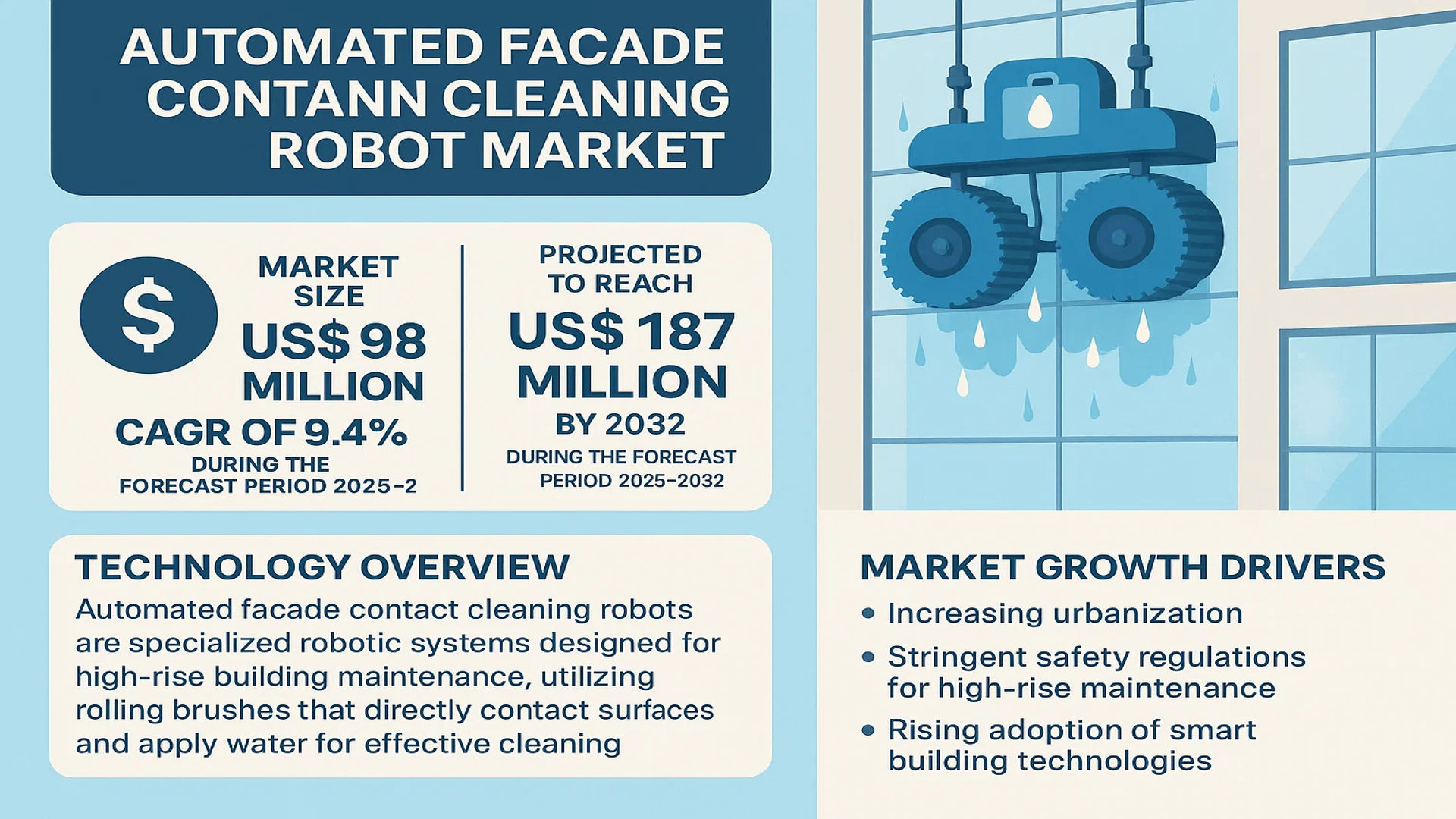
The global Automated Facade Contact Cleaning Robot Market size was valued at US$ 98 million in 2024 and is projected to reach US$ 187 million by 2032, at a CAGR of 9.4% during the forecast period 2025-2032.
Automated facade contact cleaning robots are specialized robotic systems designed for high-rise building maintenance. These devices utilize rolling brushes that directly contact building surfaces to scrub away dirt while simultaneously applying water for more effective cleaning. The technology represents a significant advancement over traditional manual methods by improving efficiency and reducing human risk in high-altitude operations.
The market growth is driven by increasing urbanization, stringent safety regulations for high-rise maintenance, and the rising adoption of smart building technologies. Key players such as Kite Robotics, IPC Eagle, and Skyline Robotics are innovating with AI-powered solutions, contributing to market expansion. In 2024, cable-based systems dominated the product segment with over 65% market share due to their reliability in tall structures, while commercial applications accounted for nearly 70% of total revenue as corporations increasingly invest in automated building maintenance solutions.
MARKET DYNAMICS
MARKET DRIVERS
Growing Focus on Building Maintenance and Aesthetic Appeal to Drive Adoption
The increasing emphasis on urban building maintenance and facade aesthetics is significantly boosting the automated facade cleaning robot market. As cities expand vertically with high-rise constructions, manual cleaning methods become increasingly hazardous and inefficient. These robots provide a safer alternative while delivering superior cleaning quality through direct surface contact technology. The global construction industry is witnessing steady growth, with commercial high-rises particularly driving demand – commercial applications currently account for approximately 62% of the automated facade cleaning robot market share. This trend is particularly pronounced in Asia-Pacific, where rapid urbanization is creating massive demand for efficient high-rise maintenance solutions.
Technological Advancements in Robotics to Accelerate Market Growth
Significant improvements in robotic vision systems, AI-powered navigation, and water recycling mechanisms are making automated facade cleaning robots more capable and cost-effective. Modern systems now incorporate advanced sensors that can detect facade irregularities and adjust cleaning patterns accordingly, while machine learning algorithms enable route optimization. Recent innovations include automated water recycling systems that reduce consumption by up to 70%, addressing sustainability concerns. The integration of IoT connectivity allows for remote monitoring and predictive maintenance, further enhancing operational efficiency. These technological leapfrogs are making robotic solutions increasingly attractive compared to traditional methods.
Increasing Safety Regulations to Boost Market Penetration
Stringent workplace safety regulations worldwide are compelling building owners to shift from risky human-led cleaning operations to robotic solutions. The high accident rate in traditional window cleaning – particularly for high-rise buildings – has led many governments to implement stricter safety requirements. Rope access cleaning, while still prevalent, faces increasing scrutiny due to its inherent risks. Automated robots eliminate the need for human workers to operate at dangerous heights while delivering more consistent results. In Europe and North America particularly, stringent OSHA and EU safety directives are accelerating adoption rates as building owners seek compliance while maintaining operational efficiency.
MARKET RESTRAINTS
High Initial Investment Costs Remain Significant Adoption Barrier
While operational costs are lower long-term, the substantial upfront investment required for robotic facade cleaning systems remains a key market restraint. A single automated cleaning unit can cost between $50,000 to $150,000 depending on capabilities, making it difficult for small and medium-sized facilities to justify the expenditure. Additionally, specialized installation requirements and potential facade modifications can add 20-30% to initial costs. Many building owners continue to favor traditional cleaning methods due to lower immediate expenses, despite higher long-term operational costs and safety risks.
Other Restraints
Technical Limitations on Certain Facade Types
Current robotic systems face challenges with highly irregular surfaces, curved glass structures, and certain specialized materials. While technology is improving, approximately 15-20% of modern architectural designs still present compatibility issues for standard cleaning robots. This limitation restricts market potential in certain high-end architectural segments.
Limited Awareness in Developing Markets
In emerging economies, lack of awareness about robotic cleaning alternatives and entrenched reliance on low-cost manual labor significantly slows adoption. Many building operators in these regions remain unfamiliar with the long-term cost benefits and safety advantages of automated solutions.
MARKET CHALLENGES
Operational Limitations in Extreme Weather Conditions Pose Implementation Challenges
Automated facade cleaning robots face performance issues during adverse weather, particularly in regions with extreme temperatures or frequent precipitation. Systems may malfunction in sub-zero conditions where water freezing affects cleaning mechanisms, while high winds can disrupt positioning accuracy. These limitations reduce operational windows in certain climates, necessitating supplementary cleaning methods during unsuitable weather periods.
Other Challenges
Regulatory Variance Across Regions
Significant differences in safety and operational regulations between countries complicate large-scale deployment strategies. Some jurisdictions have strict rules regarding water usage and runoff from cleaning operations, requiring complex system modifications for compliance.
Power Supply and Infrastructure Requirements
The need for reliable power sources and potential facade modifications for proper robot operation presents implementation hurdles. Many older buildings require infrastructure upgrades before robotic systems can be deployed effectively.
MARKET OPPORTUNITIES
Emerging Smart City Initiatives to Create Substantial Growth Potential
The global smart city movement presents significant opportunities for automated facade cleaning solutions. As urban centers integrate more IoT-enabled infrastructure, demand grows for compatible cleaning systems that can interface with smart building management platforms. Many municipal governments are allocating substantial budgets for modernizing city infrastructure, including automated maintenance solutions. The smart cities market is projected to maintain double-digit growth, creating parallel opportunities for robotic cleaning technologies that offer data collection and reporting capabilities.
Retrofit Market for Existing Buildings Offers Untapped Potential
While new construction drives adoption, the massive inventory of existing high-rise buildings represents a largely underserved market opportunity. As building owners recognize the long-term cost and safety benefits of robotic solutions, retrofit installations are becoming increasingly common. This segment is particularly significant in mature real estate markets with extensive existing commercial building stock that requires regular maintenance.
Service-based Business Models to Expand Market Accessibility
Many vendors are shifting toward robotics-as-a-service (RaaS) models to overcome adoption barriers. These subscription-based offerings dramatically reduce upfront costs for building owners while providing vendors with recurring revenue streams. The RaaS approach makes automated cleaning accessible to a broader range of properties and represents one of the fastest-growing segments in the industry.
AUTOMATED FACADE CONTACT CLEANING ROBOT MARKET TRENDS
Rising Urbanization and Smart City Initiatives Fuel Demand for Automated Cleaning Solutions
The global shift toward urbanization is accelerating the adoption of automated facade contact cleaning robots, with cities prioritizing efficient and safe building maintenance solutions. As skyscrapers and high-rise buildings become more prevalent, traditional cleaning methods involving human laborers on scaffolding or cranes are increasingly seen as risky and inefficient. Automated robots, equipped with rolling brushes and water jets, offer a superior alternative by minimizing human intervention while maximizing cleaning precision. The smart city movement has further spurred this adoption, with investments in automation technologies growing at a compound annual growth rate (CAGR) of nearly 7.5% over the past five years, a trend expected to persist as safety regulations tighten.
Other Trends
Technological Integration and AI-Driven Enhancements
The integration of AI and IoT into facade cleaning robots is revolutionizing the market, enabling real-time monitoring, predictive maintenance, and adaptive cleaning patterns. Advanced sensors allow robots to detect surface contaminants with high accuracy, adjusting water pressure and brush speed accordingly. Robotics firms are also leveraging machine learning to enhance navigation algorithms, ensuring robots operate seamlessly on complex building facades. The demand for these sophisticated solutions is expected to grow by over 25% annually in the next six years, particularly in commercial sectors where operational efficiency is critical.
Sustainability and Water Conservation Drive Innovation
Environmental concerns are pushing manufacturers to develop eco-friendly cleaning robots that reduce water wastage and chemical usage. Traditional facade cleaning consumes significant volumes of water, but robotic systems now incorporate closed-loop water recycling mechanisms, cutting consumption by up to 60%. Governments in regions like Europe and North America are incentivizing green building practices, with policies mandating water-efficient technologies. This regulatory push is creating a lucrative niche for automated cleaning solutions, particularly in markets where sustainability compliance is strictly enforced.
Shift Toward Wireless and Autonomous Systems
While cable-based robots currently dominate the market, wireless and fully autonomous systems are gaining traction due to their flexibility and reduced setup time. Innovations in battery technology and wireless charging enable robots to operate for extended periods without manual intervention. This shift is particularly evident in the Asia-Pacific region, where rapid commercial infrastructure development is driving demand for scalable cleaning solutions. Analysts project that wireless systems will account for nearly 40% of the market by 2030, given their ability to adapt to diverse architectural designs without extensive retrofitting.
COMPETITIVE LANDSCAPE
Key Industry Players
Automated Facade Cleaning Robotics Market Sees Rapid Innovation and Strategic Expansion
The global Automated Facade Contact Cleaning Robot market is highly competitive, with both established players and emerging innovators vying for market share. While the market remains fragmented, key players are investing heavily in R&D to enhance robot efficiency, AI integration, and sustainability features. Kite Robotics and Skyline Robotics currently lead the sector with their advanced window-cleaning robotics solutions, particularly in high-rise building applications.
IPC Eagle has gained significant traction in North America through its hybrid cleaning systems that combine both traditional and robotic cleaning methods. Meanwhile, Chinese manufacturers like Yantai Haitelin and Beijing Litu are expanding aggressively in the Asia-Pacific region, leveraging cost advantages and government support for smart city initiatives.
Technological differentiation is becoming crucial as companies compete on water efficiency, safety features, and autonomous operation capabilities. Several players are now incorporating computer vision and IoT connectivity to provide real-time facade condition monitoring alongside cleaning services.
Strategic partnerships are shaping the competitive landscape, with robotics firms collaborating with building management companies and facade engineering specialists. Recent developments show WCB Robotics and Serbot expanding into Middle Eastern markets, where high-rise construction is booming.
List of Key Automated Facade Cleaning Robot Companies Profiled
- Kite Robotics (U.S.)
- IPC Eagle (U.S.)
- Skyline Robotics (Israel)
- Autonopia (Germany)
- Yantai Haitelin (China)
- Beijing Litu (China)
- Sypron (Poland)
- WCB Robotics (South Korea)
- Derson Arc Cleaners (U.K.)
- Welbot Technology (China)
- Serbot (Switzerland)
- Sky Pro (Japan)
- Fraunhofer (Germany)
Segment Analysis:
By Type
Cable-Based Robots Dominate Due to Higher Stability and Load Capacity
The market is segmented based on type into:
- Cable
- Subtypes: Single-cable, Multi-cable, and others
- Wireless
- Subtypes: Battery-operated, Solar-powered, and others
- Hybrid
- Track-mounted
- Others
By Application
Commercial Segment Leads Owing to High Demand for Skyscraper Maintenance
The market is segmented based on application into:
- Residential
- Commercial
- Subtypes: Office buildings, Shopping malls, and others
- Industrial
- Government buildings
- Others
By End User
Facility Management Companies Drive Adoption for Efficient Building Maintenance
The market is segmented based on end user into:
- Facility management companies
- Construction companies
- Government agencies
- Real estate developers
- Others
By Operation Mode
Fully Autonomous Segment Gains Traction with Advancements in AI and Machine Learning
The market is segmented based on operation mode into:
- Manual operation
- Semi-autonomous
- Fully autonomous
- Remote-controlled
Regional Analysis: Automated Facade Contact Cleaning Robot Market
Asia-Pacific
The Asia-Pacific region dominates the global automated facade cleaning robot market, driven by rapid urbanization, high-rise building construction, and labor cost pressures. Countries like China, Japan, and South Korea are witnessing significant adoption due to innovative smart city initiatives and stringent workplace safety regulations. China’s market alone accounts for over 35% of regional demand, with companies like Yantai Haitelin and Beijing Litu leading domestic production. While initial adoption focuses on commercial buildings, residential applications are growing as developers integrate cleaning solutions into property management services. Water recycling features are becoming mandatory in major cities to address environmental concerns.
North America
North America represents the second-largest market, with the U.S. contributing nearly 80% of regional revenue. Strict OSHA safety regulations and insurance premium reductions for automated cleaning systems are key adoption drivers. Major players like IPC Eagle and Kite Robotics are introducing AI-powered navigation systems for complex building geometries. The commercial sector dominates applications, particularly in financial districts and tech campuses. However, high initial costs limit widespread adoption in mid-market segments. Recent developments include hybrid systems that combine drone technology with contact cleaning for hard-to-reach areas.
Europe
Europe’s market growth is fueled by sustainability mandates and historic building preservation needs. Germany and France lead in adoption, with regulations requiring water-efficient cleaning methods for protected facades. Companies like Serbot and Fraunhofer specialize in heritage-compatible robotic solutions. The EU’s Green Building Initiative is accelerating retrofitting projects that incorporate automated cleaning systems. While labor unions initially resisted automation, partnerships with equipment manufacturers have created new technician training programs. Northern European countries show particular interest in winter-grade robots capable of operating in sub-zero temperatures.
Middle East & Africa
The Middle East presents a high-growth market, especially in UAE and Saudi Arabia, where ambitious skyscraper projects demand innovative maintenance solutions. Dust accumulation in desert climates creates unique cleaning challenges that robotic systems address through specialized filtration. Though currently a premium service limited to luxury developments, municipal initiatives in smart cities like NEOM are driving broader adoption. Africa’s market remains nascent but shows potential in South Africa and Nigeria, where security concerns make unmanned cleaning solutions attractive for high-end commercial properties.
South America
South America’s market growth is constrained by economic instability but shows pockets of opportunity in Brazil’s financial centers and Chile’s mining corporate hubs. Building managers prioritize cost-effective cable-based systems over wireless models due to infrastructure limitations. Local manufacturers face competition from Chinese imports, though Argentina’s Autonopia has gained market share with customized solutions for colonial-style architecture. Environmental regulations are gradually encouraging adoption, particularly in cities battling air pollution from construction activities.
Report Scope
This market research report provides a comprehensive analysis of the global Automated Facade Contact Cleaning Robot market, covering the forecast period 2024–2032. It offers detailed insights into market dynamics, technological advancements, competitive landscape, and key trends shaping the industry.
Key focus areas of the report include:
- Market Size & Forecast: Historical data and future projections for revenue, unit shipments, and market value across major regions and segments.
- Segmentation Analysis: Detailed breakdown by product type (Cable vs. Wireless), application (Residential vs. Commercial), and end-user industries to identify high-growth segments.
- Regional Outlook: Insights into market performance across North America, Europe, Asia-Pacific, Latin America, and Middle East & Africa, including country-level analysis.
- Competitive Landscape: Profiles of leading market participants including Kite Robotics, IPC Eagle, and Skyline Robotics, covering their product portfolios, market share, and strategic initiatives.
- Technology Trends: Assessment of automation advancements, AI integration, water-saving technologies, and evolving cleaning methodologies.
- Market Drivers & Challenges: Evaluation of factors such as urbanization, green building initiatives, and safety regulations alongside implementation challenges.
- Stakeholder Analysis: Strategic insights for robot manufacturers, building service providers, facility managers, and investors.
The research employs primary and secondary methodologies, including interviews with industry leaders and analysis of verified market data, to ensure accuracy and reliability.
FREQUENTLY ASKED QUESTIONS:
What is the current market size of Global Automated Facade Contact Cleaning Robot Market?
-> Automated Facade Contact Cleaning Robot size was valued at US$ 98 million in 2024 and is projected to reach US$ 187 million by 2032, at a CAGR of 9.4% .
Which key companies operate in this market?
-> Major players include Kite Robotics, IPC Eagle, Skyline Robotics, Autonopia, and Yantai Haitelin, with the top five companies holding approximately 42% market share in 2024.
What are the key growth drivers?
-> Primary drivers include increasing high-rise construction (global skyscraper count grew 48% in 2010-2020), worker safety regulations, and water conservation requirements in urban areas.
Which region dominates the market?
-> Asia-Pacific accounts for 38% of global demand in 2024, led by China’s rapid urbanization, while North America shows the highest adoption rate per capita.
What are the emerging trends?
-> Emerging trends include AI-powered navigation systems, water recycling features, modular designs for multi-surface cleaning, and integration with building management systems.

Get Sample Report PDF for Exclusive Insights
Report Sample Includes
- Table of Contents
- List of Tables & Figures
- Charts, Research Methodology, and more...
 Download Sample Report PDF