AR-VR Devices Haptic Driver IC Market Insights
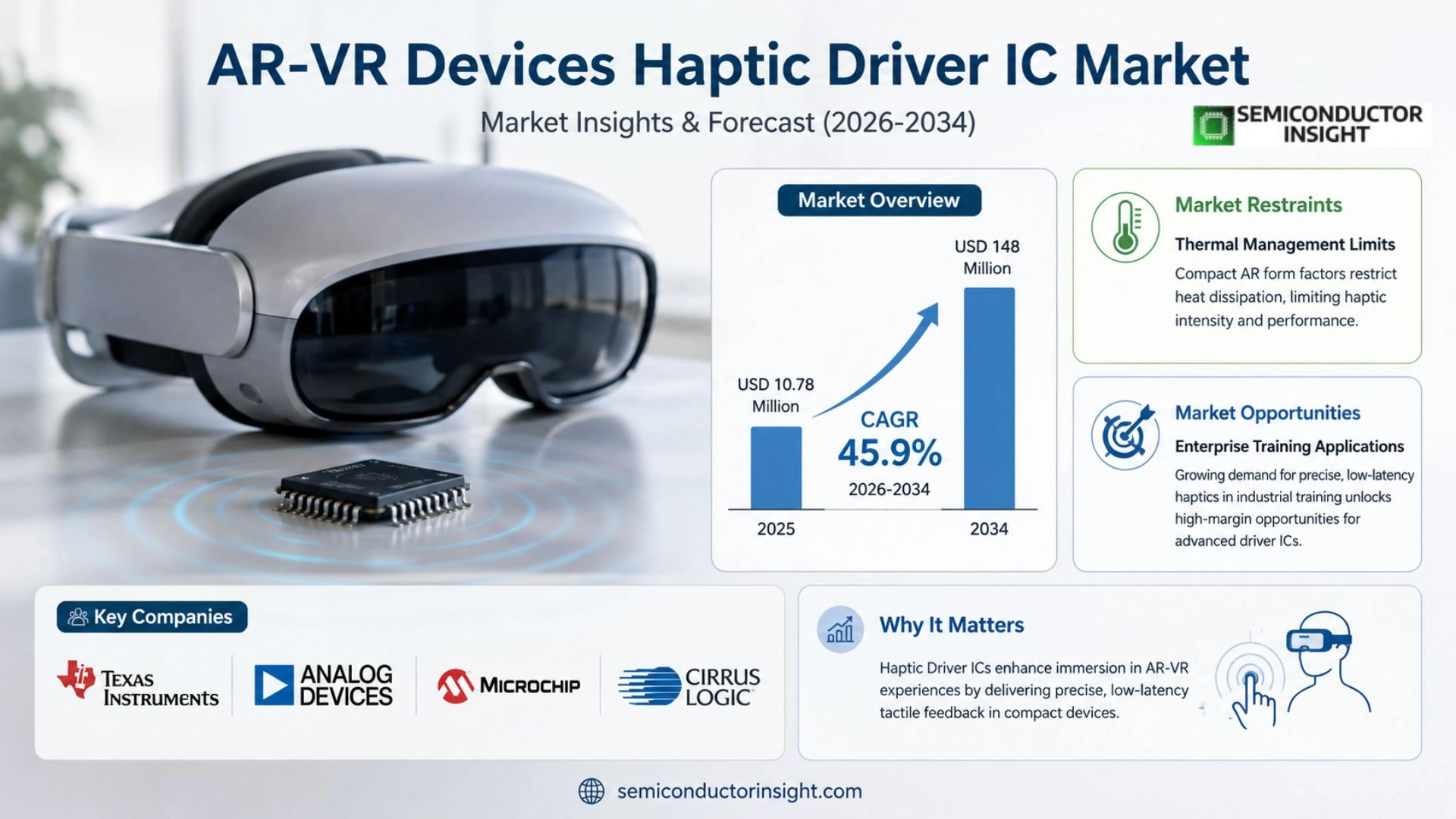
AR‑VR Devices Haptic Driver IC market was valued at USD 10.78 million in 2025 and is projected to reach USD 148 million by 2034, exhibiting a CAGR of 45.9% during the forecast period.
AR and VR device haptic driver ICs are specialized mixed‑signal chips employed in AR glasses, VR headsets, MR devices, game controllers and related wearables. Their core function is to translate host touch commands into low‑latency, repeatable mechanical feedback while meeting stringent size, power and thermal limits. The dominant technology paths comprise low‑voltage closed‑loop drivers for ERM/LRA actuators and high‑voltage waveform drivers for piezo actuators, featuring automatic resonance tracking, fast start‑up/braking, on‑chip waveform libraries or SRAM storage, real‑time streaming playback and fault diagnostics.
The market is gaining momentum because XR hardware is shifting from pure visual/audio competition toward multi‑modal experience differentiation, making haptic feedback a decisive user‑experience element. Vendor roadmaps from Texas Instruments and Renesas demonstrate integration of closed‑loop control and on‑chip waveform playback, signaling a move from simple vibration generators to system‑level haptic solutions. Moreover, International Data Corporation reports that the global XR device market is expected to grow by 44.4 % year over year in 2025 and 33.5 % in 2026, underscoring expanding demand for immersive interaction components such as haptic driver ICs.
MARKET DRIVERS
Consumer Immersion Demand
Recent releases from leading headset manufacturers showcase tactile feedback that rivals real‑world touch, pushing end‑users to expect richer sensations. This expectation fuels a steady influx of design projects that embed haptic driver ICs directly into optical stacks, shortening the time‑to‑market for next‑gen experiences.
Integration Cost Decline
Advances in semiconductor packaging have trimmed bill‑of‑materials for haptic drivers by roughly 15 % over the past twelve months. The resulting margin improvement encourages OEMs to allocate larger portions of their budgets to tactile modules, expanding the overall addressable base of AR‑VR Devices Haptic Driver IC Market.
➤ “Adopting compact, low‑power driver ICs translates into longer battery life and more immersive sessions,” notes a senior engineering director at a major headset firm.
Because tactile realism now differentiates premium devices, brands that secure a reliable supply of high‑performance driver chips are positioned to capture early adopters, reinforcing a virtuous cycle of investment and product refinement.
MARKET CHALLENGES
Supply Chain Volatility
Foundries juggling demand spikes for AI accelerators have occasionally deferred capacity for mixed‑signal ICs, creating intermittent bottlenecks for haptic driver production. Consequently, project timelines can slip, prompting some developers to retain legacy solutions longer than preferred.
Other Challenges
Regulatory Hurdles
Safety standards for wearable electronics differ across regions, and compliance testing adds both cost and lead time. Companies must navigate divergent electromagnetic‑interference limits, which can restrict design flexibility.
MARKET RESTRAINTS
Thermal Management Limits
The confined geometry of AR glasses leaves little room for heat sinks. As driver ICs push higher current densities to achieve stronger actuation, designers face trade‑offs between tactile intensity and device temperature, often curbing the maximum feasible haptic strength.
MARKET OPPORTUNITIES
Enterprise Training Applications
Manufacturers of industrial simulators are integrating precise haptic cues to replicate equipment vibrations and resistance. This niche demands driver ICs with ultra‑low latency and customizable waveform libraries, presenting a high‑margin revenue stream for suppliers that can certify performance under rigorous operational conditions.
AR-VR Devices Haptic Driver IC Market Trends
Integration of Closed‑Loop Control for Immersive Feedback
AR‑VR Devices Haptic Driver IC Market is witnessing a decisive shift toward closed‑loop driver architectures that combine automatic resonance tracking with on‑chip waveform libraries. This approach reduces latency to a few microseconds, allowing AR glasses and VR headsets to deliver tactile cues that feel synchronized with visual content. Designers are favoring low‑voltage closed‑loop drivers for ERM and LRA actuators because they meet the stringent power envelope of wearable platforms while preserving tactile fidelity. At the same time, high‑voltage piezo drivers are gaining traction in lightweight XR accessories, where bandwidth and localized feedback are paramount. The convergence of these pathways is prompting chip manufacturers to bundle diagnostic functions and fault‑tolerant logic directly into the IC, thereby shortening the validation cycle for OEMs and improving overall system reliability.
Other Trends
Emergence of Piezoelectric Driver Architectures
Piezoelectric driver ICs are moving beyond niche applications, propelled by the demand for thinner form factors and higher frequency vibration patterns. Manufacturers such as Analog Devices have introduced high‑voltage drivers capable of delivering up to 110 V peak‑to‑peak, enabling compact actuators that can be embedded in slim AR lenses. The ability to generate narrow‑band, high‑precision pulses expands the design space for developers seeking to simulate textures or subtle surface interactions. This capability is especially relevant for medical treatment devices and precision gaming peripherals, where nuanced feedback differentiates premium products from commodity offerings.
Regional Competition and Supply‑Chain Dynamics
While the United States and Japan continue to dominate high‑performance analog design, Korean and Chinese firms are leveraging efficient supply chains to offer competitively priced solutions with comparable performance metrics. Companies such as Zinitix and Shanghai Awinic Technology are explicitly targeting XR and gaming segments, reinforcing the competitive pressure on established players. This regional diversification is prompting a wave of collaborative development programs, wherein Western design expertise is paired with Asian manufacturing scalability, ultimately accelerating time‑to‑market for next‑generation haptic systems.
COMPETITIVE LANDSCAPE
Key Industry Players
Competitive dynamics shaping the AR‑VR haptic driver IC ecosystem
The market is anchored by a handful of semiconductor powerhouses that have translated deep mixed‑signal expertise into dedicated haptic drivers for immersive devices. Texas Instruments leads the field with a broad portfolio that spans low‑voltage closed‑loop solutions for ERM/LRA actuators and high‑voltage piezo drivers, leveraging its extensive analog design base and aggressive automotive‑grade reliability programs. Analog Devices follows closely, differentiating through integrated waveform libraries and precision resonance‑tracking blocks that appeal to premium headset OEMs seeking sub‑millisecond latency. Microchip Technology rounds out the top tier by offering a cost‑optimized line of open‑loop drivers paired with turnkey evaluation kits, a formula that resonates with volume‑focused gaming controller manufacturers. The concentration of design wins among these three firms reflects a market structure where integration depth, reference design support, and the ability to co‑engineer with actuator suppliers dictate competitive advantage.
Beyond the dominant trio, a diverse set of niche players is expanding the competitive perimeter. Renesas Electronics and Cirrus Logic provide mixed‑signal IP that targets mid‑range wearables, while onsemi and Boréas Technologies specialize in ultra‑compact packages suited for AR glasses where form‑factor constraints dominate. Asian manufacturers such as Dongwoon Anatech, IMAGIS, SNA Co., ZINITIX, and Shanghai Awinic Technology are capitalizing on regional supply‑chain efficiencies to offer aggressive pricing and rapid product cycles, often coupling ICs with locally produced actuators. This stratified landscape creates a bifurcated battle: legacy analog leaders vie for high‑value design contracts, whereas emerging firms chase volume in cost‑sensitive segments, forcing all participants to continuously innovate on power efficiency, integration density, and software tooling.
List of Key AR‑VR Devices Haptic Driver IC Companies Profiled
- Texas Instruments
- Analog Devices
- Microchip Technology
- Cirrus Logic
- onsemi
- Boréas Technologies
- Renesas Electronics
- Dongwoon Anatech
- IMAGIS Co., Ltd.
- SNA Co., Ltd.
- ZINITIX Co., Ltd.
- Shanghai Awinic Technology Co., Ltd.
Segment Analysis:
| Segment Category | Sub-Segments | Key Insights |
| By Type |
|
LRA Driver IC
|
| By Application |
|
Wearable Devices
|
| By End User |
|
Gaming Controllers
|
| By Actuator Architecture |
|
Closed‑Loop Drivers
|
| By Technology Trend |
|
Automatic Resonance Tracking
|
Regional Analysis: AR-VR Devices Haptic Driver IC Market
North America
The convergence of high‑resolution displays and more responsive haptic drivers is prompting mainstream gamers to upgrade their rigs, while streaming platforms experiment with tactile feedback to enrich viewer engagement. These shifts compel manufacturers to align driver IC specifications with user expectations for seamless, low‑latency sensations.
Corporations investing in immersive training modules are demanding driver solutions that can replicate nuanced textures, influencing suppliers to develop customizable force curves that can be tuned for specific industrial scenarios.
Recent logistics constraints have accelerated the reshoring of critical component fabrication, especially for precision‑tuned driver ICs, thereby shortening lead times and improving resilience for North American headset makers.
Updated safety standards for wearable electronics are prompting designers to embed protective circuitry within driver ICs, a development that adds a layer of compliance without sacrificing performance.
Europe
European firms are leveraging strong collaborations between automotive OEMs and AR‑VR innovators, channeling haptic driver development toward cockpit simulation and driver‑assistance testing. The region’s emphasis on sustainability drives research into recyclable materials for actuator components, pushing suppliers to consider eco‑friendly manufacturing routes while maintaining tactile fidelity.
Asia‑Pacific
In Asia‑Pacific, the market is buoyed by rapid adoption of mixed‑reality experiences in mobile entertainment and educational platforms. Manufacturers are capitalizing on cost‑effective silicon production capabilities, enabling a wave of competitively priced headsets that integrate advanced haptic drivers, thereby expanding the addressable user base beyond early adopters.
South America
South American markets are witnessing incremental growth as telecom operators roll out 5G coverage, unlocking low‑latency streaming of AR‑VR content. Local hardware assemblers are beginning to source driver ICs from regional foundries, fostering a nascent supply chain that could reduce dependence on imports.
Middle East & Africa
The Middle East & Africa region is exploring AR‑VR applications for remote diagnostics and oil‑field training, where precise haptic feedback can simulate tactile cues of equipment handling. Investment incentives from sovereign wealth funds are encouraging startups to prototype driver‑centric solutions tailored to harsh environments.
Report Scope
This market research report provides a comprehensive analysis of the AR-VR Devices Haptic Driver IC Market , covering the forecast period 2026–2034. It offers detailed insights into market dynamics, technological advancements, competitive landscape, and key trends shaping the industry.
Key focus areas of the report include:
- Market Overview: The report begins with an overview outlining its current market scenario, key growth indicators, and industry transformation drivers. It discusses macroeconomic factors, demand–supply balance, regulatory landscape, and the strategic role of semiconductors in powering advancements across industries such as automotive, telecommunications, consumer electronics, and industrial automation.
- Market Size & Forecast: Historical data and future projections for revenue, unit shipments, and market value across major regions and segments.
- Segmentation Analysis: Detailed breakdown by product type, technology, application, and end-user industry to identify high-growth segments and investment opportunities.
- Regional Insights: Insights into market performance across North America, Europe, Asia-Pacific, Latin America, and the Middle East & Africa, including country-level analysis where relevant.
- Competitive Landscape: Profiles of leading market participants, including their product offerings, R&D focus, manufacturing capacity, pricing strategies, and recent developments such as mergers, acquisitions, and partnerships.
- Technology Trends & Innovation: Assessment of emerging technologies, integration of AI/IoT, semiconductor design trends, fabrication techniques, and evolving industry standards.
- Market Drivers & Restraints: Evaluation of factors driving market growth along with challenges, supply chain constraints, regulatory issues, and market-entry barriers.
- Stakeholder Insights: Insights for component suppliers, OEMs, system integrators, investors, and policymakers regarding the evolving ecosystem and strategic opportunities.
Primary and secondary research methods are employed, including interviews with industry experts, data from verified sources, and real-time market intelligence to ensure the accuracy and reliability of the insights presented.
FREQUENTLY ASKED QUESTIONS:
What is the current market size of AR-VR Devices Haptic Driver IC Market?
-> AR‑VR Devices Haptic Driver IC market is projected to reach USD 148 million by 2034, exhibiting a CAGR of 45.9% during the forecast period.
Which key companies operate in AR-VR Devices Haptic Driver IC Market?
-> Key players include Texas Instruments, Analog Devices, Inc., Microchip Technology Inc., Renesas Electronics Corporation, Cirrus Logic, Inc., onsemi, Boréas Technologies Inc., Dongwoon Anatech Co., Ltd., IMAGIS Co., Ltd., SNA Co., Ltd., ZINITIX Co., Ltd., Shanghai Awinic Technology Co., Ltd.
What are the key growth drivers?
-> Key growth drivers include rapid expansion of XR hardware, increasing demand for low‑latency haptic feedback in AR/VR/MR devices, integration of closed‑loop driver technologies, and the push for lighter, power‑efficient miniature packaging.
Which region dominates the market?
-> North America leads in market share due to strong semiconductor capabilities in the United States, while Asia‑Pacific shows the fastest growth driven by Chinese and Korean manufacturers.
What are the emerging trends?
-> Emerging trends include dual‑track driver architectures (ERM/LRA and piezoelectric), on‑chip waveform libraries, real‑time streaming playback, and increased focus on system‑level haptic optimization for immersive XR experiences.
Get Sample Report PDF for Exclusive Insights
Report Sample Includes
- Table of Contents
- List of Tables & Figures
- Charts, Research Methodology, and more...
 Download Sample Report PDF