Haptic Driver IC Market Insights
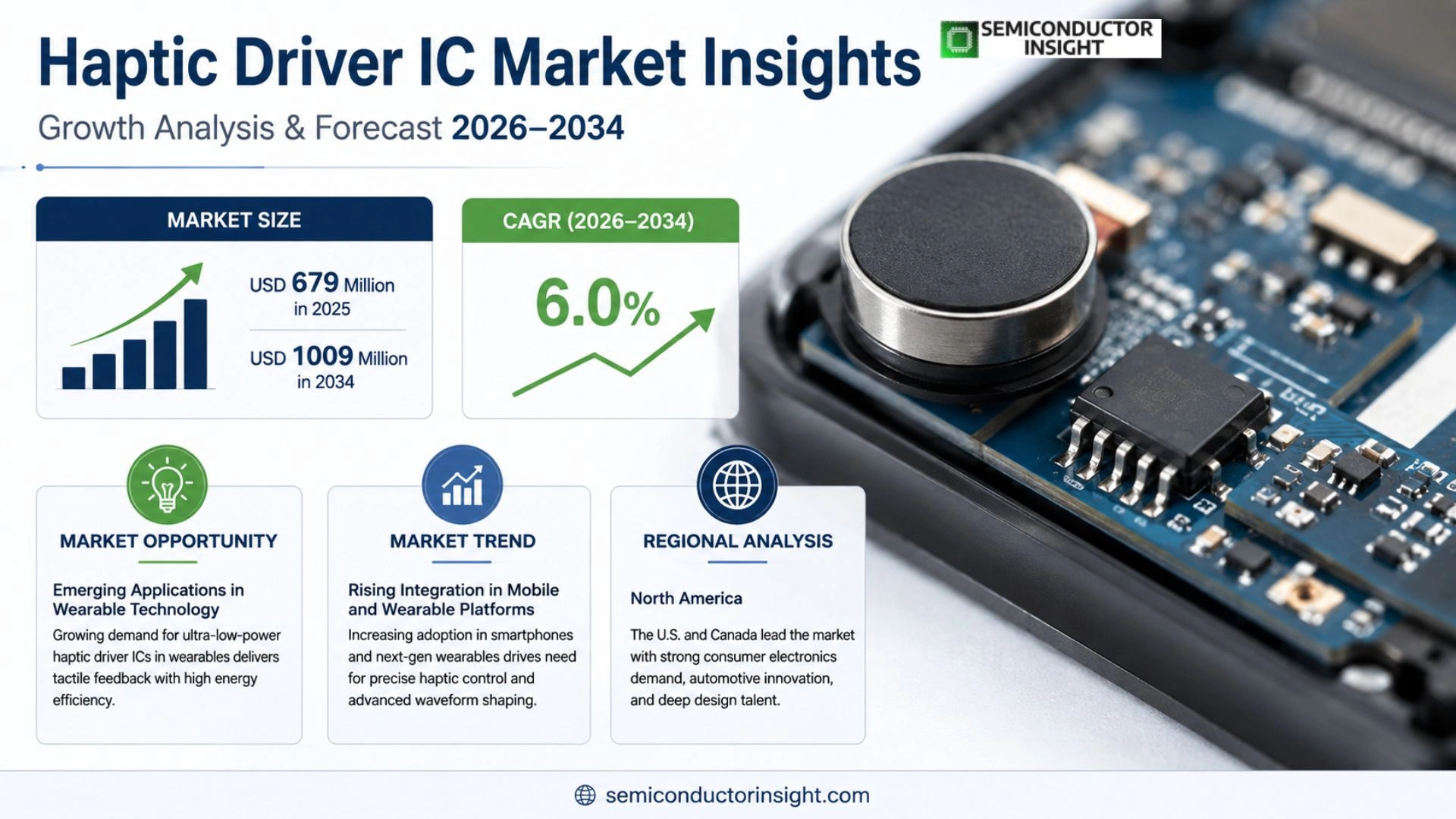
Haptic Driver IC market size was valued at USD 679 million in 2025 and will grow to USD 1009 million by 2034, reflecting a CAGR of 6.0% over the forecast period.
Haptic Driver ICs are integrated circuits that supply power and precise control signals to haptic actuators such as eccentric rotating mass (ERM) and linear resonant actuators (LRA). They manage voltage, frequency, waveform shape and drive strength, often embedding closed‑loop control, waveform memory and resonance tracking for higher responsiveness and energy efficiency. Typical unit prices range from USD 0.2 to USD 2, with advanced programmable solutions positioned at the upper end.
The market expands because smartphones, wearables, automotive touch interfaces and gaming devices increasingly rely on tactile feedback to differentiate user experience. Manufacturers are adding closed‑loop features and integrating drivers into PMICs or system‑on‑chip platforms, which lowers component count while raising performance expectations. Companies such as Texas Instruments, ON Semiconductor, Infineon Technologies and Synaptics continue releasing new generations that support LRA and piezo actuators, reinforcing the upward trend.
MARKET DRIVERS
Rising Adoption of Immersive Interfaces
The surge in consumer interest for augmented‑reality (AR) and virtual‑reality (VR) platforms is prompting OEMs to embed tactile feedback that feels natural. Manufacturers view precise vibration cues as a way to differentiate products, leading to a noticeable uptick in design budgets allocated to haptic solutions within Haptic Driver IC market.
Increasing Demand for Compact Automotive Haptics
Automotive cabins are becoming digital ecosystems where drivers rely on nuanced alerts for safety and convenience. The trend toward miniaturized driver ICs that can operate across a wide temperature range is fueling component orders from Tier‑1 suppliers seeking to meet stricter driver‑assist regulations.
➤ Industry analysts note that the convergence of consumer electronics and automotive requirements is creating a hybrid demand curve that benefits suppliers able to service both segments.
These dynamics collectively raise the strategic importance of Haptic Driver IC market, prompting investors to monitor supply‑chain resilience and innovation pipelines closely.
MARKET CHALLENGES
Escalating Development Costs
Designing driver ICs that meet stringent low‑power and high‑frequency specifications demands sophisticated process technologies. The capital outlay required for silicon validation and firmware integration often exceeds the budget caps of midsize device makers, limiting entry of new competitors.
Other Challenges
Supply Chain Constraints
The reliance on specialized substrates and analog components creates bottlenecks, especially when global semiconductor fab capacity is stretched. Firms that cannot secure long‑term material agreements risk delayed product launches.
MARKET RESTRAINTS
Regulatory Barriers in Healthcare Devices
Medical-grade haptic feedback systems must satisfy rigorous safety certifications, which extend development cycles and increase compliance costs. The necessity to demonstrate biocompatibility and electromagnetic compatibility restricts rapid adoption of new driver IC architectures within Haptic Driver IC market.
MARKET OPPORTUNITIES
Emerging Applications in Wearable Technology
Wearables are transitioning from simple activity trackers to sophisticated health‑monitoring platforms that rely on tactile alerts for real‑time feedback. This shift opens a niche for ultra‑low‑power driver ICs capable of delivering nuanced haptic patterns while preserving battery life, positioning Haptic Driver IC market for incremental growth in a segment that values both ergonomics and energy efficiency.
Haptic Driver IC Market Trends
Rising Integration in Mobile and Wearable Platforms
Haptic Driver IC market is seeing intensified placement of tactile controllers inside flagship smartphones and next‑generation wearables. As manufacturers chase higher user‑experience scores, they embed more sophisticated vibration engines that demand precise voltage regulation and waveform shaping. This pressure has prompted semiconductor firms to bundle closed‑loop algorithms directly into driver silicon, enabling millisecond‑level latency and programmable patterns without external processors. The result is a noticeable shift in bill‑of‑materials composition, where a single driver can replace multiple discrete components, reducing board space and power draw,critical advantages for devices striving for thinner profiles and longer battery lives.
Other Trends
Shift Toward Closed‑Loop Architectures
Closed‑loop designs now dominate new product introductions because they deliver consistent feedback across temperature swings and manufacturing variances. By continuously monitoring actuator position, these drivers adjust drive strength in real time, which translates into smoother haptic sensations for end users. OEMs value this capability for premium automotive touch panels and immersive gaming controllers, where unpredictable vibrations could undermine perceived quality. The engineering effort required to implement such feedback loops is increasingly outsourced to fabless specialists, allowing system integrators to focus on form factor and software integration.
Emergence of System‑Level Power Management Integration
Another observable trend is the convergence of haptic drivers with broader power‑management IC (PMIC) platforms. By co‑hosting haptic control blocks alongside voltage regulators and battery‑management circuits, chip providers can offer a single package that addresses both power efficiency and tactile performance. This integration reduces component count and simplifies firmware development, a benefit that resonates with OEMs targeting cost‑sensitive mid‑range segments. At the same time, high‑end devices continue to favor dedicated driver ICs that support advanced waveform memory and piezo‑actuator compatibility, preserving higher margins for niche applications where tactile fidelity is a market differentiator.
COMPETITIVE LANDSCAPE
Key Industry Players
Haptic Driver IC Market – Competitive Overview
Texas Instruments dominates the high‑volume segment, leveraging its deep analog‑mixed‑signal expertise and a broad portfolio that spans open‑loop ERM drivers to closed‑loop LRA solutions. Its fabless model, coupled with strong design‑win relationships in smartphone OEMs, creates a barrier to entry for newer entrants. The company’s pricing power stems from economies of scale and a well‑established supply chain that includes leading foundries and OSAT partners. Competitive pressure is intensifying as mid‑tier players introduce integrated haptic modules, but TI’s ability to embed firmware updates and support multi‑device ecosystems keeps it firmly at the top of the market hierarchy.
Niche innovators such as Dongwoon Anatech, RichTap, and Zinitix focus on specialized closed‑loop architectures for wearable and automotive touch panels, carving out profitable slices where latency and energy efficiency are paramount. Mid‑size firms like Microchip, ON Semiconductor, and Synaptics differentiate through system‑on‑chip (SoC) integration, bundling power management with haptic control to appeal to cost‑sensitive OEMs. Asian manufacturers,including Shenzhen Goodix Technology, Wuhan Silicon Integrated, Shanghai Awinic Technology, and Chipsea Technologies,capitalize on rapid prototyping capabilities and close proximity to actuator suppliers, allowing them to respond swiftly to emerging form‑factor trends. Collectively, this diversified ecosystem supports a resilient market where product depth and application‑specific expertise drive competitive positioning.
List of Key Haptic Driver IC Companies Profiled
- Texas Instruments
- Dongwoon Anatech
- Microchip Technology
- ON Semiconductor
- Infineon Technologies
- Synaptics
- Renesas Electronics
- RichTap
- Zinitix
- Cirrus Logic
- Shenzhen Goodix Technology
- Wuhan Silicon Integrated
- Shanghai Awinic Technology
- Chipsea Technologies
Segment Analysis:
| Segment Category | Sub-Segments | Key Insights |
| By Type |
|
LRA Driver IC leads the segment because it offers precise resonance control, enabling smoother tactile sensations; – Designers prefer LRA for its low power draw and fast response, which supports immersive user experiences. – The technology integrates well with programmable waveforms, facilitating software‑defined haptics across devices. – OEMs value the predictable performance across temperature ranges, reinforcing its dominance in premium smartphones and wearables. |
| By Application |
|
Mobile Terminals dominate because tactile feedback is a core differentiator in flagship smartphones; – Manufacturers embed haptic drivers to enrich touch navigation, gaming, and accessibility features. – The rapid iteration cycles of mobile platforms drive continuous innovation in driver firmware and integration. – Consumer expectations for seamless, low‑latency vibrations push suppliers toward closed‑loop architectures. |
| By End User |
|
Smartphone OEMs are the primary end‑users, driving demand for highly integrated driver solutions; – The push for slimmer devices incentivizes the adoption of compact, low‑power ICs. – Integration of haptic drivers within PMICs creates system‑level efficiencies and cost advantages. – OEMs seek drivers that support multi‑modal feedback, aligning with AI‑driven user interfaces. |
| By Drive Method |
|
Closed‑loop Drive is emerging as the leading approach due to its ability to monitor actuator motion in real time; – It delivers consistent vibration intensity across device aging and temperature variations. – The feedback loop enables adaptive patterns that enhance user immersion in gaming and AR scenarios. – Although costlier, premium segments justify the investment for higher perceived quality. |
| By Integration Level |
|
Integrated Haptic Modules are gaining traction as system‑on‑chip strategies mature; – They reduce PCB footprint and simplify BOM management for compact devices. – Integration fosters tighter coordination between firmware and actuator control, improving latency. – OEMs view modules as a pathway to differentiate products without extensive custom ASIC development. |
Regional Analysis: Haptic Driver IC Market
North America
OEMs prioritize multi‑axis haptic drivers that can render nuanced textures, pushing suppliers to integrate advanced DAC techniques. The trend toward edge‑AI processing forces IC designers to embed configurable waveform engines, enabling real‑time adaptation to user interactions.
Proximity to wafer fabs reduces lead times, while diversified packaging partners mitigate single‑point failures. Companies are renegotiating contracts to secure silicon allotments for upcoming product cycles, reflecting a cautious stance on geopolitical volatility.
Federal safety standards for autonomous vehicles now reference haptic alerts as part of the driver‑monitoring suite. Compliance requirements compel manufacturers to source ICs with documented reliability metrics, influencing supplier selection.
Legacy players leverage established design‑win relationships, while emerging firms differentiate through ultra‑low‑voltage architectures that extend battery life for wearable devices. Strategic alliances with software firms amplify ecosystem lock‑in.
Europe
European manufacturers exhibit a strong preference for haptic solutions that comply with stringent electromagnetic‑compatibility directives. Automotive clusters in Germany and France treat tactile feedback as a safety adjunct, prompting joint development programs with regional silicon vendors. In consumer electronics, the emphasis on privacy drives integration of on‑device haptic processing, limiting reliance on cloud‑based AI. Design houses benefit from a well‑established standards ecosystem, which shortens certification timelines. Collaboration between research institutions and industry accelerates adoption of novel piezoelectric actuator interfaces, positioning Europe as a hub for next‑generation tactile experiences.
Asia‑Pacific
The Asia‑Pacific region blends massive manufacturing capacity with a rapidly maturing end‑user market. Mobile handset assemblers in South Korea and Taiwan embed sophisticated drivers to meet user expectations for immersive gaming. Meanwhile, China’s smart‑home rollout incorporates haptic feedback into appliance panels, creating a fertile ground for volume orders. Local fabless firms exploit cost‑effective silicon processes to offer competitive pricing, though they face pressure to improve power efficiency for wearables. Government incentives for IoT expansion indirectly boost demand for tactile interfaces, prompting several joint ventures between domestic providers and multinational design houses.
South America
In South America, market activity centers on niche applications such as biometric access controls and low‑cost educational tablets. Brazilian startups experiment with tactile feedback to differentiate e‑learning platforms, while Argentine automotive suppliers explore haptic cues for driver‑assist prototypes. Limited local fab capacity means most ICs are imported, creating a reliance on established global distributors. Nevertheless, regional trade agreements have lowered tariff barriers, allowing smaller players to acquire advanced driver ICs at more attractive price points. This evolving supply environment encourages partnerships that blend local market insight with external technology expertise.
Middle East & Africa
The Middle East & Africa segment is characterized by selective adoption in luxury automotive interiors and premium consumer electronics. Wealth‑driven demand for immersive in‑vehicle experiences drives collaborations with European and North American IC designers. In Africa, the focus lies on ruggedized devices for field health workers, where haptic feedback aids in error‑resilient data entry. Infrastructure constraints limit on‑site testing, prompting reliance on remote validation services. Despite modest overall volume, the region’s willingness to invest in differentiated tactile features offers a strategic foothold for vendors aiming to diversify their global footprint.
Report Scope
This market research report provides a comprehensive analysis of the Haptic Driver IC Market , covering the forecast period 2026–2034. It offers detailed insights into market dynamics, technological advancements, competitive landscape, and key trends shaping the industry.
Key focus areas of the report include:
- Market Overview: The report begins with an overview outlining its current market scenario, key growth indicators, and industry transformation drivers. It discusses macroeconomic factors, demand–supply balance, regulatory landscape, and the strategic role of semiconductors in powering advancements across industries such as automotive, telecommunications, consumer electronics, and industrial automation.
- Market Size & Forecast: Historical data and future projections for revenue, unit shipments, and market value across major regions and segments.
- Segmentation Analysis: Detailed breakdown by product type, technology, application, and end-user industry to identify high-growth segments and investment opportunities.
- Regional Insights: Insights into market performance across North America, Europe, Asia-Pacific, Latin America, and the Middle East & Africa, including country-level analysis where relevant.
- Competitive Landscape: Profiles of leading market participants, including their product offerings, R&D focus, manufacturing capacity, pricing strategies, and recent developments such as mergers, acquisitions, and partnerships.
- Technology Trends & Innovation: Assessment of emerging technologies, integration of AI/IoT, semiconductor design trends, fabrication techniques, and evolving industry standards.
- Market Drivers & Restraints: Evaluation of factors driving market growth along with challenges, supply chain constraints, regulatory issues, and market-entry barriers.
- Stakeholder Insights: Insights for component suppliers, OEMs, system integrators, investors, and policymakers regarding the evolving ecosystem and strategic opportunities.
Primary and secondary research methods are employed, including interviews with industry experts, data from verified sources, and real-time market intelligence to ensure the accuracy and reliability of the insights presented.
FREQUENTLY ASKED QUESTIONS:
What is the current market size of Haptic Driver IC Market?
-> Haptic Driver IC market will grow to USD 1009 million by 2034, reflecting a CAGR of 6.0% over the forecast period.
Which key companies operate in Haptic Driver IC Market?
-> Key players include TI, Dongwoon Anatech, Microchip, ON Semiconductor, Infineon Technologies, Synaptics, Renesas Electronics, RichTap, Zinitix, Cirrus Logic, Shenzhen Goodix Technology, Wuhan Silicon Integrated, Shanghai Awinic Technology, Chipsea Technologies.
What are the key growth drivers?
-> Key growth drivers include rising adoption of smartphones, wearables, automotive touch interfaces, and gaming devices; increasing demand for high‑performance closed‑loop and programmable haptic drivers; miniaturization of consumer electronics; and the push toward richer, immersive tactile experiences.
Which region dominates the market?
-> Asia accounts for the largest share of Haptic Driver IC market, driven by strong consumption in mobile terminals, wearable devices, and automotive applications, while also showing the fastest growth rates.
What are the emerging trends?
-> Emerging trends include integration of haptic drivers into PMICs and SoC platforms, development of software‑defined haptics, adoption of AI/IoT for adaptive feedback, and increased focus on low‑latency, energy‑efficient closed‑loop solutions for LRA and piezo actuators.
Get Sample Report PDF for Exclusive Insights
Report Sample Includes
- Table of Contents
- List of Tables & Figures
- Charts, Research Methodology, and more...
 Download Sample Report PDF