MARKET INSIGHTS
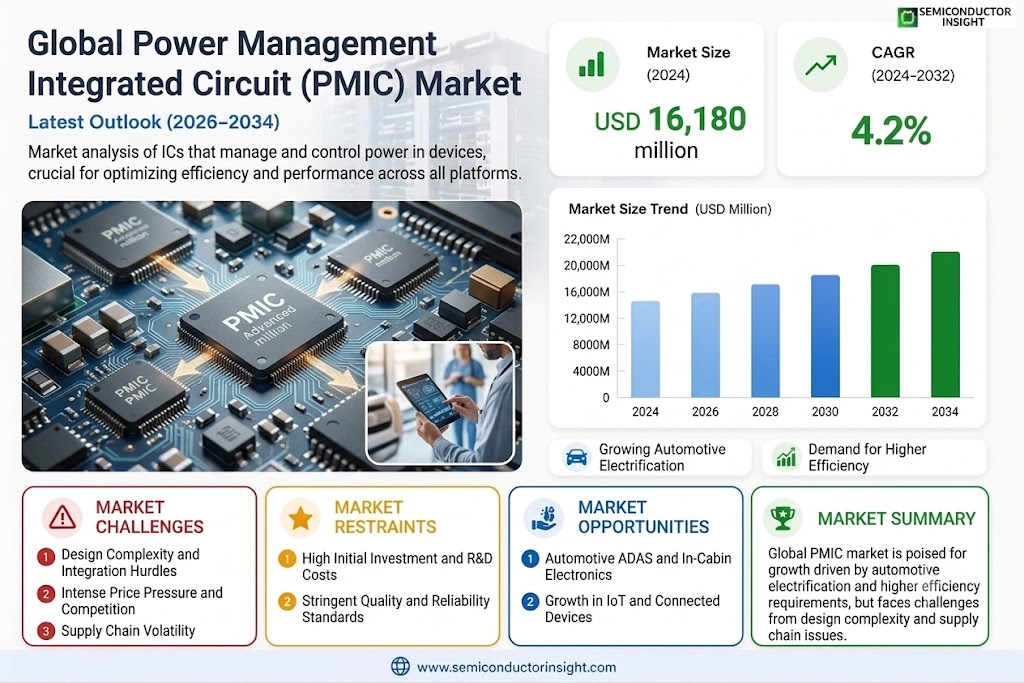
Global Power Management Integrated Circuit (PMIC) Market was valued at USD 16,180 million in 2024 to USD 21,470 million by 2032, exhibiting a CAGR of 4.2% during the forecast period.
Power Management Integrated Circuits (PMICs) are specialized semiconductor devices that manage power requirements and support voltage scaling and power delivery sequencing in electronic devices. These components are essential for optimizing power usage in any device with a power supply, battery, or power cord. PMICs encompass various product types including Voltage Regulators, Smart Home ICs, Standard Power ICs, Mobile Digital ICs, Industrial Driver ICs, and others.
The market is experiencing steady growth due to several factors, including increasing demand for energy-efficient electronics and rapid adoption of IoT devices across industries. Furthermore, the automotive sector’s transition toward electric vehicles and advanced driver assistance systems is contributing significantly to market expansion. Initiatives by key players in developing more integrated and efficient PMIC solutions are also expected to fuel market growth. For instance, leading manufacturers like Texas Instruments and Qualcomm continue to introduce advanced PMICs with higher power density and improved thermal performance for next-generation applications. Texas Instruments, Qualcomm, Analog Devices, STMicroelectronics, and Infineon are some of the key players that operate in the market with comprehensive product portfolios.
MARKET DRIVERS
Proliferation of Portable and Connected Electronics
The demand for PMICs is fundamentally driven by the exponential growth in smartphones, tablets, wearables, and other battery-powered consumer electronics. These devices require sophisticated power management for efficient battery usage, multiple voltage domains, and fast charging capabilities. The integration of advanced features like 5G connectivity and high-resolution displays further increases the complexity and necessity of PMICs.
Expansion of the Internet of Things (IoT) and Edge Computing
The deployment of billions of IoT devices, from industrial sensors to smart home appliances, creates a massive market for low-power PMICs. These applications demand components that can operate efficiently for years on small batteries or harvested energy, driving innovation in ultra-low-quiescent-current and power-efficient designs. Edge computing nodes also require robust power delivery and management solutions to ensure reliable operation.
➤ Global automotive industry’s shift towards electrification is a major catalyst. Electric vehicles (EVs) and hybrid vehicles rely on complex PMICs for battery management systems (BMS), onboard chargers, and infotainment systems, representing a high-growth segment.
Furthermore, the increasing power density and performance requirements of data centers, fueled by artificial intelligence (AI) and high-performance computing (HPC), are pushing the need for advanced, high-efficiency PMICs to manage power delivery to CPUs, GPUs, and ASICs while minimizing energy loss and heat generation.
MARKET CHALLENGES
Design Complexity and Integration Hurdles
As end-products become more feature-rich, PMICs must integrate more functionssuch as voltage regulators, battery chargers, and fuel gaugesinto a single chip. This increasing complexity leads to longer and more expensive design cycles, verification challenges, and potential yield issues during manufacturing.
Other Challenges
Intense Price Pressure and Competition
The PMIC market is highly competitive, with numerous established players and new entrants. This environment creates significant price pressure, especially for consumer electronics, forcing manufacturers to continuously reduce costs while adding functionality, which can squeeze profit margins.
Supply Chain Volatility and Material Shortages
The semiconductor industry has faced significant supply chain disruptions, including shortages of wafers and specific raw materials. These constraints can lead to extended lead times and increased component costs, impacting the ability of PMIC suppliers to meet market demand reliably.
MARKET RESTRAINTS
High Initial Investment and R&D Costs
Developing advanced PMICs requires substantial investment in research and development, specialized design tools, and state-of-the-art fabrication facilities. The high capital expenditure acts as a barrier to entry for new companies and can slow down the pace of innovation from smaller players, consolidating market power among a few large semiconductor firms.
Stringent Quality and Reliability Standards
PMICs used in automotive, medical, and industrial applications must adhere to rigorous standards for reliability, safety, and longevity. Meeting these certifications, such as AEC-Q100 for automotive, adds significant time and cost to the development and qualification process, restraining the speed of time-to-market for new products targeting these sectors.
MARKET OPPORTUNITIES
Growth in Automotive Electrification and Advanced Driver-Assistance Systems (ADAS)
The transition to electric and autonomous vehicles presents a substantial growth avenue. PMICs are critical for powering ADAS sensors, vehicle electrification systems, and in-cabin electronics. The demand for automotive-grade PMICs is expected to grow significantly higher than the overall market average.
Adoption of GaN and SiC Technologies
The emergence of wide-bandgap semiconductors like Gallium Nitride (GaN) and Silicon Carbide (SiC) offers opportunities for next-generation PMICs. These materials enable higher efficiency, faster switching speeds, and operation at higher temperatures, making them ideal for high-power applications in fast chargers, 5G infrastructure, and industrial systems.
Expansion of Renewable Energy Systems
Global push for renewable energy is driving demand for PMICs in solar microinverters, wind power systems, and energy storage solutions. These applications require highly efficient power conversion and management to maximize energy harvest and storage, creating a specialized and growing niche for PMIC suppliers.
Power Management Integrated Circuit (PMIC) Market Trends
Steady Market Expansion Driven by Electrification and Connectivity
Global Power Management Integrated Circuit (PMIC) Market is on a stable growth trajectory, valued at $16,180 million in 2024 and projected to reach $21,470 million by 2032, with a compound annual growth rate (CAGR) of 4.2%. This sustained expansion is fundamentally driven by the pervasive trend of electrification across almost all industries and the escalating demand for connected devices. PMICs, which are critical for managing power requirements, voltage scaling, and power delivery sequencing, are indispensable components in virtually every modern electronic device with a power supply or battery. The market’s growth is underpinned by the continuous innovation in consumer electronics, the automotive industry’s shift towards electric vehicles (EVs), and the global build-out of telecommunications infrastructure. As devices become more complex and power-hungry, the role of PMICs in optimizing energy efficiency has become more crucial than ever.
Other Trends
Geographical Market Concentration
The Asia-Pacific region dominates the global PMIC market, accounting for over 30% of the total share. This is largely due to the region’s strong manufacturing base for consumer electronics and its rapidly expanding automotive and industrial sectors. Following Asia-Pacific, the combined markets of North America and Europe represent over 45% of the global market. These regions’ shares are bolstered by advanced technological adoption, significant investments in research and development, and the presence of major industry players.
Product and Application Leadership
Within product segments, Voltage Regulators are the largest category, holding a market share exceeding 40%. Their widespread use is attributed to their fundamental role in providing stable voltage levels to sensitive electronic components across all applications. In terms of application, the Telecom & Networking sector is the largest consumer of PMICs, driven by the ongoing global deployment of 5G infrastructure and data centers. The Automotive sector follows closely, with PMICs being essential for advanced driver-assistance systems (ADAS), infotainment, and the powertrains of electric vehicles.
Competitive Landscape and Market Consolidation
Global PMIC market features a competitive landscape dominated by a few key players. The top three manufacturersincluding industry leaders like Qualcomm and Texas Instrumentscollectively hold over 30% of the global market share. This indicates a significant level of market consolidation, where technological expertise, extensive product portfolios, and economies of scale provide a competitive edge. The concentration of market power among these large companies underscores the high barriers to entry in this technology-intensive industry, which requires substantial investment in research and development to create efficient and innovative power management solutions for next-generation applications.
COMPETITIVE LANDSCAPE
Key Industry Players
Leading Manufacturers Drive Innovation in a Highly Concentrated Market
Global Power Management Integrated Circuit (PMIC) Market is characterized by a high degree of consolidation, with the top three manufacturers Texas Instruments, Qualcomm, and Analog Devices collectively holding a dominant market share exceeding 30%. Texas Instruments (TI) stands as the clear market leader, renowned for its extensive and highly integrated portfolio of PMICs that cater to a vast array of applications from consumer electronics to industrial systems. This leadership is reinforced by significant investments in research and development, advanced manufacturing capabilities, and strong global distribution networks. The competitive dynamic is intensely focused on technological innovation, particularly in improving power efficiency, reducing form factors, and integrating more functionalities onto a single chip to meet the evolving demands of energy-conscious applications like smartphones, Internet of Things (IoT) devices, and electric vehicles.
Beyond the dominant players, a strong group of established semiconductor companies hold significant niches and influence. Companies like STMicroelectronics, Infineon Technologies, and ON Semiconductor leverage their expertise in specific end markets such as automotive and industrial power systems, where reliability and performance under harsh conditions are paramount. Dialog Semiconductor (now part of Renesas Electronics) has a historically strong position in providing power management solutions for mobile devices. Other key participants, including NXP Semiconductors, Maxim Integrated (part of Analog Devices), and MediaTek, compete by offering specialized solutions that combine power management with processing or connectivity, creating highly optimized systems-on-chip (SoCs) for target applications. The market also features important suppliers like ROHM, Microchip Technology, and Skyworks Solutions, who serve diverse segments from LED lighting to telecom infrastructure with specialized components.
List of Key Power Management Integrated Circuit (PMIC) Companies Profiled
- Texas Instruments
- Qualcomm
- Analog Devices
- STMicroelectronics
- ON Semiconductor
- Infineon Technologies
- NXP Semiconductors
- Toshiba
- Maxim Integrated (Analog Devices)
- Dialog Semiconductor (Renesas Electronics)
- Renesas Electronics
- Skyworks Solutions
- MediaTek Inc.
- Microchip Technology
- ROHM Semiconductor
Segment Analysis:
| Segment Category | Sub-Segments | Key Insights |
| By Type |
|
Standard Power ICs represent the foundational core of the PMIC market, providing essential voltage regulation and power sequencing functions across countless electronic devices. Their widespread use in established applications ensures consistent demand. Concurrently, Mobile Digital ICs are a high-growth driver, propelled by the relentless innovation in smartphones and portable electronics, which demand increasingly sophisticated power management for efficiency and longer battery life. The complexity and performance requirements for power management in mobile applications continue to elevate the technological and competitive landscape for this sub-segment. |
| By Application |
|
Consumer Electronics is the dominant application segment due to the pervasive adoption of smartphones, laptops, tablets, and wearables, all of which critically depend on efficient PMICs. This segment drives innovation towards smaller form factors and higher power density. The Vehicle Electronics segment is experiencing rapid growth, fueled by the electrification of vehicles and the integration of advanced driver-assistance systems (ADAS) and infotainment, demanding robust and reliable power management solutions that can withstand automotive-grade environmental conditions. |
| By End User |
|
Original Equipment Manufacturers (OEMs) are the leading end users, as they integrate PMICs directly into their final products, such as consumer devices, automotive systems, and industrial equipment. Their requirements drive specifications for performance, efficiency, and integration. Electronic Manufacturing Services (EMS) providers represent a significant channel, assembling electronic products for OEMs and requiring a reliable supply of PMICs. The relationship between OEMs and EMS providers influences supply chain dynamics and purchasing volumes in the market. |
| By Power Management Function |
|
Voltage Regulators constitute the most critical and widely used function, essential for providing stable and clean power to sensitive components like microprocessors and memory. The demand for multi-phase and low-dropout (LDO) regulators remains high. Battery Management ICs are a key growth area, particularly with the expansion of portable electronics and electric vehicles, requiring sophisticated charging, monitoring, and protection circuitry to maximize battery life, safety, and performance, which adds significant value to end products. |
| By Integration Level |
|
Multi-Function PMICs are the leading segment, offering a compelling combination of multiple power management functions on a single chip, which reduces the overall system footprint, simplifies design complexity, and improves reliability for space-constrained applications like smartphones. The trend towards Highly Integrated SoC/Power Management solutions is accelerating, particularly in advanced mobile and computing applications, where integrating power management directly with the main processor or system-on-chip delivers optimal performance and power efficiency, representing the frontier of PMIC technology. |
Regional Analysis: Power Management Integrated Circuit (PMIC) Market
Asia-Pacific
The region’s unparalleled concentration of electronics assembly plants creates a foundational demand for PMICs. This includes high-volume production of smartphones, PCs, and televisions, requiring a constant supply of power management components for voltage regulation and battery charging, making it the core of the global PMIC supply chain.
National policies across the region actively promote semiconductor self-sufficiency and advanced manufacturing. Substantial investments and incentives are directed towards domestic chip design and fabrication, fostering a favorable environment for PMIC developers and manufacturers to expand their capabilities and market presence.
Asia-Pacific is a first-mover in deploying next-generation technologies. The swift rollout of 5G infrastructure, the aggressive push towards electric vehicle production, and the proliferation of IoT devices all demand advanced PMICs that offer higher efficiency, smaller form factors, and greater integration.
A deeply integrated supply chain, from raw wafer production to final assembly, allows for efficient and cost-effective PMIC manufacturing. Close proximity between fabless design houses, semiconductor foundries, and end-product manufacturers accelerates time-to-market and fosters collaborative innovation in power management solutions.
North America
North America remains a critical and highly innovative region in the PMIC market, characterized by a strong focus on research and development and the presence of leading semiconductor companies. The market is driven by demand from advanced sectors such as data centers, cloud computing, and automotive electronics, particularly for electric and autonomous vehicles which require sophisticated power management for their complex systems. The region’s emphasis on high-performance computing and AI applications also fuels the need for next-generation PMICs that can handle extreme power densities with high efficiency. While manufacturing volume is lower than in Asia-Pacific, North America’s strength lies in designing high-value, specialized PMICs for cutting-edge applications, maintaining its influence through technological leadership and intellectual property.
Europe
The European PMIC market is distinguished by its strong automotive and industrial sectors. The region’s stringent regulations on energy efficiency and carbon emissions drive innovation in power management for a wide range of applications, from automotive electrification to industrial automation and renewable energy systems. European automotive manufacturers, in particular, are major consumers of advanced PMICs for electric vehicle powertrains, battery management, and in-vehicle infotainment systems. The presence of several major semiconductor suppliers focused on these high-reliability markets supports a stable demand base. The market’s growth is further supported by initiatives like the European Chips Act, which aims to strengthen the region’s semiconductor ecosystem.
South America
The South American PMIC market is smaller but growing, primarily driven by the increasing adoption of consumer electronics and the gradual modernization of industrial infrastructure. Countries like Brazil and Argentina are seeing rising demand for PMICs in smartphones, appliances, and automotive applications. The market growth is also linked to investments in telecommunications infrastructure, including the expansion of 4G and 5G networks, which require reliable power management solutions for base stations and networking equipment. While the market faces challenges related to economic volatility and reliance on imports, it presents opportunities for growth as digitalization efforts continue across the continent.
Middle East & Africa
The PMIC market in the Middle East and Africa is emerging, with growth centered on specific development projects and digital transformation initiatives. In the Middle East, investments in smart city projects, telecommunications, and diversification away from oil-dependent economies are creating demand for PMICs in infrastructure and consumer goods. In Africa, the market is driven by the rapid expansion of mobile connectivity and the adoption of off-grid solar power solutions, both of which rely on efficient power management components. The region represents a future growth frontier, with potential expanding as economic development and technological adoption accelerate.
Report Scope
This market research report provides a comprehensive analysis of the Power Management Integrated Circuit (PMIC) Market, covering the forecast period 2024–2032. It offers detailed insights into market dynamics, technological advancements, competitive landscape, and key trends shaping the industry.
Key focus areas of the report include:
- Market Overview: The report begins with an overview outlining its current market scenario, key growth indicators, and industry transformation drivers. It discusses macroeconomic factors, demand–supply balance, regulatory landscape, and the strategic role of semiconductors in powering advancements across industries such as automotive, telecommunications, consumer electronics, and industrial automation.
- Market Size & Forecast: Historical data and future projections for revenue, unit shipments, and market value across major regions and segments.
- Segmentation Analysis: Detailed breakdown by product type, technology, application, and end-user industry to identify high-growth segments and investment opportunities.
- Regional Insights: Insights into market performance across North America, Europe, Asia-Pacific, Latin America, and the Middle East & Africa, including country-level analysis where relevant.
- Competitive Landscape: Profiles of leading market participants, including their product offerings, R&D focus, manufacturing capacity, pricing strategies, and recent developments such as mergers, acquisitions, and partnerships.
- Technology Trends & Innovation: Assessment of emerging technologies, integration of AI/IoT, semiconductor design trends, fabrication techniques, and evolving industry standards.
- Market Drivers & Restraints: Evaluation of factors driving market growth along with challenges, supply chain constraints, regulatory issues, and market-entry barriers.
- Stakeholder Insights: Insights for component suppliers, OEMs, system integrators, investors, and policymakers regarding the evolving ecosystem and strategic opportunities.
Primary and secondary research methods are employed, including interviews with industry experts, data from verified sources, and real-time market intelligence to ensure the accuracy and reliability of the insights presented.
FREQUENTLY ASKED QUESTIONS:
What is the current market size of Power Management Integrated Circuit (PMIC) Market?
-> Power Management Integrated Circuit (PMIC) Market was valued at USD 16,180 million in 2024 to USD 21,470 million by 2032, exhibiting a CAGR of 4.2% during the forecast period.
Which key companies operate in Power Management Integrated Circuit (PMIC) Market?
-> Key players include Texas Instruments, Qualcomm, Dialog Semiconductor, Analog Devices, STMicroelectronics, ON Semi, Infineon, NXP, Toshiba, Maxim Integrated, Renesas, Skyworks, MediaTek Inc., Microchip, ROHM, Cypress Semiconductor, Power Integrations, Silergy, On-Bright Electronics, and Alpha and Omega Semiconductor, among others. Global top three manufacturers hold a share over 30%.
What are the key growth drivers?
-> Key growth drivers include increasing demand from consumer electronics, automotive, telecommunications, and industrial automation sectors, along with advancements in power efficiency and integration technologies.
Which region dominates the market?
-> Asia-Pacific is the largest market, with a share over 30%, followed by North America and Europe, which together account for over 45% of the global market.
What are the emerging trends?
-> Emerging trends include increased integration for multi-domain power management, adoption in 5G and IoT devices, development of ultra-low-power solutions, and focus on energy-efficient and compact PMIC designs.
Get Sample Report PDF for Exclusive Insights
Report Sample Includes
- Table of Contents
- List of Tables & Figures
- Charts, Research Methodology, and more...
 Download Sample Report PDF