MARKET INSIGHTS
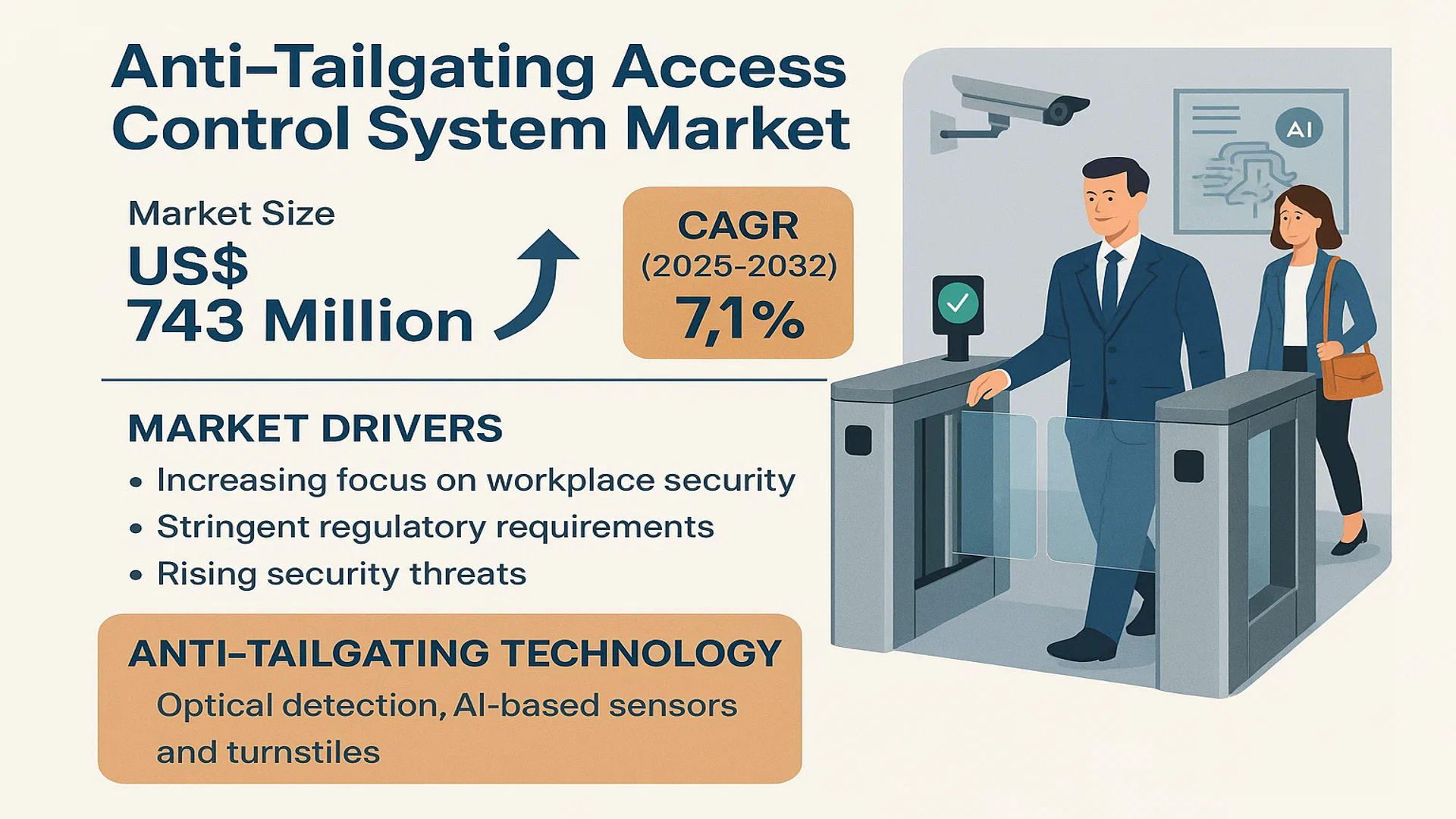
The global Anti-Tailgating Access Control System Market size was valued at US$ 743 million in 2024 and is projected to reach US$ 1.28 billion by 2032, at a CAGR of 7.1% during the forecast period 2025-2032.
Anti-tailgating access control systems are specialized security solutions designed to prevent unauthorized individuals from following authorized personnel into restricted areas. These systems utilize technologies such as optical detection, AI-based sensors, and turnstile mechanisms to monitor and control entry points in real-time. The increasing focus on workplace security, coupled with stringent regulatory requirements across sectors like healthcare, education, and commercial facilities, is driving adoption.
The market growth is further fueled by rising security threats and the need for advanced perimeter protection. While traditional systems relied on physical barriers, modern solutions integrate AI and IoT for real-time analytics. Key players like AXIS, Alcatraz AI, and Optex are leading innovations, with North America and Europe dominating market share due to high security spending. However, Asia-Pacific is emerging as a high-growth region because of rapid infrastructure development.
MARKET DYNAMICS
MARKET DRIVERS
Rising Security Threats and Unauthorized Access Incidents Fuel Market Demand
The global anti-tailgating access control system market is experiencing significant growth due to increasing security threats across commercial, governmental, and residential sectors. With growing incidents of unauthorized access and security breaches, organizations are prioritizing advanced solutions that prevent tailgating – one of the most common physical security vulnerabilities. Recent statistics indicate that over 40% of security breaches in corporate facilities occur through tailgating incidents, driving urgent demand for more sophisticated access control mechanisms.
Regulatory Compliance and Security Standards Propel Market Expansion
Stringent government regulations and industry-specific security standards are acting as powerful market catalysts. Numerous sectors including healthcare, financial services, and critical infrastructure face mandatory compliance requirements for access control. In the healthcare sector alone, HIPAA regulations mandate strict access controls, creating significant demand for anti-tailgating solutions. Meanwhile, the financial sector’s adoption of these systems grew by 28% year-over-year as banks implement advanced security measures to protect sensitive areas.
Technological Advancements in AI and IoT Accelerate Market Growth
Integration of artificial intelligence and IoT capabilities is revolutionizing anti-tailgating systems, making them more effective and efficient. Modern solutions now incorporate facial recognition, thermal imaging, and behavioral analytics to detect and prevent unauthorized access attempts. The AI detection system segment is projected to grow at a compound annual growth rate (CAGR) of 18% through 2032, significantly outpacing traditional optical systems. Furthermore, cloud-based access control platforms enable real-time monitoring and rapid response capabilities, features that are becoming standard requirements for enterprise security deployments.
MARKET RESTRAINTS
High Implementation Costs and Budget Constraints Limit Market Penetration
While demand for anti-tailgating solutions grows, significant cost barriers hinder widespread adoption. Complete system implementations often require six-figure investments when factoring in hardware, software, and integration expenses. Small and medium-sized enterprises particularly struggle with these capital requirements, as basic optical detection systems can exceed $60,000 per installation point, while advanced AI-powered solutions often surpass $150,000. These substantial costs create resistance in price-sensitive markets and elongate sales cycles as organizations evaluate ROI timelines.
Other Restraints
False Positives and System Reliability Concerns
Even advanced systems sometimes generate false positives, triggering unnecessary security alerts that disrupt normal operations. Industry data suggests that legacy optical detection systems have an accuracy rate of approximately 85-90%, while AI-enhanced solutions reach 93-95% – still not meeting the near-perfect reliability that many high-security environments require. These performance limitations make some organizations hesitant to replace existing security infrastructure.
Complex Integration with Legacy Systems
Many facilities face technical challenges when integrating modern anti-tailgating solutions with existing security infrastructure. Older access control systems often lack the necessary APIs and connectivity options for seamless integration, requiring expensive upgrades or complete replacements. This complexity particularly impacts governmental and institutional buildings where security systems may be decades old, creating substantial barriers to modernization efforts.
MARKET CHALLENGES
Balancing Security with User Convenience Poses Operational Challenges
Market players face the complex task of developing systems that maintain high security while minimizing disruption to legitimate users. Overly aggressive anti-tailgating measures can create bottlenecks and workforce frustration, particularly in high-traffic environments like corporate offices and healthcare facilities. Recent surveys indicate that 67% of employees consider strict access controls to negatively impact their work experience when not implemented thoughtfully. Companies must carefully design systems that detect unauthorized access without creating excessive inconvenience, requiring sophisticated programming and user experience considerations.
Other Challenges
Data Privacy and Compliance Concerns
Advanced systems utilizing facial recognition and behavioral analytics raise significant privacy considerations. New and evolving data protection regulations in various jurisdictions impose strict requirements on biometric data collection and processing. Many organizations hesitate to implement these technologies due to potential legal liabilities and the complexities of maintaining compliance across different regions.
Workforce Training and Change Management
Effective deployment requires comprehensive staff training and cultural adaptation, which often proves more challenging than the technical implementation itself. Security personnel must learn new monitoring techniques, while all employees need education on proper access protocols. Organizations frequently underestimate the time and resources required for successful adoption, with studies showing that inadequate training contributes to 45% of suboptimal system implementations.
MARKET OPPORTUNITIES
Emerging Smart City Infrastructure Creates New Growth Avenues
The global smart city movement presents substantial opportunities for anti-tailgating solution providers. Municipal governments investing in intelligent urban infrastructure increasingly incorporate advanced access control systems for public buildings, transportation hubs, and critical utilities. Market analysts project that smart city-related security investments will account for nearly 30% of total anti-tailgating system revenues by 2028. These large-scale projects offer providers the chance to deploy integrated solutions across multiple facilities while benefiting from government budgets that are typically less constrained than private sector counterparts.
Other Opportunities
Cloud-Based Solutions and Subscription Models
The shift toward cloud-hosted security platforms enables new business models and revenue streams. Providers are developing subscription-based anti-tailgating services that reduce upfront costs for customers while creating predictable recurring revenue. This approach particularly appeals to small and mid-sized businesses previously priced out of the market, potentially expanding the total addressable market by approximately 35% over the next five years.
Healthcare Sector Expansion
Post-pandemic healthcare security concerns have created urgent demand for advanced access controls in medical facilities. Hospitals require sophisticated solutions that protect sensitive areas like pharmacies, research labs, and patient records while maintaining smooth operations. The healthcare vertical is anticipated to be the fastest-growing segment, with projected annual growth rates exceeding 22% through 2030 as facilities modernize security infrastructure.
ANTI-TAILGATING ACCESS CONTROL SYSTEM MARKET TRENDS
Increasing Security Concerns Driving Market Growth
The global anti-tailgating access control system market is experiencing robust growth, fueled by escalating security concerns across commercial, residential, and institutional sectors. With unauthorized access incidents rising by approximately 25% over the past five years, organizations are increasingly adopting advanced security solutions to mitigate risks. Optical detection systems currently dominate the market with a 42% share, while AI-powered solutions are gaining traction at a CAGR of 15%. The healthcare and education sectors in particular are allocating 30% more budget toward security infrastructure upgrades following recent security breaches.
Other Trends
Integration of AI and IoT Technologies
The integration of artificial intelligence with IoT sensors is revolutionizing anti-tailgating solutions, enabling real-time behavioral analytics and predictive threat detection. Modern systems can now distinguish between authorized single-entry and potential tailgating attempts with 98% accuracy. This technological leap is reducing false alarms by 40% compared to traditional systems, making them particularly valuable for high-security facilities. While initial implementation costs remain high, the long-term operational benefits are driving adoption across Fortune 500 companies and government facilities.
Sector-Specific Adoption Patterns
Commercial real estate leads in anti-tailgating system implementation, accounting for 35% of global installations, followed closely by healthcare at 28%. The education sector has seen the fastest growth at 20% year-over-year following heightened campus security concerns. Residential adoption remains limited to high-end properties, representing just 5% of the market. Manufacturers are developing more compact and cost-effective solutions to penetrate the mid-market residential segment, with average system prices projected to decrease by 15% over the next three years through economies of scale and technological advancements.
COMPETITIVE LANDSCAPE
Key Industry Players
Security Providers Accelerate AI-Driven Anti-Tailgating Solutions to Meet Rising Demand
The global anti-tailgating access control system market features a dynamic competitive environment with established security providers and agile tech innovators vying for market share. AXIS Communications leads the sector with its comprehensive portfolio of optical and AI-powered detection systems, maintaining strong positions in both North American and European markets. In 2024, AXIS captured approximately 18% of global revenue share, according to market analysis.
Alcatraz AI has emerged as a disruptive force with its facial authentication barriers, particularly gaining traction in the commercial segment where the company’s Rock platform demonstrates a 99.8% tailgate detection accuracy. Meanwhile, Detex Corporation strengthened its market position through strategic partnerships with major building automation providers in Q2 2024.
The competitive landscape is further intensified by regional specialists like Japan’s Optex, which dominates the Asian market with its LiDAR-based detection systems, and the UK’s Meesons Safe Secure Access, whose mechanical turnstile solutions maintain strong demand in high-security environments.
Recent market developments include the April 2024 launch of Openpath’s AI-enabled tailgate detection update, which integrates with existing access control systems to provide real-time alerts. This reflects the industry-wide shift toward software enhancements complementing hardware solutions.
List of Key Anti-Tailgating Solution Providers
- AXIS Communications (Sweden)
- Alcatraz AI (U.S.)
- Designed Security, Inc. (U.S.)
- Detex Corporation (U.S.)
- ELID Technology Intl., Inc. (U.S.)
- Hayward Turnstiles (U.K.)
- IEE Smart Sensing Solution (Luxembourg)
- Infrared Integrated Systems Ltd (U.K.)
- Integrated Design Limited (IDL) (U.K.)
- Kouba Systems (Australia)
- Meesons Safe Secure Access (U.K.)
- Newton Security (U.S.)
- Openpath (U.S.)
- Optex (Japan)
- Passport Technologies Inc. (U.S.)
Segment Analysis:
By Type
Optical Detection Systems Lead the Market Due to Enhanced Security and Cost-Effectiveness
The market is segmented based on type into:
- Optical Detection System
- Subtypes: Infrared sensors, laser-based sensors, and others
- AI Detection System
- Subtypes: Machine learning-based, deep learning-based, and others
- Turnstile Systems
- Mantraps
- Others
By Application
Commercial Sector Dominates Owing to High Security Requirements in Corporate Spaces
The market is segmented based on application into:
- Commercial
- Residential
- Healthcare
- Education
- Others
By Deployment
On-Premise Deployment Remains Preferred Due to Security Control and Data Privacy
The market is segmented based on deployment into:
- On-Premise
- Cloud-Based
By End User
Enterprises Lead the Market Due to Increasing Security Compliance Needs
The market is segmented based on end user into:
- Enterprises
- Government & Defense
- Industrial
- Others
Regional Analysis: Anti-Tailgating Access Control System Market
North America
North America dominates the global anti-tailgating access control system market, driven by stringent security regulations and substantial investments in advanced security infrastructure. The U.S., in particular, leads the region with a heightened focus on safeguarding commercial and governmental facilities. High-profile security breaches have accelerated adoption, particularly in sectors like banking, healthcare, and critical infrastructure. AI-powered detection systems are gaining traction due to their enhanced accuracy, while turnstile-integrated solutions remain prevalent in corporate and transportation hubs. Key players such as Detex Corporation and Alcatraz AI are actively expanding their product portfolios to cater to evolving compliance demands.
Europe
Europe’s anti-tailgating market is shaped by GDPR and other data protection laws, which mandate strict access control protocols. Countries like Germany and the U.K. are early adopters of biometric and AI-driven solutions, particularly in smart city projects. However, cost sensitivity in Southern and Eastern Europe limits penetration, favoring traditional optical detection systems. The region’s emphasis on privacy-compliant technologies promotes innovation, with companies like AXIS and Optex developing systems that balance security with regulatory adherence.
Asia-Pacific
The Asia-Pacific market is the fastest-growing, fueled by rapid urbanization and rising security threats in densely populated regions. China and India are key contributors, with large-scale deployments in transportation (e.g., metro systems) and commercial real estate. While budget constraints persist, local manufacturers are competing on affordability, driving down costs for optical detection systems. Governments are increasingly mandating access control in public venues, creating opportunities for providers like ELID Technology and Infrared Integrated Systems.
South America
Market growth in South America is moderate, constrained by economic volatility but supported by increasing crime rates. Brazil and Argentina are investing in security upgrades for retail and corporate sectors, though adoption leans toward mid-range solutions. Political instability delays large-scale projects, but the demand for turnstile-based systems in airports and stadiums offers a steady revenue stream. International players face competition from regional suppliers offering cost-effective alternatives.
Middle East & Africa
The MEA market is nascent but expanding, led by Gulf Cooperation Council (GCC) countries deploying high-end systems in smart cities and oil/gas facilities. Facial recognition and AI analytics are prioritized in the UAE and Saudi Arabia, while African nations rely on simpler solutions due to infrastructure gaps. Security concerns around critical infrastructure and tourism hubs are key growth drivers, though funding disparities hinder uniform adoption across the region.
Report Scope
This market research report provides a comprehensive analysis of the Global Anti-Tailgating Access Control System Market, covering the forecast period 2024–2032. It offers detailed insights into market dynamics, technological advancements, competitive landscape, and key trends shaping the industry.
Key focus areas of the report include:
- Market Size & Forecast: Historical data and future projections for revenue, unit shipments, and market value across major regions and segments.
- Segmentation Analysis: Detailed breakdown by product type (Optical Detection System, AI Detection System), application (Commercial, Residential, Healthcare, Education, Others), and end-user industry to identify high-growth segments and investment opportunities.
- Regional Outlook: Insights into market performance across North America, Europe, Asia-Pacific, Latin America, and the Middle East & Africa, including country-level analysis.
- Competitive Landscape: Profiles of leading market participants, including their product offerings, R&D focus, manufacturing capacity, pricing strategies, and recent developments such as mergers, acquisitions, and partnerships.
- Technology Trends & Innovation: Assessment of emerging technologies, integration of AI/IoT, and evolving industry standards in anti-tailgating solutions.
- Market Drivers & Restraints: Evaluation of factors driving market growth along with challenges, supply chain constraints, regulatory issues, and market-entry barriers.
- Stakeholder Analysis: Insights for component suppliers, OEMs, system integrators, investors, and policymakers regarding the evolving ecosystem and strategic opportunities.
Primary and secondary research methods are employed, including interviews with industry experts, data from verified sources, and real-time market intelligence to ensure the accuracy and reliability of the insights presented.
FREQUENTLY ASKED QUESTIONS:
What is the current market size of Global Anti-Tailgating Access Control System Market?
-> Anti-Tailgating Access Control System market size was valued at US$ 743 million in 2024 and is projected to reach US$ 1.28 billion by 2032, at a CAGR of 7.1% during the forecast period 2025-2032.
Which key companies operate in Global Anti-Tailgating Access Control System Market?
-> Key players include AXIS, Alcatraz AI, Designed Security, Inc., Detex Corporation, ELID Technology Intl., Inc., Hayward Turnstiles, IEE Smart Sensing Solution, Infrared Integrated Systems Ltd, Integrated Design Limited (IDL), and Kouba Systems, among others.
What are the key growth drivers?
-> Key growth drivers include increasing security concerns, regulatory mandates for access control, and technological advancements in AI-based detection systems.
Which region dominates the market?
-> North America currently leads the market, while Asia-Pacific is expected to witness the highest growth rate during the forecast period.
What are the emerging trends?
-> Emerging trends include integration of facial recognition, cloud-based access control solutions, and multi-layered security approaches.

Get Sample Report PDF for Exclusive Insights
Report Sample Includes
- Table of Contents
- List of Tables & Figures
- Charts, Research Methodology, and more...
 Download Sample Report PDF