AI Vision Processing Chips Market Insights
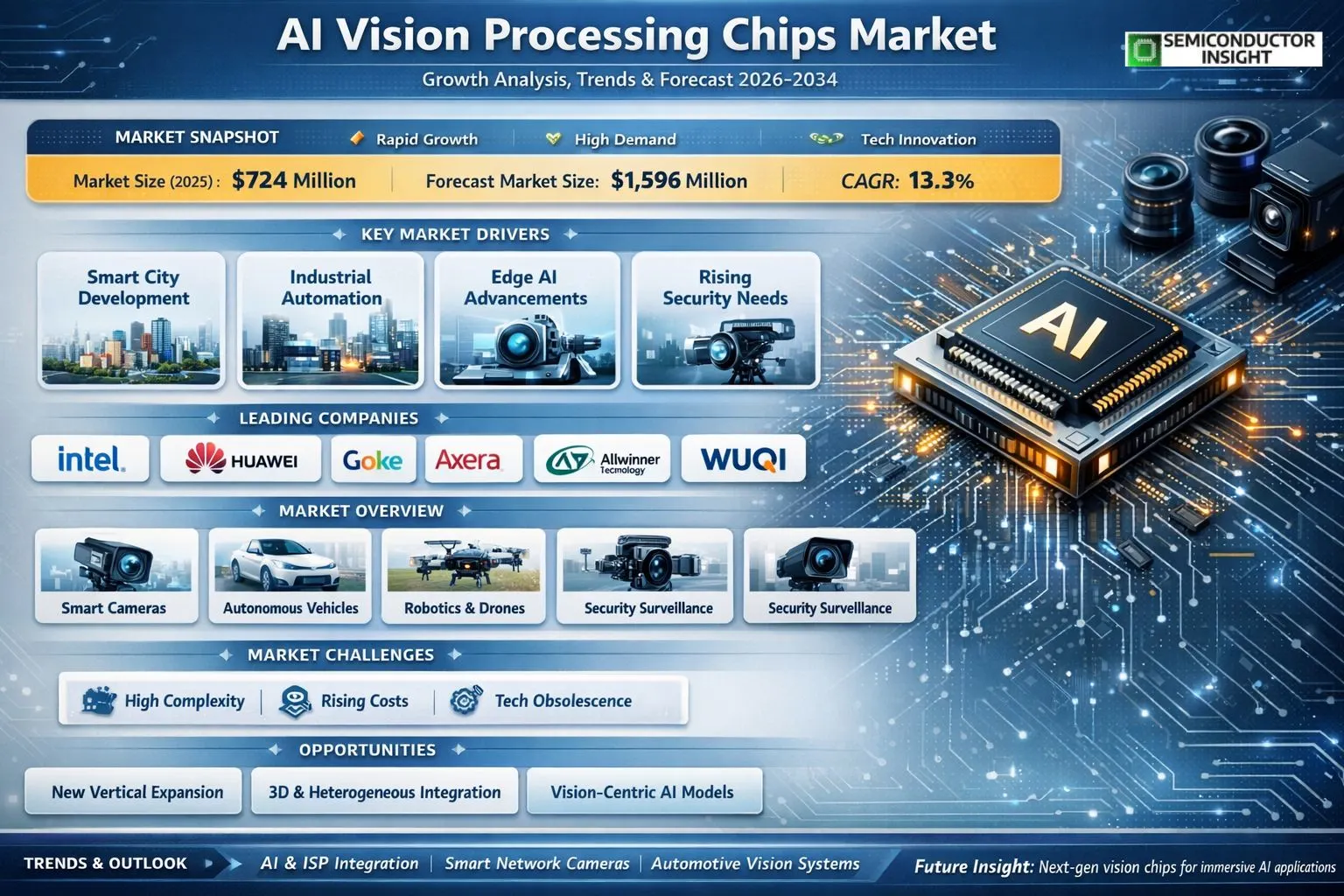
Global AI vision processing chips market size was valued at USD 724 million in 2025. The market is projected to grow from USD 820 million in 2026 to USD 1,596 million by 2034, exhibiting a CAGR of 13.3% during the forecast period.
AI vision processing chips are specialized integrated circuits designed for efficient image and video analysis tasks. These chips integrate advanced image signal processing (ISP) technology with dedicated deep learning accelerators, enabling them to process complex visual algorithms directly at the hardware level. This architecture is crucial for providing real-time, high-precision image recognition and intelligent analysis in applications such as smart network cameras, autonomous vehicles, robotics, and security surveillance systems.
The market is experiencing rapid growth due to several key drivers, including the explosive demand for smart city infrastructure and industrial automation, which relies heavily on intelligent visual sensing. Furthermore, advancements in edge AI computing are pushing chip development towards higher efficiency and lower power consumption. Initiatives by leading semiconductor companies are also accelerating market expansion. For instance, companies like Intel (with its Movidius VPUs), Huawei HiSilicon, and a cohort of Chinese fabless firms such as Goke Microelectronics and Axera Semiconductor are continuously launching new products tailored for specific vision applications. This competitive landscape is fostering innovation and driving down costs, making AI vision capabilities accessible for a broader range of devices and fueling further market penetration.
MARKET DRIVERS
Explosion of Edge AI and Vision Applications
The primary catalyst for AI vision processing chips market is the massive shift toward edge computing. Deploying artificial intelligence directly within devices,from smartphones and autonomous vehicles to smart cameras and industrial robots,demands specialized, low-power, high-performance silicon. These chips process image and video data in real-time, enabling faster decision-making and reducing latency and bandwidth costs associated with cloud processing. This trend is critical for applications like real-time surveillance, augmented reality, and advanced driver-assistance systems (ADAS), fueling unprecedented demand.
Demand for Superior Efficiency and Performance
Traditional CPUs and GPUs are often inefficient for the parallel processing loads of complex computer vision algorithms like convolutional neural networks (CNNs). The market is driven by the need for Application-Specific Integrated Circuits (ASICs) and System-on-Chip (SoC) designs optimized for vision tasks. These chips deliver significantly higher frames-per-second performance per watt, a critical metric for battery-powered and thermally constrained devices. This efficiency is a key driver for adoption across consumer electronics and IoT sectors.
➤ A recent industry analysis projects that the segment for edge-based vision processors will grow at a compound annual rate exceeding 28% over the next five years, significantly outpacing the broader semiconductor market.
Furthermore, advancements in neural network architectures and the proliferation of high-resolution image sensors create a continuous performance requirement that only dedicated AI Vision Processing Chips can address, securing their long-term market trajectory.
MARKET CHALLENGES
High Design Complexity and Soaring Costs
The development cycle for cutting-edge AI Vision Processing Chips is extraordinarily complex and capital-intensive. Designing and fabricating at advanced nodes (e.g., 5nm, 3nm) involves immense R&D expenditure and significant risk. This creates a high barrier to entry, consolidating the market among a few well-funded players. Additionally, integrating diverse processing cores (NPUs, DSPs, ISPs) into a single SoC while managing power and heat dissipation presents a persistent engineering challenge that can delay time-to-market for new products.
Other Challenges
Rapid Technological Obsolescence
The pace of innovation in both AI algorithms and semiconductor processes is relentless. A chip architecture optimized for today’s popular neural networks may be inefficient for next-generation models, risking quick obsolescence and shortening product life cycles. This forces companies into a continuous and costly redesign cycle to maintain competitiveness.
Fragmented Software Ecosystem and Talent Gap
Maximizing chip performance requires deeply optimized software tools and libraries. A fragmented software stack across different vendors’ hardware can hinder developer adoption. Moreover, a severe global shortage of engineers skilled in both deep learning and advanced hardware design constrains the ability of companies to innovate and scale production efficiently.
MARKET RESTRAINTS
Global Semiconductor Supply Chain Volatility
AI vision processing chips market is acutely vulnerable to disruptions in Global semiconductor supply chain. Reliance on a concentrated network of advanced foundries, coupled with geopolitical tensions and fluctuating demand for raw materials, can lead to prolonged shortages and increased wafer prices. These constraints limit production capacity, increase lead times for end-product manufacturers, and can suppress market growth despite strong underlying demand. Such volatility makes strategic supply chain management a critical, yet restraining, factor for industry expansion.
Economic Sensitivity and Investment Cycles
As high-value components, demand for vision processing chips is closely tied to the investment cycles of key downstream industries like automotive, consumer electronics, and industrial automation. Economic downturns or reduced capital expenditure in these sectors can lead to immediate order postponements or cancellations. The long and costly development cycle for new chips means companies face significant financial risk if a target market experiences a downturn near a product’s launch, acting as a powerful restraint on aggressive R&D investment.
MARKET OPPORTUNITIES
Expansion into New Vertical Industries
Beyond established applications, AI vision processing chips market finds robust opportunities in emerging verticals. In healthcare, they enable portable diagnostic imaging and real-time surgical assistance. In agriculture, they power autonomous harvesting and crop monitoring drones. Retail leverages them for cashier-less checkout and inventory management. Each new vertical represents a multi-billion-dollar addressable market, driving demand for customized chip solutions that meet specific power, performance, and cost requirements, diversifying revenue streams for chip designers.
Advancements in Heterogeneous and 3D Integration
Technological breakthroughs in chip packaging, such as 3D stacking and heterogeneous integration, present a transformative opportunity. These techniques allow manufacturers to combine specialized vision processing cores with high-bandwidth memory and sensors in a single, compact package. This leads to radical improvements in system performance and energy efficiency while potentially lowering costs. Companies that master these advanced packaging technologies will gain a significant competitive edge in creating next-generation solutions for space-constrained and performance-hungry applications.
Rise of Vision-Centric AI and Generative Models
The evolution of AI toward multimodal and generative models that deeply understand and create visual content opens a new frontier. Future AI Vision Processing Chips will need to handle not just recognition but also complex scene generation and real-time video synthesis. This shift requires new architectural approaches, creating opportunities for innovators to design the foundational silicon for the next wave of immersive computing, content creation, and human-machine interaction, positioning the market for sustained long-term growth.
MAIN TITLE HERE () Trends
Integration of AI and Traditional ISP Fuels Edge Intelligence
A dominant trend within AI vision processing chips market is the sophisticated integration of deep learning accelerators with advanced Image Signal Processors (ISP) on a single chip. This architectural convergence enables these specialized circuits to process complex visual algorithms directly at the hardware level. By handling low-level image correction, enhancement, and high-level AI inference concurrently, these chips deliver the real-time, high-precision analysis required for applications like smart network cameras and autonomous vehicle vision systems. This trend is critical for moving intelligent vision processing from the cloud to the device edge, reducing latency and bandwidth dependence.
Other Trends
Specialization for Smart Network Cameras and Automotive
There is a clear segmentation trend, with chip architectures being increasingly tailored to specific application verticals. For smart network cameras and security surveillance, there is strong demand for chips balancing computational efficiency with low power consumption. Conversely, within the vehicle vision products segment, the emphasis is shifting towards higher performance chips capable of processing multiple, concurrent high-resolution video streams to meet stringent automotive safety standards. This application-specific optimization is a key driver for innovation among manufacturers.
Geographical Market Diversification and Competitive Landscape
The competitive dynamics of AI vision processing chips market are evolving with a strategic push from Asia-based manufacturers. While North America holds significant market share, companies from China are expanding their global presence with competitive offerings across different computational segments, from below 2TOPs to above 4TOPs. This diversification is fostering competition and accelerating the development of cost-effective solutions, broadening adoption potential. The market is characterized by continuous strategic activity, including focused development plans to capture growth in high-potential application areas and regional markets.
COMPETITIVE LANDSCAPE
Key Industry Players
A Highly Dynamic and Segmented Market Driven by Edge Intelligence
AI vision processing chips market features a fragmented competitive structure, characterized by a diverse mix of global semiconductor giants and specialized fabless companies primarily from China. Leadership in terms of market revenue share is held by a small group of established players, with the top five manufacturers in 2025 accounting for a significant portion of global revenue. Intel leverages its portfolio of Movidius VPUs (Vision Processing Units) and Agilex FPGAs to serve high-performance computer vision applications in security and automotive. Similarly, Huawei HiSilicon’s Ascend AI processors and Kirin SoCs with integrated NPUs have secured a strong foothold, particularly in China’s smart surveillance and automotive sectors. These leaders compete on processing capability (measured in TOPS), power efficiency, and the robustness of their associated software toolchains and developer ecosystems.
Beyond the top revenue leaders, a vibrant layer of niche innovators is addressing specific performance tiers and applications. Several companies, including Anhui Eyevolution Technology, Axera Semiconductor, and Shanghai NextVPU, are key players in the market segments below 4TOPs, focusing on cost-effective AIoT devices, smart cameras, and edge security. Goke Microelectronics and Allwinner Technology are prominent in integrating vision processing into multimedia SoCs for consumer and commercial applications. The competitive landscape is further enriched by specialists like Tsingmicro Intelligent Technology and WUQI Microelectronics, which target high-performance computing and robotics. These companies are intensifying competition through rapid innovation in neural network architectures, low-power design, and tailored solutions for markets like autonomous vehicles and industrial automation.
List of Key AI Vision Processing Chips Companies Profiled
- Intel Corporation
- Huawei HiSilicon
- Goke Microelectronics Co., Ltd.
- Anhui Eyevolution Technology Co., Ltd.
- Axera Semiconductor
- Allwinner Technology Co., Ltd.
- WUQI Microelectronics
- Shanghai NextVPU Semiconductor Ltd.
- Tsingmicro Intelligent Technology (Beijing) Co., Ltd.
- NVIDIA Corporation
- Qualcomm Technologies, Inc.
- Apple Inc. (via proprietary silicon)
- AMD (Xilinx)
- Texas Instruments Incorporated
- Hailo Technologies Ltd.
Segment Analysis:
| Segment Category | Sub-Segments | Key Insights |
| By Type |
|
Mid-Range Compute (2TOPs-4TOPs) chips form the high-volume core of the market, striking an optimal balance for widespread commercial deployment. These chips deliver sufficient processing power for mainstream real-time analytics like facial recognition and object detection without excessive power draw or cost. They are the primary enabler for intelligent features in consumer and commercial security cameras. The segment benefits from strong design flexibility, allowing integration into diverse hardware architectures from edge devices to gateway appliances, thus fostering broad ecosystem adoption and continuous performance refinement. |
| By Application |
|
Security Surveillance remains the dominant application segment, serving as the primary growth engine for AI vision chip adoption. This segment’s leadership is anchored in Global imperative for intelligent, proactive security solutions that move beyond simple recording to real-time threat detection and behavioral analysis. The transition from legacy analog systems to IP-based smart camera networks is a major catalyst, requiring embedded AI processing at the edge to reduce bandwidth needs and enable instant response. Furthermore, integration with smart city infrastructure and industrial safety protocols creates a continuous pipeline for advanced, specialized surveillance applications, ensuring sustained demand for more capable and efficient vision processors. |
| By End User |
|
Commercial & Industrial end-users represent the most significant and diverse demand segment. This encompasses sectors like retail for smart retail analytics, manufacturing for quality inspection and robotic guidance, and critical infrastructure for perimeter security. The leadership stems from a strong return-on-investment case where AI vision drives operational efficiency, safety, and automation, directly impacting the bottom line. Deployment scales range from thousands of units in a factory or city-wide project to specialized high-value equipment, creating demand for both standardized and custom chip solutions. The continuous push for industrial automation and smart building management ensures this segment remains a key innovation and volume driver. |
| By Integration Level |
|
System-on-Chip (SoC) Integrated solutions are leading as they offer the optimal balance for mass-market penetration. Integrating the vision processing accelerator with the main application processor, memory, and connectivity onto a single chip dramatically reduces overall system cost, power consumption, and physical footprint, which is critical for compact edge devices like cameras and sensors. This high level of integration simplifies product design and accelerates time-to-market for OEMs, making advanced AI features accessible for a wider range of products. The trend towards more heterogeneous SoC architectures, combining different compute units, further solidifies this segment’s dominance for mainstream applications. |
| By Processing Architecture |
|
CNN/DNN Optimized architectures are the undisputed mainstream choice, as they are specifically tailored for the convolutional and deep neural network operations that underpin modern computer vision. This specialization allows for extreme efficiencies in processing image and video data for tasks like classification and detection, delivering the necessary performance within strict power budgets for edge deployment. The entire software ecosystem, including major frameworks and trained models, is built around this architectural paradigm, creating a powerful incumbent advantage. Continuous innovation focuses on enhancing these cores with sparsity support, advanced dataflow techniques, and multi-modal capabilities to handle next-generation vision algorithms efficiently. |
Regional Analysis: Global AI Vision Processing Chips Market
Asia-Pacific
The region’s strength lies in its unparalleled vertical integration. Major players in wafer fabrication, chip design, and final assembly operate within a tight geographic cluster. This proximity accelerates the development cycle for new AI Vision Processing Chips, allowing for rapid prototyping and scaling to meet the demands of global technology firms.
Asia-Pacific’s leadership in electric vehicle production and industrial robotics creates a massive, captive market for AI vision chips. These sectors require sophisticated, real-time vision processing for autonomous driving features and machine vision quality control, driving continuous demand for more powerful and efficient specialized chips.
National policies are a critical driver. Substantial state funding and supportive regulatory frameworks aim to build sovereign capability in semiconductor design and manufacturing. This strategic focus directly fuels innovation and capacity expansion within AI vision processing chips market segment, ensuring long-term regional dominance.
The region is home to the world’s largest smartphone and consumer electronics brands. The relentless push for enhanced camera capabilities, augmented reality features, and on-device AI processing in these products generates consistent, high-volume demand for advanced vision chips, providing a stable revenue base for chip developers.
North America
North America remains a powerhouse of innovation and advanced R&D in AI vision processing chips market. The region is characterized by a concentration of pioneering tech giants, cutting-edge chip design houses, and leading academic institutions that drive architectural breakthroughs. Its focus is predominantly on the high-performance frontier, developing chips for data centers, autonomous vehicle systems, and specialized industrial and defense applications. The market dynamics are shaped by intense competition and collaboration between major cloud service providers designing their own silicon and fabless semiconductor companies creating next-generation architectures. While manufacturing is largely outsourced, the intellectual property and design leadership emanating from North American firms set global standards and define the performance benchmarks for the entire AI Vision Processing Chips Market segment.
Europe
Europe carves a distinct niche in AI vision processing chips market, emphasizing precision engineering, automotive integration, and adherence to stringent regulatory and ethical standards for AI. The region’s formidable automotive industry, with its deep focus on advanced driver-assistance systems (ADAS) and automated driving, is a primary driver for high-reliability vision processing solutions. European dynamics are also heavily influenced by robust data privacy laws, which incentivize the development of on-device processing capabilities over cloud-dependent models. This focus on edge computing and functional safety creates demand for chips that are not only powerful but also explainable, secure, and energy-efficient. Collaborative research initiatives across the EU further support the development of specialized vision chips for industrial automation, medical imaging, and smart mobility applications.
South America
AI vision processing chips market in South America is an emerging landscape primarily driven by adoption rather than indigenous production. Market growth is catalyzed by the modernization of agricultural technology, where vision chips are used for drone-based crop monitoring and automated sorting, and by increasing investments in public security infrastructure requiring intelligent surveillance systems. The region’s dynamics involve navigating economic volatility while integrating vision AI solutions into key sectors like mining and logistics to improve efficiency and safety. While local chip design is limited, partnerships with global technology providers are fostering the deployment of vision processing technologies tailored to regional industrial needs and specific applications in resource management and urban development.
Middle East & Africa
AI vision processing chips market in the Middle East & Africa region exhibits a dual-track dynamic. In the Middle East, particularly in the Gulf Cooperation Council nations, market growth is propelled by ambitious smart city megaprojects, investments in non-oil economic diversification, and national AI strategies. These initiatives create demand for vision chips in areas like traffic management, security, and tourism. In parts of Africa, the market is driven by innovative applications in sectors such as fintech for identity verification and in agriculture for yield optimization. The regional dynamic is less about chip manufacturing and more about strategic deployment of vision processing technology to address specific socio-economic challenges, foster digital inclusion, and modernize critical infrastructure. Partnerships with international chip suppliers are key to market development.
Report Scope
This market research report provides a comprehensive analysis of the AI Vision Processing Chips Market , covering the forecast period 2026–2034. It offers detailed insights into market dynamics, technological advancements, competitive landscape, and key trends shaping the industry.
Key focus areas of the report include:
- Market Overview: The report begins with an overview outlining the current market scenario, key growth indicators, and industry transformation drivers. It discusses macroeconomic factors, demand–supply balance, regulatory landscape, and the strategic role of semiconductors in powering advancements across industries such as automotive, telecommunications, consumer electronics, and industrial automation.
- Market Size & Forecast: Historical data and future projections for revenue, unit shipments, and market value across major regions and segments.
- Segmentation Analysis: Detailed breakdown by product type, technology, application, and end-user industry to identify high-growth segments and investment opportunities.
- Regional Insights: Insights into market performance across North America, Europe, Asia-Pacific, Latin America, and the Middle East & Africa, including country-level analysis where relevant.
- Competitive Landscape: Profiles of leading market participants, including their product offerings, R&D focus, manufacturing capacity, pricing strategies, and recent developments such as mergers, acquisitions, and partnerships.
- Technology Trends & Innovation: Assessment of emerging technologies, integration of AI/IoT, semiconductor design trends, fabrication techniques, and evolving industry standards.
- Market Drivers & Restraints: Evaluation of factors driving market growth along with challenges, supply chain constraints, regulatory issues, and market-entry barriers.
- Stakeholder Insights: Insights for component suppliers, OEMs, system integrators, investors, and policymakers regarding the evolving ecosystem and strategic opportunities.
Primary and secondary research methods are employed, including interviews with industry experts, data from verified sources, and real-time market intelligence to ensure the accuracy and reliability of the insights presented.
FREQUENTLY ASKED QUESTIONS:
What is the current market size of AI Vision Processing Chips Market?
-> Global AI Vision Processing Chips Market was valued at USD 724 million in 2025 and is projected to reach USD 1596 million by 2034, growing at a CAGR of 13.3% during the forecast period.
Which key companies operate in AI Vision Processing Chips Market?
-> Key players include Intel, Huawei HiSilicon, Goke Microelectronics, Anhui Eyevolution Technology, Axera Semiconductor, Allwinner Technology, WUQI Microelectronics, Shanghai NextVPU, Tsingmicro Intelligent Technology, among others.
What are the key growth drivers?
-> Key growth drivers include rising demand for real-time, high-precision image recognition and intelligent analysis in applications like smart cameras, self-driving cars, robots, and security monitoring, alongside the integration of advanced image signal processing and deep learning accelerators at the hardware level.
Which region dominates the market?
-> Global market analysis shows significant activity across regions. In 2025, the U.S. and China represent key regional markets, with detailed country-level insights provided for North America, Europe, Asia, South America, and the Middle East & Africa.
What are the emerging trends?
-> Emerging trends include the development of specialized chips for efficient visual algorithm processing at the hardware level, integration of AI accelerators for edge computing in vision applications, and expansion into diverse applications such as vehicle vision products and smart network cameras.

Get Sample Report PDF for Exclusive Insights
Report Sample Includes
- Table of Contents
- List of Tables & Figures
- Charts, Research Methodology, and more...
 Download Sample Report PDF