
AI Automated Checkout Vision Processing Unit Market Insights
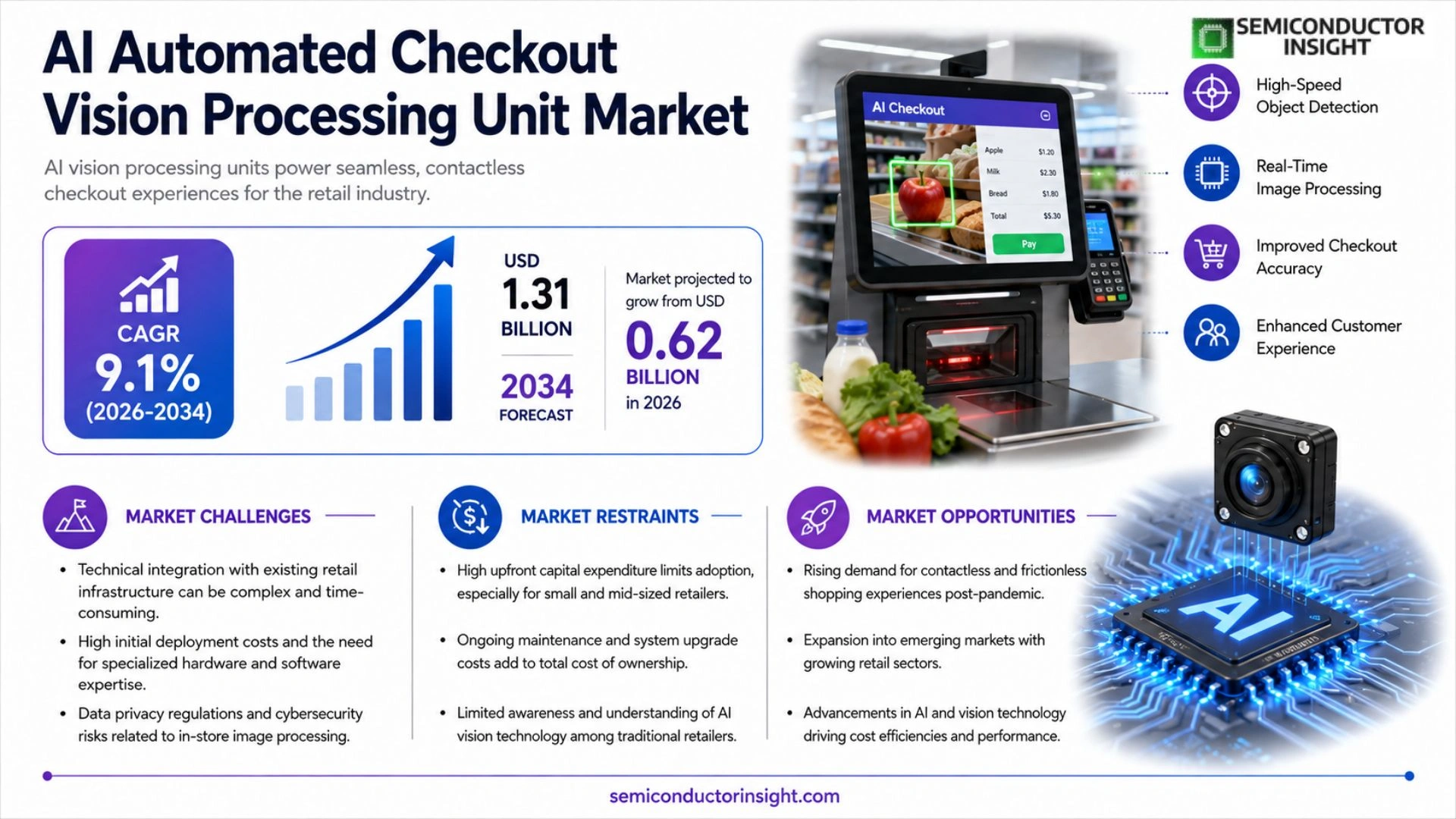
Global AI Automated Checkout Vision Processing Unit market size was valued at USD 0.58 billion in 2025. The market is projected to grow from USD 0.62 billion in 2026 to USD 1.31 billion by 2034, exhibiting a CAGR of 9.1 % during the forecast period.
Vision processing units (VPUs) designed for automated checkout combine high‑resolution imaging sensors with dedicated neural‑network accelerators that execute object‑recognition and depth‑mapping algorithms at the edge. These chips enable real‑time identification of items on a conveyor belt or shelf without barcode scanning, supporting multi‑modal inputs such as RGB, infrared and time‑of‑flight data. By offloading inference from general‑purpose CPUs, VPUs reduce latency below 50 ms and lower power consumption compared with traditional GPU solutions.
The market is experiencing rapid growth because retailers are seeking contactless shopping experiences while labor costs rise worldwide. Furthermore, advances in edge‑AI silicon,exemplified by NVIDIA’s Jetson series and Intel’s Movidius Myriad X,have lowered entry barriers for midsize stores. Recent collaborations reinforce this trend; for instance, in March 2024 Walmart announced a partnership with Google Cloud to deploy VPU‑enabled checkout lanes across its U.S. footprint, while Amazon Go expanded its network of sensor‑rich stores using custom ASICs from Qualcomm.
MARKET DRIVERS
Increasing Adoption of Contactless Retail Solutions
AI Automated Checkout Vision Processing Unit Market is being propelled by retailers seeking frictionless purchase experiences. By 2025, more than 45% of midsize grocery chains are projected to pilot fully automated checkout lanes, driven by consumer preference for touch‑free interactions and the proven reduction in queue times.
Advancements in Edge AI and Low‑Power Chipsets
Recent breakthroughs in edge‑AI algorithms allow vision‑processing units to execute real‑time object recognition while consuming less than 2 watts of power. These efficiencies make large‑scale deployments financially viable, enabling retailers to replace legacy barcode scanners with integrated vision units at a cost‑per‑store reduction of roughly 30%.
➤ “Deployments that combine low‑latency inference with on‑device learning are reshaping the economics of self‑service checkout,”
Consequently, investors are allocating capital toward OEMs that can deliver scalable hardware platforms. The confidence is reflected in a 22% CAGR forecast for AI Automated Checkout Vision Processing Unit Market through 2030, underscoring the technology’s strategic importance to the broader retail automation ecosystem.
MARKET CHALLENGES
Technical Integration and Legacy System Compatibility
Many established supermarkets operate on heterogeneous POS infrastructures that were not designed for high‑throughput vision data streams. Integrating new processing units often requires custom middleware, extending rollout timelines and inflating implementation budgets.
Other Challenges
Regulatory and Data Privacy Concerns
Stringent privacy regulations in Europe and North America mandate on‑device data handling, limiting the use of cloud‑based analytics and increasing the complexity of compliance testing for vision‑based checkout solutions.
MARKET RESTRAINTS
High Initial Capital Expenditure
Despite declining component costs, the upfront investment for a fully automated checkout system,including cameras, processing units, and integration services,remains a barrier for small‑format retailers. The steep capital requirement constrains market penetration until financing models become more accessible.
MARKET OPPORTUNITIES
Expansion into Emerging Markets
Rapid urbanization and rising disposable incomes in Southeast Asia and Latin America are creating demand for high‑efficiency retail solutions. Enterprises that adapt vision processing units to local network conditions and price sensitivities can capture a sizable share of a market projected to exceed $1.2 billion by 2030.
AI Automated Checkout Vision Processing Unit Market Trends
Edge AI Integration Accelerates Retail Checkout
AI Automated Checkout Vision Processing Unit Market is being reshaped by the migration of vision workloads to edge‑optimized silicon. Modern vision processing units combine high‑resolution imaging sensors with dedicated neural‑network accelerators that execute object‑recognition and depth‑mapping algorithms directly on the checkout lane. By keeping inference at the edge, latency falls below 50 ms and power draw is markedly lower than legacy GPU approaches. Retailers benefit from real‑time item identification without barcode scanning, supporting RGB, infrared and time‑of‑flight inputs. This capability aligns with the growing demand for contactless shopping experiences and the pressure to curb labor expenses across global store networks.
Other Trends
Sensor Fusion Expands Functionality
Advances in sensor fusion are creating a second wave of momentum within AI Automated Checkout Vision Processing Unit Market. Vendors such as NVIDIA (Jetson series) and Intel (Movidius Myriad X) now ship VPUs that ingest multiple data streams,visual, thermal and depth,to improve item classification accuracy under varying lighting conditions. Recent deployments illustrate the impact: Walmart’s March 2024 partnership with Google Cloud introduced VPU‑enabled lanes that blend RGB and infrared feeds, while Amazon Go’s expansion leverages Qualcomm ASICs to harmonize visual and lidar inputs across its sensor‑rich stores. The resulting robustness reduces false‑positive reads and supports a broader product assortment, reinforcing retailer confidence in edge‑AI checkout solutions.
Supply Chain Consolidation Drives Cost Efficiency
Beyond hardware innovation, AI Automated Checkout Vision Processing Unit Market is responding to supply‑chain rationalization. Manufacturers are standardizing form factors and interfaces, enabling retailers to source VPUs from multiple vendors while preserving software compatibility. This consolidation lowers total cost of ownership and shortens integration cycles for midsize operators. At the same time, open‑source frameworks for edge inference are maturing, allowing system integrators to reuse models across different VPU families without extensive re‑training. The net effect is a more predictable rollout timeline and a pricing environment that encourages wider adoption of vision‑based checkout across both flagship and regional store formats.
COMPETITIVE LANDSCAPE
Key Industry Players
Emerging Leaders and Established Titans Shape the AI Checkout VPU Market
AI Automated Checkout Vision Processing Unit Market is anchored by a few dominant silicon providers that have leveraged edge‑AI expertise to create dedicated VPU families. NVIDIA leads with its Jetson Xavier and Orin platforms, offering high‑throughput neural accelerators that meet the sub‑50 ms latency requirement for real‑time item recognition. Intel follows closely with the Movidius Myriad X and the newer OpenVINO‑compatible Vision Processing Units, which are favored for their low power envelope and strong developer ecosystem. Qualcomm’s Snapdragon Compute Platform and its custom ASICs for retail deployments provide another competitive tier, balancing performance and integration ease for midsize chains. These three firms command the majority of design wins in large‑scale retailer pilots, establishing a clear tiered structure where tier‑1 chipmakers supply the core hardware while system integrators and software vendors add vertical value.
Beyond the tier‑1 giants, a growing cohort of specialized vendors is sharpening the market’s focus on checkout‑specific workloads. MediaTek has introduced the NeuroPilot VPU line, targeting cost‑sensitive stores that require integrated ISP capabilities. Horizon Robotics and Cambricon offer inference‑optimized ASICs that excel in multi‑modal sensor fusion, a critical advantage for stores deploying RGB‑IR‑ToF sensor arrays. Samsung’s Exynos Vision series and Graphcore’s IPU‑based solutions are attracting niche adopters seeking custom acceleration for proprietary checkout algorithms. Additionally, Synaptics and Texas Instruments provide peripheral‑focused vision processors that integrate directly with checkout kiosks, enabling rapid time‑to‑market for boutique retailers. This diversified ecosystem creates a competitive landscape where differentiation hinges on power efficiency, sensor integration, and software stack openness.
List of Key AI Automated Checkout Vision Processing Unit Companies Profiled
- NVIDIA
- Intel
- Qualcomm
- MediaTek
- Horizon Robotics
- Cambricon
- Samsung Electronics
- Graphcore
- Synaptics
- Texas Instruments
- Apple (custom VPU for retail)
- Microsoft Azure Percept (edge VPU solution)
Segment Analysis:
| Segment Category | Sub-Segments | Key Insights |
| By Type |
|
Embedded VPUs
|
| By Application |
|
Self‑Checkout Kiosks
|
| By End User |
|
Large Retail Chains
|
| By Technology |
|
Neural‑Accelerator VPUs
|
| By Deployment Model |
|
On‑Premise Edge Deployments
|
Regional Analysis: AI Automated Checkout Vision Processing Unit Market
Shoppers increasingly expect seamless, cashier‑free experiences, prompting retailers to prioritize vision‑driven checkout solutions that eliminate line wait times and improve basket accuracy, reinforcing demand for specialized processing units.
Data‑privacy statutes such as CCPA shape how visual data is captured and processed, encouraging developers to embed on‑device AI that limits cloud transmission, thereby influencing hardware design choices.
Advances in low‑power ASICs and neuromorphic processors enable real‑time image analysis at the edge, allowing checkout units to operate efficiently in high‑traffic retail environments without compromising speed.
Major hardware vendors are pursuing partnership models with software firms to co‑develop turnkey vision platforms, creating bundled offerings that accelerate market penetration for fresh entrants.
Europe
European retailers are adopting AI Automated Checkout Vision Processing Unit solutions at a measured pace, reflecting a balance between innovation appetite and stringent GDPR compliance. Major grocery chains in Germany and the United Kingdom are conducting pilot programs that emphasize on‑device processing to mitigate privacy concerns. Collaboration between automotive‑grade sensor manufacturers and retail technology firms is fostering bespoke vision modules tailored to diverse store formats. While capital availability is strong, procurement cycles tend to be longer, encouraging vendors to demonstrate clear ROI through reduced labor costs and enhanced checkout throughput before scaling deployments.
Asia‑Pacific
The Asia‑Pacific region shows rapid enthusiasm for vision‑based checkout technology, driven by dense urban markets in China, Japan, and South Korea where consumer expectations for speed are high. Retail conglomerates are integrating AI Automated Checkout Vision Processing Unit hardware into flagship stores to differentiate brand experiences. Local semiconductor producers are leveraging existing manufacturing capacity to produce cost‑effective vision chips, enabling wider adoption across mid‑tier retailers. However, varying regulatory approaches to data handling across the region create a fragmented compliance landscape, prompting vendors to adopt flexible architecture that can be customized for each jurisdiction.
South America
In South America, retail chains are beginning to explore AI Automated Checkout Vision Processing Unit deployments as part of broader digital transformation initiatives. Brazil and Argentina lead pilot efforts, focusing on high‑traffic supermarkets where labor shortages drive interest in automated solutions. Market participants stress the importance of robust hardware that can operate under diverse store conditions, including variable lighting and network reliability. Partnerships with local technology firms are emerging to adapt vision algorithms to regional product mixes, ensuring accurate item identification despite differences in packaging standards.
Middle East & Africa
The Middle East & Africa market exhibits nascent but growing curiosity about AI Automated Checkout Vision Processing Unit technology, particularly in luxury retail environments in the Gulf Cooperation Council states. High disposable incomes and a cultural focus on premium experiences motivate early adoption of cashier‑free concepts. Meanwhile, African retail hubs are evaluating cost‑effective vision solutions that can function with limited infrastructure. Stakeholders highlight the need for energy‑efficient processing units to accommodate locations with intermittent power, and for scalable software that can be localized to address product variety across the continent.
Report Scope
This market research report provides a comprehensive analysis of the AI Automated Checkout Vision Processing Unit Market , covering the forecast period 2026–2034. It offers detailed insights into market dynamics, technological advancements, competitive landscape, and key trends shaping the industry.
Key focus areas of the report include:
- Market Overview: The report begins with an overview outlining its current market scenario, key growth indicators, and industry transformation drivers. It discusses macroeconomic factors, demand–supply balance, regulatory landscape, and the strategic role of semiconductors in powering advancements across industries such as automotive, telecommunications, consumer electronics, and industrial automation.
- Market Size & Forecast: Historical data and future projections for revenue, unit shipments, and market value across major regions and segments.
- Segmentation Analysis: Detailed breakdown by product type, technology, application, and end-user industry to identify high-growth segments and investment opportunities.
- Regional Insights: Insights into market performance across North America, Europe, Asia-Pacific, Latin America, and the Middle East & Africa, including country‑level analysis where relevant.
- Competitive Landscape: Profiles of leading market participants, including their product offerings, R&D focus, manufacturing capacity, pricing strategies, and recent developments such as mergers, acquisitions, and partnerships.
- Technology Trends & Innovation: Assessment of emerging technologies, integration of AI/IoT, semiconductor design trends, fabrication techniques, and evolving industry standards.
- Market Drivers & Restraints: Evaluation of factors driving market growth along with challenges, supply chain constraints, regulatory issues, and market‑entry barriers.
- Stakeholder Insights: Insights for component suppliers, OEMs, system integrators, investors, and policymakers regarding the evolving ecosystem and strategic opportunities.
Primary and secondary research methods are employed, including interviews with industry experts, data from verified sources, and real‑time market intelligence to ensure the accuracy and reliability of the insights presented.
FREQUENTLY ASKED QUESTIONS:
What is the current market size of AI Automated Checkout Vision Processing Unit Market?
-> AI Automated Checkout Vision Processing Unit market is projected to grow from USD 0.62 billion in 2026 to USD 1.31 billion by 2034, a CAGR of 9.1%
Which key companies operate in AI Automated Checkout Vision Processing Unit Market?
-> Key players include NVIDIA, Intel, Qualcomm, Google Cloud, Walmart, and Amazon Go, among others.
What are the key growth drivers?
-> Key growth drivers include rising demand for contactless checkout experiences, increasing labor costs, and advancements in edge‑AI silicon that lower entry barriers for retailers.
Which region dominates the market?
-> North America leads the market due to early‑adopter retailers and a strong technology ecosystem, while Asia‑Pacific shows rapid growth potential.
What are the emerging trends?
-> Emerging trends include multi‑modal sensor integration, VPU‑enabled edge inference, and strategic partnerships between retailers and cloud/semiconductor providers.
Get Sample Report PDF for Exclusive Insights
Report Sample Includes
- Table of Contents
- List of Tables & Figures
- Charts, Research Methodology, and more...
 Download Sample Report PDF




