Key Statistics
Key Takeaways
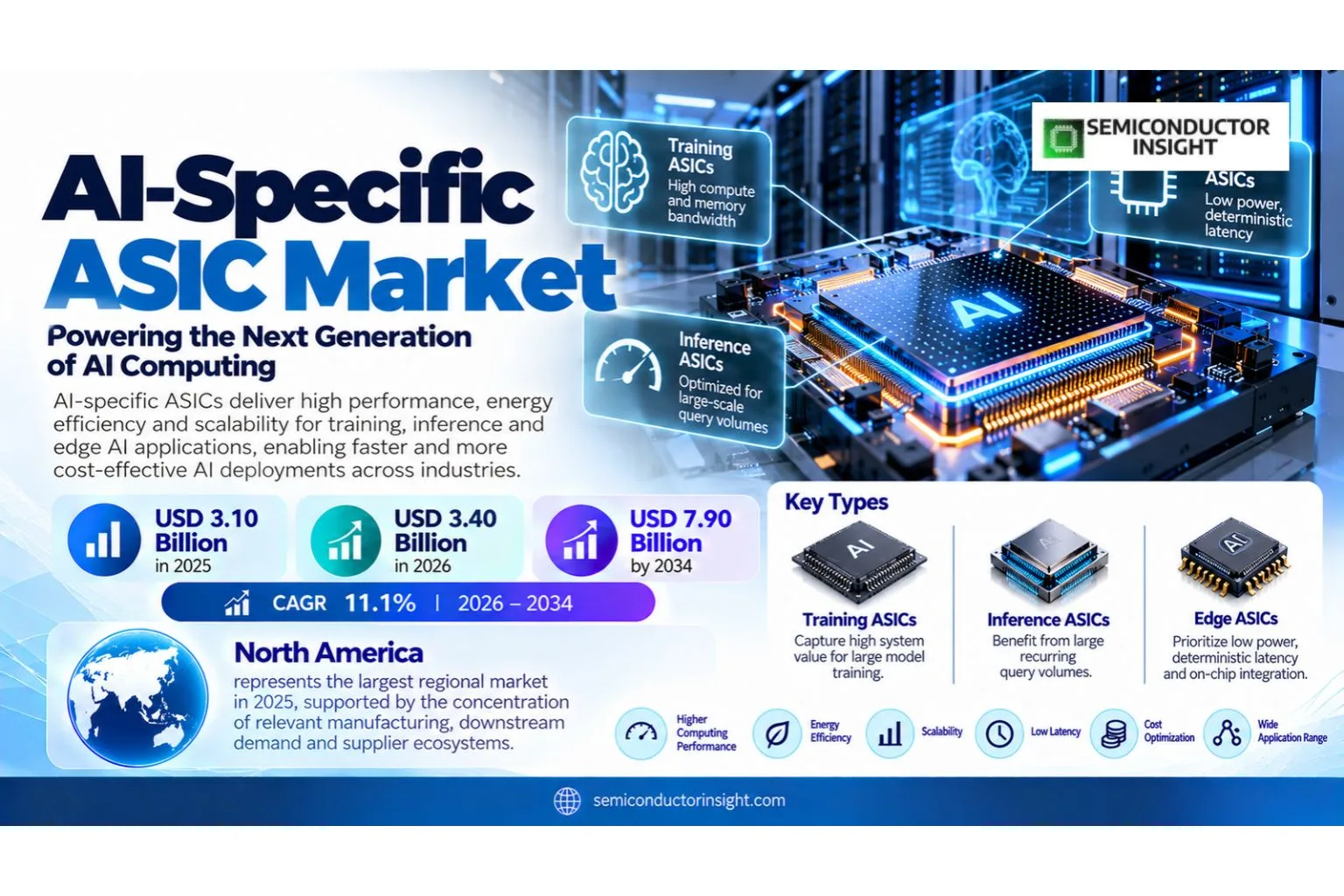
- The market is valued at USD 3.10 billion in 2025 and is projected to reach USD 7.90 billion by 2034, representing a 11.1% CAGR over 2026–2034.
- Training ASICs is a major product segment, while adjacent variants are expanding as performance, integration and cost requirements evolve.
- Data Centers & Cloud AI is a leading application area, supported by demand across Consumer Devices, Automotive.
- North America is the largest market in 2025 based on the current concentration of demand, manufacturing capacity and ecosystem maturity.
AI-Specific ASIC Market Overview
AI-Specific ASIC devices are custom integrated circuits optimized for machine-learning training or inference rather than general-purpose computing. They use specialized matrix, tensor or vector engines, tightly managed memory hierarchies and workload-specific interconnects to deliver higher performance per watt for selected AI workloads. Commercial adoption of AI-Specific ASIC products therefore depends on system-level productivity, integration requirements, reliability expectations and the economics of replacing established alternatives in real operating environments.
The market is expanding as hyperscalers seek greater control over AI infrastructure economics. Custom accelerators can reduce dependence on merchant GPUs, tailor memory and network architecture to internal software, and optimize inference cost at massive scale. The trade-off is high development expense, long design cycles and continued dependence on advanced foundry and packaging capacity.
Segment Analysis: By Type
Training ASICs capture high system value because large models require extreme compute and memory bandwidth, while inference ASICs benefit from much larger recurring query volumes. Edge ASICs prioritize low power, deterministic latency and tighter on-chip integration. Within this segment, customers increasingly compare lifecycle support, qualification requirements, integration effort and total ownership cost rather than relying on a single specification or upfront price.
| Type | Market relevance |
|---|---|
| Training ASICs | Highest-performance large-model training. |
| Inference ASICs | Largest long-term query volume. |
| Edge AI ASICs | Low-power real-time local inference. |
Segment Analysis: By Application
Data centers and cloud AI dominate because hyperscalers deploy custom accelerators at fleet scale. Consumer, automotive and robotics use smaller devices where energy efficiency and real-time local processing matter more than peak data-center throughput. Within this segment, customers increasingly compare lifecycle support, qualification requirements, integration effort and total ownership cost rather than relying on a single specification or upfront price.
| Application | Market relevance |
|---|---|
| Data Centers & Cloud AI | Largest revenue and advanced-node demand. |
| Consumer Devices | On-device AI and media processing. |
| Automotive | ADAS, cabin and vehicle intelligence. |
| Enterprise Edge & Robotics | Industrial robotics and private inference. |
Segment Analysis: By Compute Architecture
Matrix and systolic-array engines remain central because neural workloads rely heavily on multiply-accumulate operations. Vendors differentiate through numeric precision, memory hierarchy, interconnect and software support rather than one universal core design. Within this segment, customers increasingly compare lifecycle support, qualification requirements, integration effort and total ownership cost rather than relying on a single specification or upfront price.
| Compute Architecture | Market relevance |
|---|---|
| Systolic Array / Matrix Engine | Highly efficient dense matrix operations. |
| Tensor / Vector Engine | Flexible AI tensor and vector workloads. |
| Domain-Specific Accelerator | Workload-specific pipeline acceleration. |
Segment Analysis: By Deployment
Hyperscale cloud leads because only the largest operators can amortize advanced-node design costs across huge fleets. Enterprise private-cloud and edge deployments are expanding where workload specialization can justify dedicated silicon. Within this segment, customers increasingly compare lifecycle support, qualification requirements, integration effort and total ownership cost rather than relying on a single specification or upfront price.
| Deployment | Market relevance |
|---|---|
| Hyperscale Cloud | Best economics for custom silicon scale. |
| Enterprise / Private Cloud | Selective specialized enterprise workloads. |
| Edge Devices | Power- and latency-constrained devices. |
Regional Analysis
North America leads because Google, AWS, Microsoft, Meta and other hyperscalers operate the largest custom-AI silicon programs, while Asia Pacific supplies much of the advanced manufacturing and packaging required to build these accelerators. Regional share also reflects supplier depth, engineering support, manufacturing concentration and the speed at which new AI-Specific ASIC designs can move from evaluation into repeat deployment.
| Region | 2025 Position | Growth Outlook | Demand Profile |
|---|---|---|---|
| North America | Largest | Very strong | Hyperscale cloud and AI platform led |
| Asia Pacific | Manufacturing center | Very strong | Foundry, packaging and regional cloud led |
| Europe | Specialty and enterprise market | Strong | AI startups, automotive and sovereign compute led |
| South America | Emerging | Moderate | Cloud consumption led |
| Middle East & Africa | Developing | Strong from smaller base | Sovereign AI and cloud led |
Detailed Regional Blocks
Why is North America important to this market?
North America leads because U.S. hyperscalers can amortize ASIC design costs across enormous AI fleets. Google and AWS have multi-generation custom accelerator roadmaps tied directly to their cloud software and data-center infrastructure. In North America, procurement decisions also depend on service coverage, qualification resources, logistics and long-term availability, so ecosystem maturity can materially influence adoption even when core technology performance is similar.
| Country / Subregion | Role | Market Context |
|---|---|---|
| United States | Global custom AI silicon hub | Hyperscalers and AI companies drive architecture and demand. |
| Canada | AI research and cloud demand | Research ecosystems support accelerator workloads. |
| Mexico | Manufacturing adjacency | Server assembly creates downstream demand. |
- Google announced eighth-generation TPU systems at Next 2026, including TPU 8t with 9,600 chips per superpod and 121 exaflops of compute.
- AWS states that nearly one million Trainium2 chips are already training and serving Anthropic’s Claude in Project Rainier.
- The largest custom programs tightly co-design chips, compilers, networks and data-center systems rather than treating the ASIC as a standalone device.
Why is Asia Pacific important to this market?
Asia Pacific is the manufacturing center because Taiwan and South Korea provide advanced foundry, memory and packaging capacity. China and other regional cloud companies are also developing more proprietary AI silicon. In Asia Pacific, procurement decisions also depend on service coverage, qualification resources, logistics and long-term availability, so ecosystem maturity can materially influence adoption even when core technology performance is similar.
| Country / Subregion | Role | Market Context |
|---|---|---|
| Taiwan | Leading-edge foundry and packaging | Advanced AI ASICs depend on regional manufacturing. |
| South Korea | HBM and semiconductor supply | Memory bandwidth is critical to accelerator performance. |
| China | Growing custom silicon ecosystem | Cloud and edge AI drive domestic accelerator programs. |
- Advanced AI ASICs increasingly require HBM and large 2.5D packages, linking their supply directly to Asian packaging capacity.
- Process-node access and packaging availability can constrain custom-chip deployment even after design completion.
- Regional cloud providers are investing in proprietary accelerators to reduce dependence on imported merchant silicon.
Why is Europe important to this market?
Europe is smaller in hyperscale custom silicon but has growing opportunities in automotive, edge AI and sovereign compute. Design activity is strongest where specialized workloads justify custom architectures. In Europe, procurement decisions also depend on service coverage, qualification resources, logistics and long-term availability, so ecosystem maturity can materially influence adoption even when core technology performance is similar.
| Country / Subregion | Role | Market Context |
|---|---|---|
| United Kingdom | AI and semiconductor design | Startups and Arm ecosystem support accelerator development. |
| Germany | Automotive and industrial AI | Edge inference creates domain-specific demand. |
| France | Sovereign compute | Public and industrial initiatives support specialized AI hardware. |
- Automotive ASICs benefit from deterministic latency and lower power compared with general-purpose accelerators.
- Sovereign AI projects can create regional demand even when fabrication remains offshore.
- Chiplet approaches may lower barriers by combining custom compute dies with standardized interfaces and memory.
Why is South America important to this market?
South America is primarily a downstream consumption market because few local companies operate at the scale needed to fund advanced AI ASICs. Demand enters through cloud services and imported accelerator systems. In South America, procurement decisions also depend on service coverage, qualification resources, logistics and long-term availability, so ecosystem maturity can materially influence adoption even when core technology performance is similar.
| Country / Subregion | Role | Market Context |
|---|---|---|
| Brazil | Largest regional AI market | Cloud and enterprise AI drive accelerator consumption. |
| Chile | Data-center growth | Cloud infrastructure adds downstream demand. |
| Argentina | Research niche | AI research creates smaller workloads. |
- Custom ASIC value is mostly captured outside the region.
- Cloud access allows users to benefit from proprietary accelerators without owning hardware.
- Local design opportunities are more likely in specialized edge devices than hyperscale training chips.
Why is Middle East & Africa important to this market?
Middle East and Africa demand is growing through Gulf sovereign-AI infrastructure and regional cloud build-out. Most custom ASICs are consumed through hyperscale services or imported server platforms. In Middle East & Africa, procurement decisions also depend on service coverage, qualification resources, logistics and long-term availability, so ecosystem maturity can materially influence adoption even when core technology performance is similar.
| Country / Subregion | Role | Market Context |
|---|---|---|
| United Arab Emirates | Sovereign AI demand | Large compute investments support accelerator consumption. |
| Saudi Arabia | AI infrastructure growth | Data-center expansion increases demand. |
| Israel | Semiconductor design hub | Networking and AI teams support custom silicon expertise. |
- Large sovereign clusters may become anchor customers for custom cloud accelerators.
- Israel provides the region’s deepest semiconductor design capability.
- Advanced-node ASIC manufacturing remains dependent on global foundry and packaging partners.
Competitive Landscape
Google, AWS, Microsoft, Meta, Broadcom, Marvell and other custom-silicon partners compete through architecture, software integration and access to leading foundries. Merchant accelerator companies also design ASIC-like domain-specific products, but hyperscaler-owned chips are distinguished by deep optimization around internal workloads.
| Company | Position | Relevant capability |
|---|---|---|
| Key participant | Multi-generation TPU roadmap extending to eighth-generation systems announced in 2026. | |
| Amazon Web Services | Key participant | Trainium and Inferentia custom accelerators paired with the Neuron software stack. |
| Microsoft | Key participant | Competes through product breadth, integration capability, qualification and customer support. |
| Meta Platforms | Key participant | Competes through product breadth, integration capability, qualification and customer support. |
| Broadcom | Key participant | Major custom-silicon design partner for hyperscale networking and AI acceleration. |
| Marvell Technology | Key participant | Competes through product breadth, integration capability, qualification and customer support. |
| NVIDIA | Key participant | Competes through product breadth, integration capability, qualification and customer support. |
| AMD | Key participant | Competes through product breadth, integration capability, qualification and customer support. |
| Intel | Key participant | Competes through product breadth, integration capability, qualification and customer support. |
Production Capacity Analysis
AI ASIC capacity depends on advanced-node wafer allocation, HBM supply, silicon interposers, substrate capacity and high-end packaging. Design teams may control architecture, but manufacturing is concentrated among a small set of foundries and OSAT or foundry packaging operations. Scaling output without degrading consistency requires stable upstream materials, disciplined process control and final testing that catches drift before products reach high-value customer systems.
Custom accelerators also require huge validation and software investment before volume deployment. Effective capacity is therefore constrained by compiler maturity, system qualification and data-center integration as well as wafer starts. Second-source planning and regional technical support therefore become increasingly important as deployments expand and buyers seek supply continuity without repeating lengthy qualification work.
Market Dynamics
The strongest economic driver is workload scale. A custom ASIC can justify very high non-recurring engineering cost when it runs billions of repeated training or inference operations across a hyperscale fleet, but the same economics may not work for smaller enterprise users. This is changing competitive behavior because vendors increasingly sell system-level value, workflow integration and lifecycle economics rather than an isolated component specification.
The competitive boundary between ASICs and merchant GPUs is also fluid. ASICs trade general programmability for efficiency, while GPUs gain specialized tensor hardware and software ecosystems. Buyers increasingly use both, matching each workload to the architecture with the best total cost and software fit. Buyers consequently evaluate total ownership cost, qualification effort and roadmap stability across the life of a program instead of focusing only on initial purchase price.
Market Drivers
| Factor | Analyst Interpretation |
|---|---|
| AI compute growth | Larger models and more inference queries require enormous accelerator capacity. |
| Energy efficiency | Custom datapaths can reduce power per training or inference operation. |
| Hyperscaler vertical integration | Cloud providers can co-design chips with software and data-center networks. |
| Edge AI | Low-power domain-specific chips enable real-time local inference. |
Market Restraints
| Factor | Analyst Interpretation |
|---|---|
| Very high design cost | Leading-edge tapeouts, verification and software require major investment. |
| Workload inflexibility | A highly specialized ASIC may become less useful if model architectures change. |
| Foundry and HBM dependence | Custom design does not remove manufacturing bottlenecks. |
| Software ecosystem burden | Compilers, frameworks and developer tools must mature alongside the silicon. |
Market Opportunities
| Factor | Analyst Interpretation |
|---|---|
| Inference ASICs | Rapid growth in AI queries creates large recurring workloads suited to specialization. |
| Agentic AI accelerators | Long-context and tool-using workloads create new architecture requirements. |
| Chiplet ASICs | Modular designs can combine custom compute with standardized I/O and memory dies. |
| Enterprise domain ASICs | Large repeated workloads in recommendation, search or vision can justify custom accelerators outside hyperscalers. |
Supply Chain Analysis
The value chain begins with workload and architecture definition, then moves through RTL design, verification, foundry manufacturing, HBM and packaging integration, compiler development and deployment into cloud or edge systems. Software and hardware are tightly coupled. Traceability and coordination between component suppliers, integrators and end users are important because failures found late in the chain can be far more expensive than the underlying part itself.
| Supply Chain Stage | Role in the Market |
|---|---|
| Architecture and RTL | Custom matrix engines, memory and interconnect are designed around target workloads. |
| Foundry fabrication | Leading-edge logic dies are produced on advanced process nodes. |
| HBM and advanced packaging | Memory stacks and interposers provide the bandwidth required by large models. |
| Compiler and cloud integration | Software exposes the ASIC to AI frameworks and production workloads. |
Recent Developments
| Date | Development | Source |
|---|---|---|
| 2026 | Google announced eighth-generation TPU systems for agentic AI, including the TPU 8t training platform with 9,600 chips per superpod. | Google Cloud |
| 2026 | AWS reports that Project Rainier uses nearly one million Trainium2 chips to train and serve Anthropic's Claude workloads. | Amazon Web Services |
| 2026 | AWS continues its Build on Trainium research program, a USD 110 million initiative supporting AI research and education on custom Trainium accelerators. | Amazon Web Services |
Report Scope & Segmentation
| Scope Item | Coverage |
|---|---|
| Base Year | 2025 |
| Estimated Year | 2026 |
| Forecast Period | 2026–2034 |
| 2025 Market Size | USD 3.10 billion |
| 2026 Estimated Size | USD 3.40 billion |
| 2034 Forecast Size | USD 7.90 billion |
| CAGR (2026–2034) | 11.1% |
| Largest Market in 2025 | North America |
| Category | Artificial Intelligence / Integrated Circuits / Custom AI Accelerators |
| By Type | Training ASICs, Inference ASICs, Edge AI ASICs |
| By Application | Data Centers & Cloud AI, Consumer Devices, Automotive, Enterprise Edge & Robotics |
| By Compute Architecture | Systolic Array / Matrix Engine, Tensor / Vector Engine, Domain-Specific Accelerator |
| By Deployment | Hyperscale Cloud, Enterprise / Private Cloud, Edge Devices |
Frequently Asked Questions
What is the 2025 market size of the AI-Specific ASIC market?
The market is valued at USD 3.10 billion in 2025.
What is the projected 2034 market size of the AI-Specific ASIC market?
The market is projected to reach USD 7.90 billion by 2034.
What is the CAGR of the AI-Specific ASIC market from 2026 to 2034?
The market is expected to expand at a CAGR of 11.1% during 2026–2034.
Which region leads the AI-Specific ASIC market?
North America is the largest market in 2025 based on the current demand, manufacturing and deployment structure.
Which type segment is important in the AI-Specific ASIC market?
Training ASICs is a major segment, while adjacent product variants are gaining share as performance and integration requirements evolve.
What is the main application for AI-Specific ASIC products?
Data Centers & Cloud AI is a leading application, with additional growth coming from Consumer Devices, Automotive.
What drives growth in the AI-Specific ASIC market?
Larger models and more inference queries require enormous accelerator capacity.
What is a key restraint for the AI-Specific ASIC market?
Leading-edge tapeouts, verification and software require major investment.
Which companies participate in the AI-Specific ASIC market?
Key participants include Google, Amazon Web Services, Microsoft, Meta Platforms, Broadcom, alongside other specialized suppliers and system companies.
What technology trend is shaping the AI-Specific ASIC market?
Rapid growth in AI queries creates large recurring workloads suited to specialization.
Research Sources & Evidence Base
View research sources used for this overview.
- Google Cloud — AI Infrastructure at Next 2026: Eighth-generation TPU systems and TPU 8t architecture scale. Source
- Google Cloud — Trillium TPU: Background on Google’s multi-generation custom TPU roadmap. Source
- Amazon Web Services — Trainium Customers: Current Trainium deployment scale including Project Rainier. Source
- Amazon Web Services — Build on Trainium: USD 110 million research program and custom AI chip ecosystem. Source
Get Sample Report PDF for Exclusive Insights
Report Sample Includes
- Table of Contents
- List of Tables & Figures
- Charts, Research Methodology, and more...
 Download Sample Report PDF