Key Statistics
Key Takeaways
- GPU servers are the largest application because synchronized accelerator workloads can create rapid rack-level power excursions that benefit from millisecond-response energy buffering.
- Hyperscale data centers are the leading end-user group as operators seek to increase rack density without oversizing every upstream power component for short-duration peaks.
- Higher-voltage rack architectures are becoming more important. 48V-class systems and emerging higher-voltage distribution reduce current for a given power level and enable supercapacitor modules to operate closer to rack and power-shelf infrastructure.
- North America is the largest regional market due to hyperscale AI investment, cloud infrastructure and early deployment of advanced rack-level power systems.
- Commercial products are moving from cells to managed power systems. Eaton markets supercapacitors specifically for AI data centers, Panasonic is developing EDLC solutions for AI-server burst loads, and Skeleton offers supercapacitor-based AI data-center peak-shaving and UPS platforms.
AI Server Supercapacitors Market Overview
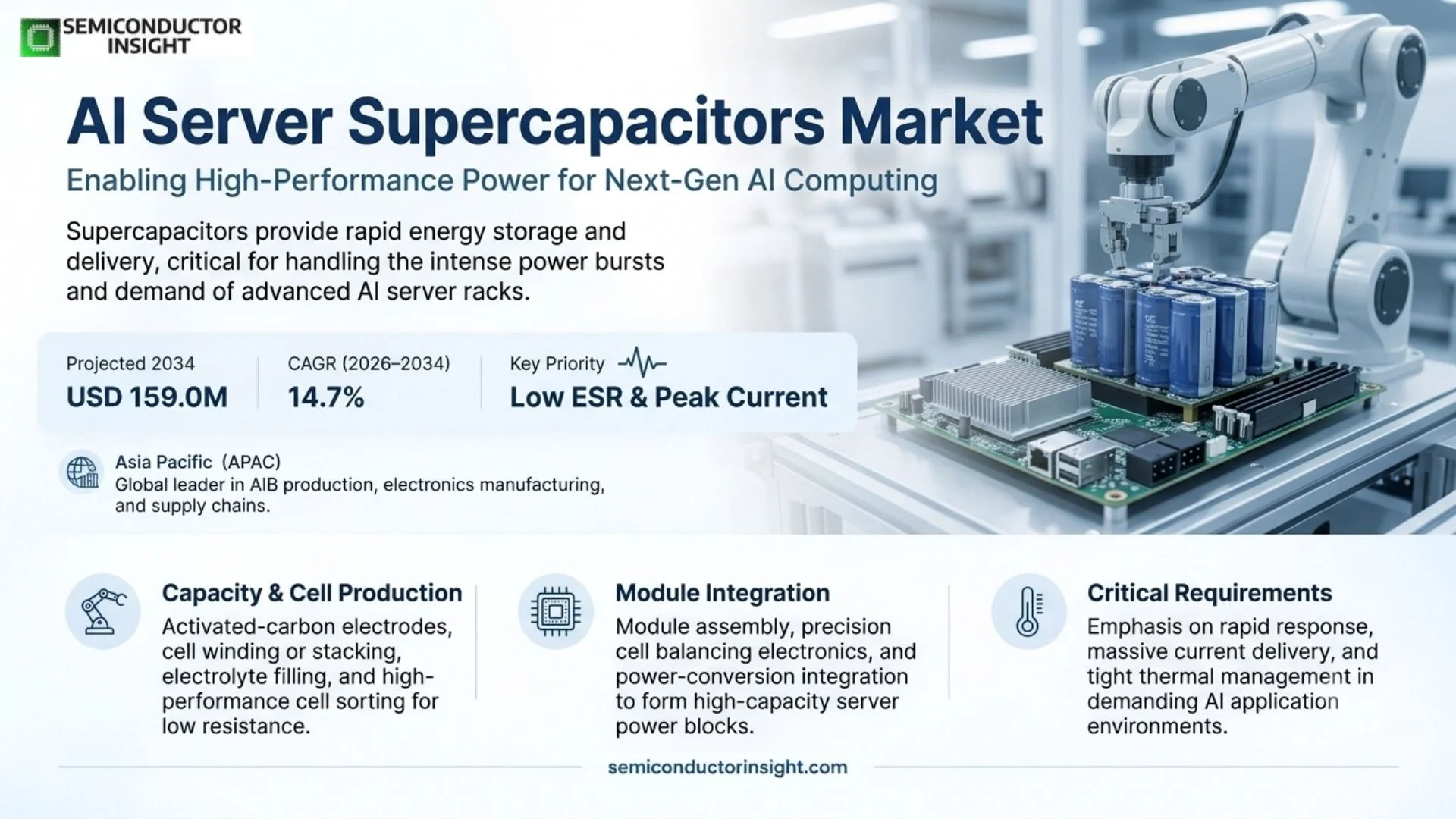
AI Server Supercapacitors market was valued at USD 46.30 million in 2025 and is projected to reach USD 159.0 million by 2034, representing a 14.7% CAGR during 2026–2034. The 2026 estimated market size is USD 53.10 million. North America is the largest regional market because hyperscale cloud operators and AI infrastructure developers are early adopters of rack-level power buffering and high-density power architectures.
AI server supercapacitors are high-power energy-storage devices used to absorb or deliver short bursts of electrical power close to servers, racks or power-conversion systems. They respond much faster than batteries and can cycle repeatedly with limited degradation, making them well suited to transient load management rather than long-duration backup.
AI workloads create unusual electrical behavior because thousands of GPUs or custom accelerators can shift between compute phases in a synchronized manner. Those transitions can cause rapid current swings that propagate upstream into power supplies, PDUs, UPS systems and utility interfaces. A local supercapacitor buffer can absorb excess power when load falls and release energy when load rises, smoothing the profile seen by the rest of the power chain.
The commercial architecture is evolving from individual cells toward modules, capacitor backup units and managed energy-buffer systems. Balancing electronics, DC/DC converters, telemetry, thermal management and control software determine how effectively the supercapacitor integrates with a 48V or higher-voltage rack architecture. This raises solution value but also increases qualification and system-integration complexity.
Segment Analysis: By Type
By type, the market includes Electrochemical Double-Layer Capacitors (EDLCs), Pseudocapacitors and Hybrid Capacitors. EDLCs are the core high-power technology because they provide very low equivalent series resistance and extremely high cycle life, while hybrid devices trade some power density for greater usable energy density.
| Type | Technical characteristics | Market position |
|---|---|---|
| EDLC | Stores charge electrostatically at the electrode-electrolyte interface, enabling very fast charge-discharge, low ESR and very high cycle life. Activated-carbon and advanced carbon materials are commonly used. | Core high-power segment for rack peak shaving, capacitor backup units and repeated transient absorption where cycle endurance and current capability matter most. |
| Pseudocapacitor | Uses fast surface redox reactions to increase stored charge. Materials can offer higher capacitance but may introduce greater aging, cost or temperature sensitivity than pure EDLC designs. | A smaller specialty segment with potential in compact systems where additional energy density is valuable and duty cycle is less extreme. |
| Hybrid Capacitor | Combines capacitive and battery-like storage mechanisms to balance power density, energy density and runtime. Hybrid products can extend backup duration while maintaining faster response than batteries. | A growing segment for rack-level buffering where operators need both short peak support and several seconds or longer of ride-through. |
Voltage and integration-level segmentation
The market is also segmented by voltage rating and integration level. Individual cells operate at only a few volts, but modules and systems connect many cells in series with balancing and DC/DC conversion. 48V-class rack distribution is already important in AI infrastructure, while higher-voltage architectures can reduce conductor size and conversion loss in future data centers.
| Axis | Segments | Commercial implication |
|---|---|---|
| By Voltage Rating | 2.5V · 2.7V / 3.0V · 48V+ Module Systems · Higher-Voltage Rack Systems | Cell voltage affects series count and balancing complexity. Rack-level systems increasingly package cells into monitored modules so customers buy a validated energy-buffer function rather than raw capacitance. |
| By Integration Level | Component-Level · Module-Level · System-Level | Component solutions suit board designers, modules simplify rack integration, and system-level products combine energy storage, converters, telemetry, cooling and orchestration for data-center deployment. |
Segment Analysis: By Application
By application, GPU Servers are the largest segment, followed by ASIC servers, FPGA servers and other high-performance systems. GPU clusters generate the most visible power-transient challenge because large numbers of accelerators can synchronize on the same workload phase and draw or release substantial power at once.
| Application | Key market insight |
|---|---|
| GPU Server | The largest application. Training and inference clusters can transition rapidly between compute and communication phases, creating steep rack-level power changes. Supercapacitors can supply or absorb those short bursts so upstream PSUs and distribution equipment operate closer to average load. |
| ASIC Server | Custom accelerators used by hyperscalers can create similar transient behavior but may use tightly optimized power architectures. Supercapacitor capacity can be tuned to the accelerator’s known load envelope and rack design. |
| FPGA Server | FPGA-based acceleration is used in networking, inference, finance and specialized compute. Power profiles can be highly workload dependent, creating selective opportunities for local energy buffers. |
| AI Storage / Network Systems | High-speed storage, switching and optical-network equipment can experience burst loads and may share the same rack power envelope as accelerators. Local supercapacitor buffering can support coordinated rack-level power management. |
| Others | Research clusters, edge AI infrastructure and mission-critical systems use supercapacitors where rapid ride-through, peak shaving or repeated power events are more important than long backup duration. |
Regional Analysis
North America dominates the AI Server Supercapacitors market because the region contains a high concentration of hyperscale cloud providers, AI infrastructure investment and advanced data-center power engineering. Asia Pacific is the fastest-growing regional opportunity through large AI build-outs and component manufacturing, while Europe emphasizes energy efficiency and grid-aware data-center design.
How do regional AI power-buffering priorities differ?
North American operators focus on rapidly scaling AI clusters and increasing rack density. Asia Pacific combines data-center expansion with capacitor and electronics manufacturing capability. Europe places strong emphasis on efficiency, renewable integration and grid constraints. Emerging regions adopt supercapacitor buffering mainly through imported server and power platforms as sovereign AI infrastructure expands.
| Region | Market position | Growth outlook | Core demand | Commercial priority |
|---|---|---|---|---|
| North America | Largest | Very high | Hyperscale GPU clusters | Rack density, peak shaving and uptime |
| Asia Pacific | Fastest-growing | Very high | Cloud, AI & component manufacturing | Cost, module supply and power density |
| Europe | Efficiency-focused | High | AI, HPC & green data centers | Grid interaction, lifecycle and efficiency |
| South America | Emerging | Moderate | Cloud / edge AI | Cost and imported platforms |
| Middle East & Africa | Emerging / investment-led | High from small base | Sovereign AI & hyperscale | Power infrastructure and system availability |
Competitive Landscape
Key participants include Eaton, Skeleton Technologies, Nippon Chemi-Con, Kyocera AVX, Yageo, CAP-XX, LS Materials, Nantong Jianghai Capacitor, Fujian Torch Electron Technology, Hunan Aihua Group, Shanghai Yongming Electronic, Maxwell Technologies, Panasonic Industry, Illinois Capacitor and Vishay. Eaton is the current market leader, while system-level integration is becoming a stronger competitive factor than cell capacitance alone.
Eaton positions supercapacitors directly for AI data-center applications where peak power cycles and utility stress must be managed. Its broader power-distribution and UPS portfolio provides an advantage because the supercapacitor can be integrated into a complete facility power architecture rather than sold as a standalone component.
Skeleton has moved aggressively toward AI infrastructure systems. Its high-power cells, modules, GrapheneUPS and peak-shaving platforms target transient power, voltage ride-through and grid constraints. The company also operates large-scale European supercapacitor manufacturing and is preparing additional capacity to address AI infrastructure demand.
Panasonic is developing EDLC products specifically for AI server burst loads and has described rack, zone and distribution-level deployment. Kyocera AVX offers 48V and higher-voltage supercapacitor modules suitable for pulse power and UPS applications, while Asian capacitor makers compete on cost, cell manufacturing and module integration.
Competitive tier structure
| Competitive tier | Representative companies | Competitive strengths |
|---|---|---|
| System / infrastructure leaders | Eaton; Skeleton Technologies; Panasonic | Rack or facility power integration, peak shaving, UPS and managed energy-buffer solutions |
| Global capacitor specialists | Kyocera AVX; Nippon Chemi-Con; Yageo; CAP-XX; Vishay | Cell and module engineering, low ESR, lifecycle, voltage scaling and global component support |
| Asian high-volume suppliers | LS Materials; Jianghai; Torch Electron; Aihua; Yongming | Capacitor manufacturing scale, regional server supply chains and competitive module cost |
Key companies profiled
AI Server Supercapacitor Capacity & Module Integration Analysis
Capacity is determined by activated-carbon or advanced-carbon electrode production, cell winding or stacking, electrolyte filling, formation, sorting, module assembly, balancing electronics and power-conversion integration. AI applications place stronger emphasis on low ESR and peak current than on energy density, so high-performance cells may require tighter sorting and thermal design than general industrial products.
Module production is as important as cell output because rack systems need higher voltage and monitored operation. Cells are connected in series and parallel, balanced, fused and integrated with busbars, temperature sensors and DC/DC converters. A weak cell or connection can limit the performance of an entire module.
System capacity is moving closer to data-center power electronics. GrapheneUPS and similar solutions combine supercapacitor cabinets with high-efficiency converters and telemetry. This shifts value from component manufacturing toward power-system engineering, software and field-service capability.
Market Dynamics
Growth is driven by AI rack power density, synchronized GPU transients, grid constraints and the need to reduce infrastructure overprovisioning. Restraints include lower energy density than batteries, system-integration cost, thermal management and the need for new rack architectures. Opportunities center on rack-level peak shaving, capacitor backup units, 48V and HVDC systems, and managed energy-buffer software.
MARKET DRIVERS
AI racks create sharp transient demand
Accelerators can synchronize across large clusters, producing power changes faster than utility and UPS systems can respond efficiently. Local buffers smooth those transitions.
Peak shaving can reduce overprovisioning
If upstream equipment is sized for the worst instantaneous load, much of its capacity can remain unused most of the time. Supercapacitors let operators design closer to average load while preserving transient headroom.
Cycle life fits continuous buffering
Batteries are strong for minutes or hours of backup but can age under very frequent high-rate cycling. Supercapacitors are designed for repeated charge-discharge events and can handle daily or continuous transient management.
48V and higher-voltage racks simplify integration
Higher rack voltage reduces current and conductor size. Supercapacitor modules can be integrated into standardized DC buses and managed through power shelves or capacitor backup units.
Drivers Impact Analysis
| Driver | Impact | Primary markets | Time horizon |
|---|---|---|---|
| AI rack power density | High | North America, Asia Pacific | Short to long term |
| GPU transient loads | High | Hyperscale clusters | Persistent |
| Grid / utility constraints | High | New AI campuses | Medium to long term |
| Power-system efficiency | Medium to high | Global data centers | Persistent |
MARKET RESTRAINTS
Supercapacitors are not long-duration backup devices
Their strength is fast power delivery over seconds or short minutes. Batteries, generators or grid redundancy are still required for extended outages.
System value depends on integration quality
Cells alone do not solve rack power excursions. Balancing, controls, converters and placement determine whether the energy buffer actually reduces upstream peaks.
High current creates thermal and busbar challenges
Even low ESR produces heat at thousands of amps. Module interconnect, cooling and current sharing must be engineered carefully.
AI power architectures are still evolving
48V, higher-voltage DC and different rack standards are being evaluated. Suppliers must support several interfaces while avoiding products tied to a short-lived architecture.
Restraints Impact Analysis
| Restraint | Impact | Exposure | Time horizon |
|---|---|---|---|
| Lower energy density than batteries | High | Long-duration backup | Persistent |
| Module / converter integration cost | Medium to high | Rack-scale systems | Short to medium term |
| Thermal / ESR management | Medium | High-current systems | Persistent |
| Architecture standardization | Medium | Emerging AI power designs | Medium term |
MARKET OPPORTUNITIES
Deploy rack-level capacitor backup units
A CBU can sit close to GPU servers and provide fast ride-through or peak support, limiting transient stress on the PSU and PDU.
Integrate peak shaving with UPS systems
Supercapacitors can handle rapid events while batteries or generators handle long outages. Hybrid systems can improve battery life and overall power-system efficiency.
Expand higher-voltage modules
Higher-voltage rack and facility architectures reduce current and conductor size. Suppliers can capture more value through monitored, serviceable modules rather than low-voltage cells.
Use telemetry for predictive maintenance
Voltage, temperature and ESR monitoring can estimate cell health and remaining life, enabling planned replacement rather than reactive failure.
AI Server Supercapacitor Value Chain Analysis
Carbon materials & electrolyte
Cell manufacturing
Module & power electronics
Data-center integration
Electrode materials determine high-current capability
Low internal resistance is essential because AI peak shaving can involve very large currents. Advanced carbon structures and low-resistance current collectors directly influence power density.
Cell sorting protects module performance
Series-connected modules are limited by the weakest cell. Sorting for capacitance, leakage and ESR improves balancing and prevents overvoltage during repeated cycling.
Power electronics determines usable functionality
Converters control charge, discharge and rack-bus interaction. Fast control is required to respond before upstream voltage droop or breaker thresholds become a problem.
System software turns storage into infrastructure value
Telemetry and orchestration can decide when to absorb or release energy based on rack workload and facility constraints. This enables more sophisticated peak shaving than a passive capacitor bank.
Recent Developments in the AI Server Supercapacitors Market
Panasonic prepares AI-data-center supercapacitor mass production
Panasonic has described EDLCs for AI-server capacitor backup units and plans production-line expansion in Japan to support AI data-center applications.
Skeleton achieves 3,500 A UL-certified peak current
Skeleton announced a record peak-current rating for a compact supercapacitor, highlighting the extreme current capability required by AI power systems.
Skeleton raises new capital for AI power expansion
The company announced a EUR 33 million first close of a larger financing round to expand high-power energy-storage solutions for AI data centers and prepare additional production capacity.
Panasonic details AI server peak-shaving architecture
Panasonic published rack, zone and distribution-level use cases for EDLC modules that absorb transient load and reduce PSU, UPS and PDU stress.
Eaton positions supercapacitors for AI data centers
Eaton’s current data-center materials highlight supercapacitors for peak-power cycles, stable power management and reduced utility stress.
REPORT SCOPE & SEGMENTATION
| Attribute | Details |
|---|---|
| Study Period | 2021–2034 |
| Base Year | 2025 |
| Estimated Year | 2026 |
| Forecast Period | 2026–2034 |
| Historical Period | 2021–2025 |
| Market Size 2025 | USD 46.30 million |
| Market Size 2034 | USD 159.0 million |
| Growth Rate | 14.7% during 2026–2034 |
| Unit | Value (USD Million) and supercapacitor/module shipments |
| By Type | Electrochemical Double-Layer Capacitor (EDLC) · Pseudocapacitor · Hybrid Capacitor |
| By Application | GPU Server · ASIC Server · FPGA Server · Others |
| By End User | Hyperscale Data Centers · Enterprise Data Centers · Cloud Service Providers |
| By Voltage Rating | 2.5V · 2.7V / 3.0V · 48V+ Systems · Higher-Voltage Rack Systems |
| By Integration Level | Component-Level · Module-Level · System-Level |
| By Region | Each region analysed by capacitor type, server application, end user, voltage rating, integration level and country market North AmericaUnited States, Canada, Mexico EuropeGermany, United Kingdom, France, Nordics and other European markets Asia PacificChina, Japan, South Korea, Taiwan, Singapore and other Asian markets South AmericaBrazil, Chile and other South American markets Middle East & AfricaSaudi Arabia, UAE, South Africa and other MEA markets |
| Key Companies Profiled | Eaton Corporation · Skeleton Technologies · Nippon Chemi-Con Corporation · Kyocera AVX · Yageo Corporation · CAP-XX Limited · LS Materials · Nantong Jianghai Capacitor · Fujian Torch Electron Technology · Hunan Aihua Group · Shanghai Yongming Electronic · Maxwell Technologies · Panasonic Industry · Illinois Capacitor · Vishay Intertechnology |
| Customization Scope | Free report customization equivalent to up to four analyst working days with purchase. Addition or alteration to country, regional and segment scope. |
Frequently Asked Questions
What is the 2025 size of the AI Server Supercapacitors market?
The market was valued at USD 46.30 million in 2025 and is projected to reach USD 159.0 million by 2034. The 2026 estimate is USD 53.10 million and the 2026–2034 CAGR is 14.7%.
Which application leads the market?
GPU servers are the largest application because large accelerator clusters create rapid power excursions that can be buffered locally with millisecond-response supercapacitors.
Which end users are adopting fastest?
Hyperscale data centers lead adoption because they operate the largest AI clusters and can capture infrastructure savings from peak shaving, higher rack density and reduced upstream overprovisioning.
Which region leads the market?
North America is the largest current market due to hyperscale cloud investment, AI infrastructure density and early adoption of advanced rack-level power systems.
What is the estimated market size in 2026?
The 2026 estimated market size is USD 53.10 million. Growth is driven by AI rack density, GPU transient loads and increasing interest in rack-level energy buffers.
Why are supercapacitors useful in AI servers?
They deliver or absorb very high power within milliseconds and can repeat that cycle many times. This makes them suitable for smoothing short GPU load spikes and providing brief ride-through without the cycle wear of batteries.
What are the main market restraints?
The main restraints are lower energy density than batteries, integration cost, thermal management at very high current and evolving data-center power architectures.
What voltage systems are important?
Individual cells operate at a few volts, but AI deployments increasingly use 48V and higher-voltage module systems. Higher voltage reduces current and conductor size for a given power level.
How do AI-server supercapacitors differ from conventional backup batteries?
Supercapacitors are optimized for rapid, frequent power events and very high cycle life. Batteries store more energy for longer outages, so the two technologies are often complementary rather than direct substitutes.
What does the report cover?
The report covers EDLC, pseudocapacitor and hybrid technologies; GPU, ASIC and FPGA server applications; hyperscale, enterprise and cloud end users; voltage and integration levels; five global regions; capacity analysis; dynamics; recent developments; and major suppliers.
Research Sources & Evidence Base
View primary and authoritative evidence used in this overview
- Eaton. Supercapacitors in AI Data Centers – Official application information on peak power cycles, stable power management and reduced utility stress.
- Panasonic Industry. Supercapacitors for Next-Gen Telecom & AI Datacenters – January 2026 official product direction for backup, peak-load support and AI infrastructure.
- Panasonic Industry. Peak Shaving for AI Data Centers – April 2026 official architecture guidance for rack, zone and distribution-level EDLC deployment.
- Skeleton Technologies. AI Data Center Peak Shaving & Backup – Official product information on supercapacitor peak shaving, power density and AI data-center applications.
- Skeleton Technologies. GrapheneUPS for AI Data Centers – April 2026 product data covering supercapacitor energy storage, SiC/GaN converters and AI-data-center UPS architecture.
- Kyocera AVX. SCM Series Large Supercapacitor Modules – Official specifications for 48V and 160V series-connected supercapacitor modules.
Get Sample Report PDF for Exclusive Insights
Report Sample Includes
- Table of Contents
- List of Tables & Figures
- Charts, Research Methodology, and more...
 Download Sample Report PDF