Key Statistics
Key Takeaways
- 500 kW–1.5 MW modular UPS systems are the fastest-growing power class because AI racks are moving from tens of kilowatts toward hundreds of kilowatts and eventually megawatt-class designs. Schneider Electric’s Galaxy VXL spans 500–1,250 kW, Vertiv Trinergy reaches 1.5–2.5 MW, and Eaton 9395XR reaches 1.5 MW.
- Hyperscale and colocation data centers are the largest application because operators must absorb rapid AI load ramps while preserving uptime and power quality. Vertiv notes that AI racks can move from roughly 10% idle to 150% overload rapidly, increasing the value of UPS architectures validated for dynamic loads.
- North America is the largest regional market because the United States has the strongest near-term AI data-center buildout, with the IEA projecting that data centers will account for almost half of U.S. electricity-demand growth through 2030. Europe and Asia Pacific follow through hyperscale, colocation and national AI infrastructure investment.
- AI-load tolerance is becoming a product requirement rather than a marketing feature. Schneider Electric has validated Galaxy VXL, VX and VL for dynamic AI workloads; Vertiv has tested large UPS systems with EdgeConneX under variable AI loads; and Eaton introduced monitoring specifically to detect AI power bursts.
- Modularity is the preferred commercial architecture because data centers need staged capital deployment, live capacity expansion and redundancy without complete system shutdown. Hot-swappable power modules, lithium-ion batteries, parallel operation and prefabricated electrical rooms shorten expansion cycles.
- 800 VDC and grid-to-chip architectures are the major long-term disruption. Eaton and NVIDIA are collaborating on 800 V high-voltage DC infrastructure for 1 MW racks and beyond, which could reshape where UPS, energy storage and power conversion functions sit inside future AI factories.
AI-Driven Modular UPS System for AI Data Centers Market Overview
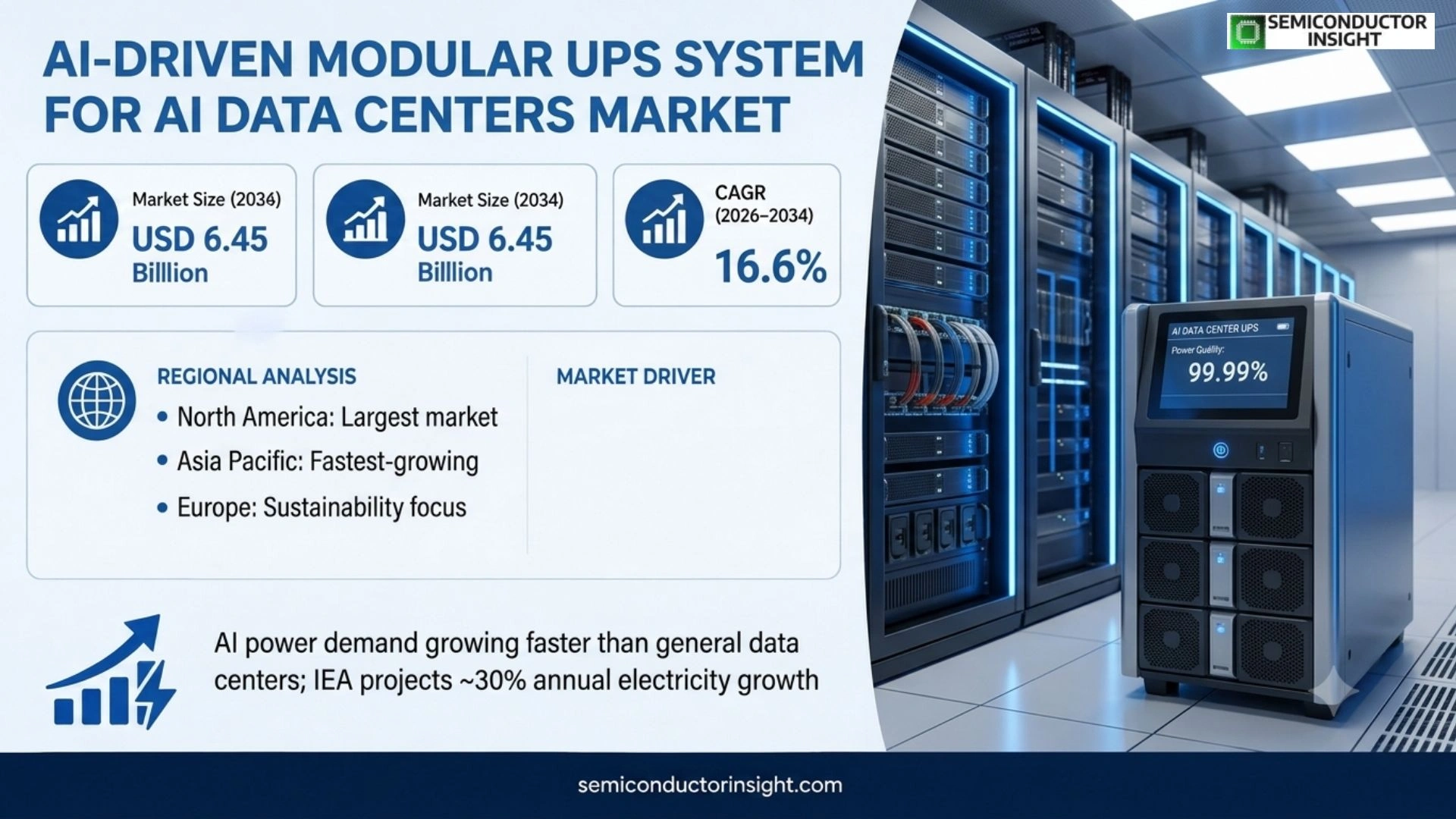
AI-driven Modular UPS System for AI Data Centers Market was valued at approximately USD 1.62 billion in 2025 and is projected to reach approximately USD 6.45 billion by 2034, representing a 16.6% CAGR during 2026–2034. North America is the largest regional market, supported by hyperscale AI investment, rising rack power density and a rapid shift toward high-capacity modular power-protection architectures.
AI-driven modular UPS systems are three-phase uninterruptible power platforms engineered for data centers that operate dense GPU, accelerator and high-performance computing workloads. Unlike traditional enterprise UPS deployments sized around relatively stable server demand, AI environments must tolerate rapid power transitions, higher power per rack and increasingly concentrated failure impact. The UPS must maintain voltage quality through sudden load changes while coordinating batteries, bypass systems, generators, grid interfaces and facility controls.
The underlying demand is structural. The International Energy Agency projects global data-center electricity consumption to more than double to around 945 TWh by 2030, with accelerated servers growing electricity use by about 30% annually in its base case. NVIDIA’s GB200 NVL72 uses 72 Blackwell GPUs and is designed as a liquid-cooled rack-scale system, illustrating why AI infrastructure is moving beyond conventional rack power assumptions. The result is a new requirement for UPS platforms that can scale in larger blocks and react to highly dynamic compute behavior.
Modular architecture is commercially important because AI campuses are built in phases. Operators can install a frame with initial power modules, add modules as GPU capacity is commissioned and preserve N+1 or N+2 redundancy without replacing the complete UPS. Schneider Electric Galaxy VL uses 50 kW power modules, Galaxy VXL uses 125 kW modules, and Eaton 9395XR scales to 1.5 MW. This staged model improves capital efficiency and reduces stranded electrical capacity during early phases of a data-center build.
The market is also expanding from hardware toward software-controlled resilience. Schneider Electric integrates Galaxy VXL with EcoStruxure IT, Vertiv launched Unify for power and thermal infrastructure visibility, and Eaton added edge analytics for detecting AI power bursts. These tools are increasingly necessary because AI data centers must coordinate UPS behavior with liquid cooling, power distribution, on-site generation and utility conditions in real time rather than manage each asset independently.
Segment Analysis: By Power Rating
By power rating, the market is segmented into Below 500 kW, 500 kW–1.5 MW, and Above 1.5 MW. The 500 kW–1.5 MW segment currently captures the broadest deployment opportunity because it aligns with large modular UPS frames used in modern hyperscale and colocation halls. Above 1.5 MW systems are expanding fastest as AI factories aggregate multiple high-density rows and megawatt-class rack clusters behind fewer high-capacity electrical blocks.
| Power Rating | Technical and commercial role | Market position |
|---|---|---|
| Below 500 kW | Used in smaller AI rooms, enterprise GPU clusters, edge AI, dedicated cooling systems and modular data-center blocks. Products in this range emphasize hot-swappable modules, compact footprint and deployment flexibility. Schneider Electric Galaxy VL spans 200–500 kW, while Vertiv Liebert APM2 scales from lower capacities through several hundred kilovolt-amperes. | A broad but more mature segment. Growth comes from enterprise AI, regional colocation and edge deployments rather than the largest hyperscale halls. Buyers prioritize rapid expansion, lithium-ion compatibility and serviceability because small sites have fewer electrical specialists on staff. |
| 500 kW–1.5 MW | This range fits high-density AI halls and modular power blocks supporting several rows or liquid-cooled rack groups. Galaxy VXL covers 500–1,250 kW and Eaton 9395XR reaches 1,500 kW. Systems are often deployed in parallel to create scalable multi-megawatt protected-power architectures. | Largest and fastest commercial segment. It balances high power density with modular redundancy and aligns well with phased AI campus builds. Customers can add modules as compute goes live while avoiding the footprint and maintenance burden of many smaller UPS frames. |
| Above 1.5 MW | Large centralized or block-level UPS platforms support hyperscale AI factories, large colocation campuses and high-density HPC installations. Vertiv Trinergy reaches 2.5 MW and is designed for rapid load changes and high-efficiency operation in AI environments. | A smaller current base but rapidly expanding. The segment benefits from multi-megawatt AI halls, prefabricated power trains and the shift toward fewer, higher-density electrical blocks. Engineering focus centers on fault current, parallel coordination, cooling, bypass architecture and grid interaction. |
Battery and energy-storage configuration
Battery architecture is a secondary segmentation spanning lithium-ion, VRLA, nickel-zinc and increasingly hybrid energy-storage approaches. Lithium-ion is gaining share because it reduces footprint, supports higher cycle life and simplifies frequent discharge or grid-interactive operation. AI campuses are also exploring battery systems that can absorb rapid power fluctuations or support grid services, which increases the value of bidirectional controls and energy-management software alongside traditional ride-through protection.
Segment Analysis: By Application
By application, the market is segmented into Hyperscale AI Data Centers, Colocation Data Centers, Enterprise AI/HPC Data Centers, and Edge/Regional AI Facilities. Hyperscale and colocation sites represent the largest value pool because they deploy large electrical blocks and must maintain contractual uptime across thousands of accelerators. Enterprise sites use smaller modular systems but benefit strongly from simplified deployment and integrated management.
| Application | Demand characteristics |
|---|---|
| Hyperscale AI Data Centers | Largest value application. Hyperscalers deploy large GPU clusters, multi-megawatt halls and liquid-cooling systems that place unusual transient demands on facility power. UPS selection focuses on high block capacity, rapid load tolerance, very high efficiency, parallel scalability, lithium-ion storage and integration with DCIM or AI-factory control systems. |
| Colocation Data Centers | Colocation operators must support multiple customer load profiles and frequently add AI capacity inside existing campuses. Modularity is particularly valuable because capacity can be installed in increments and aligned with customer contracts. Vertiv’s EdgeConneX testing under variable AI loads illustrates the importance of validating UPS behavior before hosting concentrated GPU deployments. |
| Enterprise AI/HPC Data Centers | Banks, universities, manufacturers, pharmaceutical companies and government organizations increasingly operate private GPU clusters. Their UPS requirements are smaller than hyperscalers but often stricter on turnkey simplicity, remote monitoring and service support. Modular frames reduce the need to oversize initial infrastructure and allow later expansion as AI programs mature. |
| Edge and Regional AI Facilities | Inference, telecom and sovereign AI deployments can place accelerator capacity closer to users. These sites need high power density in constrained spaces and may have weaker grid infrastructure than major hyperscale hubs. Compact modular UPS, lithium-ion batteries and prefabricated systems can improve deployment speed and resilience. |
Deployment architecture
The report also distinguishes centralized UPS, distributed block UPS and dedicated cooling/auxiliary UPS. Centralized systems maximize electrical scale, distributed architectures improve fault isolation and phased growth, while dedicated UPS for pumps and cooling protects liquid-cooled AI racks during power transitions. Vertiv specifically expects liquid-cooling systems to be paired increasingly with dedicated high-density UPS protection, reflecting the operational dependence between compute and cooling.
Regional Analysis
North America is the largest AI modular UPS market, Asia Pacific is the fastest-growing manufacturing and deployment region, and Europe is highly influenced by power availability and sustainability requirements. Regional demand is determined by AI data-center construction, electricity-grid constraints, colocation expansion and the installed service networks of UPS vendors rather than by general IT spending alone.
How does regional demand differ across AI modular UPS systems?
North America is driven by hyperscale and cloud investment, Europe by constrained grids and high-efficiency requirements, and Asia Pacific by rapid data-center construction in China, Japan, Korea, India, Singapore and Southeast Asia. The Middle East is becoming a meaningful high-value market through sovereign AI and hyperscale projects, while South America remains smaller but benefits from cloud-region and colocation expansion in Brazil and Chile.
| Region | Position | Growth outlook | Demand profile | What decides supplier selection |
|---|---|---|---|---|
| North America | Largest | Very high | Hyperscale AI and colocation led | Dynamic-load performance, MW scalability, service network, efficiency and grid-to-chip integration |
| Asia Pacific | Fastest growing | Very high | Cloud, sovereign AI and manufacturing led | Local manufacturing, cost, deployment speed, lithium-ion support and regional service |
| Europe | High-value mature market | High | Grid-constrained and sustainability led | Efficiency, footprint, grid interaction, regulatory compliance and heat/power integration |
| Middle East & Africa | Emerging high-value | Very high from small base | Sovereign AI and hyperscale campuses led | High-temperature performance, megawatt scalability, service and project delivery |
| South America | Developing | Moderate to high | Cloud region and colocation led | Reliability, local service, expansion flexibility and utility conditions |
Key AI Modular UPS Manufacturers and Competitive Landscape
Competition is concentrated among global critical-power companies with the engineering scale to validate UPS systems under dynamic AI workloads and support multi-megawatt campuses. Schneider Electric, Vertiv, Eaton, Delta, Huawei and ABB compete through power density, efficiency, modularity, serviceability and software integration. The market is shifting away from generic three-phase UPS selection toward application-specific evaluation of GPU load response, lithium-ion behavior, liquid-cooling continuity and grid interaction.
Product differentiation is increasingly measurable at the system level. Schneider Electric Galaxy VXL uses 125 kW power modules and a 1.2 m² footprint for up to 1,250 kW, Vertiv Trinergy scales to 2.5 MW and targets rapid AI load changes, and Eaton 9395XR delivers up to 1.5 MW with very high power density. These products are designed not merely to carry more load but to reduce electrical-room footprint and allow live expansion in fast-moving AI campuses.
Software and services are becoming a second competitive moat. Vertiv Unify provides infrastructure visibility across power and thermal systems; Schneider EcoStruxure IT integrates UPS management with broader data-center infrastructure; Eaton adds power-quality analytics and grid-to-chip architecture expertise. As AI facilities become more dynamic, operators increasingly value predictive diagnostics, firmware, remote services and cross-system coordination alongside hardware availability.
Key Industry Players
- Schneider Electric
- Vertiv
- Eaton
- Delta Electronics
- Huawei Digital Power
- ABB
- Socomec
- Kohler Uninterruptible Power
- Mitsubishi Electric
- Toshiba International
- Riello UPS
- Piller Power Systems
AI Modular UPS Production Capacity Analysis
UPS production capacity is constrained by power electronics, semiconductor modules, magnetics, switchgear, cabinets, lithium-ion batteries and final high-power testing. AI-driven systems are physically larger and require more sophisticated validation than enterprise UPS products because manufacturers must test megawatt-class operation, short-circuit performance, parallel behavior and rapid load transitions. Effective capacity therefore depends on high-power test infrastructure and qualified supply chains, not simply assembly-floor area.
Regional manufacturing expansion is accelerating. Eaton announced a new 350,000-square-foot Virginia facility to expand critical-power distribution manufacturing and is investing in regional grid-to-chip infrastructure. Schneider Electric manufactures Galaxy systems through a global industrial footprint, while Delta benefits from vertically integrated power-electronics manufacturing in Asia. Local production reduces lead times for large projects and can improve access to service spares during a rapid AI build cycle.
Lithium-ion battery supply is another capacity variable because compact battery cabinets are increasingly paired with modular UPS. AI sites often favor shorter autonomy with rapid generator transfer or local energy storage, but battery configuration differs by utility and resilience strategy. Vendors with qualified battery partners and integrated battery-management systems can deliver complete solutions faster than suppliers that depend on separate field engineering.
Factory acceptance testing is especially important in this market. Large customers increasingly replicate actual AI load profiles or use programmable load banks before deployment. Vertiv’s work with EdgeConneX demonstrates how system validation under variable loads can reduce project risk. Manufacturers with dedicated high-power test bays and the ability to simulate rapid transient loads can therefore convert nominal production capacity into qualified AI-ready output more effectively.
AI-Driven Modular UPS Market Dynamics
Market growth is driven by rising AI rack density, data-center electricity demand, grid constraints and the need to deploy power capacity in modular increments. Growth is restrained by high capital cost, long utility lead times, battery complexity and the possibility that future 800 VDC architectures shift some conversion functions away from conventional UPS designs. The strongest opportunities lie in AI-load-tolerant UPS, integrated energy storage, prefabricated power modules and software-defined grid interaction.
MARKET DRIVERS
Drivers Impact Analysis*
| Market Factor | Directional Impact on CAGR Forecast* | Commercial Mechanism |
|---|---|---|
| Rapid growth in AI data-center electricity demand | +3.0 to +4.2 percentage points | IEA projects data-center electricity consumption around 945 TWh by 2030, with accelerated servers growing fastest and requiring more protected power. |
| Higher rack density and dynamic GPU loads | +2.3 to +3.2 percentage points | AI racks create rapid demand changes and higher block power, forcing replacement of conventional UPS architectures with validated high-density modular systems. |
| Phased hyperscale and colocation expansion | +1.5 to +2.2 percentage points | Modular systems align capex with tenant or GPU deployment and allow redundancy and capacity to expand without replacing the complete UPS. |
AI power demand is growing faster than general data-center demand
The IEA projects accelerated-server electricity use to rise about 30% annually in its base case through 2030. This matters because AI equipment concentrates demand into fewer racks and electrical paths. A conventional data center can spread load across many moderate-density rooms, while an AI cluster can add megawatts within a limited footprint. UPS vendors therefore benefit from both aggregate capacity growth and a higher protected-power requirement per square meter.
Rapid GPU load changes create a new power-quality problem
AI workloads can move rapidly between idle, training and inference states. Vertiv notes that AI racks can move from roughly 10% idle toward 150% overload in a flash, while Eaton has introduced monitoring specifically for AI power bursts. The UPS must respond without excessive voltage distortion or unnecessary battery cycling. This creates replacement demand for systems whose control algorithms and power stages are validated for dynamic behavior rather than only steady-state efficiency.
Modularity improves capital efficiency during uncertain AI ramps
AI demand can scale faster or slower than a project’s original plan. Installing a full future UPS capacity at day one ties up capital and floor space. Modular systems let operators install the frame, battery and initial modules, then add protected power as GPU capacity is delivered. Live-swap capability can preserve uptime during expansion, reducing the operational risk of adding capacity inside an already active AI hall.
Grid delays increase the value of integrated power systems
Utility interconnection can take longer than data-center construction. Eaton and Siemens Energy are promoting modular on-site generation combined with data-center electrical infrastructure to shorten deployment timelines. UPS and battery systems become part of this broader microgrid architecture, supporting ride-through, generator transition and potentially grid services. Vendors that integrate beyond traditional backup power can capture more of the AI facility electrical stack.
MARKET RESTRAINTS
Restraints Impact Analysis*
| Market Factor | Directional Impact on CAGR Forecast* | Commercial Mechanism |
|---|---|---|
| High installed cost for MW-class redundancy | −1.3 to −1.9 percentage points | AI halls require large UPS blocks, battery systems, bypass gear and switchgear, making protected-power capex material even before IT equipment is installed. |
| Utility and electrical-room constraints | −0.9 to −1.4 percentage points | Many projects cannot energize additional UPS capacity until transformers, substations and grid connections are available. |
| Architecture uncertainty around 800 VDC | −0.7 to −1.1 percentage points | Future rack-scale DC distribution can relocate or simplify some conversion stages, creating hesitation around long-lived conventional architectures. |
Protected-power capital rises quickly with redundancy
A 10 MW AI hall may require substantially more installed UPS nameplate once N+1 or distributed redundancy is included. Battery systems, bypass panels, static switches and spare modules add further cost. Although the GPU investment is larger, electrical infrastructure must be funded before revenue-producing compute arrives. Operators therefore scrutinize efficiency, footprint and modular staging to avoid overbuilding power protection during the early phase.
Physical and utility constraints can block deployment
A compact UPS does not solve a shortage of upstream grid power, transformer capacity or switchgear. Many AI campuses are constrained by utility delivery schedules rather than building construction. This can delay orders or push customers toward temporary generation, phased energization or alternative sites. UPS demand remains strong long term, but timing can be uneven because equipment must align with the full electrical chain.
Future DC architectures could alter the product boundary
Eaton and NVIDIA are working on 800 VDC infrastructure for 1 MW racks and beyond. Higher-voltage DC can reduce conversion stages between facility power and the rack, potentially changing where battery storage and ride-through are implemented. Conventional UPS vendors are responding with grid-to-chip strategies, but customers planning long-lived campuses may evaluate whether today’s AC UPS architecture remains optimal for next-generation accelerators.
MARKET OPPORTUNITIES
AI-load-tolerant firmware and controls
The most immediate opportunity is to differentiate standard UPS hardware through control systems validated for rapid GPU load transitions. Schneider Electric explicitly markets AI-load-tolerant Galaxy platforms, and Eaton is detecting power bursts through edge analytics. Vendors can use firmware, predictive models and high-speed sensing to reduce battery stress and improve stability without changing every component in the power train.
Integrated UPS and energy-storage systems
AI campuses contain large battery assets that traditionally sit idle except during outages. With appropriate controls, lithium-ion systems can support peak shaving, generator optimization or grid services while preserving backup requirements. This creates an opportunity for UPS vendors to capture energy-management software and battery revenue and to position the system as an active grid resource rather than insurance equipment.
Prefabricated modular power trains
Construction speed is becoming a strategic advantage. UPS, switchgear, batteries and controls can be integrated into factory-built power modules or electrical rooms and tested before arrival. This reduces site labor and commissioning risk. Vertiv and Eaton both promote prefabricated infrastructure approaches around AI data centers, creating a higher-value offering than standalone UPS cabinets.
800 VDC transition and rack-level power conversion
The move toward megawatt racks creates opportunities for vendors that can bridge utility AC, facility DC and rack-level power. Eaton’s collaboration with NVIDIA demonstrates that traditional UPS companies can participate in high-voltage DC rather than be displaced by it. New products may combine static transfer, batteries, rectification and DC distribution in a more integrated architecture.
AI Modular UPS Supply Chain Analysis
The supply chain spans power semiconductors and magnetics, UPS module and cabinet manufacturing, batteries and switchgear, and data-center integration plus lifecycle service. The value chain is tightly coupled because a 1 MW UPS cannot be delivered effectively without compatible batteries, bypass gear, upstream distribution and field commissioning. Long-term service also matters because customers need firmware, spare modules and preventive maintenance throughout the facility lifecycle.
Stage 1 – Power semiconductor and component supply
UPS modules depend on high-current switching devices, capacitors, inductors, transformers, sensors and digital controls. Higher efficiency and power density push vendors toward more advanced semiconductor and thermal designs. Component qualification is conservative because a field failure can affect megawatts of protected IT load. Suppliers therefore maintain long-term sourcing and tightly controlled redesign procedures rather than switch components purely on cost.
Stage 2 – Modular frames, batteries and switchgear
The UPS frame integrates power modules, static bypass, controls and service isolation. Battery systems must match discharge current, autonomy and monitoring requirements. Large AI projects also require bypass switchgear, maintenance paths and fault coordination. Vendors that can supply these elements as a validated package reduce engineering interfaces and can move more of the project testing into the factory.
Stage 3 – Facility integration
A UPS is only one part of the AI power train. Engineers coordinate grid connection, transformers, generators, battery autonomy, cooling restart, PDUs and rack distribution. Dynamic loads can also interact with upstream electrical systems, which is why Eaton’s power-burst detection and Vertiv’s variable-load testing matter commercially. Integration capability can determine whether a technically strong UPS wins a project.
Stage 4 – Service and digital lifecycle
Modular systems create recurring service revenue because power modules, batteries and firmware can be replaced or expanded during the facility life. Remote monitoring detects degradation before failure, and live-swap systems reduce scheduled shutdowns. Large hyperscale customers increasingly value global service consistency because the same UPS platform may be deployed across several regions.
Recent Developments in the AI-Driven Modular UPS Market
Schneider Electric updated Galaxy VXL materials positioning the 500–1,250 kW modular three-phase UPS for AI factories and large data centers. The system uses 125 kW power modules, occupies about 1.2 square meters and delivers more than 97% efficiency in double-conversion operation, directly addressing the density and expansion requirements of high-power AI halls.
Eaton announced more than USD 50 million of investment in a new 350,000-square-foot Henrico County, Virginia facility for static transfer switches, power distribution units and remote power panels. The company said production is expected to begin in 2027 and specifically linked the expansion to record data-center demand and AI-factory power requirements.
Eaton introduced an edge-based solution in its Power Xpert quality platform to detect large energy fluctuations from AI computing infrastructure. The capability is designed to identify subsynchronous oscillation risks and help operators protect both critical data-center equipment and upstream grid infrastructure as GPU workloads create faster and larger power transitions.
Eaton announced collaboration with NVIDIA on grid-to-chip power-management reference architectures, including the transition toward 800 V high-voltage DC infrastructure for 1 MW racks and beyond. The work signals a major future change in how UPS, batteries and power conversion may be integrated around rack-scale AI systems.
Vertiv published results from testing with EdgeConneX in which large UPS systems were subjected to extreme AI-style variable loads. The testing confirmed continuity and efficiency and demonstrated why dynamic-load validation is becoming a procurement requirement for colocation operators preparing to host dense GPU infrastructure.
REPORT SCOPE & SEGMENTATION
| Study Period | 2021–2034 |
| Base Year | 2025 |
| Estimated Year | 2026 |
| Forecast Period | 2026–2034 |
| Historical Period | 2021–2025 |
| Market Size 2025 | USD 1.62 Billion |
| Market Size 2034 | USD 6.45 Billion |
| Growth Rate | CAGR of 16.6% from 2026–2034 |
| Largest Market 2025 | North America |
| Unit | Value (USD Million/Billion), MW and systems |
| Segmentation | By Power Rating, Application, Battery Type, Deployment Architecture and Region |
| By Power Rating | Below 500 kW · 500 kW–1.5 MW · Above 1.5 MW |
| By Application | Hyperscale AI Data Centers · Colocation Data Centers · Enterprise AI/HPC Data Centers · Edge/Regional AI Facilities |
| By Battery Type | Lithium-ion · VRLA · Nickel-zinc · Other Energy Storage |
| By Deployment Architecture | Centralized UPS · Distributed Block UPS · Dedicated Cooling/Auxiliary UPS |
| By Region | North America · Europe · Asia Pacific · South America · Middle East & Africa |
| Companies Profiled | Schneider Electric · Vertiv · Eaton · Delta Electronics · Huawei Digital Power · ABB · Socomec · Kohler Uninterruptible Power · Mitsubishi Electric · Toshiba International · Riello UPS · Piller Power Systems |
| Customization Scope | Country, capacity, power class, battery architecture, hyperscale/colocation project, vendor and site-level customization can be added for customer-specific AI data-center power requirements. |
Frequently Asked Questions
What is the size of the AI-driven modular UPS market in 2025?
The global market was valued at approximately USD 1.62 billion in 2025. It includes modular three-phase UPS systems specifically deployed in AI, GPU and high-performance data-center environments where rapid load changes and high rack density require stronger power-protection performance than conventional enterprise IT.
What is the projected market size by 2034?
The market is projected to reach approximately USD 6.45 billion by 2034, representing a 16.6% CAGR during 2026–2034. Growth is driven by AI data-center construction, higher rack power, modular expansion and increased adoption of lithium-ion batteries and integrated power-management software.
Which region leads the market?
North America is the largest market because the United States has the strongest near-term hyperscale AI buildout. The IEA projects data centers to account for almost half of U.S. electricity-demand growth through 2030, creating major investment in UPS, switchgear and related electrical infrastructure.
Which UPS power class is growing fastest?
The 500 kW–1.5 MW class is the strongest current growth segment because it aligns with modular electrical blocks used in high-density AI halls. Systems such as Schneider Galaxy VXL and Eaton 9395XR provide large capacity while allowing parallel operation and staged expansion.
Why are AI workloads harder for UPS systems?
GPU clusters can change power demand extremely quickly between idle, inference and training. Rapid transitions can create voltage and frequency stress and unnecessary battery cycling if the UPS control system is not designed for the load profile. Vendors increasingly validate products specifically for dynamic AI workloads.
Why is modular UPS architecture preferred?
Modularity allows data centers to install only the power modules required initially, add capacity as GPUs are deployed and preserve redundancy without replacing the complete system. It also simplifies service because individual modules can often be swapped while the remaining system continues operating.
What battery technology is gaining share?
Lithium-ion batteries are gaining share because they require less floor space, have longer cycle life and can support more active energy-management strategies than traditional VRLA systems. AI data centers value these benefits because electrical rooms are becoming denser and battery assets may participate in grid or peak-management functions.
What are the main restraints?
The main restraints are high installed cost, utility and transformer delays, battery and switchgear lead times, and uncertainty around future 800 VDC rack architectures. The UPS project also depends on the complete power chain, so a delayed grid connection can postpone protected-power deployment.
Which companies are profiled?
The report profiles Schneider Electric, Vertiv, Eaton, Delta Electronics, Huawei Digital Power, ABB, Socomec, Kohler, Mitsubishi Electric, Toshiba International, Riello UPS and Piller Power Systems.
What is the strongest long-term opportunity?
The strongest opportunities are AI-load-tolerant controls, integrated UPS plus battery energy storage, prefabricated modular power trains and grid-to-chip architectures that bridge utility AC, high-voltage DC and megawatt-class AI racks.
Get Sample Report PDF for Exclusive Insights
Report Sample Includes
- Table of Contents
- List of Tables & Figures
- Charts, Research Methodology, and more...
 Download Sample Report PDF