MARKET INSIGHTS
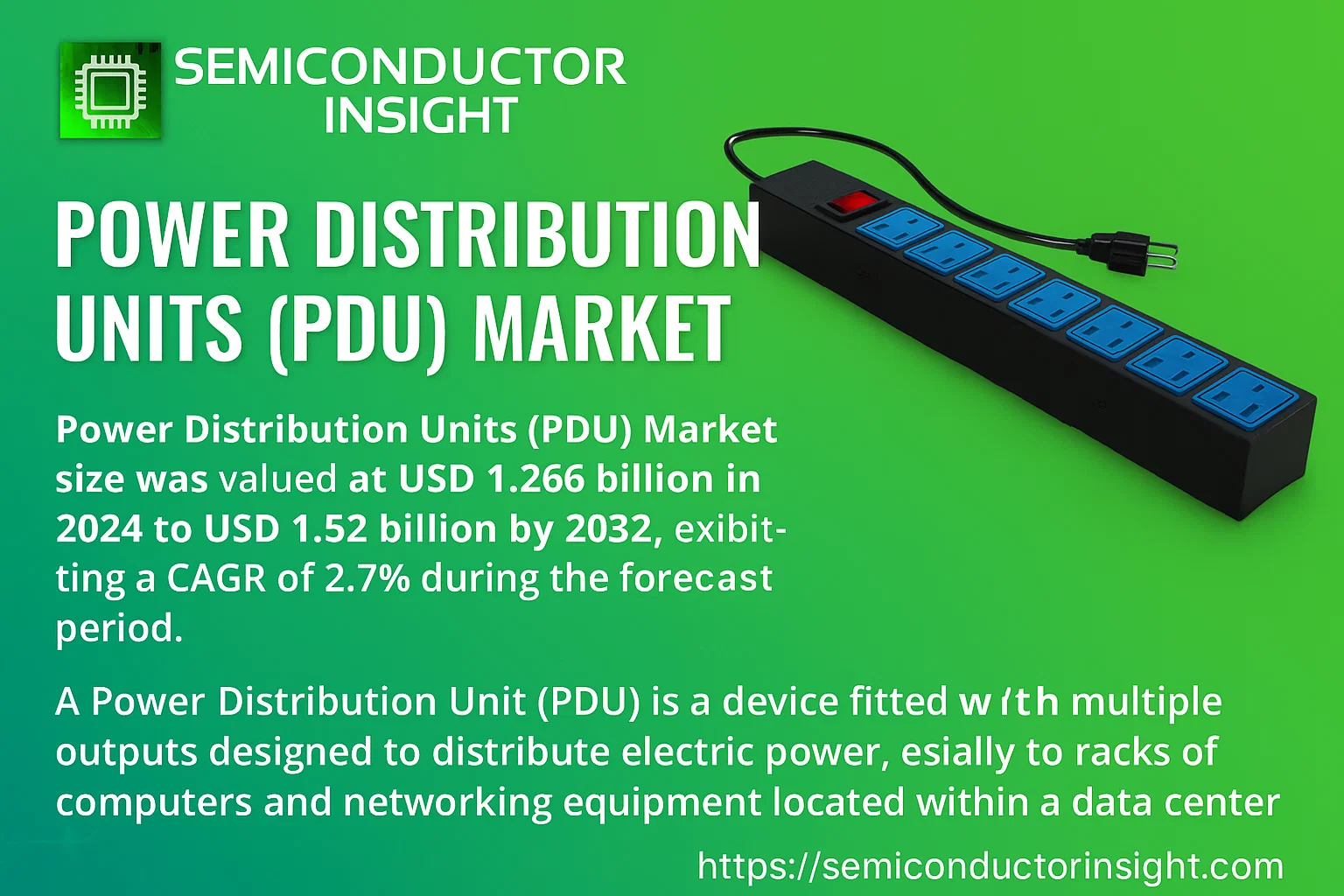
Global Power Distribution Units (PDU) Market size was valued at USD 1.266 billion in 2024 to USD 1.52 billion by 2032, exhibiting a CAGR of 2.7% during the forecast period.
A Power Distribution Unit (PDU) is a device fitted with multiple outputs designed to distribute electric power, especially to racks of computers and networking equipment located within a data center. These units are crucial for managing and protecting power in IT environments, encompassing various types such as Basic PDU, Metering PDU, Monitoring PDU, Switch PDU, and others.
The market is experiencing steady growth due to several factors, including the rising demand for data centers globally and the increasing need for efficient power management solutions. However, the market faces challenges from cost pressures and the complexity of integrating advanced PDUs into existing infrastructure. Furthermore, initiatives by key players are expected to fuel market growth through product innovation and strategic partnerships. For instance, major manufacturers like Eaton and Vertiv have recently launched new intelligent PDU series with enhanced monitoring capabilities to meet evolving data center demands. ABB, Cisco Systems Inc., Eaton Corporation plc, Schneider Electric (APC), Delta Electronics, Inc., and Emerson Electric Co. are some of the key players that operate in the market with a wide range of portfolios.
MARKET DRIVERS
Exponential Growth in Data Center Demand
The relentless expansion of cloud computing, big data analytics, and the Internet of Things (IoT) is fueling unprecedented demand for data center capacity. Every new server rack requires reliable power distribution, making PDUs a fundamental and non-negotiable component. Global data center IP traffic is projected to exceed 20 zettabytes annually, which directly translates into a substantial, sustained market for both basic and intelligent PDUs to manage this critical infrastructure.
Adoption of Intelligent and Monitored PDUs
There is a strong market shift away from basic PDUs toward intelligent, or smart, PDUs that offer remote monitoring and control capabilities. Businesses are increasingly prioritizing power management for optimizing energy efficiency, preventing downtime, and reducing operational expenses. The ability to monitor power consumption at the outlet level and remotely reboot equipment provides significant operational advantages, driving adoption in enterprise and colocation data centers.
Furthermore, the rise of edge computing deployments is creating demand for compact, environmentally hardened PDUs suitable for smaller, distributed locations. This trend expands the PDU market beyond traditional large-scale data centers into telecommunications closets and industrial settings.
MARKET CHALLENGES
Intense Price Competition and Market Fragmentation
PDU market is highly competitive and fragmented, with numerous players ranging from large, established electrical equipment manufacturers to smaller specialized firms. This environment creates significant price pressure, often squeezing profit margins. Customers, especially in cost-sensitive sectors, frequently prioritize initial purchase price over long-term features or quality, making it challenging for vendors to differentiate based on advanced capabilities alone.
Other Challenges
Integration with Legacy Infrastructure
Many existing data centers operate with aging power infrastructure that may not be readily compatible with modern intelligent PDUs. Retrofitting these environments can be complex and costly, requiring additional hardware and integration efforts, which can slow down the adoption of advanced PDU solutions.
Rapid Technological Evolution
The fast pace of innovation in data center technology means PDU manufacturers must continuously invest in research and development to keep their products relevant. Features like support for higher power densities, integration with Data Center Infrastructure Management (DCIM) software, and enhanced cybersecurity protocols are becoming standard expectations, demanding constant advancement.
MARKET RESTRAINTS
High Initial Investment for Advanced PDUs
The superior functionality of monitored and switched PDUs comes at a significantly higher cost compared to basic models. For organizations with limited capital expenditure budgets, particularly small and medium-sized businesses, this upfront cost can be a major barrier to adoption. The return on investment, while substantial in terms of energy savings and uptime, may not be immediately apparent, leading to deferred purchasing decisions.
Economic Volatility and Supply Chain Disruptions
Global economic uncertainties and fluctuations in industrial investment can lead to delays or reductions in new data center construction and upgrades, directly impacting PDU demand. Additionally, the electronics supply chain has experienced disruptions, leading to increased component costs and longer lead times for manufacturing, which can restrain market growth and profitability.
MARKET OPPORTUNITIES
Expansion into Emerging Economies
Rapid digitalization and internet penetration in Asia-Pacific, Latin America, and Africa are driving the construction of new data centers in these regions. This creates a significant greenfield opportunity for PDU providers. Markets like China, India, and Brazil are investing heavily in digital infrastructure, presenting a substantial growth avenue for both basic and intelligent PDU sales.
Rising Demand for High-Density and Three-Phase Power Solutions
As server technology evolves, power densities per rack are increasing dramatically, with some deployments exceeding 40kW. This trend fuels demand for three-phase PDUs capable of handling higher loads efficiently and safely. Vendors that offer robust, high-density power solutions are well-positioned to capture business from high-performance computing, artificial intelligence, and hyperscale data center clients.
Integration with DCIM and Sustainability Initiatives
The growing corporate emphasis on sustainability and energy efficiency opens opportunities for PDUs that seamlessly integrate with comprehensive Data Center Infrastructure Management (DCIM) systems. PDUs that provide granular, real-time power usage data are essential for organizations aiming to achieve Power Usage Effectiveness (PUE) targets and reduce their carbon footprint, creating a value-added market segment.
Power Distribution Units (PDU) Market Trends
Steady Market Expansion Fueled by Digital Infrastructure Growth
Global Power Distribution Units (PDU) market is on a trajectory of steady growth, valued at USD 1266 million in 2024 and projected to reach USD 1520 million by 2032, representing a Compound Annual Growth Rate (CAGR) of 2.7%. This consistent expansion is fundamentally driven by the relentless global demand for data center infrastructure. As businesses and services increasingly migrate to digital and cloud-based platforms, the need for reliable power distribution within data centers becomes paramount. PDUs are essential components for distributing electric power to racks of computers and networking equipment, ensuring operational uptime and efficiency. The market’s growth reflects the ongoing investment in and modernization of telecommunications, IT, and financial services infrastructure worldwide.
Other Trends
Intelligent PDUs Gaining Prominence
A significant trend is the shift from Basic PDUs towards more advanced types, including Metering, Monitoring, and Switch PDUs. These intelligent units provide critical data on power consumption, environmental conditions, and remote outlet control, enabling data center managers to optimize energy usage, improve capacity planning, and enhance overall operational resilience. This move towards intelligent power management is a key response to the challenges data centers face in power protection and efficiency, directly contributing to reduced operational costs and improved uptime.
Regional Market Dynamics
The market exhibits distinct regional concentrations, with the United States representing the largest market share at approximately 35%, followed by Europe at about 25%. This dominance is attributed to the high concentration of large-scale data centers and early adoption of advanced technologies in these regions. However, the Asia-Pacific region is anticipated to witness significant growth potential during the forecast period, fueled by rapid digitalization and data center construction in countries like China, India, and Japan.
Consolidated Competitive Landscape
The competitive environment is characterized by the presence of established global players. Major companies such as ABB, Cisco, Eaton, APC, Delta, and Emerson collectively command a significant portion of the market, with the top three players accounting for approximately 25% of the market share. Competition is based on product innovation, reliability, and the ability to offer comprehensive power management solutions. The market is seeing ongoing developments in product portfolios as manufacturers integrate more features like environmental sensors and network connectivity to meet the evolving demands of modern data centers and other critical power applications.
COMPETITIVE LANDSCAPE
Key Industry Players
A Market Characterized by Strong Incumbents and Specialized Innovators
Global Power Distribution Units (PDU) market is moderately concentrated, with the top three players ABB, Cisco, and Eaton collectively accounting for approximately 25% of the market. Schneider Electric’s brand APC is a dominant force, renowned for its comprehensive suite of Basic, Metered, Monitored, and Switched PDUs tailored for data center reliability. The market structure is defined by a mix of large, diversified industrial technology conglomerates and specialized vendors focused on data center infrastructure. These major players leverage extensive global sales networks, strong brand recognition, and broad product portfolios that cater to the demanding requirements of large-scale telecommunications, IT, and financial services clients, where uptime and power management are critical.
Beyond the market leaders, a significant number of companies compete by focusing on specific niches, technological innovation, or regional strengths. Players like Raritan (a Legrand brand) and Server Technology (also part of Legrand) are highly respected for their advanced, intelligent PDU solutions offering detailed power monitoring and remote control capabilities. Similarly, Cyber Power Systems and Tripp Lite (now part of Eaton) have established strong positions in the market with reliable and cost-effective solutions for small to mid-sized data rooms and edge computing environments. Other notable participants, such as Leviton, Geist, and Delta Power Solutions, contribute to the competitive dynamics with specialized products, ensuring a robust and varied landscape that offers choices for virtually every application and budget.
List of Key Power Distribution Units (PDU) Companies Profiled
- APC (Schneider Electric)
- ABB
- Cisco
- Eaton
- Emerson
- Raritan (Legrand)
- CIS Global
- Leviton
- Server Technology (Legrand)
- Cyber Power Systems
- Geist
- HPE
- Tripp Lite (Eaton)
- Hpxin
- Delta Power Solutions
- Fujitsu
- GE
Segment Analysis:
| Segment Category | Sub-Segments | Key Insights |
| By Type |
|
Monitoring PDU has emerged as the leading segment due to the escalating demand for real-time power management and remote monitoring capabilities in modern data centers. As data centers grow in scale and complexity, the ability to track power consumption, environmental conditions, and receive alerts for potential issues becomes critical for maximizing uptime and operational efficiency. Intelligent PDUs are increasingly viewed as essential tools for proactive infrastructure management. |
| By Application |
|
Telecommunications and IT is the dominant application segment, driven by the relentless expansion of cloud computing, hyperscale data centers, and global internet traffic. This sector’s fundamental reliance on continuous, uninterrupted power for servers, storage, and networking equipment creates a massive and sustained demand for robust and intelligent power distribution solutions. The segment’s growth is further propelled by investments in 5G infrastructure and edge computing deployments. |
| By End User |
|
Cloud Service Providers represent the most dynamic and rapidly expanding end-user segment. Their continuous construction of massive, energy-efficient hyperscale data centers to support global services directly fuels the need for advanced, high-density, and remotely manageable PDUs. The competitive nature of the cloud market places a premium on reliability, power usage effectiveness (PUE), and the ability to precisely allocate and bill for power resources, making sophisticated PDU solutions indispensable. |
| By Power Phase |
|
Three Phase PDUs are the leading segment, particularly within large-scale data center environments. They are essential for supporting high-power density racks and blade server deployments, offering superior power capacity and efficiency compared to single-phase alternatives. The trend towards consolidating IT loads into fewer, more powerful racks to optimize space and energy consumption strongly favors the adoption of three-phase power distribution infrastructure. |
| By Form Factor |
|
Rack-mounted PDU is the overwhelmingly dominant form factor due to its fundamental design alignment with standard server rack infrastructure. This form factor allows for the efficient and organized distribution of power directly to IT equipment within the rack, optimizing space utilization in densely packed data centers. Their integration into the rack environment facilitates easier cable management and provides power outlets in close proximity to the equipment they serve, enhancing both safety and operational simplicity. |
Regional Analysis: Power Distribution Units (PDU) Market
The North American market is characterized by a highly sophisticated customer base, primarily hyperscale cloud providers and large enterprises, that demand intelligent PDUs with advanced features. This drives premium product segments and fosters rapid innovation cycles, with a focus on integration, remote controllability, and predictive analytics to maximize data center uptime, efficiency, and manageability, making it the most advanced regional PDU market globally.
Strong regulatory pressures and corporate sustainability goals are significant market drivers. Energy efficiency standards and incentives for green data center operations push widespread adoption of metered and switched PDUs that enable precise power usage monitoring and proactive management. This regulatory environment encourages investments in PDU technologies that help organizations meet their carbon reduction targets and comply with local energy codes.
A mature and resilient supply chain for critical electronic components and a strong domestic manufacturing presence for critical infrastructure ensure consistent product availability and support. Proximity to major end-users allows for faster delivery times and responsive customer service. This robust ecosystem supports the high volume and specialized requirements of the regional market, fostering stability and reliability in the supply of PDU solutions.
The competitive environment is intensely dynamic, featuring a mix of large, diversified industrial players and specialized PDU manufacturers. This intense competition fuels continuous innovation in product design, connectivity options like cloud-based management platforms, and cybersecurity features for network-connected PDUs. The focus is on delivering differentiated value through enhanced reliability, user-friendly interfaces, and comprehensive lifecycle support services.
Europe
Europe represents a mature and steadily growing PDU market, characterized by a strong emphasis on energy efficiency, standardization, and robust build quality. The region’s growth is fueled by the expansion of edge computing facilities, the modernization of legacy enterprise data centers, and significant investments in sustainable digital infrastructure, particularly in Western and Northern Europe. There is a notable demand for compliant PDUs that adhere to strict regional safety and electromagnetic compatibility standards, alongside intelligent PDUs that facilitate compliance with the European Union’s stringent energy and environmental directives. The market is fragmented, with demand patterns varying from the highly advanced requirements in tech hubs like Germany and the UK to growing opportunities in Eastern European countries where data center development is accelerating.
Asia-Pacific
The Asia-Pacific region is the fastest-growing market for PDUs, driven by an explosive expansion of data center capacities, particularly in China, India, Japan, and Southeast Asia. Rapid urbanization, increasing internet penetration, and governmental digitalization initiatives are creating immense demand for both basic and intelligent PDU solutions. The market is highly diverse, ranging from cost-sensitive demand for basic PDUs in emerging economies to sophisticated requirements for intelligent rack PDUs in mature markets like Australia and Singapore. Local manufacturing capabilities are strong, leading to intense price competition, while international players compete on technology and reliability. The focus is on scalability and adaptability to support the region’s dynamic and rapidly evolving data center landscape.
South America
The South American PDU market is in a developing phase, with growth primarily concentrated in major economic centers such as Brazil, Chile, and Colombia. Market dynamics are influenced by the gradual expansion of colocation data centers and increased IT investments by the banking and telecommunications sectors. Demand is currently skewed towards basic and metered PDUs, with price sensitivity being a key factor. However, as digital infrastructure matures, there is a growing awareness of the benefits of intelligent power management. The market faces challenges related to economic volatility and infrastructure inconsistencies, but presents long-term growth potential as digital transformation initiatives gain momentum across the continent.
Middle East & Africa
The Middle East & Africa region shows promising growth for the PDU market, led by massive investments in digital infrastructure and smart city projects in Gulf Cooperation Council (GCC) countries like the UAE and Saudi Arabia. The development of large-scale data center hubs, such as in Dubai and Johannesburg, is driving demand for reliable and robust PDU solutions capable of operating in harsh environmental conditions. The market is bifurcated, with the Middle East showing a preference for high-quality, advanced PDUs for tier-III and tier-IV data centers, while many parts of Africa have stronger demand for durable, basic PDUs suited for less stable power grids. The region offers significant future growth opportunities as its digital economy expands.
Report Scope
This market research report provides a comprehensive analysis of the Power Distribution Units (PDU) Market , covering the forecast period 2025–2032. It offers detailed insights into market dynamics, technological advancements, competitive landscape, and key trends shaping the industry.
Key focus areas of the report include:
- Market Overview: The report begins with an overview outlining its current market scenario, key growth indicators, and industry transformation drivers. It discusses macroeconomic factors, demand–supply balance, regulatory landscape, and the strategic role of semiconductors in powering advancements across industries such as automotive, telecommunications, consumer electronics, and industrial automation.
- Market Size & Forecast: Historical data and future projections for revenue, unit shipments, and market value across major regions and segments.
- Segmentation Analysis: Detailed breakdown by product type, technology, application, and end-user industry to identify high-growth segments and investment opportunities.
- Regional Insights: Insights into market performance across North America, Europe, Asia-Pacific, Latin America, and the Middle East & Africa, including country-level analysis where relevant.
- Competitive Landscape: Profiles of leading market participants, including their product offerings, R&D focus, manufacturing capacity, pricing strategies, and recent developments such as mergers, acquisitions, and partnerships.
- Technology Trends & Innovation: Assessment of emerging technologies, integration of AI/IoT, semiconductor design trends, fabrication techniques, and evolving industry standards.
- Market Drivers & Restraints: Evaluation of factors driving market growth along with challenges, supply chain constraints, regulatory issues, and market-entry barriers.
- Stakeholder Insights: Insights for component suppliers, OEMs, system integrators, investors, and policymakers regarding the evolving ecosystem and strategic opportunities.
Primary and secondary research methods are employed, including interviews with industry experts, data from verified sources, and real-time market intelligence to ensure the accuracy and reliability of the insights presented.
FREQUENTLY ASKED QUESTIONS:
What is the current market size of Power Distribution Units (PDU) Market?
-> Power Distribution Units (PDU) Market size was valued at USD 1.266 billion in 2024 to USD 1.52 billion by 2032, exhibiting a CAGR of 2.7% during the forecast period.
Which key companies operate in Power Distribution Units (PDU) Market?
-> Key players include APC, ABB, Cisco, Eaton, Emerson, and Delta, among others. The top three players account for approximately 25% of the market.
What are the key growth drivers?
-> Key growth drivers include the expansion of data centers, the need for improved power protection and management solutions, and the reliance on PDU monitoring to enhance efficiency, uptime, and growth.
Which region dominates the market?
-> The United States is the main market, accounting for about 35% of the global market, followed by Europe with about 25%.
What are the emerging trends?
-> Emerging trends include the adoption of smart PDUs with metering and monitoring capabilities, the integration of advanced power management in IT infrastructure, and the focus on energy efficiency in data centers.

Get Sample Report PDF for Exclusive Insights
Report Sample Includes
- Table of Contents
- List of Tables & Figures
- Charts, Research Methodology, and more...
 Download Sample Report PDF