MARKET INSIGHTS
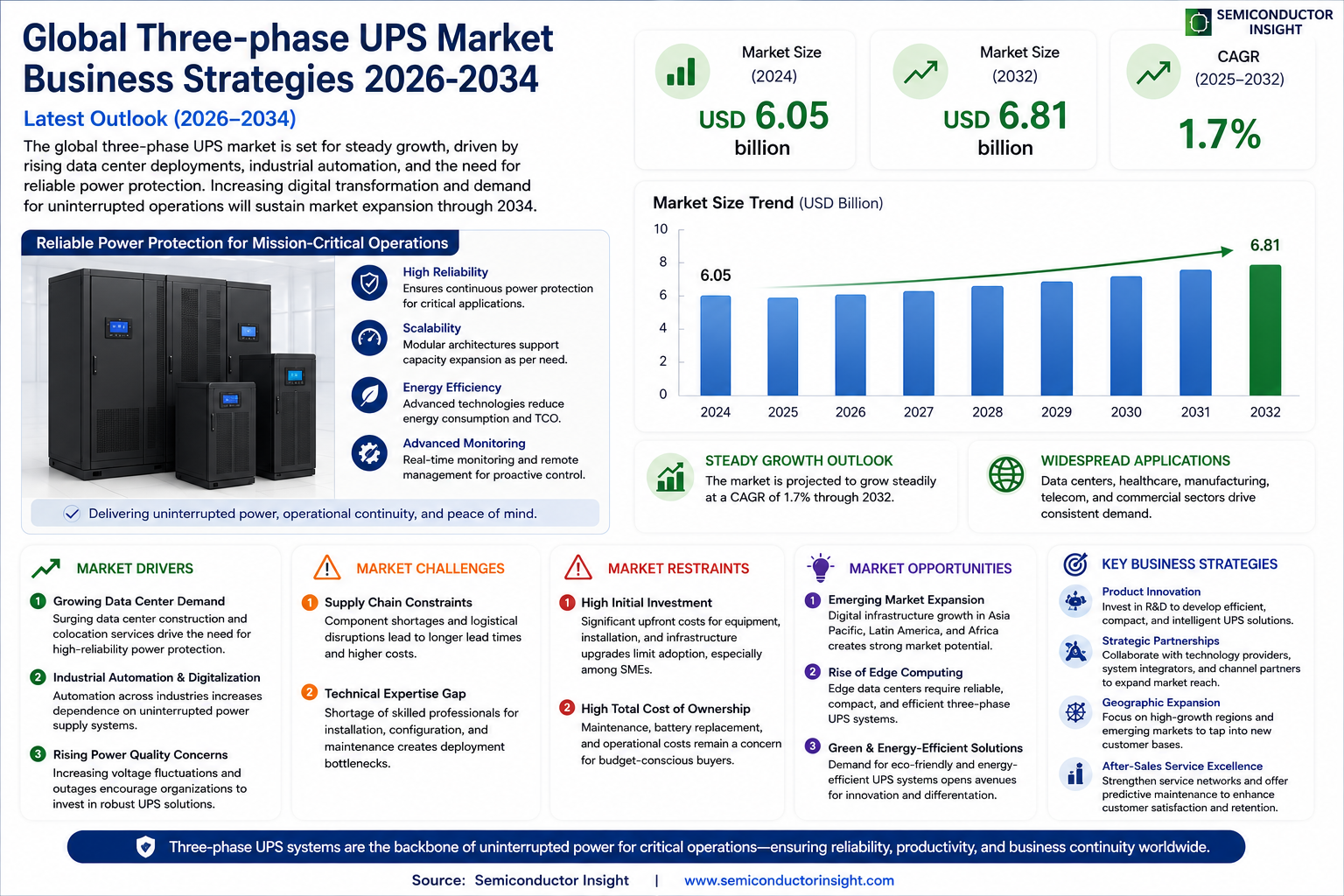
Global Three-phase UPS Market size was valued at USD 6.05 billion in 2024 to USD 6.81 billion by 2032, exhibiting a CAGR of 1.7% during the forecast period.
Three-phase UPS systems are critical power backup solutions designed to protect high-load industrial and commercial equipment from power disruptions. These systems distribute electrical loads evenly across three phases, ensuring stable voltage regulation and minimizing downtime risks. Unlike single-phase UPS units, three-phase variants handle higher power capacities, making them essential for data centers, manufacturing plants, and large-scale enterprise operations.
The market growth is driven by increasing demand for uninterrupted power in critical infrastructure, particularly in the IT and industrial sectors. Schneider Electric leads the competitive landscape with a 27% revenue share, followed by Emerson (13%) and ABB (7%). Emerging economies in Asia-Pacific are witnessing accelerated adoption due to rapid industrialization and data center expansions, while mature markets focus on upgrading aging power infrastructure with energy-efficient solutions.
MARKET DRIVERS
Rising Data Center Demand
The global data center market continues to expand rapidly, with hyperscale facilities requiring robust power protection. Three-phase UPS systems provide the necessary capacity and reliability for these facilities, supporting the exponential growth of cloud computing and digital services.
Industrial Automation Growth
Manufacturing sectors worldwide are increasingly adopting Industry 4.0 principles, which rely on uninterrupted power for automated production lines. Three-phase UPS systems ensure continuous operation of sensitive equipment, reducing downtime and maintaining production efficiency.
➤ Global UPS market reached $10.1 billion in 2023, with three-phase systems gaining market share due to their superior performance in high-load applications
Emerging markets are investing heavily in digital infrastructure, creating sustained demand for high-capacity power protection solutions. Government initiatives for smart city development further accelerate this trend.
MARKET CHALLENGES
Supply Chain Constraints
Global supply chain disruptions continue to affect component availability for UPS manufacturers. Shortages of semiconductors and other critical components have led to extended lead times and increased costs for three-phase UPS systems throughout 2023 and into 2024.
Other Challenges
Technical Expertise Gap
The complexity of three-phase UPS systems requires specialized knowledge for both installation and maintenance. Many regions report shortages of qualified technicians, creating deployment bottlenecks and increased service costs.
MARKET RESTRAINTS
High Initial Investment
Three-phase UPS systems represent a significant capital expenditure for many organizations. The initial investment includes not only the equipment cost but also installation, commissioning, and necessary infrastructure upgrades. This creates hesitation among potential buyers, especially in price-sensitive markets.
MARKET OPPORTUNITIES
Emerging Market Expansion
Rapid digitalization in developing economies presents substantial growth opportunities. Countries across Southeast Asia, Latin America, and Africa are investing heavily in digital infrastructure, creating new markets for three-phase UPS systems as data center construction and industrial automation accelerate.
Renewable Integration
The global shift toward renewable energy creates new opportunities for UPS manufacturers. Three-phase systems are increasingly integrated with solar and wind power installations, providing grid stabilization and power quality management. This convergence creates new revenue streams and application scenarios.
Three-phase UPS Market Trends
Data Center Expansion Drives Market Growth
The global three-phase UPS market is experiencing sustained growth driven by increasing data center investments worldwide. Major cloud service providers and enterprises are expanding their data center footprints, requiring robust power protection solutions. Market analysis indicates that data center applications account for approximately 45% of three-phase UPS deployments, with this segment growing at 8.3% annually. The increasing digitization of businesses and growing adoption of IoT devices are creating sustained demand for reliable power infrastructure.
Other Trends
Energy Efficiency Becomes Key Differentiator
Manufacturers are increasingly focusing on developing energy-efficient three-phase UPS systems to meet customer demand and regulatory requirements. Modern three-phase UPS systems now achieve up to 97% efficiency in online double-conversion mode, significantly reducing energy costs for large-scale operations. The industry is moving towards modular designs that allow capacity to be added as needed, reducing initial investment while maintaining future scalability. Environmental considerations are pushing manufacturers to develop eco-friendly models with reduced carbon footprints.
Edge Computing Adoption Creates New Opportunities
The rapid growth of edge computing infrastructure is creating new opportunities for three-phase UPS manufacturers. As enterprises deploy edge data centers and micro data centers closer to end-users, the demand for appropriately scaled three-phase UPS solutions has increased significantly. These installations require robust power protection while operating within space-constrained environments, driving innovation in power density and form factor optimization.
Hybrid UPS Systems Gain Traction
Hybrid three-phase UPS systems that combine different technologies are gaining market traction as customers seek balanced solutions. These systems typically integrate double-conversion online technology for critical loads with eco-mode operation for less critical applications, optimizing both performance and energy consumption. Market analysis indicates hybrid solutions are growing 40% faster than traditional single-mode systems, particularly in regions with unstable grid infrastructure where both protection and efficiency are critical considerations.
COMPETITIVE LANDSCAPE
Key Industry Players
Three-phase UPS Market Leaders and Challengers
The global three-phase UPS market is dominated by established global players with Schneider Electric holding the largest market share at 27%, followed by Emerson at 13% and ABB at 7%. These companies leverage their extensive distribution networks, strong brand recognition, and comprehensive product portfolios to maintain market leadership. Their dominance is particularly strong in data center and industrial applications where reliability is paramount.
Beyond the top three, the market includes significant competitors such as EATON, GE, and Legrand, which compete through technological innovation and regional market specialization. Companies like Riello, Socomec, and Delta focus on specific geographic markets or niche applications such as high-density data centers and industrial automation. Chinese manufacturers including KSTAR and EAST are growing rapidly, particularly in the Asia-Pacific region, offering competitive pricing and increasingly reliable products.
List of Key Three-phase UPS Companies Profiled
- Schneider Electric
- Emerson Electric Co.
- ABB Ltd.
- EATON Corporation
- General Electric
- S&C Electric Company
- Riello UPS
- AEG Power Solutions
- Legrand
- Toshiba International Corporation
- KSTAR Corporation
- Socomec Group
- EAST Group
- Kehua Data Center
- Delta Electronics, Inc.
Segment Analysis:
| Segment Category | Sub-Segments | Key Insights |
| By Type |
|
Online UPS dominates due to superior power conditioning and seamless transition capabilities, especially for critical infrastructure where even millisecond interruptions are unacceptable. Line-interactive models find favor in cost-sensitive applications with moderate power quality requirements. |
| By Application |
|
Data Centers represent the largest segment due to exponentially growing data processing needs and zero-tolerance for downtime. Industrial applications follow closely as automation and sensitive equipment require clean, uninterrupted power. Healthcare’s critical life-support and diagnostic equipment create substantial demand for high-reliability three-phase UPS systems. |
| By End User |
|
Cloud Service Providers and large enterprises drive demand as they expand data center capacities globally, requiring robust power protection for their critical infrastructure. Manufacturing facilities increasingly adopt three-phase UPS to protect sensitive automated equipment and ensure continuous production. Colocation providers standardize on high-efficiency three-phase systems to meet client service level agreements. |
| By Power Rating |
|
101-300 kVA segment captures the broadest adoption, covering medium data centers and large industrial applications. Higher capacity systems (300+ kVA) are gaining share as hyperscale data centers and large manufacturing facilities require unprecedented power density. Lower capacity systems remain relevant for small data rooms and isolated critical systems where three-phase power is available but loads are smaller. |
| By Data Center Tier |
|
Tier III data centers represent the largest market segment as they provide optimal balance between availability and cost for most enterprise applications. The shift toward Tier IV is accelerating among financial services and hyperscale cloud providers where any downtime carries extreme financial consequences. However, the substantial additional investment required for Tier IV keeps it a smaller segment overall, despite its rapid growth in specific high-value sectors. |
Regional Analysis: Three-phase UPS Market
North America
North America’s data center market represents the largest global market share, driving demand for high-capacity three-phase UPS systems to support uninterrupted operations in hyperscale data centers and colocation facilities. The concentration of cloud service providers and technology giants ensures continuous investment in power infrastructure.
Manufacturing sectors across North America increasingly adopt automation and robotics, requiring clean and continuous power from three-phase UPS systems. The region’s advanced manufacturing base and reshoring initiatives create sustained demand for industrial power protection solutions with minimal downtime.
North American markets lead in integrating renewable energy sources with grid infrastructure, requiring advanced three-phase UPS systems to manage power quality and stability. Grid modernization initiatives drive demand for UPS systems that can handle bidirectional power flow and support renewable integration.
The region’s advanced healthcare infrastructure relies heavily on uninterrupted power, with hospitals and research facilities requiring premium three-phase UPS solutions. Critical infrastructure protection mandates and cybersecurity concerns drive adoption of advanced UPS systems with remote monitoring capabilities.
Europe
Europe represents the second largest market for three-phase UPS systems, characterized by stringent energy efficiency regulations and rapid digital transformation. The region’s strong manufacturing base, particularly in Germany and Italy, drives demand for industrial-grade UPS solutions. European data center markets continue expanding with hyperscale investments, while sustainability initiatives push adoption of energy-efficient transformerless UPS designs and battery energy storage integration.
Asia-Pacific
Asia-Pacific demonstrates the fastest growth rate in three-phase UPS adoption, driven by rapid industrialization, data center expansion, and manufacturing growth. Countries like China, India, and Southeast Asian nations invest heavily in digital infrastructure and industrial automation. The region benefits from lower production costs and increasing foreign investments in data center and manufacturing sectors, though price sensitivity remains higher compared to Western markets.
South America
South America represents an emerging market with specific regional requirements for three-phase UPS systems. The market is characterized by growing investments in mining, oil, and gas industries requiring robust power protection. Brazil leads the region with its growing data center market and industrial base, while other countries show increasing adoption in healthcare and telecommunications infrastructure.
Middle East & Africa
The Middle East demonstrates strong growth in three-phase UPS adoption, particularly in Gulf Cooperation Council countries where data center investments and smart city projects drive demand. Africa shows gradual but accelerating growth, with South Africa and North African countries leading in adoption. The region benefits from Chinese infrastructure investments and increasing digitalization, though market maturity remains lower than other regions.
Report Scope
This market research report provides a comprehensive analysis of the Three-phase UPS Market, covering the forecast period 2025–2032. It offers detailed insights into market dynamics, technological advancements, competitive landscape, and key trends shaping the industry.
Key focus areas of the report include:
- Market Overview: The report begins with an overview outlining its current market scenario, key growth indicators, and industry transformation drivers. It discusses macroeconomic factors, demand–supply balance, regulatory landscape, and the strategic role of semiconductors in powering advancements across industries such as automotive, telecommunications, consumer electronics, and industrial automation.
- Market Size & Forecast: Historical data and future projections for revenue, unit shipments, and market value across major regions and segments.
- Segmentation Analysis: Detailed breakdown by product type, technology, application, and end-user industry to identify high-growth segments and investment opportunities.
- Regional Insights: Insights into market performance across North America, Europe, Asia-Pacific, Latin America, and the Middle East & Africa, including country-level analysis where relevant.
- Competitive Landscape: Profiles of leading market participants, including their product offerings, R&D focus, manufacturing capacity, pricing strategies, and recent developments such as mergers, acquisitions, and partnerships.
- Technology Trends & Innovation: Assessment of emerging technologies, integration of AI/IoT, semiconductor design trends, fabrication techniques, and evolving industry standards.
- Market Drivers & Restraints: Evaluation of factors driving market growth along with challenges, supply chain constraints, regulatory issues, and market-entry barriers.
- Stakeholder Insights: Insights for component suppliers, OEMs, system integrators, investors, and policymakers regarding the evolving ecosystem and strategic opportunities.
Primary and secondary research methods are employed, including interviews with industry experts, data from verified sources, and real-time market intelligence to ensure the accuracy and reliability of the insights presented.
FREQUENTLY ASKED QUESTIONS:
What is the current market size of Three-phase UPS Market?
-> Three-phase UPS Market size was valued at USD 6.05 billion in 2024 to USD 6.81 billion by 2032, exhibiting a CAGR of 1.7% during the forecast period.
Which key companies operate in Three-phase UPS Market?
-> Key players include Schneider-Electric, Emerson, ABB, EATON, and GE, among others.
What is the growth rate of Three-phase UPS Market?
-> The market is expected to grow at a CAGR of 1.7% during the forecast period 2024-2032.
What are the key applications of Three-phase UPS?
-> Three-phase UPS systems are primarily used in data centers, industrial equipment, enterprise-wide backup systems, and precision instruments where uninterrupted power is critical.
Which regions show highest demand for Three-phase UPS?
-> The highest demand comes from North America, Europe, and Asia-Pacific, with Asia-Pacific showing the fastest growth rate due to rapid industrialization and digitalization.
Get Sample Report PDF for Exclusive Insights
Report Sample Includes
- Table of Contents
- List of Tables & Figures
- Charts, Research Methodology, and more...
 Download Sample Report PDF