AI Audio Processor Market Insights
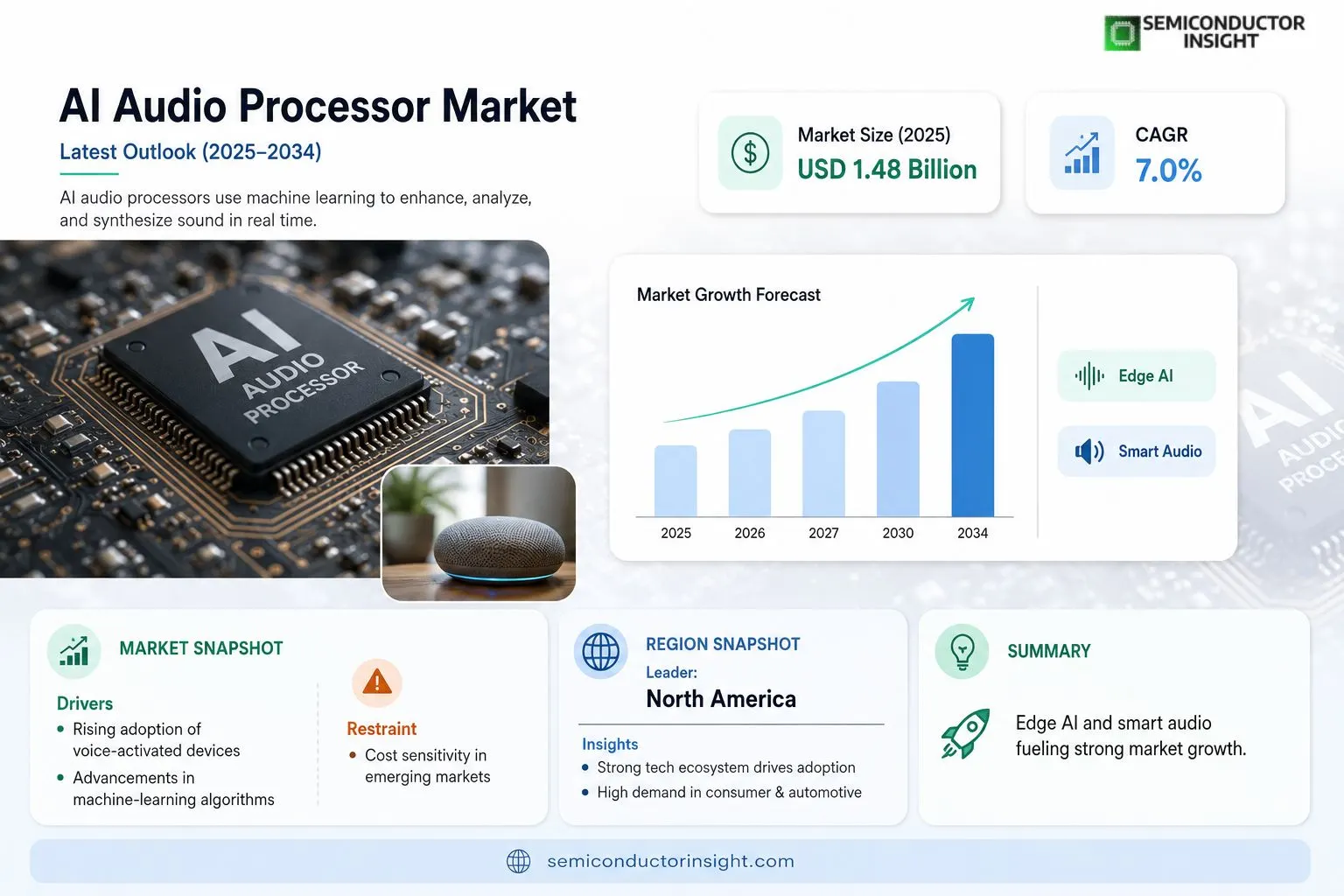
Global AI Audio Processor market size was valued at USD 1.48 billion in 2025. The market is projected to grow from USD 1.55 billion in 2025 to USD 3.21 billion by 2034, exhibiting a CAGR of 7.0% during the forecast period.
AI audio processors are specialized hardware and software platforms that employ machine‑learning algorithms to analyze, enhance, and synthesize sound in real time. They enable capabilities such as noise suppression, voice separation, acoustic scene analysis, and adaptive equalization across consumer electronics, automotive infotainment, and enterprise communication systems.The market is experiencing rapid growth because enterprises are investing heavily in immersive audio experiences, while the proliferation of smart speakers and virtual assistants fuels demand for intelligent sound processing. Furthermore, advancements in edge‑AI chips reduce latency and power consumption, encouraging adoption across mobile devices. Key players such as Dolby Laboratories, Qualcomm Technologies, NVIDIA Corporation, and Cirrus Logic are expanding their portfolios through strategic partnerships and firmware updates.
MARKET DRIVERS
Rising Adoption of Voice‑Activated Devices
AI Audio Processor Market is being propelled by the massive rollout of smart speakers, automotive infotainment systems, and wearable assistants. Consumers increasingly rely on voice commands for everyday tasks, creating a robust demand for processors that can deliver low‑latency, high‑accuracy speech recognition.
Advancements in Machine‑Learning Algorithms
Recent breakthroughs in deep‑learning models enable real‑time noise suppression and acoustic scene analysis, reducing hardware requirements while improving performance. Manufacturers can therefore embed sophisticated audio intelligence into smaller form factors, widening the addressable market.
➤ Integration of AI‑driven audio processing is now a key differentiator for consumer electronics, driving OEMs to prioritize early adoption.
Additionally, the surge in digital content creation,podcasts, streaming, and virtual events,requires professional‑grade audio enhancement tools, further accelerating growth across enterprise and consumer segments.
MARKET CHALLENGES
High Computational Power Requirements
Despite algorithmic efficiencies, many AI audio solutions still demand significant processing capability, raising concerns about battery life in portable devices and thermal management in compact hardware.
Other Challenges
Data Privacy Regulations
Stringent privacy laws in regions such as the EU and California limit the collection of voice data, compelling developers to implement on‑device processing that can increase cost and complexity.
MARKET RESTRAINTS
Cost Sensitivity in Emerging Markets
Price‑conscious consumers in developing economies often prioritize basic functionality over advanced AI features, constraining sales of premium audio processors. This restraint slows overall market penetration where volume could otherwise be high.
Complexity of Integration
Integrating AI audio modules into legacy hardware platforms requires extensive firmware development and validation, which can delay time‑to‑market and increase R&D expenditures for OEMs.The scarcity of skilled engineers proficient in both signal processing and AI further hampers rapid deployment, compelling firms to outsource development and incur additional costs.
MARKET OPPORTUNITIES
Edge‑AI Deployment in Automotive Systems
Vehicle manufacturers are investing heavily in in‑cab voice assistants and driver‑monitoring systems. Edge‑enabled AI audio processors that can operate offline present a compelling opportunity to meet safety standards while reducing data‑transmission latency.
Expansion into Healthcare Applications
AI‑enhanced audio analysis is gaining traction for remote patient monitoring, enabling real‑time detection of respiratory anomalies. This niche creates a high‑value market segment for specialised processors that comply with medical device regulations.Finally, the rise of generative audio technologies, such as AI‑driven music composition and immersive soundscapes for AR/VR, offers a new revenue stream for companies that can deliver low‑power, high‑fidelity processing solutions.
AI Audio Processor Market Trends
Rise of Edge‑AI Integrated Audio Processing
Enterprises are increasingly deploying AI‑driven audio engines that run on edge‑AI chips, a shift that reduces signal latency to sub‑millisecond levels while keeping power draw compatible with battery‑operated devices. This hardware evolution enables real‑time noise suppression, adaptive equalization, and acoustic scene analysis directly on smartphones, wearables, and automotive infotainment modules. The result is a smoother user experience, especially in noisy environments, and a measurable boost in speech‑recognition accuracy for virtual assistants. The overall AI Audio Processor Market benefits from this hardware‑software convergence, as developers can embed sophisticated sound‑processing algorithms without relying on cloud resources.
Other Trends
Smart Speaker and Automotive Integration
Smart speakers have become the primary household interface for voice‑first applications, prompting manufacturers to embed advanced audio processors that can isolate multiple voices and dynamically balance music playback with command detection. In parallel, automotive OEMs are standardizing on intelligent sound platforms that adapt cabin acoustics to driving conditions, providing clearer navigation prompts and hands‑free communication. The dual momentum in consumer and automotive sectors creates a feedback loop: as hardware capabilities expand, software vendors introduce more granular sound‑enhancement features, which in turn drives further hardware investment.
Strategic Partnerships and Ecosystem Expansion
Leading semiconductor and audio‑technology firms are forming joint development agreements to accelerate firmware updates and broaden algorithm libraries. These collaborations streamline integration for device OEMs, allowing faster time‑to‑market for products that require multi‑band noise reduction, voice separation, and spatial audio rendering. Ecosystem growth is also evident in open‑source toolkits that promote interoperability across platforms, reducing development costs for startups while encouraging larger players to maintain compatibility with emerging standards. The cumulative effect is a more resilient supply chain and a steady pipeline of innovative audio solutions that keep the market trajectory firmly upward.
COMPETITIVE LANDSCAPEKey Industry Players
AI Audio Processor Market – Competitive Overview
AI Audio Processor Market is anchored by a small cohort of globally recognized semiconductor and audio‑technology leaders that control the majority of high‑performance chip designs and firmware ecosystems. Dolby Laboratories leverages its long‑standing expertise in perceptual audio coding and recently introduced AI‑driven spatial audio rendering that has been adopted by leading consumer‑electronics OEMs. Qualcomm Technologies integrates AI audio acceleration into its Snapdragon mobile platforms, enabling on‑device noise suppression and voice separation for smartphones and wearables. NVIDIA Corporation extends its GPU‑based AI inferencing capabilities to audio workloads, offering developers flexible SDKs for real‑time acoustic scene analysis. Cirrus Logic supplies tightly integrated mixed‑signal solutions that combine DSP cores with edge‑AI accelerators, making it a preferred supplier for automotive infotainment and smart speaker manufacturers. These incumbents benefit from extensive IP portfolios, deep OEM relationships, and the ability to bundle AI audio features with broader system‑on‑chip offerings, shaping a market structure that favors scale, integration, and rapid firmware updates.Beyond the dominant players, a diverse set of niche innovators contributes specialized functionality and accelerates market diffusion. Texas Instruments and MediaTek focus on cost‑effective AI audio ASICs for mid‑range devices, while Intel’s Xeon‑based inference platforms serve enterprise communication and cloud‑hosted audio processing services. Analog Devices delivers high‑precision Sigma‑Delta converters paired with AI‑enhanced beamforming algorithms for professional audio gear. Samsung Electronics embeds AI audio processing within its Exynos SoCs, targeting premium smartphones and home appliances. Amazon Web Services (AWS) provides cloud‑native AI audio APIs that complement on‑device processors for hybrid solutions. Apple integrates proprietary AI audio pipelines across its ecosystem, emphasizing privacy‑preserving on‑device inference. Xilinx (AMD) supplies reconfigurable FPGA‑based AI audio accelerators for custom OEM applications, and DSP Group offers licensed DSP cores that empower smaller manufacturers to embed intelligent sound enhancement without developing proprietary silicon. This broader ecosystem of specialized firms expands functionality, price points, and geographic reach, fostering competitive pressure that drives innovation across the AI audio processor value chain.
List of Key AI Audio Processor Companies Profiled
- Dolby Laboratories
- Qualcomm Technologies
- NVIDIA Corporation
- Cirrus Logic
- Texas Instruments
- MediaTek
- Intel
- Analog Devices
- Samsung Electronics
- Amazon Web Services (AWS)
- Apple
- Xilinx (AMD)
- DSP Group
Segment Analysis:
| Segment Category | Sub-Segments | Key Insights |
| By Type |
|
Hardware Accelerators
|
| By Application |
|
Consumer Voice Assistants
|
| By End User |
|
Device OEMs
|
| By Industry |
|
Media & Entertainment
|
| By Deployment Mode |
|
Edge Devices
|
Regional Analysis: North America
North America
The consumer electronics segment represents a substantial portion of the North American AI audio processor market. Smart speakers, headphones, and televisions are increasingly incorporating AI-powered audio features, creating a strong demand for these processors. The focus is on delivering immersive and personalized audio experiences.
The automotive sector is witnessing rapid adoption of AI audio processors for enhanced in-car experiences. Features like voice assistants, driver monitoring systems, and sophisticated sound systems rely heavily on these processors. Safety and convenience are key drivers in this segment.
Professional audio and broadcast applications are also contributing to the North American market growth. AI audio processors are utilized for real-time audio processing, noise reduction, and improved sound quality in recording studios and broadcasting facilities. The need for high precision and reliability drives innovation in this area.
Emerging applications in healthcare and wellness devices are creating new opportunities for AI audio processors. These devices leverage AI for features like speech analysis, personalized sound therapy, and remote patient monitoring.
Europe
Europe presents a significant and steadily growing market for AI Audio Processor Market. Driven by a strong emphasis on innovation and a sophisticated consumer base, the region is witnessing increasing demand across various sectors. The European market benefits from robust government initiatives supporting technological advancement and a strong ecosystem of research institutions and technology companies. Key applications include smart home devices, automotive systems, and professional audio equipment. The focus in Europe is on developing energy-efficient and privacy-focused AI audio solutions, aligning with the region’s stringent data protection regulations. Businesses are actively exploring partnerships to leverage technological expertise and expand market reach.
Asia-Pacific
Asia-Pacific is poised for substantial growth in AI Audio Processor Market. Rapid urbanization, increasing disposable incomes, and a burgeoning consumer electronics industry are driving demand in countries like China, Japan, and South Korea. The region’s strong manufacturing base and supportive government policies further contribute to market expansion. Key applications are concentrated in smart speakers, wearables, and automotive infotainment systems. The market is characterized by intense competition, with both established players and emerging companies vying for market share. Regional players are focusing on developing cost-effective AI solutions tailored to the specific needs of the Asian market.
South America
South America represents an emerging market for AI Audio Processors, with considerable potential for future growth. Growing smartphone penetration, increasing adoption of smart home devices, and a rising demand for connected cars are key drivers. Although the market is currently smaller compared to North America and Asia-Pacific, the growth trajectory is promising. Opportunities exist in the consumer electronics and automotive sectors, with a focus on delivering value-for-money AI solutions. The region’s increasing digital literacy and evolving consumer preferences are expected to further fuel market expansion.
Middle East & Africa
The Middle East and Africa present a developing market for AI Audio Processors, with substantial long-term growth potential. Increasing investments in smart infrastructure, a growing consumer electronics market, and a rising adoption of connected vehicles are driving demand. Key applications include smart home devices, automotive infotainment systems, and professional audio equipment. The region’s focus on technological advancement and digital transformation is expected to further accelerate market growth. Opportunities exist for companies offering cost-effective and localized AI audio solutions.
Report Scope
This market research report provides a comprehensive analysis of the AI Audio Processor Market , covering the forecast period 2026–2034. It offers detailed insights into market dynamics, technological advancements, competitive landscape, and key trends shaping the industry.
Key focus areas of the report include:
- Market Overview: The report begins with an overview outlining its current market scenario, key growth indicators, and industry transformation drivers. It discusses macroeconomic factors, demand–supply balance, regulatory landscape, and the strategic role of semiconductors in powering advancements across industries such as automotive, telecommunications, consumer electronics, and industrial automation.
- Market Size & Forecast: Historical data and future projections for revenue, unit shipments, and market value across major regions and segments.
- Segmentation Analysis: Detailed breakdown by product type, technology, application, and end-user industry to identify high-growth segments and investment opportunities.
- Regional Insights: Insights into market performance across North America, Europe, Asia-Pacific, Latin America, and the Middle East & Africa, including country-level analysis where relevant.
- Competitive Landscape: Profiles of leading market participants, including their product offerings, R&D focus, manufacturing capacity, pricing strategies, and recent developments such as mergers, acquisitions, and partnerships.
- Technology Trends & Innovation: Assessment of emerging technologies, integration of AI/IoT, semiconductor design trends, fabrication techniques, and evolving industry standards.
- Market Drivers & Restraints: Evaluation of factors driving market growth along with challenges, supply chain constraints, regulatory issues, and market-entry barriers.
- Stakeholder Insights: Insights for component suppliers, OEMs, system integrators, investors, and policymakers regarding the evolving ecosystem and strategic opportunities.
Primary and secondary research methods are employed, including interviews with industry experts, data from verified sources, and real-time market intelligence to ensure the accuracy and reliability of the insights presented.
FREQUENTLY ASKED QUESTIONS:
What is the current market size of AI Audio Processor Market?
-> AI Audio Processor Market was valued at USD 1.48 billion in 2025 and is expected to reach USD 3.21 billion by 2034, reflecting a CAGR of 7.0% during the forecast period.
Which key companies operate in AI Audio Processor Market?
-> Key players include Dolby Laboratories, Qualcomm Technologies, NVIDIA Corporation, and Cirrus Logic, among others.
What are the key growth drivers?
-> Key growth drivers include investment in immersive audio experiences, proliferation of smart speakers and virtual assistants, and advancements in edge‑AI chips that reduce latency and power consumption.
Which region dominates the market?
-> The market is globally distributed with leading adoption in North America and Europe, while rapid growth is observed in Asia‑Pacific.
What are the emerging trends?
-> Emerging trends include integration of AI‑enhanced audio processing in consumer electronics, automotive infotainment, and enterprise communication systems, as well as the development of edge‑AI chips for low‑latency sound analysis.
Get Sample Report PDF for Exclusive Insights
Report Sample Includes
- Table of Contents
- List of Tables & Figures
- Charts, Research Methodology, and more...
 Download Sample Report PDF