Key Statistics
Key Takeaways
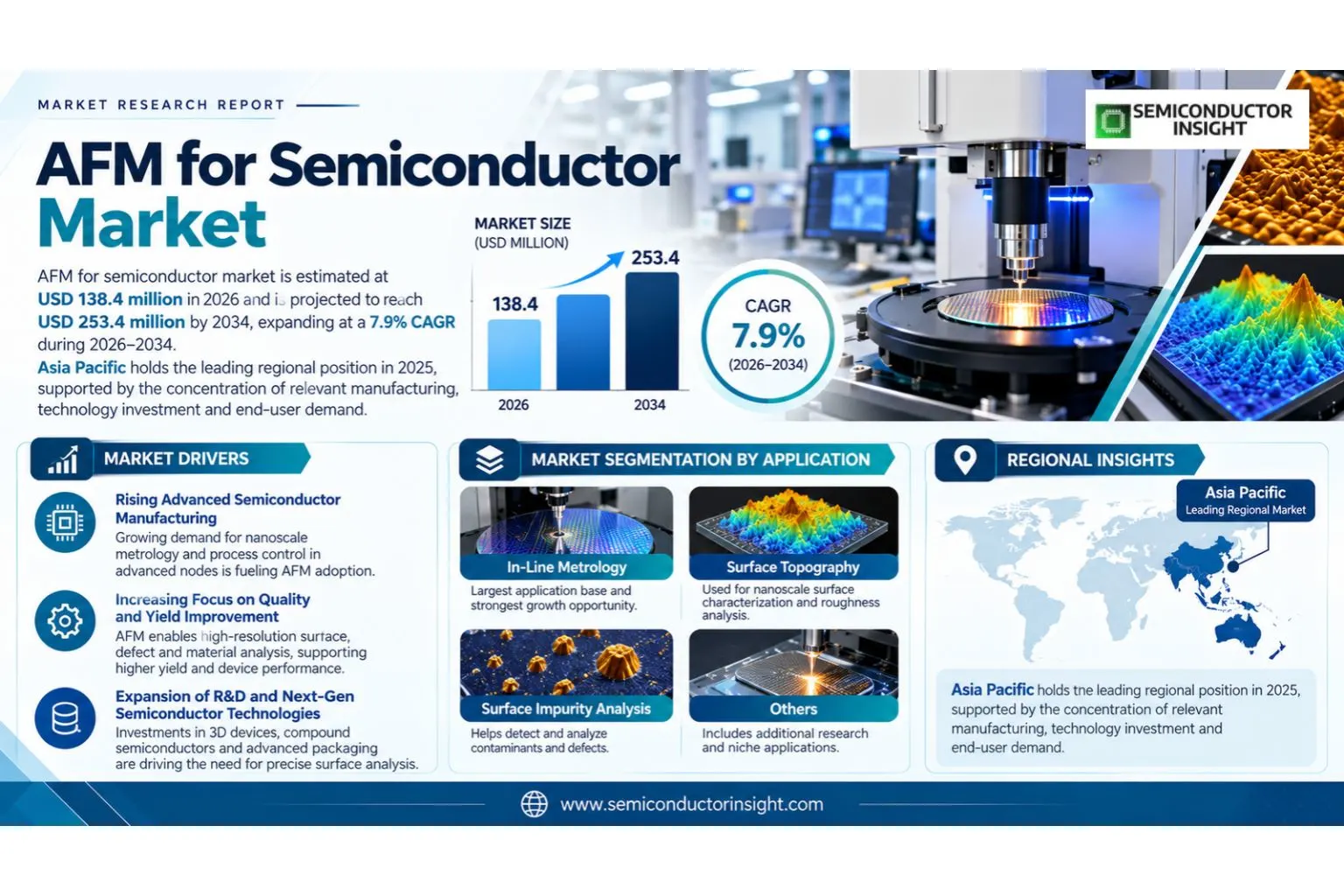
- The global AFM for Semiconductor market is estimated at USD 138.4 million in 2026 and is projected to reach USD 253.4 million by 2034, representing a 7.9% CAGR over 2026–2034.
- Large Sample AFM represents the largest type position, while Large Sample AFM benefits most from the current shift toward higher-value and more integrated system architectures.
- In-Line Metrology is the largest application, while In-Line Metrology shows the strongest incremental opportunity as end users expand automation, precision control and data-rich monitoring.
- Asia Pacific holds the leading regional position in 2025 because its industrial base, customer concentration and technology ecosystem create the strongest commercial pull for suppliers.
- The main growth engine is advanced-node and 3d device metrology, whereas throughput remains lower than optical inspection remains the most persistent constraint on broader adoption.
- Competitive advantage is shifting toward suppliers that combine core hardware performance with application software, qualification support, integration capability and regional service rather than competing on component specifications alone.
AFM for Semiconductor Market Overview
Afm for semiconductor market is estimated at USD 138.4 million in 2026 and is projected to reach USD 253.4 million by 2034, expanding at a 7.9% CAGR during 2026–2034. Asia Pacific holds the leading regional position in 2025, supported by the concentration of relevant manufacturing, technology investment and end-user demand.
Atomic force microscopy in semiconductor manufacturing is moving from a primarily laboratory-oriented surface-characterization role toward automated, recipe-driven metrology embedded closer to production. The commercial market covers AFM platforms, wafer-handling configurations, scanning heads, probes and application software used to measure nanoscale topography, critical dimensions, roughness, step height, defects and material properties across front-end wafer processing, advanced packaging, photomask work and failure analysis. Demand intensity rises as device structures become three-dimensional and conventional optical metrology reaches sensitivity limits on increasingly complex surfaces.
Large-sample and automated platforms carry a materially higher selling value than benchtop research systems because they add wafer handling, contamination control, recipe automation, host communication and high-throughput measurement. Park Systems’ industrial portfolio includes automated AFM tools for wafer processing and advanced packaging, while Bruker markets fab-ready automated AFM for high-volume semiconductor manufacturing. These architectures illustrate why purchasing decisions increasingly depend on production integration, uptime, repeatability and automated defect-location capability rather than on spatial resolution alone.
The market should be understood as a system-level purchasing decision rather than a standalone component category. Buyers evaluate performance, qualification risk, integration time, service response and lifecycle cost together. This shifts value toward suppliers with proven application engineering and repeatable production capability. The result is a market in which technical differentiation can support pricing, but only when the supplier can translate specifications into measurable yield, uptime, safety, throughput or maintenance benefits for the end user.
Segment Analysis: By Type
By type, the AFM for Semiconductor market is segmented into Small Sample AFM, Large Sample AFM. Large Sample AFM holds the leading position, while the fastest growth is concentrated in configurations that solve higher-value integration, reliability or performance requirements rather than purely price-driven use cases.
| Type | Market position and demand characteristics |
|---|---|
| Small Sample AFM | Small Sample AFM serves a distinct set of performance and cost requirements within the market. Its commercial position depends on application fit, technical qualification, integration complexity and the supplier’s ability to maintain repeatable performance across production environments. Established segment reflects the balance between installed-base demand and the rate at which customers are shifting toward more advanced configurations. |
| Large Sample AFM | Large Sample AFM serves a distinct set of performance and cost requirements within the market. Its commercial position depends on application fit, technical qualification, integration complexity and the supplier’s ability to maintain repeatable performance across production environments. Largest type reflects the balance between installed-base demand and the rate at which customers are shifting toward more advanced configurations. |
Type selection is increasingly driven by total system economics
Customers increasingly compare afm for semiconductor configurations on total installed value rather than purchase price alone. A higher-cost solution can be preferred when it reduces calibration time, improves yield, eliminates auxiliary hardware or provides better diagnostic information. This favors products that simplify integration and support consistent operation at scale. Commodity configurations remain important for cost-sensitive applications, but margin and strategic differentiation are concentrated in products that solve a difficult measurement, automation or reliability problem.
Segment Analysis: By Application
By application, demand spans In-Line Metrology, Surface Topography, Surface Impurity Analysis, Others. In-Line Metrology forms the largest application base, while In-Line Metrology is positioned for the strongest incremental growth as customers increase investment in automation, precision and connected operations.
| Application | Demand characteristics |
|---|---|
| In-Line Metrology | Largest application. Purchasing is driven by the requirement to improve process control, reliability, safety or throughput in this application. Buyers typically qualify suppliers on performance under real operating conditions, integration with existing equipment and the economic cost of failure. Growth therefore depends on the pace of capital deployment and the degree to which the technology becomes embedded in standard equipment architectures. |
| Surface Topography | Relevant demand segment. Purchasing is driven by the requirement to improve process control, reliability, safety or throughput in this application. Buyers typically qualify suppliers on performance under real operating conditions, integration with existing equipment and the economic cost of failure. Growth therefore depends on the pace of capital deployment and the degree to which the technology becomes embedded in standard equipment architectures. |
| Surface Impurity Analysis | Relevant demand segment. Purchasing is driven by the requirement to improve process control, reliability, safety or throughput in this application. Buyers typically qualify suppliers on performance under real operating conditions, integration with existing equipment and the economic cost of failure. Growth therefore depends on the pace of capital deployment and the degree to which the technology becomes embedded in standard equipment architectures. |
| Others | Relevant demand segment. Purchasing is driven by the requirement to improve process control, reliability, safety or throughput in this application. Buyers typically qualify suppliers on performance under real operating conditions, integration with existing equipment and the economic cost of failure. Growth therefore depends on the pace of capital deployment and the degree to which the technology becomes embedded in standard equipment architectures. |
Additional Segment Analysis: By Deployment Stage
| Deployment Stage | Commercial relevance |
|---|---|
| R&D and Failure Analysis | This segment represents a distinct commercial configuration within the afm for semiconductor market. Adoption depends on performance requirements, cost, compatibility with the host system and the level of qualification demanded by the target industry. Suppliers that can offer multiple configurations across the same platform improve cross-selling opportunities and reduce the customer’s engineering burden when moving between applications. |
| Process Development | This segment represents a distinct commercial configuration within the afm for semiconductor market. Adoption depends on performance requirements, cost, compatibility with the host system and the level of qualification demanded by the target industry. Suppliers that can offer multiple configurations across the same platform improve cross-selling opportunities and reduce the customer’s engineering burden when moving between applications. |
| In-Line Production Metrology | This segment represents a distinct commercial configuration within the afm for semiconductor market. Adoption depends on performance requirements, cost, compatibility with the host system and the level of qualification demanded by the target industry. Suppliers that can offer multiple configurations across the same platform improve cross-selling opportunities and reduce the customer’s engineering burden when moving between applications. |
Additional Segment Analysis: By Wafer/Sample Format
| Wafer/Sample Format | Commercial relevance |
|---|---|
| Small Samples | This segment represents a distinct commercial configuration within the afm for semiconductor market. Adoption depends on performance requirements, cost, compatibility with the host system and the level of qualification demanded by the target industry. Suppliers that can offer multiple configurations across the same platform improve cross-selling opportunities and reduce the customer’s engineering burden when moving between applications. |
| 200 mm Wafers | This segment represents a distinct commercial configuration within the afm for semiconductor market. Adoption depends on performance requirements, cost, compatibility with the host system and the level of qualification demanded by the target industry. Suppliers that can offer multiple configurations across the same platform improve cross-selling opportunities and reduce the customer’s engineering burden when moving between applications. |
| 300 mm Wafers and Large Substrates | This segment represents a distinct commercial configuration within the afm for semiconductor market. Adoption depends on performance requirements, cost, compatibility with the host system and the level of qualification demanded by the target industry. Suppliers that can offer multiple configurations across the same platform improve cross-selling opportunities and reduce the customer’s engineering burden when moving between applications. |
Regional Analysis
Asia Pacific leads the AFM for Semiconductor market in 2025, while regional growth rates differ according to manufacturing concentration, technology adoption, end-user investment and local supply-chain maturity. The market is not simply a set of geographic revenue pools; each region has a different purchasing logic and supplier-selection process.
How does regional demand differ across the AFM for Semiconductor market?
Regional demand is shaped by where the relevant equipment is built, where end users deploy it, and how quickly local customers adopt advanced technologies. Mature regions tend to place greater weight on qualification, software and service, while high-growth manufacturing regions generate more unit demand and new design-in opportunities. Project-led regions can still be commercially attractive when applications are high value. Suppliers therefore need regional product positioning rather than a single global sales approach.
| Region | Position | Growth outlook | Demand profile | Supplier-selection gate |
|---|---|---|---|---|
| Asia Pacific | Largest | High | Manufacturing and technology-led | Local service, qualification and supply reliability |
| North America | High-value established | Moderate-high | Innovation and replacement-led | Local service, qualification and supply reliability |
| Europe | High-value established | Moderate-high | Engineering and regulation-led | Local service, qualification and supply reliability |
| South America | Emerging / project-led | Selective | Project-led | Local service, qualification and supply reliability |
| Middle East & Africa | Emerging / project-led | Selective | Project-led | Local service, qualification and supply reliability |
Key AFM for Semiconductor Manufacturers and Competitive Landscape
Competition in the AFM for Semiconductor market is shaped by application expertise, product reliability, integration capability and global support. The market includes established multinational suppliers, specialist technology companies and regional competitors, with customer qualification creating meaningful switching costs in demanding applications.
Leading suppliers compete by building platforms that can be adapted across multiple customer requirements without forcing a complete redesign. This lowers development time for the customer and creates cross-selling opportunities for the vendor. Brand reputation matters most in high-cost or safety-critical applications, where the financial impact of unreliable measurement or control can exceed the purchase price of the hardware by a wide margin.
Specialist companies remain important because many applications require niche performance, custom packaging or proprietary algorithms. These firms can win against larger suppliers when they solve a difficult technical problem faster or provide more responsive engineering support. However, scaling from prototype to volume production requires quality systems, manufacturing repeatability and a service model that can support customers in multiple regions.
Regional competitors often enter through cost-sensitive applications and then move upward as product quality improves. Their strongest advantage is usually local access, shorter lead time and willingness to customize. Global suppliers respond by broadening product families and adding software, diagnostics and support services that make direct price comparison more difficult. The result is a tiered market rather than a single winner-takes-all structure.
| Competitive tier | Representative companies | Typical advantage |
|---|---|---|
| Global technology leaders | Park Systems, Bruker, Oxford Instruments, NT-MDT, HORIBA | Broad portfolios, strong qualification history, global support and premium applications |
| Established specialists | Hitachi High-Tech, Nanosurf, Nanonics Imaging, attocube systems AG, Concept Scientific Instruments | Focused technical niches, application depth and regional strengths |
| Emerging / niche suppliers | NanoMagnetics Instruments, AFM Workshop, GETec Microscopy, A.P.E. Research, RHK Technology | Customization, local access and targeted product differentiation |
Companies profiled
The profiled supplier set includes Park Systems, Bruker, Oxford Instruments, NT-MDT, HORIBA, Hitachi High-Tech, Nanosurf, Nanonics Imaging, attocube systems AG, Concept Scientific Instruments, NanoMagnetics Instruments, AFM Workshop, GETec Microscopy, A.P.E. Research, RHK Technology. The competitive relevance of each company varies by geography, product architecture and target application, so customer shortlists are usually narrower than the complete profiled universe.
AFM for Semiconductor Production Capacity Analysis
Production capacity for AFM for Semiconductor products is concentrated where the enabling components, precision manufacturing skills and end-user industries are already established. Capacity expansion therefore follows both customer proximity and access to specialized process know-how.
The production footprint is constrained by more than factory floor space. Critical inputs can include precision materials, semiconductor or optical components, calibration equipment, clean manufacturing, specialized test systems and engineering labor. Capacity that lacks validated quality systems is not interchangeable with qualified capacity, particularly in semiconductor, automotive, medical or aerospace applications. As a result, suppliers often scale through phased line additions and customer qualification rather than by building large speculative capacity.
Asia Pacific has the strongest manufacturing density for many electronic and precision components, while North America and Europe retain substantial high-value engineering and specialty production. Regional diversification is increasing as customers seek supply resilience, but duplicating advanced production requires process transfer, trained staff and long qualification cycles. The practical supply risk is therefore concentrated in specialized subcomponents and manufacturing know-how rather than in basic assembly alone.
AFM for Semiconductor Market Dynamics: Drivers, Restraints and Opportunities
The market outlook combines structural growth from advanced-node and 3d device metrology with persistent constraints from throughput remains lower than optical inspection. The strongest suppliers will be those that convert technical performance into lower total cost, better uptime, improved yield or new end-user functionality.
MARKET DRIVERS
| Driver | Impact | Commercial mechanism |
|---|---|---|
| Advanced-node and 3D device metrology | High | Gate-all-around transistors, high-aspect-ratio structures, hybrid bonding and advanced interconnects create surface and dimensional measurements that are difficult to resolve relia… |
| Growth in 300 mm capacity and advanced packaging | High | SEMI’s 300 mm fab outlook tracks hundreds of fabs and production lines worldwide and projects continued capacity additions, while advanced packaging investment is rising with AI an… |
| Shift toward in-line and automated AFM | Medium-High | The economic case for AFM strengthens when measurements can be automated and moved closer to the process step rather than waiting for offline laboratory analysis. Modern systems su… |
| Need for non-destructive nanoscale surface information | Medium | AFM can inspect sensitive surfaces without requiring conductive coating and can measure height directly rather than infer it solely from image contrast. This matters in thin films,… |
Advanced-node and 3D device metrology
Gate-all-around transistors, high-aspect-ratio structures, hybrid bonding and advanced interconnects create surface and dimensional measurements that are difficult to resolve reliably with a single optical technique. AFM provides direct topographic information at nanometer and sub-nanometer scale and can complement optical and electron-beam methods. As process windows tighten, fabs place more value on repeatability, recipe automation and correlation across metrology tools, supporting demand for production-capable AFM systems.
Growth in 300 mm capacity and advanced packaging
SEMI’s 300 mm fab outlook tracks hundreds of fabs and production lines worldwide and projects continued capacity additions, while advanced packaging investment is rising with AI and high-bandwidth-memory demand. Each new or expanded process flow creates additional metrology steps for wafer edges, CMP surfaces, bumps, hybrid-bond interfaces and package substrates. AFM suppliers benefit when tools are qualified for 300 mm handling and can operate inside automated fab workflows.
Shift toward in-line and automated AFM
The economic case for AFM strengthens when measurements can be automated and moved closer to the process step rather than waiting for offline laboratory analysis. Modern systems support automatic wafer handling, multi-site recipes, probe exchange, analysis software and SECS/GEM communication. These capabilities shorten engineering feedback loops and make AFM useful for process control, not only root-cause analysis, broadening the addressable installed base inside advanced fabs.
Need for non-destructive nanoscale surface information
AFM can inspect sensitive surfaces without requiring conductive coating and can measure height directly rather than infer it solely from image contrast. This matters in thin films, CMP, dielectric stacks, wafer bonding and specialty materials where preserving the sample is valuable. The ability to revisit the same site after process changes also supports development learning, increasing the instrument’s value in R&D and yield engineering.
MARKET RESTRAINTS
| Restraint | Impact | Commercial mechanism |
|---|---|---|
| Throughput remains lower than optical inspection | High | AFM scans a comparatively small area and physically raster-scans a probe, so throughput is inherently constrained relative to wide-field optical inspection. Vendors mitigate this w… |
| High capital cost and integration effort | Medium-High | Fab-ready AFM requires vibration control, wafer automation, cleanroom compatibility, software qualification and process-specific recipe development. The acquisition price is only p… |
| Specialized applications require expert interpretation | Medium | Although automation is improving, difficult AFM modes and semiconductor structures still require strong applications expertise. Tip artifacts, scan-speed trade-offs, sample chargin… |
| Competition from complementary metrology technologies | Medium | Optical profilometry, scatterometry, electron microscopy, X-ray methods and interferometry continue to improve. In many production steps, fabs select the fastest technique that mee… |
Throughput remains lower than optical inspection
AFM scans a comparatively small area and physically raster-scans a probe, so throughput is inherently constrained relative to wide-field optical inspection. Vendors mitigate this with faster scanners, targeted defect review and hybrid AFM-optical workflows, but high-volume fabs still reserve AFM for measurements where its vertical resolution or material sensitivity provides incremental value. This limits replacement of broader, faster inspection platforms.
High capital cost and integration effort
Fab-ready AFM requires vibration control, wafer automation, cleanroom compatibility, software qualification and process-specific recipe development. The acquisition price is only part of the total cost; engineering time, probe management and maintenance also influence ownership economics. Smaller fabs and research facilities may therefore prefer shared metrology infrastructure or lower-cost benchtop systems instead of fully automated production tools.
Specialized applications require expert interpretation
Although automation is improving, difficult AFM modes and semiconductor structures still require strong applications expertise. Tip artifacts, scan-speed trade-offs, sample charging or contamination and complex 3D geometries can complicate interpretation. Suppliers with strong field application teams and libraries of validated recipes therefore hold an advantage, while customers face a learning curve before the instrument can be used consistently across multiple process modules.
Competition from complementary metrology technologies
Optical profilometry, scatterometry, electron microscopy, X-ray methods and interferometry continue to improve. In many production steps, fabs select the fastest technique that meets control requirements, using AFM only for reference or targeted measurements. The market therefore grows through complementary use and new measurement problems rather than through wholesale displacement of incumbent metrology systems.
MARKET OPPORTUNITIES
Hybrid AFM and optical metrology
Combining AFM with white-light interferometry or optical navigation can extend measurement scale while reducing the time spent scanning large areas. Park Systems’ integrated AFM-WLI approach demonstrates the commercial direction: optical methods locate and characterize broad features, while AFM resolves nanoscale detail. Vendors that integrate multiple modes into a single automated recipe can address throughput objections and capture a larger share of metrology spend.
Advanced packaging and hybrid bonding
Chiplets, wafer-level packaging, micro-bumps and hybrid bonding increase the importance of local planarity, bump height, wafer bow and surface roughness. These measurements are directly connected to yield and bond integrity. AFM platforms capable of handling warped 300 mm wafers, tape frames and large substrates can move beyond traditional front-end applications and participate in the rapidly expanding advanced packaging equipment ecosystem.
Automated defect review
Linking defect maps from inspection tools to AFM coordinates creates a high-value workflow in which AFM is used only where nanoscale follow-up is needed. Automated navigation, tip exchange and analysis reduce operator intervention and make such targeted review practical in production. This creates opportunities for closer integration with inspection databases and fab manufacturing-execution systems.
Growth in regional semiconductor capacity
New fabs and packaging lines in the United States, Europe, Japan, India and Southeast Asia diversify equipment demand beyond established Northeast Asian clusters. New facilities need local applications support, tool qualification and service infrastructure. AFM suppliers with regional service teams and SEMI-compatible automation can use greenfield projects to win design-ins before process flows become standardized around incumbent tools.
AFM for Semiconductor Supply Chain Analysis
Raw materials & enabling components
Core manufacturing
Integration & distribution
End-use operation
Raw materials & enabling components
Specialized materials, semiconductor devices, optics, mechanics, RF parts or precision substrates depending on architecture. Value capture rises when a supplier controls a difficult-to-replicate capability such as proprietary design, precision calibration, qualification data or software integration. Bottlenecks become commercially important when they lengthen lead times or limit the ability to qualify alternative suppliers, which is why customers increasingly evaluate resilience as part of sourcing decisions.
Core manufacturing
Fabrication, assembly, calibration, software loading and quality control that establish product performance and repeatability. Value capture rises when a supplier controls a difficult-to-replicate capability such as proprietary design, precision calibration, qualification data or software integration. Bottlenecks become commercially important when they lengthen lead times or limit the ability to qualify alternative suppliers, which is why customers increasingly evaluate resilience as part of sourcing decisions.
Integration & distribution
OEM design-in, distributors, system integrators and applications teams that adapt the product to customer equipment. Value capture rises when a supplier controls a difficult-to-replicate capability such as proprietary design, precision calibration, qualification data or software integration. Bottlenecks become commercially important when they lengthen lead times or limit the ability to qualify alternative suppliers, which is why customers increasingly evaluate resilience as part of sourcing decisions.
End-use operation
Factories, vehicles, research laboratories, infrastructure or industrial assets where recurring replacement and service demand is created. Value capture rises when a supplier controls a difficult-to-replicate capability such as proprietary design, precision calibration, qualification data or software integration. Bottlenecks become commercially important when they lengthen lead times or limit the ability to qualify alternative suppliers, which is why customers increasingly evaluate resilience as part of sourcing decisions.
Recent Developments in the AFM for Semiconductor Market
SEMI’s 300 mm fab outlook continued to show capacity expansion through the second half of the decade, with logic, foundry and memory investment supporting additional process-control requirements. For AFM suppliers, the significance is not the wafer count alone: new advanced-node lines increase the number of nanoscale dimensional and surface measurements that must be qualified and maintained.
Park Systems expanded the commercial case for multi-scale metrology through its NX-Hybrid WLI platform, which combines automated AFM with white-light interferometry, wafer handling, automatic probe exchange and fab-host communication. The development directly addresses the historical throughput limitation of AFM by letting broad-area optical measurements and nanoscale AFM measurements operate within one workflow.
SEMI reported 18 new semiconductor fab construction projects expected to start in 2025, including fifteen 300 mm facilities, with operations generally beginning from 2026 to 2027. The distributed project pipeline across the Americas, Japan, China, Europe, Taiwan, Korea and Southeast Asia broadens geographic demand for metrology tool qualification and local field-service capacity.
REPORT SCOPE & SEGMENTATION
| Attribute | Coverage |
|---|---|
| Base Year | 2025 |
| Estimated Year | 2026 |
| Forecast Period | 2026–2034 |
| 2025 Market Size | USD 128.3 million |
| 2026 Market Size | USD 138.4 million |
| 2034 Projected Market Size | USD 253.4 million |
| CAGR (2026–2034) | 7.9% |
| Largest Market in 2025 | Asia Pacific |
| By Type | Small Sample AFM, Large Sample AFM |
| By Application | In-Line Metrology, Surface Topography, Surface Impurity Analysis, Others |
| By Deployment Stage | R&D and Failure Analysis, Process Development, In-Line Production Metrology |
| By Wafer/Sample Format | Small Samples, 200 mm Wafers, 300 mm Wafers and Large Substrates |
| Regions | North America; Europe; Asia Pacific; South America; Middle East & Africa |
| Companies Profiled | Park Systems, Bruker, Oxford Instruments, NT-MDT, HORIBA, Hitachi High-Tech, Nanosurf, Nanonics Imaging, attocube systems AG, Concept Scientific Instruments, NanoMagnetics Instruments, AFM Workshop, GETec Microscopy, A.P.E. Research, RHK Technology |
Frequently Asked Questions
What is the current size of the AFM for Semiconductor market?
The global AFM for Semiconductor market is estimated at USD 138.4 million in 2026 and is projected to reach USD 253.4 million by 2034, representing a 7.9% CAGR during 2026–2034. The 2025 base-year market size is USD 128.3 million. Growth is supported by higher end-user technology intensity, automation and the need for more reliable or precise system performance.
Which region leads the AFM for Semiconductor market?
Asia Pacific holds the leading regional position in 2025. Its advantage reflects the concentration of relevant manufacturing, technology investment and end-user activity. Other regions remain commercially important for premium applications, research, regulation-driven adoption or project demand, so suppliers typically use different channel and service strategies by geography.
Which type leads the AFM for Semiconductor market?
Large Sample AFM holds the strongest current type position. Its leadership is tied to broad application coverage, installed-base demand and a favorable balance between performance and cost. Growth within the type segment increasingly depends on automation, digital integration and the ability to reduce total system cost rather than on standalone hardware specifications.
Which application is the largest for AFM for Semiconductor?
In-Line Metrology forms the largest application base, reflecting the technology’s established role in processes where accuracy, control, reliability or sensing quality directly affects output. In-Line Metrology offers a strong incremental opportunity as investment shifts toward more automated, data-rich and performance-sensitive operating environments.
What are the main growth drivers?
The main growth drivers are advanced-node and 3d device metrology, growth in 300 mm capacity and advanced packaging, shift toward in-line and automated afm and need for non-destructive nanoscale surface information. Together they increase either the number of addressable system installations or the value of technology required per installation, supporting both unit demand and higher-value product configurations.
What are the main restraints on market growth?
Growth is constrained by throughput remains lower than optical inspection, high capital cost and integration effort, specialized applications require expert interpretation and competition from complementary metrology technologies. These factors affect adoption economics, qualification timing or competitive substitution. Suppliers mitigate them through integration, automation, software, service and more application-specific product design.
Who are the key companies in the AFM for Semiconductor market?
Key companies profiled include Park Systems, Bruker, Oxford Instruments, NT-MDT, HORIBA, Hitachi High-Tech, Nanosurf, Nanonics Imaging, together with additional specialist and regional suppliers. Competitive position varies by product architecture, geography and application. Customers usually shortlist suppliers based on qualification history, performance, integration capability and local support rather than company size alone.
Which technology trends are shaping the market?
The most important technology trends are greater automation, digital connectivity, embedded diagnostics, software-assisted analysis and tighter integration with the host system. These changes move the product from a passive hardware component toward a more intelligent subsystem. Suppliers that can verify performance under production conditions are better positioned to defend pricing and secure long-term design wins.
Where are the strongest new opportunities?
New opportunities are concentrated in hybrid afm and optical metrology, advanced packaging and hybrid bonding, automated defect review and growth in regional semiconductor capacity. The common theme is that customers are willing to adopt higher-value technology when it enables a new function, reduces maintenance or improves operating economics in a measurable way.
What is the outlook for the AFM for Semiconductor market through 2034?
The market is projected to reach USD 253.4 million by 2034 from USD 138.4 million in 2026, a 7.9% CAGR. Growth should remain uneven by segment and region, with the best performance coming from applications where the technology becomes embedded in new equipment architectures, automation programs or high-value measurement and control workflows.
Research Sources & Evidence Base
View research sources used for this overview.
- SEMI. Eighteen New Semiconductor Fabs to Start Construction in 2025. Supporting evidence for industry activity, technology development, regional demand or competitive context.
- SEMI. 300mm Fab Outlook. Supporting evidence for industry activity, technology development, regional demand or competitive context.
- Park Systems. Industrial AFM for semiconductor fabrication. Supporting evidence for industry activity, technology development, regional demand or competitive context.
- Park Systems. Park NX-Hybrid WLI. Supporting evidence for industry activity, technology development, regional demand or competitive context.
- Bruker. Automated AFM and CIPT Systems. Supporting evidence for industry activity, technology development, regional demand or competitive context.

Get Sample Report PDF for Exclusive Insights
Report Sample Includes
- Table of Contents
- List of Tables & Figures
- Charts, Research Methodology, and more...
 Download Sample Report PDF