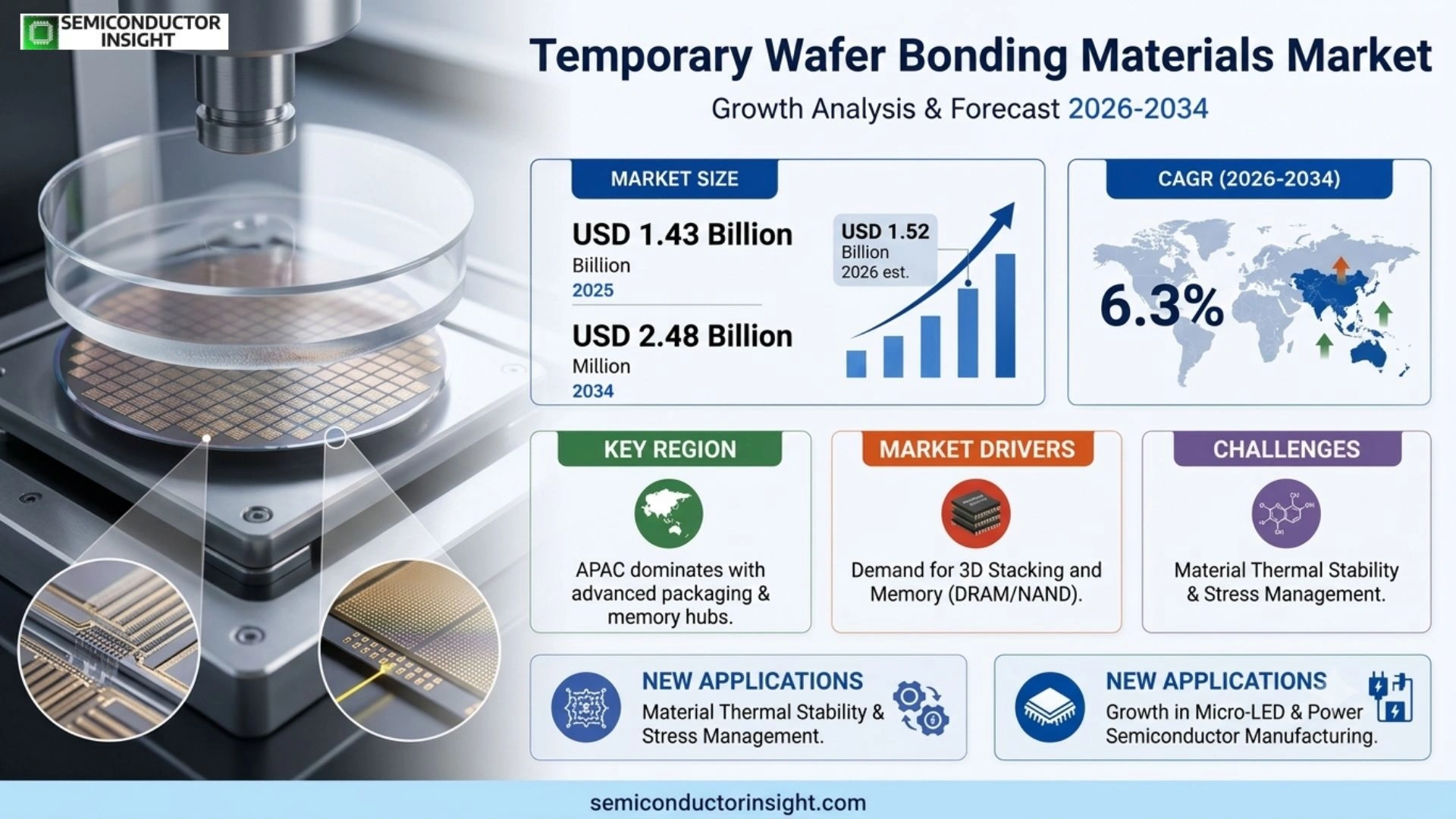
Key Statistics
Key Takeaways
- Thermoplastic materials remain the established baseline for many temporary support flows, while UV-curable and laser-release-compatible systems gain attention as process windows move toward cleaner, lower-stress debonding.
- Wafer-level packaging is the largest application, extending into fan-out, 3D TSV and heterogeneous integration; compound semiconductors are an attractive growth area because thin SiC and GaN wafers are mechanically demanding.
- Asia Pacific is the largest and fastest-growing region, supported by the world’s deepest concentration of foundries, OSATs, memory manufacturers and high-volume electronics packaging lines.
- HBM, chiplets and ultra-thin wafers raise requirements for thermal stability, low warpage, chemical resistance and stress-free debond rather than simply increasing adhesive volume.
- Qualification complexity and equipment-material co-dependence are the main restraints because adhesive, carrier, bonder, downstream chemistry and debond tool must work as one process.
Temporary Wafer Bonding Materials Market Overview
Temporary Wafer Bonding Materials Market was valued at USD 1.43 billion in 2025 and is projected to reach USD 2.48 billion by 2034, representing a 6.3% CAGR during 2026–2034. The 2026 estimated market size is USD 1.52 billion. Asia Pacific is the largest and fastest-growing market in 2025 because it concentrates advanced packaging, memory, power-semiconductor and wafer-level manufacturing capacity.
Temporary wafer bonding materials attach a processed wafer to a rigid carrier so the wafer can be thinned, back-ground, etched, metallized, diced or otherwise handled without cracking or excessive warpage. After backside processing, the material must release cleanly and predictably. The category includes adhesives, films, metallic or composite systems and release layers designed as part of a complete handling process.
The core commercial problem is mechanical support without permanent contamination. Thin wafers can bow, chip or fracture under process stress, while excessive residue or debond force can destroy high-value devices after most manufacturing cost has been incurred. Buyers qualify bond strength, coating uniformity, thermal and chemical resistance, outgassing, debond energy, residue and compatibility with carrier and tool architecture.
Advanced packaging broadens the addressable market. Fan-out, 3D integration, HBM, chiplets, MEMS and compound semiconductors increasingly use temporary support during thinning or backside processing. Brewer Science’s December 2025 demonstration of 300 mm wafers thinned to 15 micrometers with silicon carriers and IR laser debonding illustrates movement toward more fragile wafers and demanding process sequences.
Segment Analysis: By Type
The source page segments the market into Thermoplastic Materials, UV Curing Materials, Composite Films, Metallic Materials and Others. Thermoplastics are the established baseline because they provide controllable bonding across broad process conditions. UV-curable and release-layer systems gain strategic value where customers need lower thermal budgets, high throughput or laser-assisted debonding with minimal stress on ultra-thin wafers.
| Type | Technical / purchasing role | Market position |
|---|---|---|
| Thermoplastic Materials | Thermoplastic adhesives are coated and bonded through controlled heating and pressure, then released by thermal, chemical or mechanical methods depending on formulation. They are widely understood and can tolerate demanding backside processes, making viscosity, glass-transition behavior and solvent compatibility key purchasing variables. This matters commercially because process qualification, integration effort, supply continuity, engineering support and total manufacturing risk often influence purchasing decisions as strongly as component price, so suppliers that solve deployment constraints can defend approved positions even when technically similar alternatives are available. | Established leading format. Thermoplastics remain a core choice for wafer thinning and high-temperature support because process recipes are mature. Their challenge is balancing high-temperature stability with manageable debond and residue removal after the wafer has become mechanically fragile. This matters commercially because process qualification, integration effort, supply continuity, engineering support and total manufacturing risk often influence purchasing decisions as strongly as component price, so suppliers that solve deployment constraints can defend approved positions even when technically similar alternatives are available. |
| UV Curing Materials | UV-curable systems use light-activated chemistry to create rapid support layers and can pair with optical or laser release concepts. They are attractive where throughput, lower thermal budget or clean debond are priorities, but require suitable carrier optical properties and uniform exposure across the wafer. This matters commercially because process qualification, integration effort, supply continuity, engineering support and total manufacturing risk often influence purchasing decisions as strongly as component price, so suppliers that solve deployment constraints can defend approved positions even when technically similar alternatives are available. | Fast-growing route. 3M’s wafer support system demonstrates the appeal of UV-curable adhesive combined with a light-to-heat-conversion release layer. The value proposition is a complete process window with fast cure, controlled support and low-stress debond rather than adhesive chemistry sold in isolation. This matters commercially because process qualification, integration effort, supply continuity, engineering support and total manufacturing risk often influence purchasing decisions as strongly as component price, so suppliers that solve deployment constraints can defend approved positions even when technically similar alternatives are available. |
| Composite Films | Composite films provide controlled thickness and handling in a preformed format, reducing some coating variability compared with liquid systems. Their layered construction can combine adhesion, stress management and release functions, useful when fabs want repeatable bondline thickness and simplified handling. This matters commercially because process qualification, integration effort, supply continuity, engineering support and total manufacturing risk often influence purchasing decisions as strongly as component price, so suppliers that solve deployment constraints can defend approved positions even when technically similar alternatives are available. | Composite films compete where process repeatability and clean handling justify higher material cost. Adoption depends on lamination equipment, wafer topography and thermal compatibility, while suppliers differentiate through film uniformity, low void formation and release behavior across large 300 mm wafers or panel formats. This matters commercially because process qualification, integration effort, supply continuity, engineering support and total manufacturing risk often influence purchasing decisions as strongly as component price, so suppliers that solve deployment constraints can defend approved positions even when technically similar alternatives are available. |
| Metallic Materials | Metallic temporary bonding systems use metal layers or solder-like concepts to provide stiffness and high-temperature capability. They can be valuable in severe process conditions but introduce added deposition, removal and contamination-control considerations compared with polymeric adhesives. This matters commercially because process qualification, integration effort, supply continuity, engineering support and total manufacturing risk often influence purchasing decisions as strongly as component price, so suppliers that solve deployment constraints can defend approved positions even when technically similar alternatives are available. | A specialized segment for demanding thermal or mechanical environments. Metallic systems can exceed some polymer temperature limits, but adoption is constrained by added equipment steps, contamination concerns and the need to remove the temporary layer without damaging device surfaces or subsequent metallization. This matters commercially because process qualification, integration effort, supply continuity, engineering support and total manufacturing risk often influence purchasing decisions as strongly as component price, so suppliers that solve deployment constraints can defend approved positions even when technically similar alternatives are available. |
| Others | The source-defined Others category includes emerging release chemistries, hybrid structures and application-specific bonding concepts. These products target unusual substrates, ultra-high temperatures, transparent or opaque carriers, or novel debond mechanisms required by advanced packaging research and specialty semiconductor production. This matters commercially because process qualification, integration effort, supply continuity, engineering support and total manufacturing risk often influence purchasing decisions as strongly as component price, so suppliers that solve deployment constraints can defend approved positions even when technically similar alternatives are available. | Small in current volume but innovation intensive. This category captures differentiated approaches for chiplets, compound semiconductors and next-generation panel or wafer handling, where suppliers can gain premium design wins if new chemistry solves a process window that standard thermoplastic, UV or film systems cannot meet. This matters commercially because process qualification, integration effort, supply continuity, engineering support and total manufacturing risk often influence purchasing decisions as strongly as component price, so suppliers that solve deployment constraints can defend approved positions even when technically similar alternatives are available. |
Debond method and carrier compatibility
Material selection cannot be separated from the debond mechanism and carrier. Thermal slide, chemical release, mechanical separation, UV release and laser debonding impose different requirements on adhesion, optical absorption, thermal stability and residue. Glass carriers enable optical release concepts, while silicon carriers can better match wafer thermal expansion. Suppliers increasingly compete as process partners by qualifying adhesive, carrier and debond tool together.
Segment Analysis: By Application
The source applications are Wafer-level Packaging, MEMS, Compound Semiconductor and Others. Wafer-level packaging is the largest because fan-out, 3D TSV and heterogeneous integration require stable handling through thinning and backside processing. Compound-semiconductor use grows from a smaller base as SiC, GaN and related wafers become thinner and more mechanically vulnerable during power-device and RF manufacturing.
| Application | Demand characteristics |
|---|---|
| Wafer-level Packaging | Largest application. Fan-out, through-silicon-via, HBM and chiplet processes use temporary carriers to stabilize wafers or reconstructed wafers while thinning, metallizing, molding or building redistribution layers. Purchasing is driven by yield, throughput and clean debond because failure occurs late after significant device cost has accumulated. This matters commercially because process qualification, integration effort, supply continuity, engineering support and total manufacturing risk often influence purchasing decisions as strongly as component price, so suppliers that solve deployment constraints can defend approved positions even when technically similar alternatives are available. |
| MEMS | MEMS wafers can contain cavities, topography and fragile mechanical structures that complicate conventional chucking and thinning. Temporary bonding allows backside processing while protecting the device surface, but materials must avoid contaminating sensitive features. Suppliers benefit from custom process support because MEMS architectures vary widely. This matters commercially because process qualification, integration effort, supply continuity, engineering support and total manufacturing risk often influence purchasing decisions as strongly as component price, so suppliers that solve deployment constraints can defend approved positions even when technically similar alternatives are available. |
| Compound Semiconductor | SiC, GaN, GaAs and other compound-semiconductor wafers are high value and can be mechanically challenging during thinning or backside metallization. Temporary support reduces breakage risk, while material compatibility must account for higher temperatures and specialized chemistries. Automotive power and RF growth creates a premium application where yield protection can justify higher material cost. |
| Others | The Others category includes research, optoelectronics, sensors, LED and emerging heterogeneous-integration flows. These applications often use nonstandard substrates or small production volumes, making flexible coating, carrier and debond options important. Suppliers that provide evaluation materials and application engineering can convert laboratory process wins into future commercial specifications. This matters commercially because process qualification, integration effort, supply continuity, engineering support and total manufacturing risk often influence purchasing decisions as strongly as component price, so suppliers that solve deployment constraints can defend approved positions even when technically similar alternatives are available. |
Regional Analysis
Asia Pacific leads because temporary bonding is consumed where wafers are thinned, packaged and processed in volume. North America shapes advanced packaging architectures and materials innovation, Europe combines equipment, research and power-device specialization, while South America and Middle East & Africa remain smaller research and project markets. The growth map follows semiconductor manufacturing and advanced packaging capacity rather than end-device consumption.
How does temporary wafer bonding demand differ by region?
Asian customers buy materials for high-volume production and value local response, lot consistency and equipment compatibility. North American customers often qualify materials during early advanced-packaging development. Europe emphasizes power devices, MEMS and collaborative equipment research. Emerging regions purchase evaluation or pilot quantities and depend on distributors for controlled storage and application support.
| Region | Position | Growth outlook | Demand profile | What decides supplier selection |
|---|---|---|---|---|
| Asia Pacific | Largest | Highest in market | Advanced packaging and high-volume manufacturing led | Local application support and process qualification |
| North America | Major established market | Strong | R&D, AI packaging and domestic fab led | Co-development and equipment compatibility |
| Europe | Major established market | Steady | Equipment, MEMS and power-device led | Documentation and reliability qualification |
| South America | Emerging | Selective | Research and import led | Distributor support and landed cost |
| Middle East & Africa | Emerging | Selective | Research and diversification led | Technical partnership and import reliability |
Competitive Landscape
Competition spans semiconductor-material specialists, diversified chemical companies and process-platform suppliers. The source report profiles Brewer Science, 3M, Sekisui, HD MicroSystems, Dow, Henkel, Nissan Chemical, TOK and other participants. Customers do not select chemistry on datasheet properties alone; they qualify a combined bond, process and debond window, making application laboratories and equipment partnerships central competitive assets.
Brewer Science competes through high-temperature temporary bonding expertise and process development with equipment and research partners. Its December 2025 ultra-thin wafer demonstration shows the value of co-optimizing adhesive with silicon carriers and IR laser debonding. Process integration knowledge becomes part of the qualified solution and creates a stronger customer relationship than general-purpose adhesive supply.
3M positions a complete wafer support system using UV-curable adhesive, release coating, carrier and process sequence. It highlights fan-out, 3D TSV, MEMS, LED, IGBT and heterogeneous integration, demonstrating how diversified materials suppliers can use polymer, coating and tape capabilities to build a temporary-bonding platform rather than compete on one formulation. This matters commercially because process qualification, integration effort, supply continuity, engineering support and total manufacturing risk often influence purchasing decisions as strongly as component price, so suppliers that solve deployment constraints can defend approved positions even when technically similar alternatives are available.
Japanese and other Asian chemical suppliers benefit from proximity to high-volume manufacturing, while global firms bring cross-region support. The moat is qualification history: once a material demonstrates uniform coating, thermal stability, low outgassing, acceptable warpage and clean debond on production wafers, customers are reluctant to change chemistry without a compelling cost or performance reason.
Tier structure
| Competitive tier | Representative participants | How suppliers compete |
|---|---|---|
| Process-specialist leaders | Brewer Science; 3M | Compete through complete temporary support process windows, application laboratories and close work with equipment companies. Their strongest advantage is the ability to troubleshoot bond, backside processing and debond as one system, reducing customer integration risk during advanced packaging development. This matters commercially because process qualification, integration effort, supply continuity, engineering support and total manufacturing risk often influence purchasing decisions as strongly as component price, so suppliers that solve deployment constraints can defend approved positions even when technically similar alternatives are available. |
| Semiconductor chemical majors | Sekisui Chemical; Nissan Chemical; TOKYO OHKA KOGYO; HD MicroSystems (DuPont) | Leverage semiconductor-grade chemistry, regional technical service and established fab relationships. They can bundle temporary bonding with adjacent coatings, dielectric materials and process chemicals, supporting customers that prefer suppliers with robust quality systems and multi-product semiconductor manufacturing experience. This matters commercially because process qualification, integration effort, supply continuity, engineering support and total manufacturing risk often influence purchasing decisions as strongly as component price, so suppliers that solve deployment constraints can defend approved positions even when technically similar alternatives are available. |
| Diversified adhesives & specialists | Dow; Henkel; Samcien Semiconductor Materials; AI Technology | Compete through formulation, application niches, cost or regional availability. Moving into leading-edge packaging requires equipment validation and defect-control data because customer acceptance depends on wafer-level yield rather than bulk adhesive performance alone. This matters commercially because process qualification, integration effort, supply continuity, engineering support and total manufacturing risk often influence purchasing decisions as strongly as component price, so suppliers that solve deployment constraints can defend approved positions even when technically similar alternatives are available. |
Key companies profiled
The source report profiles Brewer Science; Samcien Semiconductor Materials; Sekisui Chemical; 3M; HD MicroSystems (DuPont); Dow; Henkel; Nissan Chemical; TOKYO OHKA KOGYO; AI Technology. The group includes temporary-bonding specialists, diversified adhesive manufacturers and semiconductor chemical suppliers. Market positions should be evaluated by thermal and chemical process windows, debond method, residue, carrier compatibility, application-lab capability, quality systems and customer qualification rather than total corporate sales.
Temporary Wafer Bonding Materials Production Capacity Analysis
Production capacity combines polymer or specialty-material synthesis, clean filtration, controlled blending, coating or film conversion, semiconductor-grade packaging and application validation. The practical bottleneck is not only liters of adhesive: advanced customers require lot consistency, trace impurities, tight rheology and shelf-life control, while new capacity must be qualified on specific coaters, bonders, carriers and debond systems before serving production.
Liquid bonding materials require controlled raw-material quality, synthesis and filtration so particles or ionic contamination do not create wafer defects. Viscosity and solvent balance must remain stable because coating thickness directly affects bond uniformity and warpage. Chemical reactor capacity can expand relatively quickly, but converting output into semiconductor revenue requires clean packaging, statistical process control and qualification data.
Film and composite formats add coating, lamination and thickness-uniformity constraints. Producers need web handling, defect inspection and clean conversion capability to deliver large-area films without particles, gels or thickness excursions. As panel-level packaging develops, material width and area scale become additional manufacturing variables, favoring suppliers with semiconductor cleanliness and precision film-processing experience.
Application laboratories are effectively part of productive capacity because they determine how fast a new formulation can be qualified. Suppliers need to coat, bond, thin, heat, chemically process and debond test wafers while measuring bow, thickness variation, residue and damage. A company with ample chemical output but limited application capability can struggle to support simultaneous customer ramps.
Temporary Wafer Bonding Materials Market Dynamics: Drivers, Restraints and Opportunities
Growth is driven by advanced packaging, HBM, wafer thinning, MEMS and compound semiconductors, while restraints come from material and equipment cost, complex multi-step qualification, residue control and wafer-damage risk during debond. Attractive opportunities include high-temperature laser-release systems, ultra-thin wafer handling, fan-out and panel packaging, and support tailored to SiC and GaN. This matters commercially because process qualification, integration effort, supply continuity, engineering support and total manufacturing risk often influence purchasing decisions as strongly as component price, so suppliers that solve deployment constraints can defend approved positions even when technically similar alternatives are available.
MARKET DRIVERS
Drivers Impact Analysis*
| Factor | Relative impact* | Commercial mechanism |
|---|---|---|
| HBM and heterogeneous integration | High | Thin die and multi-die stacks increase the need for rigid temporary support. |
| Fan-out and wafer-level packaging | High | Redistribution, molding and thinning broaden use of temporary carriers. |
| Compound semiconductor growth | Medium-High | High-value SiC and GaN wafers benefit from breakage reduction. |
| Ultra-thin wafer handling | Medium-High | Thinner wafers increase warpage and fracture risk. |
HBM and chiplets increase thin-wafer handling requirements
AI accelerators are increasing demand for HBM and heterogeneous integration, where multiple thin dies are stacked or assembled closely. Temporary bonding enables thinning and backside processing while maintaining support. The value of a robust material rises with die cost because a late-stage fracture, crack or residue defect can destroy a device that has already accumulated substantial fabrication expense.
Fan-out packaging expands temporary support steps
Fan-out wafer-level and panel-level packaging rearranges known-good die in molded structures and then builds redistribution layers. Temporary carriers help control warpage and provide a flat process surface through lithography, plating and other steps. Materials must support large-area structures and clean release, creating demand for chemistries engineered around advanced packaging. This matters commercially because process qualification, integration effort, supply continuity, engineering support and total manufacturing risk often influence purchasing decisions as strongly as component price, so suppliers that solve deployment constraints can defend approved positions even when technically similar alternatives are available.
Ultra-thin wafers require sophisticated carrier systems
Brewer Science’s 2025 demonstration of 300 mm wafers thinned to 15 micrometers shows how mechanical margins are shrinking. At these thicknesses, small stress differences can bow or fracture wafers, so adhesive modulus, carrier thermal expansion and debond energy become system-level design parameters, increasing the value of process-integrated materials. This matters commercially because process qualification, integration effort, supply continuity, engineering support and total manufacturing risk often influence purchasing decisions as strongly as component price, so suppliers that solve deployment constraints can defend approved positions even when technically similar alternatives are available.
Power and compound semiconductors broaden demand
SiC and GaN wafers are expensive and can undergo aggressive backside grinding, metallization and thermal processes. Temporary bonding reduces handling risk while maintaining a stable surface for processing. Automotive and power-electronics growth therefore creates a high-value application where material cost is small relative to potential wafer loss. This matters commercially because process qualification, integration effort, supply continuity, engineering support and total manufacturing risk often influence purchasing decisions as strongly as component price, so suppliers that solve deployment constraints can defend approved positions even when technically similar alternatives are available.
MARKET RESTRAINTS
Restraints Impact Analysis*
| Factor | Relative impact* | Commercial mechanism |
|---|---|---|
| Complex bond/debond integration | High | Material, carrier, equipment and downstream chemistry must work in one qualified window. |
| Residue and wafer-damage risk | High | A failed debond can destroy high-value wafers late in manufacturing. |
| Material and equipment cost | Medium | Advanced carrier and release systems raise process cost. |
| Environmental and solvent constraints | Medium | Solvent handling and waste rules influence formulation and adoption. |
Temporary bonding is a system, not a single material substitution
Changing adhesive can require new coating parameters, bond pressure, cure conditions, carrier preparation, backside process checks and debond recipes. Chemistry that performs well in isolation may fail after plasma, wet chemistry or heat. This integration burden lengthens qualification and makes customers conservative about switching once a production flow reaches stable yield. This matters commercially because process qualification, integration effort, supply continuity, engineering support and total manufacturing risk often influence purchasing decisions as strongly as component price, so suppliers that solve deployment constraints can defend approved positions even when technically similar alternatives are available.
Debond defects occur after substantial value has been added
The wafer is often thinned and processed before temporary support is removed, so cracks, delamination, particles or residue at debond can destroy expensive completed devices. Customers demand large process margins and defect data rather than laboratory demonstrations alone. The financial consequence of late-stage failure raises the threshold for new suppliers and formulations.
Advanced carrier and release methods add cost
Laser debond, specialized glass or silicon carriers and high-performance adhesives improve process capability but add equipment and material expense. Lower-value devices may not justify the full platform, limiting adoption to applications where thin-wafer handling, yield or process temperature creates a clear economic benefit. Suppliers must demonstrate total yield improvement. This matters commercially because process qualification, integration effort, supply continuity, engineering support and total manufacturing risk often influence purchasing decisions as strongly as component price, so suppliers that solve deployment constraints can defend approved positions even when technically similar alternatives are available.
Environmental controls influence solvent-based formulations
Coating and cleaning chemistries can involve volatile solvents or process waste managed under strict environmental and worker-safety rules. Customers increasingly prefer materials that reduce hazardous handling or simplify cleaning without sacrificing thermal performance. Reformulation can trigger a new qualification cycle, so environmental improvement must be introduced with careful change control. This matters commercially because process qualification, integration effort, supply continuity, engineering support and total manufacturing risk often influence purchasing decisions as strongly as component price, so suppliers that solve deployment constraints can defend approved positions even when technically similar alternatives are available.
MARKET OPPORTUNITIES
Laser-release systems for ultra-thin wafers
IR and laser debonding can reduce mechanical stress during carrier separation and enable thinner wafers than some conventional methods. Suppliers can develop adhesives and release layers tuned to carrier optical properties and process temperature. The strongest opportunity is a validated material-and-equipment recipe transferable from pilot work into high-volume HBM or chiplet manufacturing.
Panel-level fan-out packaging
Panel-level packaging processes more die area per cycle than a round wafer but creates challenges in large-area warpage, coating uniformity and carrier handling. Temporary bonding suppliers can adapt liquid or film systems for larger formats, expanding material consumption and creating a qualification barrier that rewards early collaboration with panel and equipment developers.
High-temperature support for compound semiconductors
Power-device and RF wafers may encounter backside processes at temperatures beyond standard polymer capability. Materials that maintain adhesion and low outgassing under higher thermal load, then debond cleanly, can address SiC, GaN and specialty devices. These wafers are high value, supporting premium material pricing even at lower unit volumes. This matters commercially because process qualification, integration effort, supply continuity, engineering support and total manufacturing risk often influence purchasing decisions as strongly as component price, so suppliers that solve deployment constraints can defend approved positions even when technically similar alternatives are available.
Reusable carriers and lower-residue economics
Customers can reduce total process cost by reusing carriers and minimizing solvent-intensive cleanup. Suppliers that combine durable carrier interfaces, clean release and predictable adhesive removal can compete on cost per wafer rather than price per gram, shifting value toward complete process optimization and creating service opportunities. This matters commercially because process qualification, integration effort, supply continuity, engineering support and total manufacturing risk often influence purchasing decisions as strongly as component price, so suppliers that solve deployment constraints can defend approved positions even when technically similar alternatives are available.
Temporary Wafer Bonding Materials Supply Chain Analysis
Polymer & specialty raw materials
Upstream chemistry determines adhesion, thermal stability, optical response, outgassing and cleanability. Semiconductor suppliers need tightly controlled raw materials with traceability and low contamination. Formulation changes made by upstream vendors can affect wafer performance, so qualified producers maintain change-control agreements and incoming analytical testing. This matters commercially because process qualification, integration effort, supply continuity, engineering support and total manufacturing risk often influence purchasing decisions as strongly as component price, so suppliers that solve deployment constraints can defend approved positions even when technically similar alternatives are available.
Formulation, filtration & film conversion
Producers formulate rheology and cure behavior, remove particles through fine filtration and fill material in clean conditions. Film products add coating, drying and lamination controls. Lot uniformity is critical because small viscosity or thickness shifts can alter bondline thickness, wafer bow and downstream process performance. This matters commercially because process qualification, integration effort, supply continuity, engineering support and total manufacturing risk often influence purchasing decisions as strongly as component price, so suppliers that solve deployment constraints can defend approved positions even when technically similar alternatives are available.
Carrier & equipment integration
The same adhesive behaves differently depending on carrier surface, optical absorption, bond temperature and debond architecture. Materials companies work with equipment makers to define recipes and process limits. Joint integration reduces customer qualification risk and creates a moat because the approved solution becomes a specific combination of chemistry, carrier and tool settings.
Advanced packaging & wafer processing
Production customers measure yield, warpage, thickness variation, contamination, residue and throughput across full wafer lots. Once a material passes qualification, recurring consumption follows wafer starts and process cycles. Suppliers must maintain lot consistency and technical support because a material excursion can interrupt highly utilized packaging lines. This matters commercially because process qualification, integration effort, supply continuity, engineering support and total manufacturing risk often influence purchasing decisions as strongly as component price, so suppliers that solve deployment constraints can defend approved positions even when technically similar alternatives are available.
Recent Developments in the Temporary Wafer Bonding Materials Market
Recent developments emphasize ultra-thin 300 mm wafer handling, chiplet integration and complete temporary bonding platforms. The direction is toward materials that tolerate higher process temperatures, support increasingly fragile wafers and release with lower stress, while equipment and carrier compatibility become part of the supplier value proposition rather than a separate customer engineering task.
SEMI linked 2026 memory equipment spending to HBM, DDR5 and AI infrastructure. The investment is relevant to temporary bonding because HBM and advanced memory packaging rely on thin dies and complex backside or stacking processes. More capacity raises demand for carrier-assisted handling solutions with strong yield and debond performance. This matters commercially because process qualification, integration effort, supply continuity, engineering support and total manufacturing risk often influence purchasing decisions as strongly as component price, so suppliers that solve deployment constraints can defend approved positions even when technically similar alternatives are available.
The collaborators presented a process using silicon carriers, high-temperature BrewerBOND adhesive and EVG IR laser debonding to handle 300 mm wafers thinned to 15 micrometers. The work demonstrates that ultra-thin support requires coordinated control of adhesive stability, carrier mechanics and low-stress debond rather than a standalone material. This matters commercially because process qualification, integration effort, supply continuity, engineering support and total manufacturing risk often influence purchasing decisions as strongly as component price, so suppliers that solve deployment constraints can defend approved positions even when technically similar alternatives are available.
3M positions its wafer support system for fan-out wafer and panel packaging, 3D TSV, MEMS, IGBT, LED and heterogeneous integration. The platform combines UV-curable adhesive, release coating and carrier process steps, illustrating competition through a workflow addressing thermal and chemical resistance, warpage, throughput and clean release. This matters commercially because process qualification, integration effort, supply continuity, engineering support and total manufacturing risk often influence purchasing decisions as strongly as component price, so suppliers that solve deployment constraints can defend approved positions even when technically similar alternatives are available.
REPORT SCOPE & SEGMENTATION
The report scope preserves the source page’s five material types and four applications while rebasing its 2023 and 2030 market-size anchors to a common 2025 base, 2026 estimate and 2034 forecast. The printed 6.30% growth rate is consistent with the published anchors to rounding, so the standardized series retains that compound growth factor.
| Report attribute | Coverage |
|---|---|
| Market | Temporary Wafer Bonding Materials |
| Base year | 2025 |
| Estimated year | 2026 |
| Forecast period | 2026–2034 |
| 2025 market size | USD 1.43 billion |
| 2034 forecast size | USD 2.48 billion |
| CAGR | 6.3% during 2026–2034 |
| Largest market in 2025 | Asia Pacific |
| By Type | Thermoplastic Materials; UV Curing Materials; Composite Films; Metallic Materials; Others |
| By Application | Wafer-level Packaging; MEMS; Compound Semiconductor; Others |
| Additional segmentation | Regional coverage and manufacturer analysis; temporary bonding and debond process ecosystem including carriers and equipment compatibility |
| Regions | North America; Europe; Asia Pacific; South America; Middle East & Africa |
| Companies profiled | Brewer Science; Samcien Semiconductor Materials; Sekisui Chemical; 3M; HD MicroSystems (DuPont); Dow; Henkel; Nissan Chemical; TOKYO OHKA KOGYO; AI Technology |
Frequently Asked Questions
What is the temporary wafer bonding materials market size in 2025?
The global temporary wafer bonding materials market is valued at USD 1.43 billion in 2025 under the standardized series used in this overview. The value is carried consistently through the Key Statistics, Market Overview, report scope and FAQ sections so that the article uses one market definition and one financial baseline rather than mixing figures from different source windows.
What is the forecast size of the temporary wafer bonding materials market by 2034?
The market is projected to reach USD 2.48 billion by 2034. The endpoint follows the annual growth factor implied by the source page’s published market-size anchors, keeping the 2025 base value, 2026 estimate, 2034 forecast and stated compound rate mathematically consistent across the full report overview. This matters commercially because process qualification, integration effort, supply continuity, engineering support and total manufacturing risk often influence purchasing decisions as strongly as component price, so suppliers that solve deployment constraints can defend approved positions even when technically similar alternatives are available.
What CAGR is expected for the temporary wafer bonding materials market during 2026–2034?
The standardized forecast corresponds to a 6.3% CAGR during 2026–2034. This rate is derived from the two published market-size anchors and is used consistently throughout the article, providing a stable reference for comparing segment momentum, regional demand, supplier positioning and the balance between growth drivers and operating constraints. This matters commercially because process qualification, integration effort, supply continuity, engineering support and total manufacturing risk often influence purchasing decisions as strongly as component price, so suppliers that solve deployment constraints can defend approved positions even when technically similar alternatives are available.
Which region is the largest temporary wafer bonding materials market in 2025?
Asia Pacific is identified as the largest market in 2025. Its leadership reflects the concentration of the relevant semiconductor manufacturing, packaging, display, device-production or supply-chain activities, giving suppliers a deeper installed base, more frequent qualification events and stronger local demand for technical support and continuity of supply. This matters commercially because process qualification, integration effort, supply continuity, engineering support and total manufacturing risk often influence purchasing decisions as strongly as component price, so suppliers that solve deployment constraints can defend approved positions even when technically similar alternatives are available.
Which product type leads the temporary wafer bonding materials market?
Thermoplastic Materials is the leading source-defined type in this overview. Its position reflects broad use in established production flows, a large qualified installed base and purchasing familiarity among semiconductor manufacturers, while newer material or technology formats can grow faster from smaller bases as advanced devices create tighter thermal, mechanical, purity or resolution requirements.
Which application is most important in the temporary wafer bonding materials market?
Wafer-level Packaging is the principal application within the source-defined segmentation. Purchasing is shaped by the consequence of failure in production: the selected material or component must meet process, yield, reliability and integration requirements, making qualification history and supplier engineering support important commercial variables alongside the nominal product specification. This matters commercially because process qualification, integration effort, supply continuity, engineering support and total manufacturing risk often influence purchasing decisions as strongly as component price, so suppliers that solve deployment constraints can defend approved positions even when technically similar alternatives are available.
Which region is growing fastest in the temporary wafer bonding materials market?
Asia Pacific has the strongest growth profile in this overview. New fabs, advanced packaging lines, localized supply chains or technology migrations create repeated qualification events, and suppliers benefit most where they can support these projects locally with dependable logistics, process engineering and product variants aligned with each customer’s manufacturing roadmap. This matters commercially because process qualification, integration effort, supply continuity, engineering support and total manufacturing risk often influence purchasing decisions as strongly as component price, so suppliers that solve deployment constraints can defend approved positions even when technically similar alternatives are available.
What are the main growth drivers for the temporary wafer bonding materials market?
The principal drivers are semiconductor capacity expansion, higher device integration, tighter manufacturing tolerances, advanced packaging or lithography adoption and the need for materials or components that protect yield as process complexity rises. These forces create new purchasing events whenever a fab adds capacity, changes a process module or qualifies a new technology generation.
What are the main restraints on the temporary wafer bonding materials market?
The principal restraints are long customer qualification cycles, manufacturing complexity, concentrated upstream supply, demanding defect or purity specifications and the high cost of process failure. These conditions slow supplier switching and new-product revenue conversion, while strengthening incumbents that can demonstrate stable process control, dependable capacity and application-engineering support. This matters commercially because process qualification, integration effort, supply continuity, engineering support and total manufacturing risk often influence purchasing decisions as strongly as component price, so suppliers that solve deployment constraints can defend approved positions even when technically similar alternatives are available.
Who are the key suppliers in the temporary wafer bonding materials market?
The source report profiles Brewer Science; Samcien Semiconductor Materials; Sekisui Chemical; 3M; HD MicroSystems (DuPont); Dow; Henkel; Nissan Chemical; TOKYO OHKA KOGYO; AI Technology. Competitive advantage depends on process capability, material consistency, customer qualification, intellectual property, capacity planning and technical support. The strongest suppliers translate product performance into repeatable fab or packaging yield while maintaining continuity of supply across multi-year semiconductor product and equipment cycles.
Research Sources & Evidence Base
Get Sample Report PDF for Exclusive Insights
Report Sample Includes
- Table of Contents
- List of Tables & Figures
- Charts, Research Methodology, and more...
 Download Sample Report PDF