Resist Processing Systems Market Trends, Business Strategies 2026-2036

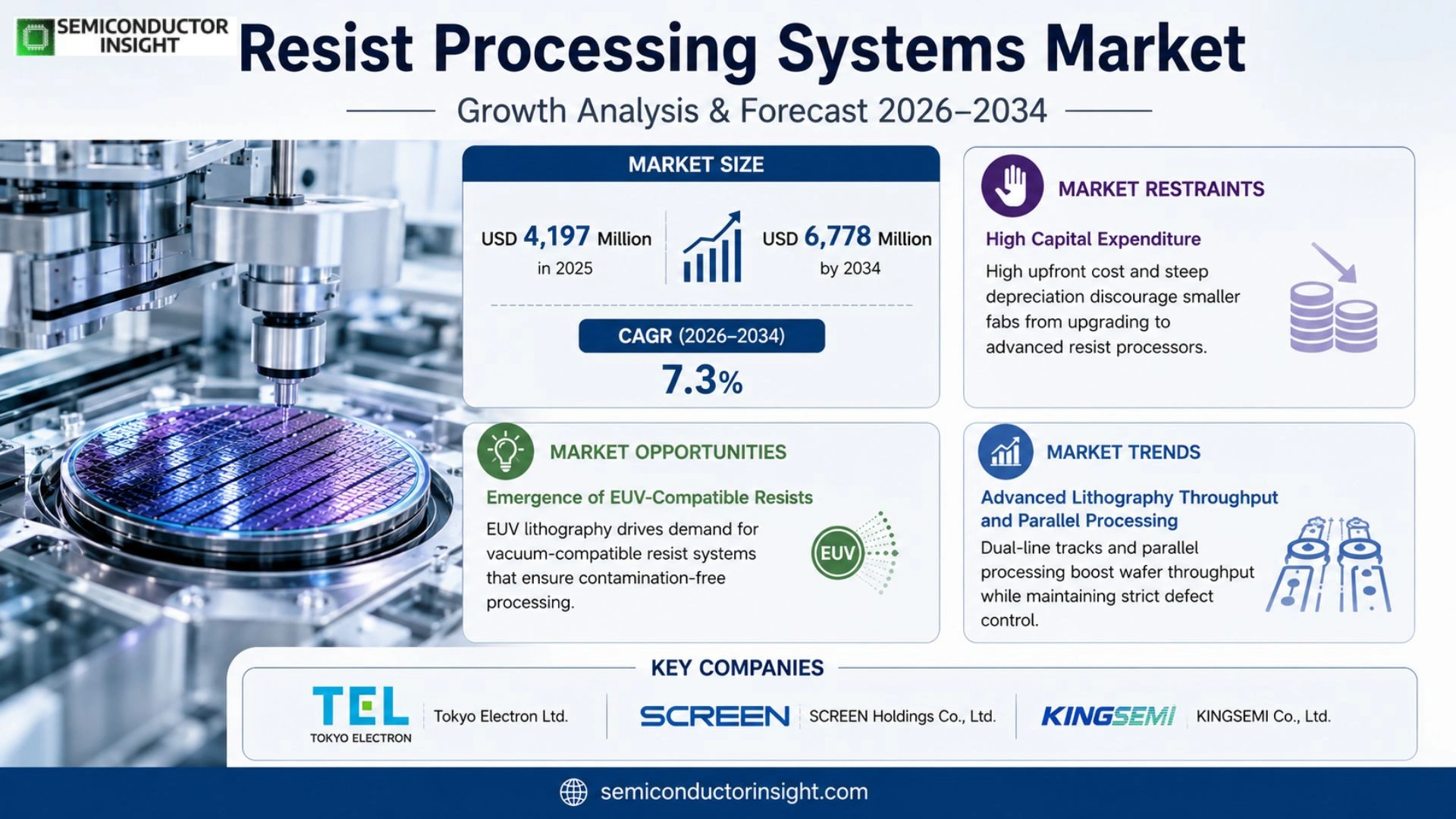
Resist Processing Systems market will reach USD 6,778 million by 2034, reflecting a CAGR of 7.3% over the forecast period.

PDF Icon Download Sample Report PDF
  • Quick Dispatch

    All Orders

  • Secure Payment

    100% Secure Payment

Price range: $1,500.00 through $4,250.00

Clear

Resist Processing Systems Market Insights

Resist Processing Systems market size was valued at USD 4,197 million in 2025 and will reach USD 6,778 million by 2034, reflecting a CAGR of 7.3% over the forecast period.

Resist Processing Systems refer to integrated coat/develop “track” tools (coater/developer, wafer track) positioned beside a stepper or scanner within a lithography cell to carry out the sequential resist‑processing flow that enables pattern transfer. In practice, a resist track combines modular functions such as spin or spray coating, edge‑bead removal (EBR), soft bake / post‑exposure bake (PEB) / chill conditioning, puddle or spray developing, rinse/dry stages, buffering and robotic wafer handling together with FOUP/load‑port interfaces and alignment modules designed to match scanner takt time. Tokyo Electron’s annual report describes the coater/developer as the system that coats and develops wafers with photoresist while operating in concert with the exposure tool.

The market expands because of heightened capital spending on semiconductor lithography equipment, growing demand for high‑throughput 300 mm multi‑module tracks and the need for tighter defect control as EUV and High‑NA nodes mature. Suppliers such as TEL have introduced CLEAN TRACK™ LITHIUS series with enhanced OEE and lower cost of ownership, while SCREEN’s DT‑3000 (SOKUDO DUO) offers dual parallel lines that raise throughput for immersion ArF and e‑beam applications. Emerging players from China and SEMES are also adding capacity, reinforcing supply‑chain resilience across regions.
Resist Processing Systems Market Outlook

MARKET DRIVERS

Technology Adoption in Advanced Lithography

Manufacturers of semiconductors are integrating more sophisticated resist processing workflows to meet the dimensional tolerances demanded by sub‑10 nm node devices. This shift forces equipment suppliers to refine coating uniformity and develop low‑scratch formulations, thereby stimulating demand for Resist Processing Systems market.

Cost‑Efficiency Pressures

Foundries are under pressure to reduce per‑wafer expenditures while maintaining yield. Modern resist processing platforms that combine multi‑track alignment with inline metrology enable tighter cycle times, translating into measurable savings that justify capital allocation.

➤ Firms that can deliver a 15 % reduction in cycle time while preserving defect density are rapidly gaining preference among high‑volume producers.

Because yield improvement directly impacts revenue, investment in next‑generation resist processors is being treated as a strategic lever rather than a discretionary expense, cementing Resist Processing Systems market as a vital component of contemporary fab strategies.

MARKET CHALLENGES

Complexity of Multi‑Layer Integration

As device architectures evolve toward heterogeneous integration, the number of resist layers per wafer is climbing. Managing cross‑contamination and maintaining critical dimension control across diverse materials increases process complexity, raising the barrier for entry for new equipment vendors.

Other Challenges

Skilled Workforce Shortage

The specialized knowledge required to operate and maintain high‑precision resist processing lines is scarce, prompting fabs to invest heavily in training programs or to outsource certain steps, which can dilute the perceived advantage of in‑house systems.

Regulatory scrutiny over chemical usage adds another layer of difficulty, as compliance with emerging environmental standards forces manufacturers to reassess solvent compositions and waste‑handling protocols.

MARKET RESTRAINTS

High Capital Expenditure

Initial outlay for state‑of‑the‑art resist processors often exceeds the budget thresholds of smaller fabs, prompting them to postpone upgrades despite clear efficiency gains. The steep depreciation schedule further discourages rapid fleet turnover.

Additionally, the long qualification cycles associated with new resist chemistries can stall adoption, as manufacturers prefer proven lines to avoid production disruptions.

These financial and operational frictions act as a ceiling on the pace at which Resist Processing Systems market can expand across the broader semiconductor ecosystem.

MARKET OPPORTUNITIES

Emergence of EUV‑Compatible Resists

The transition to extreme ultraviolet lithography creates a niche for resist processing platforms that can handle EUV‑sensitive formulations without introducing contamination. Suppliers that engineer vacuum‑compatible toolchains stand to capture a sizable share of upcoming fab investments.

Parallel advances in AI‑driven process optimization present another growth vector. By embedding predictive analytics within resist processors, vendors can offer adaptive control loops that continuously fine‑tune exposure parameters, delivering higher yields with minimal operator intervention.

Finally, expanding demand from specialty sectors such as quantum‑computing chips and advanced sensor arrays introduces tailored resist processing requirements, opening avenues for customized system offerings within Resist Processing Systems market.

Resist Processing Systems Market Trends

Advanced Lithography Throughput and Parallel Processing

The broader evolution of Resist Processing Systems market is reshaping equipment design around productivity pressure on lithography cells. Equipment makers such as Tokyo Electron and SCREEN have introduced dual‑line tracks that double wafer‑per‑hour capability while preserving tight defect budgets. The additional line allows simultaneous coat‑develop cycles, matching the decreasing takt time of high‑NA EUV scanners. Customers report that the extra throughput translates into higher fab utilization and lower per‑chip cost, especially in logic and high‑density memory fabs where scanner time commands a premium. This shift toward parallelism is reinforced by tighter thermal stability requirements; dual‑line architectures spread heat loads, reducing wafer‑temperature drift that would otherwise impair critical dimension control. Moreover, the modular footprint eases integration into existing cleanrooms, enabling incremental upgrades without major layout changes. The overall effect is a measurable lift in overall equipment effectiveness, strengthening the business case for capital allocation to next‑generation lithography.

Other Trends

Supply‑Chain Localization and Second‑Source Emergence

Geopolitical pressures and recent shortages have prompted semiconductor manufacturers to diversify their equipment base. Domestic suppliers in China and emerging Korean players are now field‑testing ArF‑i photo‑processing tracks that claim comparable uptime to established Japanese and European models. This emergence of second‑source options reduces reliance on a single vendor and shortens lead times, a factor that many fabs cite when planning capacity expansions. The trend also spurs competitive pricing, as incumbents introduce cost‑of‑ownership improvements to retain market share. For equipment integrators, the need to certify new tools across a broader set of scanner interfaces creates opportunities for software upgrades and standardized data pipelines.

Material Diversification and Packaging Integration

Beyond traditional photoresist, customers are demanding tracks that handle polymer‑based hard masks, bottom‑anti‑reflective coatings, and spin‑on die‑attach layers. Platform vendors have responded by adding interchangeable coating heads, variable‑temperature bake modules, and solvent‑recovery loops that accommodate the wider viscosity range of these materials. This capability opens Resist Processing Systems market to advanced packaging lines, where mixed 200 mm/300 mm flows and back‑end wafer‑level processes are becoming routine. By supporting both front‑end lithography and back‑end packaging within a single footprint, equipment providers create a tighter value chain and capture additional service revenue. The convergence of material flexibility and packaging complexity therefore represents a strategic growth vector for the sector.

COMPETITIVE LANDSCAPE

Key Industry Players

Resist Processing Systems Competitive Overview

The market is dominated by a handful of large‑scale equipment manufacturers whose portfolio integrates high‑throughput coater/developer tracks directly beside lithography scanners. Tokyo Electron (TEL) leverages its CLEAN TRACK™ LITHIUS™ line to deliver modular 300 mm platforms that combine spin/spray coating, edge‑bead removal, soft‑bake, develop, and robotic handling in a single footprint. TEL’s emphasis on defect control, OEE improvement and flexible material compatibility has cemented its role as the benchmark for front‑end fabs pursuing advanced‑node readiness. SCREEN follows a parallel trajectory with its DT‑3000 (SOKUDO DUO) family, which distinguishes itself by offering dual parallel process lines that double throughput while preserving alignment precision for immersion ArF and emerging e‑beam exposure tools. Both firms have shaped a market structure where economies of scale and integrated software ecosystems dictate supplier selection, forcing midsize contenders to specialize in niche applications or complementary material sets.

Beyond the two giants, a diversified set of specialists expands the ecosystem. KINGSEMI’s KS‑FT200/300 series targets mixed 200 mm/300 mm lines and supports unconventional coatings such as BARC and spin‑on hard masks, appealing to advanced packaging players. EV Group (EVG) and SUSS Group focus on modular R&D tracks that can be re‑configured for back‑end processing or pilot‑line pilots, providing flexibility absent in monolithic platforms. SEMES and China’s emerging domestic vendors are introducing cost‑effective ArF‑i photo‑processing tracks that address supply‑chain resilience concerns. Additional contributors include TAZMO, PNC Technology Group, Obducat, ELS System Technology, Litho Tech Japan Corporation, and LithExx‑Systems, each carving out relevance through region‑specific service networks, customized software stacks, or specialty material handling. Collectively, these players generate a competitive environment where differentiation hinges on throughput architecture, material breadth, and alignment with fab automation strategies.

List of Key Resist Processing Systems Companies Profiled

Segment Analysis:

Segment Category Sub-Segments Key Insights
By Type
  • Multi‑Module Track Platforms
  • Standalone Coater/Developer Units
  • Integrated Photomask Processing Systems
Multi‑Module Track Platforms

  • Drive high throughput required by leading logic fabs, aligning with scanner takt time.
  • Offer extensibility for emerging node materials such as PI, BARC, and spin‑on hard masks.
  • Provide consolidated OEE benefits through integrated bake, develop, and handling modules.
By Application
  • Logic & CPU Manufacturing
  • Memory (NAND & DRAM) Production
  • Advanced Packaging Integration
  • Specialty Coatings & Emerging Materials
  • Others
Logic & CPU Manufacturing

  • Requires tight defect control and thermal stability as node scaling intensifies.
  • Benefits from dual‑line track architectures to match the high‑value scanner uptime.
  • Integrates advanced materials handling, supporting future EUV and High‑NA processes.
By End User
  • Integrated Device Manufacturers (IDMs)
  • Foundries
  • Research & Development Laboratories
Foundries

  • Prioritize platform flexibility to serve multiple customers and process generations.
  • Emphasize reliability and low downtime to protect high‑value scanner utilization.
  • Drive demand for second‑source and localized track solutions to enhance supply‑chain resilience.
By Technology
  • 300 mm High‑Throughput Tracks
  • 200 mm Flexible Platforms
  • Emerging 450 mm Conceptual Systems
300 mm High‑Throughput Tracks

  • Form the backbone of high‑volume logic manufacturing, delivering the speed required for advanced node cycles.
  • Support a broad portfolio of materials, enabling quick adaptation to new resist chemistries.
  • Offer footprint efficiency that aligns with fab space constraints while maximizing equipment utilization.
By Process Stage
  • Front‑End Coat & Develop
  • Back‑End Bake & Conditioning
  • Mixed‑Mode Packaging Integration
Front‑End Coat & Develop

  • Critical for achieving defect‑free pattern transfer, especially under EUV and High‑NA constraints.
  • Integrates precise fluid metering and temperature control to meet tighter process windows.
  • Acts as a gateway for new material introductions, influencing downstream bake and packaging steps.

Regional Analysis: Resist Processing Systems Market

North America

North America continues to dominate Resist Processing Systems market, driven by a confluence of high‑volume semiconductor fabs, aggressive technology roadmaps, and deep R&D investment from equipment manufacturers. The United States hosts a cluster of integrated circuit producers that routinely pursue sub‑10 nm patterning, prompting a sustained demand for precision resist coating and stripping solutions. Strategic collaborations between chipmakers and material suppliers accelerate the introduction of chemically amplified resists that address line‑edge roughness challenges. Meanwhile, venture capital flows into niche startups focused on dry‑film technologies, enriching the ecosystem with alternative process options. The region’s ability to mobilize capital quickly and enforce intellectual property protections creates an environment where innovation can translate into commercial adoption within short cycles. Furthermore, the presence of defense and aerospace programs encourages the development of radiation‑hard resist formulations, adding a specialty segment that bolsters overall demand. Policy incentives targeting domestic chip production reinforce capacity expansion, ensuring that equipment manufacturers retain a pipeline of orders for high‑throughput processing platforms. Collectively, these factors cement North America’s status as the leading region.

Advanced Lithography Adoption
The migration to extreme‑ultraviolet (EUV) lithography has heightened the need for resists with low out‑gassing and high absorption efficiency. North American fabs prioritize suppliers that can guarantee defect‑free coating at sub‑20 nm pitches, prompting a shift toward chemically amplified, high‑contrast formulations. This demand shapes vendor roadmaps and spurs joint development programs.
Supply Chain Resilience
Recent disruptions highlighted the importance of on‑shoring critical consumables. Manufacturers increasingly source resist precursors from domestic chemical producers, reducing lead times and insulating production schedules from overseas volatility. This strategic re‑sourcing is evident across both legacy and next‑generation process lines.
Regulatory Landscape
Stringent environmental regulations governing solvent emissions drive adoption of low‑VOC resists. North American regulators also enforce strict waste‑management protocols, compelling suppliers to innovate greener chemistries without sacrificing performance, thereby creating a competitive edge for firms that meet compliance early.
Emerging Applications
Beyond mainstream logic chips, the region witnesses rising interest in resist processing for photonic integrated circuits and advanced packaging. These niches demand tailored viscosity profiles and precise thickness control, prompting equipment vendors to expand their portfolio with niche‑specific coaters and developers.

Europe
European semiconductor hubs in Germany, the Netherlands and France sustain a mature base of resist manufacturers that benefit from strong collaborative research frameworks such as the EU Micronex program. Resist Processing Systems market in Europe is shaped by a balanced mix of legacy 28 nm production and early‑stage EUV adoption, compelling suppliers to maintain dual‑track portfolios. Environmental directives push firms toward solvent‑reduction strategies, while the region’s emphasis on standards compliance encourages harmonized testing protocols across borders. As manufacturers align with circular‑economy goals, recycling of resist waste streams becomes a differentiator, fostering partnerships between chemical firms and equipment makers focused on closed‑loop process solutions.

Asia‑Pacific
Asia‑Pacific continues to expand its footprint through massive capacity investments in China, Taiwan, South Korea and Singapore. The region’s rapid scaling of advanced nodes fuels a voracious appetite for high‑performance resists capable of handling dense patterning while maintaining yield. Supply‑chain agility is a hallmark, with local chemical parks enabling quick formulation tweaks in response to fab feedback. Nevertheless, divergent regulatory environments create pockets of restraint, particularly in markets where solvent‑emission limits are tightening. Companies that can navigate these varied compliance regimes while offering cost‑effective, high‑throughput solutions capture a decisive advantage in a market where volume growth remains a primary driver.

South America
South American participation in Resist Processing Systems market is emerging, anchored by modest fabrication facilities in Brazil and Argentina that target niche applications such as automotive and IoT devices. The region’s growth trajectory is tempered by limited access to the most advanced lithography equipment, prompting a focus on mature‑node resist chemistries that balance performance with affordability. Partnerships with European and North American material suppliers are common, enabling technology transfer and up‑skilling of local engineering talent. Government initiatives aimed at fostering a domestic semiconductor ecosystem are gradually improving the investment climate, though infrastructure constraints continue to shape the pace of adoption.

Middle East & Africa
The Middle East & Africa segment of Resist Processing Systems market is characterized by nascent activity, with a handful of pilot lines in the United Arab Emirates and Saudi Arabia exploring advanced packaging and display technologies. These projects prioritize resists that support flexible substrates and low‑temperature processing, aligning with regional ambitions in wearable electronics and smart‑city sensors. Import reliance remains high, but strategic agreements with global suppliers are introducing localized material handling capabilities. Economic diversification plans that emphasize high‑tech manufacturing are likely to stimulate modest demand, especially as regional players seek to position themselves within global supply chains.

Report Scope

This market research report provides a comprehensive analysis of the Resist Processing Systems Market , covering the forecast period 2026–2034. It offers detailed insights into market dynamics, technological advancements, competitive landscape, and key trends shaping the industry.

Key focus areas of the report include:

  • Market Overview: The report begins with an overview outlining its current market scenario, key growth indicators, and industry transformation drivers. It discusses macroeconomic factors, demand–supply balance, regulatory landscape, and the strategic role of semiconductors in powering advancements across industries such as automotive, telecommunications, consumer electronics, and industrial automation.
  • Market Size & Forecast: Historical data and future projections for revenue, unit shipments, and market value across major regions and segments.
  • Segmentation Analysis: Detailed breakdown by product type, technology, application, and end-user industry to identify high-growth segments and investment opportunities.
  • Regional Insights: Insights into market performance across North America, Europe, Asia-Pacific, Latin America, and the Middle East & Africa, including country-level analysis where relevant.
  • Competitive Landscape: Profiles of leading market participants, including their product offerings, R&D focus, manufacturing capacity, pricing strategies, and recent developments such as mergers, acquisitions, and partnerships.
  • Technology Trends & Innovation: Assessment of emerging technologies, integration of AI/IoT, semiconductor design trends, fabrication techniques, and evolving industry standards.
  • Market Drivers & Restraints: Evaluation of factors driving market growth along with challenges, supply chain constraints, regulatory issues, and market-entry barriers.
  • Stakeholder Insights: Insights for component suppliers, OEMs, system integrators, investors, and policymakers regarding the evolving ecosystem and strategic opportunities.

Primary and secondary research methods are employed, including interviews with industry experts, data from verified sources, and real-time market intelligence to ensure the accuracy and reliability of the insights presented.

FREQUENTLY ASKED QUESTIONS:

What is the current market size of Resist Processing Systems Market?

-> Resist Processing Systems market will reach USD 6,778 million by 2034, reflecting a CAGR of 7.3% over the forecast period.

Which key companies operate in Resist Processing Systems Market?

-> Key players include Tokyo Electron Ltd. (TEL), KINGSEMI, SUSS Group, SCREEN, EV Group (EVG), TAZMO, SEMES, PNC Technology Group, Obducat, ELS System Technology, Litho Tech Japan Corporation, LithExx-Systems, among others.

What are the key growth drivers?

-> Key growth drivers include tighter defect and thermal stability requirements for EUV/High-NA lithography, increasing OEE and uptime pressure on scanner time, expansion of advanced packaging and new material applications, and supply‑chain resilience with regionalization of track tool sources.

Which region dominates the market?

-> Asia‑Pacific dominates Resist Processing Systems market, driven by the concentration of semiconductor fabs in China, Japan, South Korea, and Taiwan, while also showing the fastest growth rates.

What are the emerging trends?

-> Emerging trends include dual‑line high‑throughput track platforms, integration of new coating materials such as PI, BARC and spin‑on hard masks, broader adoption of 200 mm and mixed‑size workflows for advanced packaging, and increased domestic development of track tools in emerging economies.

Resist Processing Systems Market Trends, Business Strategies 2026-2036

Get Sample Report PDF for Exclusive Insights

Report Sample Includes

  • Table of Contents
  • List of Tables & Figures
  • Charts, Research Methodology, and more...

PDF Icon Download Sample Report PDF
SKU: c9268a2ad732
Category:
License Type

Corporate License, Excel License, PDF and Excel Databook License

Download Sample Report

Table of Content

1 Introduction to Research & Analysis Reports
1.1 Resist Processing Systems Market Definition
1.2 Market Segments
1.2.1 Segment by Process
1.2.2 Segment by Application
1.2.3 Segment by Wafer Size
1.3 Global Resist Processing Systems Market Overview
1.4 Features & Benefits of This Report
1.5 Methodology & Sources of Information
1.5.1 Research Methodology
1.5.2 Research Process
1.5.3 Base Year
1.5.4 Report Assumptions & Caveats
2 Global Resist Processing Systems Overall Market Size
2.1 Global Resist Processing Systems Market Size: 2025 VS 2034
2.2 Global Resist Processing Systems Market Size, Prospects & Forecasts: 2021-2034
2.3 Global Resist Processing Systems Sales: 2021-2034
3 Company Landscape
3.1 Top Resist Processing Systems Players in Global Market
3.2 Top Global Resist Processing Systems Companies Ranked by Revenue
3.3 Global Resist Processing Systems Revenue by Companies
3.4 Global Resist Processing Systems Sales by Companies
3.5 Global Resist Processing Systems Price by Manufacturer (2021-2026)
3.6 Top 3 and Top 5 Resist Processing Systems Companies in Global Market, by Revenue in 2025
3.7 Global Manufacturers Resist Processing Systems Product Type
3.8 Tier 1, Tier 2, and Tier 3 Resist Processing Systems Players in Global Market
3.8.1 List of Global Tier 1 Resist Processing Systems Companies
3.8.2 List of Global Tier 2 and Tier 3 Resist Processing Systems Companies
4 Sights by Process
4.1 Overview
4.1.1 Segment by Process – Global Resist Processing Systems Market Size Markets, 2025 & 2034
4.1.2 Front-end Track (Coater & Developer)
4.1.3 Back-end Track (Coater & Developer)
4.2 Segment by Process – Global Resist Processing Systems Revenue & Forecasts
4.2.1 Segment by Process – Global Resist Processing Systems Revenue, 2021-2026
4.2.2 Segment by Process – Global Resist Processing Systems Revenue, 2027-2034
4.2.3 Segment by Process – Global Resist Processing Systems Revenue Market Share, 2021-2034
4.3 Segment by Process – Global Resist Processing Systems Sales & Forecasts
4.3.1 Segment by Process – Global Resist Processing Systems Sales, 2021-2026
4.3.2 Segment by Process – Global Resist Processing Systems Sales, 2027-2034
4.3.3 Segment by Process – Global Resist Processing Systems Sales Market Share, 2021-2034
4.4 Segment by Process – Global Resist Processing Systems Price (Manufacturers Selling Prices), 2021-2034
5 Sights by Application
5.1 Overview
5.1.1 Segment by Application – Global Resist Processing Systems Market Size Markets, 2025 & 2034
5.1.2 Foundry and Logic Equipment
5.1.3 NAND Equipment
5.1.4 DRAM Equipment
5.1.5 Others
5.2 Segment by Application – Global Resist Processing Systems Revenue & Forecasts
5.2.1 Segment by Application – Global Resist Processing Systems Revenue, 2021-2026
5.2.2 Segment by Application – Global Resist Processing Systems Revenue, 2027-2034
5.2.3 Segment by Application – Global Resist Processing Systems Revenue Market Share, 2021-2034
5.3 Segment by Application – Global Resist Processing Systems Sales & Forecasts
5.3.1 Segment by Application – Global Resist Processing Systems Sales, 2021-2026
5.3.2 Segment by Application – Global Resist Processing Systems Sales, 2027-2034
5.3.3 Segment by Application – Global Resist Processing Systems Sales Market Share, 2021-2034
5.4 Segment by Application – Global Resist Processing Systems Price (Manufacturers Selling Prices), 2021-2034
6 Sights by Wafer Size
6.1 Overview
6.1.1 Segment by Wafer Size – Global Resist Processing Systems Market Size, 2025 & 2034
6.1.2 300mm Track (Coater & Developer)
6.1.3 200mm Track (Coater & Developer)
6.1.4 Others
6.2 Segment by Wafer Size – Global Resist Processing Systems Revenue & Forecasts
6.2.1 Segment by Wafer Size – Global Resist Processing Systems Revenue, 2021-2026
6.2.2 Segment by Wafer Size – Global Resist Processing Systems Revenue, 2027-2034
6.2.3 Segment by Wafer Size – Global Resist Processing Systems Revenue Market Share, 2021-2034
6.3 Segment by Wafer Size – Global Resist Processing Systems Sales & Forecasts
6.3.1 Segment by Wafer Size – Global Resist Processing Systems Sales, 2021-2026
6.3.2 Segment by Wafer Size – Global Resist Processing Systems Sales, 2027-2034
6.3.3 Segment by Wafer Size – Global Resist Processing Systems Sales Market Share, 2021-2034
6.4 Segment by Wafer Size – Global Resist Processing Systems Price (Manufacturers Selling Prices), 2021-2034
7 Sights Region
7.1 By Region – Global Resist Processing Systems Market Size, 2025 & 2034
7.2 By Region – Global Resist Processing Systems Revenue & Forecasts
7.2.1 By Region – Global Resist Processing Systems Revenue, 2021-2026
7.2.2 By Region – Global Resist Processing Systems Revenue, 2027-2034
7.2.3 By Region – Global Resist Processing Systems Revenue Market Share, 2021-2034
7.3 By Region – Global Resist Processing Systems Sales & Forecasts
7.3.1 By Region – Global Resist Processing Systems Sales, 2021-2026
7.3.2 By Region – Global Resist Processing Systems Sales, 2027-2034
7.3.3 By Region – Global Resist Processing Systems Sales Market Share, 2021-2034
7.4 North America
7.4.1 By Country – North America Resist Processing Systems Revenue, 2021-2034
7.4.2 By Country – North America Resist Processing Systems Sales, 2021-2034
7.4.3 United States Resist Processing Systems Market Size, 2021-2034
7.4.4 Canada Resist Processing Systems Market Size, 2021-2034
7.4.5 Mexico Resist Processing Systems Market Size, 2021-2034
7.5 Europe
7.5.1 By Country – Europe Resist Processing Systems Revenue, 2021-2034
7.5.2 By Country – Europe Resist Processing Systems Sales, 2021-2034
7.5.3 Germany Resist Processing Systems Market Size, 2021-2034
7.5.4 France Resist Processing Systems Market Size, 2021-2034
7.5.5 U.K. Resist Processing Systems Market Size, 2021-2034
7.5.6 Italy Resist Processing Systems Market Size, 2021-2034
7.5.7 Russia Resist Processing Systems Market Size, 2021-2034
7.5.8 Nordic Countries Resist Processing Systems Market Size, 2021-2034
7.5.9 Benelux Resist Processing Systems Market Size, 2021-2034
7.6 Asia
7.6.1 By Region – Asia Resist Processing Systems Revenue, 2021-2034
7.6.2 By Region – Asia Resist Processing Systems Sales, 2021-2034
7.6.3 China Resist Processing Systems Market Size, 2021-2034
7.6.4 Japan Resist Processing Systems Market Size, 2021-2034
7.6.5 South Korea Resist Processing Systems Market Size, 2021-2034
7.6.6 Southeast Asia Resist Processing Systems Market Size, 2021-2034
7.6.7 India Resist Processing Systems Market Size, 2021-2034
7.7 South America
7.7.1 By Country – South America Resist Processing Systems Revenue, 2021-2034
7.7.2 By Country – South America Resist Processing Systems Sales, 2021-2034
7.7.3 Brazil Resist Processing Systems Market Size, 2021-2034
7.7.4 Argentina Resist Processing Systems Market Size, 2021-2034
7.8 Middle East & Africa
7.8.1 By Country – Middle East & Africa Resist Processing Systems Revenue, 2021-2034
7.8.2 By Country – Middle East & Africa Resist Processing Systems Sales, 2021-2034
7.8.3 Turkey Resist Processing Systems Market Size, 2021-2034
7.8.4 Israel Resist Processing Systems Market Size, 2021-2034
7.8.5 Saudi Arabia Resist Processing Systems Market Size, 2021-2034
7.8.6 UAE Resist Processing Systems Market Size, 2021-2034
8 Manufacturers & Brands Profiles
8.1 TEL (Tokyo Electron Ltd.)
8.1.1 TEL (Tokyo Electron Ltd.) Company Summary
8.1.2 TEL (Tokyo Electron Ltd.) Business Overview
8.1.3 TEL (Tokyo Electron Ltd.) Resist Processing Systems Major Product Offerings
8.1.4 TEL (Tokyo Electron Ltd.) Resist Processing Systems Sales and Revenue in Global (2021-2026)
8.1.5 TEL (Tokyo Electron Ltd.) Key News & Latest Developments
8.2 KINGSEMI
8.2.1 KINGSEMI Company Summary
8.2.2 KINGSEMI Business Overview
8.2.3 KINGSEMI Resist Processing Systems Major Product Offerings
8.2.4 KINGSEMI Resist Processing Systems Sales and Revenue in Global (2021-2026)
8.2.5 KINGSEMI Key News & Latest Developments
8.3 SUSS Group
8.3.1 SUSS Group Company Summary
8.3.2 SUSS Group Business Overview
8.3.3 SUSS Group Resist Processing Systems Major Product Offerings
8.3.4 SUSS Group Resist Processing Systems Sales and Revenue in Global (2021-2026)
8.3.5 SUSS Group Key News & Latest Developments
8.4 SCREEN
8.4.1 SCREEN Company Summary
8.4.2 SCREEN Business Overview
8.4.3 SCREEN Resist Processing Systems Major Product Offerings
8.4.4 SCREEN Resist Processing Systems Sales and Revenue in Global (2021-2026)
8.4.5 SCREEN Key News & Latest Developments
8.5 EV Group (EVG)
8.5.1 EV Group (EVG) Company Summary
8.5.2 EV Group (EVG) Business Overview
8.5.3 EV Group (EVG) Resist Processing Systems Major Product Offerings
8.5.4 EV Group (EVG) Resist Processing Systems Sales and Revenue in Global (2021-2026)
8.5.5 EV Group (EVG) Key News & Latest Developments
8.6 TAZMO
8.6.1 TAZMO Company Summary
8.6.2 TAZMO Business Overview
8.6.3 TAZMO Resist Processing Systems Major Product Offerings
8.6.4 TAZMO Resist Processing Systems Sales and Revenue in Global (2021-2026)
8.6.5 TAZMO Key News & Latest Developments
8.7 SEMES
8.7.1 SEMES Company Summary
8.7.2 SEMES Business Overview
8.7.3 SEMES Resist Processing Systems Major Product Offerings
8.7.4 SEMES Resist Processing Systems Sales and Revenue in Global (2021-2026)
8.7.5 SEMES Key News & Latest Developments
8.8 PNC Technology Group
8.8.1 PNC Technology Group Company Summary
8.8.2 PNC Technology Group Business Overview
8.8.3 PNC Technology Group Resist Processing Systems Major Product Offerings
8.8.4 PNC Technology Group Resist Processing Systems Sales and Revenue in Global (2021-2026)
8.8.5 PNC Technology Group Key News & Latest Developments
8.9 Obducat
8.9.1 Obducat Company Summary
8.9.2 Obducat Business Overview
8.9.3 Obducat Resist Processing Systems Major Product Offerings
8.9.4 Obducat Resist Processing Systems Sales and Revenue in Global (2021-2026)
8.9.5 Obducat Key News & Latest Developments
8.10 ELS System Technology
8.10.1 ELS System Technology Company Summary
8.10.2 ELS System Technology Business Overview
8.10.3 ELS System Technology Resist Processing Systems Major Product Offerings
8.10.4 ELS System Technology Resist Processing Systems Sales and Revenue in Global (2021-2026)
8.10.5 ELS System Technology Key News & Latest Developments
8.11 Litho Tech Japan Corporation
8.11.1 Litho Tech Japan Corporation Company Summary
8.11.2 Litho Tech Japan Corporation Business Overview
8.11.3 Litho Tech Japan Corporation Resist Processing Systems Major Product Offerings
8.11.4 Litho Tech Japan Corporation Resist Processing Systems Sales and Revenue in Global (2021-2026)
8.11.5 Litho Tech Japan Corporation Key News & Latest Developments
8.12 LithExx-Systems
8.12.1 LithExx-Systems Company Summary
8.12.2 LithExx-Systems Business Overview
8.12.3 LithExx-Systems Resist Processing Systems Major Product Offerings
8.12.4 LithExx-Systems Resist Processing Systems Sales and Revenue in Global (2021-2026)
8.12.5 LithExx-Systems Key News & Latest Developments
9 Global Resist Processing Systems Production Capacity, Analysis
9.1 Global Resist Processing Systems Production Capacity, 2021-2034
9.2 Resist Processing Systems Production Capacity of Key Manufacturers in Global Market
9.3 Global Resist Processing Systems Production by Region
10 Key Market Trends, Opportunity, Drivers and Restraints
10.1 Market Opportunities & Trends
10.2 Market Drivers
10.3 Market Restraints
11 Resist Processing Systems Supply Chain Analysis
11.1 Resist Processing Systems Industry Value Chain
11.2 Resist Processing Systems Upstream Market
11.3 Resist Processing Systems Downstream and Clients
11.4 Marketing Channels Analysis
11.4.1 Marketing Channels
11.4.2 Resist Processing Systems Distributors and Sales Agents in Global
12 Conclusion
13 Appendix
13.1 Note
13.2 Examples of Clients
13.3 DisclaimerList of Tables
Table 1. Key Players of Resist Processing Systems in Global Market
Table 2. Top Resist Processing Systems Players in Global Market, Ranking by Revenue (2025)
Table 3. Global Resist Processing Systems Revenue by Companies, (US$, Mn), 2021-2026
Table 4. Global Resist Processing Systems Revenue Share by Companies, 2021-2026
Table 5. Global Resist Processing Systems Sales by Companies, (Units), 2021-2026
Table 6. Global Resist Processing Systems Sales Share by Companies, 2021-2026
Table 7. Key Manufacturers Resist Processing Systems Price (2021-2026) & (US$/Unit)
Table 8. Global Manufacturers Resist Processing Systems Product Type
Table 9. List of Global Tier 1 Resist Processing Systems Companies, Revenue (US$, Mn) in 2025 and Market Share
Table 10. List of Global Tier 2 and Tier 3 Resist Processing Systems Companies, Revenue (US$, Mn) in 2025 and Market Share
Table 11. Segment by Process – Global Resist Processing Systems Revenue, (US$, Mn), 2025 & 2034
Table 12. Segment by Process – Global Resist Processing Systems Revenue (US$, Mn), 2021-2026
Table 13. Segment by Process – Global Resist Processing Systems Revenue (US$, Mn), 2027-2034
Table 14. Segment by Process – Global Resist Processing Systems Sales (Units), 2021-2026
Table 15. Segment by Process – Global Resist Processing Systems Sales (Units), 2027-2034
Table 16. Segment by Application – Global Resist Processing Systems Revenue, (US$, Mn), 2025 & 2034
Table 17. Segment by Application – Global Resist Processing Systems Revenue (US$, Mn), 2021-2026
Table 18. Segment by Application – Global Resist Processing Systems Revenue (US$, Mn), 2027-2034
Table 19. Segment by Application – Global Resist Processing Systems Sales (Units), 2021-2026
Table 20. Segment by Application – Global Resist Processing Systems Sales (Units), 2027-2034
Table 21. Segment by Wafer Size – Global Resist Processing Systems Revenue, (US$, Mn), 2025 & 2034
Table 22. Segment by Wafer Size – Global Resist Processing Systems Revenue, (US$, Mn), 2021-2026
Table 23. Segment by Wafer Size – Global Resist Processing Systems Revenue, (US$, Mn), 2027-2034
Table 24. Segment by Wafer Size – Global Resist Processing Systems Sales, (Units), 2021-2026
Table 25. Segment by Wafer Size – Global Resist Processing Systems Sales, (Units), 2027-2034
Table 26. By Region – Global Resist Processing Systems Revenue, (US$, Mn), 2025 & 2034
Table 27. By Region – Global Resist Processing Systems Revenue, (US$, Mn), 2021-2026
Table 28. By Region – Global Resist Processing Systems Revenue, (US$, Mn), 2027-2034
Table 29. By Region – Global Resist Processing Systems Sales, (Units), 2021-2026
Table 30. By Region – Global Resist Processing Systems Sales, (Units), 2027-2034
Table 31. By Country – North America Resist Processing Systems Revenue, (US$, Mn), 2021-2026
Table 32. By Country – North America Resist Processing Systems Revenue, (US$, Mn), 2027-2034
Table 33. By Country – North America Resist Processing Systems Sales, (Units), 2021-2026
Table 34. By Country – North America Resist Processing Systems Sales, (Units), 2027-2034
Table 35. By Country – Europe Resist Processing Systems Revenue, (US$, Mn), 2021-2026
Table 36. By Country – Europe Resist Processing Systems Revenue, (US$, Mn), 2027-2034
Table 37. By Country – Europe Resist Processing Systems Sales, (Units), 2021-2026
Table 38. By Country – Europe Resist Processing Systems Sales, (Units), 2027-2034
Table 39. By Region – Asia Resist Processing Systems Revenue, (US$, Mn), 2021-2026
Table 40. By Region – Asia Resist Processing Systems Revenue, (US$, Mn), 2027-2034
Table 41. By Region – Asia Resist Processing Systems Sales, (Units), 2021-2026
Table 42. By Region – Asia Resist Processing Systems Sales, (Units), 2027-2034
Table 43. By Country – South America Resist Processing Systems Revenue, (US$, Mn), 2021-2026
Table 44. By Country – South America Resist Processing Systems Revenue, (US$, Mn), 2027-2034
Table 45. By Country – South America Resist Processing Systems Sales, (Units), 2021-2026
Table 46. By Country – South America Resist Processing Systems Sales, (Units), 2027-2034
Table 47. By Country – Middle East & Africa Resist Processing Systems Revenue, (US$, Mn), 2021-2026
Table 48. By Country – Middle East & Africa Resist Processing Systems Revenue, (US$, Mn), 2027-2034
Table 49. By Country – Middle East & Africa Resist Processing Systems Sales, (Units), 2021-2026
Table 50. By Country – Middle East & Africa Resist Processing Systems Sales, (Units), 2027-2034
Table 51. TEL (Tokyo Electron Ltd.) Company Summary
Table 52. TEL (Tokyo Electron Ltd.) Resist Processing Systems Product Offerings
Table 53. TEL (Tokyo Electron Ltd.) Resist Processing Systems Sales (Units), Revenue (US$, Mn) and Average Price (US$/Unit) & (2021-2026)
Table 54. TEL (Tokyo Electron Ltd.) Key News & Latest Developments
Table 55. KINGSEMI Company Summary
Table 56. KINGSEMI Resist Processing Systems Product Offerings
Table 57. KINGSEMI Resist Processing Systems Sales (Units), Revenue (US$, Mn) and Average Price (US$/Unit) & (2021-2026)
Table 58. KINGSEMI Key News & Latest Developments
Table 59. SUSS Group Company Summary
Table 60. SUSS Group Resist Processing Systems Product Offerings
Table 61. SUSS Group Resist Processing Systems Sales (Units), Revenue (US$, Mn) and Average Price (US$/Unit) & (2021-2026)
Table 62. SUSS Group Key News & Latest Developments
Table 63. SCREEN Company Summary
Table 64. SCREEN Resist Processing Systems Product Offerings
Table 65. SCREEN Resist Processing Systems Sales (Units), Revenue (US$, Mn) and Average Price (US$/Unit) & (2021-2026)
Table 66. SCREEN Key News & Latest Developments
Table 67. EV Group (EVG) Company Summary
Table 68. EV Group (EVG) Resist Processing Systems Product Offerings
Table 69. EV Group (EVG) Resist Processing Systems Sales (Units), Revenue (US$, Mn) and Average Price (US$/Unit) & (2021-2026)
Table 70. EV Group (EVG) Key News & Latest Developments
Table 71. TAZMO Company Summary
Table 72. TAZMO Resist Processing Systems Product Offerings
Table 73. TAZMO Resist Processing Systems Sales (Units), Revenue (US$, Mn) and Average Price (US$/Unit) & (2021-2026)
Table 74. TAZMO Key News & Latest Developments
Table 75. SEMES Company Summary
Table 76. SEMES Resist Processing Systems Product Offerings
Table 77. SEMES Resist Processing Systems Sales (Units), Revenue (US$, Mn) and Average Price (US$/Unit) & (2021-2026)
Table 78. SEMES Key News & Latest Developments
Table 79. PNC Technology Group Company Summary
Table 80. PNC Technology Group Resist Processing Systems Product Offerings
Table 81. PNC Technology Group Resist Processing Systems Sales (Units), Revenue (US$, Mn) and Average Price (US$/Unit) & (2021-2026)
Table 82. PNC Technology Group Key News & Latest Developments
Table 83. Obducat Company Summary
Table 84. Obducat Resist Processing Systems Product Offerings
Table 85. Obducat Resist Processing Systems Sales (Units), Revenue (US$, Mn) and Average Price (US$/Unit) & (2021-2026)
Table 86. Obducat Key News & Latest Developments
Table 87. ELS System Technology Company Summary
Table 88. ELS System Technology Resist Processing Systems Product Offerings
Table 89. ELS System Technology Resist Processing Systems Sales (Units), Revenue (US$, Mn) and Average Price (US$/Unit) & (2021-2026)
Table 90. ELS System Technology Key News & Latest Developments
Table 91. Litho Tech Japan Corporation Company Summary
Table 92. Litho Tech Japan Corporation Resist Processing Systems Product Offerings
Table 93. Litho Tech Japan Corporation Resist Processing Systems Sales (Units), Revenue (US$, Mn) and Average Price (US$/Unit) & (2021-2026)
Table 94. Litho Tech Japan Corporation Key News & Latest Developments
Table 95. LithExx-Systems Company Summary
Table 96. LithExx-Systems Resist Processing Systems Product Offerings
Table 97. LithExx-Systems Resist Processing Systems Sales (Units), Revenue (US$, Mn) and Average Price (US$/Unit) & (2021-2026)
Table 98. LithExx-Systems Key News & Latest Developments
Table 99. Resist Processing Systems Capacity of Key Manufacturers in Global Market, 2024-2026 (Units)
Table 100. Global Resist Processing Systems Capacity Market Share of Key Manufacturers, 2024-2026
Table 101. Global Resist Processing Systems Production by Region, 2021-2026 (Units)
Table 102. Global Resist Processing Systems Production by Region, 2027-2034 (Units)
Table 103. Resist Processing Systems Market Opportunities & Trends in Global Market
Table 104. Resist Processing Systems Market Drivers in Global Market
Table 105. Resist Processing Systems Market Restraints in Global Market
Table 106. Resist Processing Systems Raw Materials
Table 107. Resist Processing Systems Raw Materials Suppliers in Global Market
Table 108. Typical Resist Processing Systems Downstream
Table 109. Resist Processing Systems Downstream Clients in Global Market
Table 110. Resist Processing Systems Distributors and Sales Agents in Global Market

List of Figures
Figure 1. Resist Processing Systems Product Picture
Figure 2. Resist Processing Systems Segment by Process in 2025
Figure 3. Resist Processing Systems Segment by Application in 2025
Figure 4. Resist Processing Systems Segment by Wafer Size in 2025
Figure 5. Global Resist Processing Systems Market Overview: 2025
Figure 6. Key Caveats
Figure 7. Global Resist Processing Systems Market Size: 2025 VS 2034 (US$, Mn)
Figure 8. Global Resist Processing Systems Revenue: 2021-2034 (US$, Mn)
Figure 9. Resist Processing Systems Sales in Global Market: 2021-2034 (Units)
Figure 10. The Top 3 and 5 Players Market Share by Resist Processing Systems Revenue in 2025
Figure 11. Segment by Process – Global Resist Processing Systems Revenue, (US$, Mn), 2025 & 2034
Figure 12. Segment by Process – Global Resist Processing Systems Revenue Market Share, 2021-2034
Figure 13. Segment by Process – Global Resist Processing Systems Sales Market Share, 2021-2034
Figure 14. Segment by Process – Global Resist Processing Systems Price (US$/Unit), 2021-2034
Figure 15. Segment by Application – Global Resist Processing Systems Revenue, (US$, Mn), 2025 & 2034
Figure 16. Segment by Application – Global Resist Processing Systems Revenue Market Share, 2021-2034
Figure 17. Segment by Application – Global Resist Processing Systems Sales Market Share, 2021-2034
Figure 18. Segment by Application – Global Resist Processing Systems Price (US$/Unit), 2021-2034
Figure 19. Segment by Wafer Size – Global Resist Processing Systems Revenue, (US$, Mn), 2025 & 2034
Figure 20. Segment by Wafer Size – Global Resist Processing Systems Revenue Market Share, 2021-2034
Figure 21. Segment by Wafer Size – Global Resist Processing Systems Sales Market Share, 2021-2034
Figure 22. Segment by Wafer Size -Global Resist Processing Systems Price (US$/Unit), 2021-2034
Figure 23. By Region – Global Resist Processing Systems Revenue, (US$, Mn), 2025 & 2034
Figure 24. By Region – Global Resist Processing Systems Revenue Market Share, 2021 VS 2025 VS 2034
Figure 25. By Region – Global Resist Processing Systems Revenue Market Share, 2021-2034
Figure 26. By Region – Global Resist Processing Systems Sales Market Share, 2021-2034
Figure 27. By Country – North America Resist Processing Systems Revenue Market Share, 2021-2034
Figure 28. By Country – North America Resist Processing Systems Sales Market Share, 2021-2034
Figure 29. United States Resist Processing Systems Revenue, (US$, Mn), 2021-2034
Figure 30. Canada Resist Processing Systems Revenue, (US$, Mn), 2021-2034
Figure 31. Mexico Resist Processing Systems Revenue, (US$, Mn), 2021-2034
Figure 32. By Country – Europe Resist Processing Systems Revenue Market Share, 2021-2034
Figure 33. By Country – Europe Resist Processing Systems Sales Market Share, 2021-2034
Figure 34. Germany Resist Processing Systems Revenue, (US$, Mn), 2021-2034
Figure 35. France Resist Processing Systems Revenue, (US$, Mn), 2021-2034
Figure 36. U.K. Resist Processing Systems Revenue, (US$, Mn), 2021-2034
Figure 37. Italy Resist Processing Systems Revenue, (US$, Mn), 2021-2034
Figure 38. Russia Resist Processing Systems Revenue, (US$, Mn), 2021-2034
Figure 39. Nordic Countries Resist Processing Systems Revenue, (US$, Mn), 2021-2034
Figure 40. Benelux Resist Processing Systems Revenue, (US$, Mn), 2021-2034
Figure 41. By Region – Asia Resist Processing Systems Revenue Market Share, 2021-2034
Figure 42. By Region – Asia Resist Processing Systems Sales Market Share, 2021-2034
Figure 43. China Resist Processing Systems Revenue, (US$, Mn), 2021-2034
Figure 44. Japan Resist Processing Systems Revenue, (US$, Mn), 2021-2034
Figure 45. South Korea Resist Processing Systems Revenue, (US$, Mn), 2021-2034
Figure 46. Southeast Asia Resist Processing Systems Revenue, (US$, Mn), 2021-2034
Figure 47. India Resist Processing Systems Revenue, (US$, Mn), 2021-2034
Figure 48. By Country – South America Resist Processing Systems Revenue Market Share, 2021-2034
Figure 49. By Country – South America Resist Processing Systems Sales, Market Share, 2021-2034
Figure 50. Brazil Resist Processing Systems Revenue, (US$, Mn), 2021-2034
Figure 51. Argentina Resist Processing Systems Revenue, (US$, Mn), 2021-2034
Figure 52. By Country – Middle East & Africa Resist Processing Systems Revenue, Market Share, 2021-2034
Figure 53. By Country – Middle East & Africa Resist Processing Systems Sales, Market Share, 2021-2034
Figure 54. Turkey Resist Processing Systems Revenue, (US$, Mn), 2021-2034
Figure 55. Israel Resist Processing Systems Revenue, (US$, Mn), 2021-2034
Figure 56. Saudi Arabia Resist Processing Systems Revenue, (US$, Mn), 2021-2034
Figure 57. UAE Resist Processing Systems Revenue, (US$, Mn), 2021-2034
Figure 58. Global Resist Processing Systems Production Capacity (Units), 2021-2034
Figure 59. The Percentage of Production Resist Processing Systems by Region, 2025 VS 2034
Figure 60. Resist Processing Systems Industry Value Chain
Figure 61. Marketing Channels