AXI Inspection System Market Insights
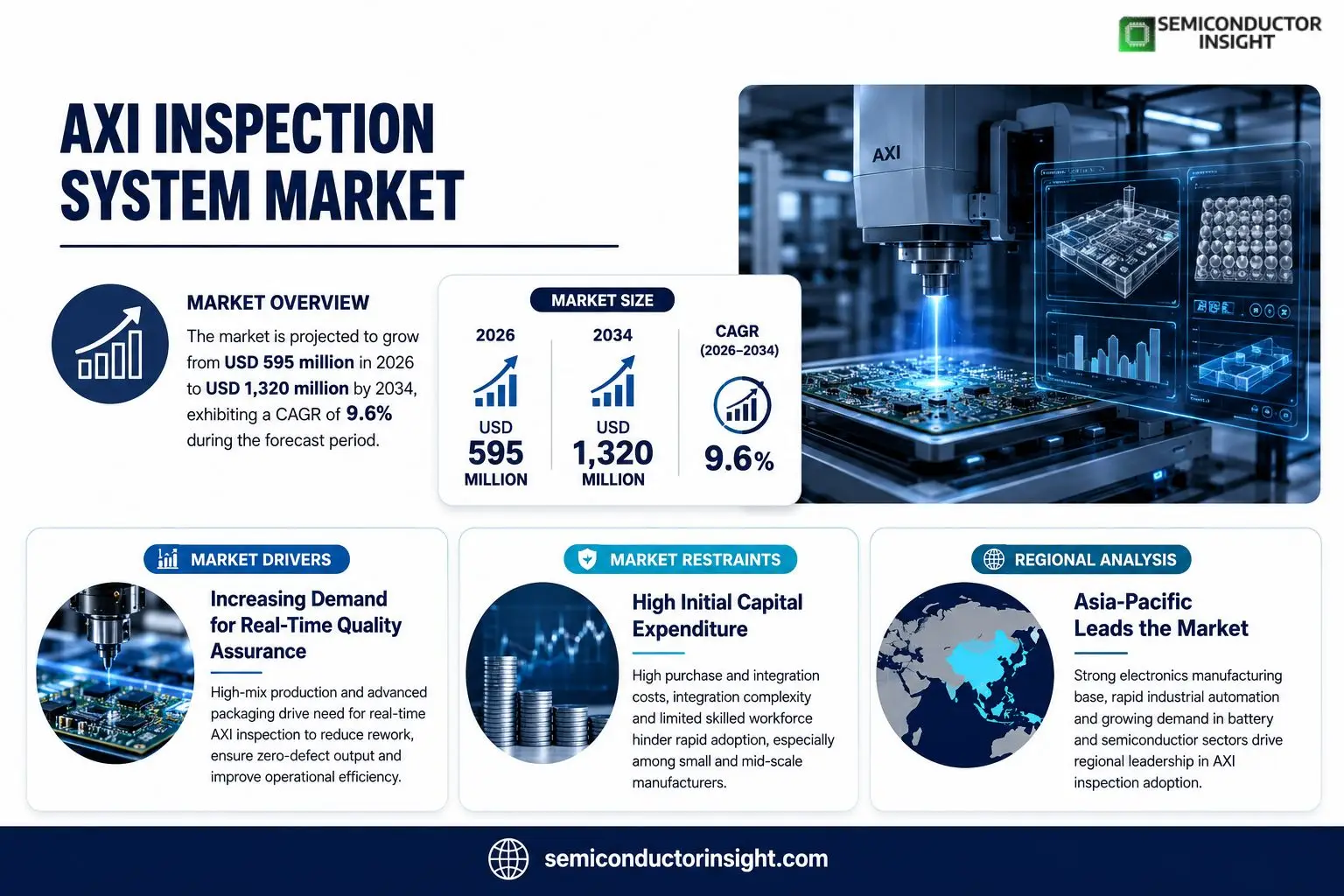
AXI Inspection System market size was valued at USD 577 million in 2025. The market is projected to grow from USD 595 million in 2026 to USD 1,320 million by 2034, exhibiting a CAGR of approximately 9.6% during the forecast period.
Automated X‑ray inspection (AXI) is an advanced non‑destructive testing solution that employs high‑energy X‑ray sources, precision motion control and high‑resolution detectors to expose internal structures and hidden defects within complex manufactured products such as printed circuit boards, semiconductor packages, lithium‑battery modules and photovoltaic panels.The expansion of advanced packaging formats that conceal solder anomalies, heightened safety standards in the new‑energy sector and broader adoption of Industry 4.0 quality‑control workflows are accelerating demand for AXI systems; nevertheless, substantial capital requirements and the rapid pace of AI‑enabled imaging innovation create significant entry barriers for smaller players.
MARKET DRIVERS
Increasing Demand for Real‑Time Quality Assurance
The rise of high‑mix, low‑volume production lines has forced manufacturers to seek inspection technologies that can keep pace with rapid changeover. AXI Inspection System Market solutions, with their adaptive imaging algorithms, deliver defect detection within seconds, allowing firms to cut rework costs and maintain tight delivery schedules. This operational pressure is a primary catalyst for broader adoption.
Regulatory Pressure on Safety‑Critical Sectors
Automotive, aerospace, and medical device producers face ever‑stricter safety standards. Inspection platforms that provide traceable, pixel‑level evidence are becoming non‑negotiable compliance tools. Companies that embed AXI’s high‑resolution sensors can demonstrate conformity during audits, turning a regulatory hurdle into a competitive edge.
➤ “Customers are willing to invest up to 15 % more for inspection systems that guarantee zero‑defect releases,” notes a senior manager at a leading OEM.
Because defect‑free output directly influences brand reputation, firms are reallocating capital from traditional manual checks to automated AXI Inspection System Market offerings, expecting faster ROI through reduced warranty claims.
MARKET CHALLENGES
High Initial Capital Expenditure
While the long‑term savings are evident, the upfront purchase and integration costs of AXI systems remain a barrier for small‑to‑midscale manufacturers. Financing models have yet to mature, leaving many organizations hesitant to commit large budgets without clear short‑term payback.
Other Challenges
Integration Complexity
Legacy production lines often rely on proprietary PLCs and outdated data protocols. Aligning these environments with modern AXI hardware can demand extensive custom engineering, stretching project timelines and inflating costs.
MARKET RESTRAINTS
Limited Skilled Workforce
The sophisticated analytics embedded in AXI Inspection System Market products require operators with specialized training. A shortage of personnel capable of interpreting high‑resolution data hampers rapid deployment, especially in regions where technical education lags behind industrial demand.Consequently, firms often resort to external consultants, which adds another layer of expense and can dilute internal knowledge transfer, slowing the overall adoption curve.
MARKET OPPORTUNITIES
Emergence of Edge‑AI Analytics
Embedding AI inference at the sensor level allows AXI Inspection System Market devices to flag anomalies before data even reaches a central server. This capability unlocks new use cases in remote factories where bandwidth is limited, and real‑time decision‑making is critical.Furthermore, partnerships with cloud‑service providers are creating subscription‑based models that lower the entry threshold. Small manufacturers can now access premium inspection capabilities on a pay‑per‑use basis, expanding the addressable market and fostering ecosystem growth.
AXI Inspection System Market Trends
Accelerated Adoption in Advanced Electronics
Production of AXI inspection equipment reached nearly 4,000 units in 2025, reflecting a clear shift among high‑mix manufacturers toward deeper internal visibility. The surge is driven by the migration to fine‑pitch BGA and CSP packages, where solder joint integrity cannot be confirmed through optical means alone. Companies that have integrated automated X‑ray inspection into their line‑side quality gates report a measurable drop in field failure rates, especially in power‑dense modules for electric vehicles and data‑center servers. This operational advantage is translating into tighter warranty exposure and a stronger competitive foothold for early adopters.
Other Trends
Supply‑Chain Consolidation and Modular Design
Leading OEMs are standardising on modular AXI platforms that separate the high‑energy source, detector array, and motion subsystem. This architecture reduces capital outlay for mid‑size players while allowing rapid re‑configuration between 2D, 3D and computed‑tomography (CT) modes. The modular approach also encourages a tiered supplier ecosystem: core imaging components remain concentrated in established Asian and European facilities, whereas value‑added software and AI analytics are increasingly sourced from specialised firms in North America. The result is a more resilient supply chain that can scale with the expanding demand from lithium‑battery and photovoltaic manufacturers.
Integration with Smart Manufacturing Initiatives
Smart‑factory pilots across Asia and Europe illustrate how AXI inspection data is being streamed directly into Manufacturing Execution Systems (MES) and enterprise resource planning (ERP) platforms. Real‑time defect classification, powered by machine‑learning models, enables dynamic process adjustments without halting production. In the battery sector, this capability is critical for verifying weld consistency in high‑energy cells, a factor that directly influences safety certifications. As Industry 4.0 standards mature, vendors that can offer seamless API connectivity and traceable measurement logs will capture the most compelling share of the growing AXI Inspection System Market.
COMPETITIVE LANDSCAPE
Key Industry Players
AXI Inspection System market exhibits a balanced mix of integrators and specialist innovators.
ViTrox remains the most visible force in the segment, leveraging a vertically integrated production model that couples in‑house X‑ray source design with proprietary detector electronics. This approach secures high gross margins and enables rapid rollout of 3D/CT capabilities, a feature increasingly demanded by semiconductor and lithium‑battery manufacturers. The company’s footprint across Singapore, China and the United States gives it a strategic advantage in serving both high‑volume automotive electronics assemblers and niche aerospace projects. Competitors such as Nordson and Omron occupy the premium tier by bundling advanced motion‑control hardware with AI‑driven analytics, thereby capturing customers that prioritize traceability and integration with MES platforms.Beyond the top tier, a cluster of specialized firms sustains market depth. Nikon and Viscom rely on legacy optics expertise to deliver high‑resolution 2D AXI units for PCB testing, while Unicomp Technology and Innometry focus on cost‑effective offline solutions for mid‑size producers. Emerging entrants like Waygate Technologies (Baker Hughes) and XAVIS Co., Ltd. tap into the growing demand for inline inspection in high‑throughput battery lines. Regional players such as Zhengye Technology, Saki Corporation and DC Precision reinforce the supply chain in China, Japan and Europe, often partnering with local OEMs to customize software interfaces for industry‑specific standards.
List of Key AXI Inspection System Companies Profiled
- ViTrox
- Nordson
- Viscom
- Omron
- Unicomp Technology
- Innometry
- Nikon
- Waygate Technologies (Baker Hughes)
- Zhengye Technology
- XAVIS Co., Ltd.
- Saki Corporation
- DC Precision
- Test Research Inc. (TRI)
- ZEISS
- Creative Electron
Segment Analysis:
| Segment Category | Sub-Segments | Key Insights |
| By Type |
|
Inline AXI is favored where real‑time quality feedback is essential.
Offline AXI offers flexibility for low‑volume or prototype production, allowing detailed analysis without line disruption.
|
| By Application |
|
PCB Assembly remains the dominant application because hidden solder joints and BGA structures are invisible to optical methods.
Semiconductor Packaging drives demand for high‑resolution 3D AXI to validate advanced CSP and BGA formats.
Lithium‑Battery Production leverages AXI for safety‑critical weld and internal cell inspection.
|
| By End User |
|
EMS Providers adopt AXI to differentiate their quality guarantees and meet the strict defect‑free mandates of their customers.
Automotive OEMs require AXI for safety‑critical electronic control units (ECUs) and power electronics.
Battery Cell Producers leverage AXI to validate cell integrity before module assembly.
|
| By Technology |
|
3D AXI / CT is emerging as the most valuable technology for complex, high‑density components where internal geometry must be visualized.
AI‑Enhanced Image Analytics adds a layer of intelligent defect classification, reducing operator dependency.
|
| By Integration Mode |
|
MES‑Connected AXI Platforms are gaining traction as manufacturers pursue Industry 4.0 interoperability.
Hybrid Cloud‑Based Inspection Solutions allow remote expert analysis and scalable storage of inspection imagery.
|
Regional Analysis: AXI Inspection System Market
Federal aviation authorities and automotive safety boards maintain strict defect‑detection thresholds, prompting manufacturers to adopt AXI solutions that can certify compliance without manual re‑inspection. This regulatory pressure accelerates the migration from legacy gauges to integrated optical platforms, especially in high‑value programs where re‑work costs are prohibitive.
Tier‑one suppliers are increasingly requesting real‑time defect analytics that feed directly into production execution systems. The demand is less about volume and more about precision, as manufacturers aim to reduce scrap rates in composite airframe assembly and electric‑vehicle battery pack production.
Recent breakthroughs in hyperspectral imaging enable detection of sub‑surface anomalies, a capability that aligns with the region’s shift toward lightweight, multi‑material constructions. Vendors that embed these sensors into existing line‑side fixtures gain a clear differentiation advantage.
Domestic system integrators leverage proximity to key customers to provide rapid prototyping and on‑site engineering support. International players compensate for distance by establishing joint‑venture service hubs in major industrial corridors such as the Midwest and Southern California.
Europe
European manufacturers are navigating a landscape shaped by stringent EU directives on product safety and environmental impact. While the market is not as large as North America, the emphasis on sustainable manufacturing has spurred interest in AXI solutions that minimize waste by catching defects early. Aerospace hubs in France and Germany, together with high‑mix automotive plants in the United Kingdom, treat inspection accuracy as a supply‑chain risk mitigator. Vendors that can demonstrate compliance with REACH and other chemical‑use regulations tend to secure longer contracts, as OEMs seek partners who understand the regulatory overlay. The region’s fragmented supplier base also creates opportunities for niche players offering modular inspection kits that can be tailored to diverse production lines.
Asia‑Pacific
The Asia‑Pacific arena presents a paradox of rapid industrial expansion tempered by uneven technology adoption. Nations such as Japan and South Korea have already embedded AXI inspection within high‑precision electronics and semiconductor fabs, driven by a cultural emphasis on defect‑free output. In contrast, emerging economies like Vietnam and Indonesia are still scaling up their basic automation infrastructure, making the market receptive to entry‑level optical solutions. The divergent pace of adoption encourages vendors to adopt a tiered portfolio strategy: advanced AI‑enabled systems for mature markets and cost‑effective, plug‑and‑play units for developing plants. Cross‑border supply chains amplify the need for standardized inspection data formats, pushing regional alliances toward harmonized software protocols.
South America
South American manufacturers are largely concentrated in the automotive and heavy‑equipment sectors, where legacy inspection practices still dominate. Nevertheless, rising export requirements from North America and Europe are pressuring local producers to upgrade to AXI inspection systems that can certify compliance with foreign quality standards. Brazil’s growing aerospace component industry, in particular, is beginning to source inspection platforms that can integrate with existing ERP environments. The primary barrier remains limited local expertise, prompting multinational vendors to establish training centers in São Paulo and Buenos Aires to accelerate workforce upskilling.
Middle East & Africa
In the Middle East, petrochemical and defense contracts are the main drivers of AXI inspection adoption, as operators demand high‑integrity verification for safety‑critical pipelines and weapon systems. The United Arab Emirates and Saudi Arabia have launched government‑backed initiatives to digitalize manufacturing, which include incentives for adopting advanced visual inspection technologies. African markets, while still nascent, show early signs of interest in inspection tools that can support growing renewable‑energy equipment assembly, particularly wind‑turbine blade manufacturing. Limited local distribution networks mean that vendors often partner with regional engineering firms to provide end‑to‑end implementation and after‑sales support.
Report Scope
This market research report provides a comprehensive analysis of the AXI Inspection System Market , covering the forecast period 2026–2034. It offers detailed insights into market dynamics, technological advancements, competitive landscape, and key trends shaping the industry.
Key focus areas of the report include:
- Market Overview: The report begins with an overview outlining its current market scenario, key growth indicators, and industry transformation drivers. It discusses macroeconomic factors, demand–supply balance, regulatory landscape, and the strategic role of semiconductors in powering advancements across industries such as automotive, telecommunications, consumer electronics, and industrial automation.
- Market Size & Forecast: Historical data and future projections for revenue, unit shipments, and market value across major regions and segments.
- Segmentation Analysis: Detailed breakdown by product type, technology, application, and end-user industry to identify high-growth segments and investment opportunities.
- Regional Insights: Insights into market performance across North America, Europe, Asia-Pacific, Latin America, and the Middle East & Africa, including country-level analysis where relevant.
- Competitive Landscape: Profiles of leading market participants, including their product offerings, R&D focus, manufacturing capacity, pricing strategies, and recent developments such as mergers, acquisitions, and partnerships.
- Technology Trends & Innovation: Assessment of emerging technologies, integration of AI/IoT, semiconductor design trends, fabrication techniques, and evolving industry standards.
- Market Drivers & Restraints: Evaluation of factors driving market growth along with challenges, supply chain constraints, regulatory issues, and market-entry barriers.
- Stakeholder Insights: Insights for component suppliers, OEMs, system integrators, investors, and policymakers regarding the evolving ecosystem and strategic opportunities.
Primary and secondary research methods are employed, including interviews with industry experts, data from verified sources, and real-time market intelligence to ensure the accuracy and reliability of the insights presented.
FREQUENTLY ASKED QUESTIONS:
What is the current market size of AXI Inspection System Market?
-> AXI Inspection System Market was valued at USD 577 million in 2025 and is expected to reach USD 1100 million by 2032 with a CAGR of 8.9% during the forecast period.
Which key companies operate in AXI Inspection System Market?
-> Key players include ViTrox, Omron, Nordson, Viscom, Nikon, among others.
What are the key growth drivers?
-> Key growth drivers include increased automation in electronics manufacturing, proliferation of advanced packaging formats (BGAs, CSPs), growth of lithium‑battery and new‑energy sectors, and rising demand for high‑precision inspection in automotive and industrial automation.
Which region dominates the market?
-> Asia dominates the market, driven by strong manufacturing bases in China, Japan, and South Korea, while Europe and North America remain significant contributors.
What are the emerging trends?
-> Emerging trends include AI‑enabled image analytics, 3D/CT inspection technologies, and integration of AXI data with MES/Industry 4.0 platforms.

Get Sample Report PDF for Exclusive Insights
Report Sample Includes
- Table of Contents
- List of Tables & Figures
- Charts, Research Methodology, and more...
 Download Sample Report PDF