Fluorinated Photovoltaic Backsheet Market Insights
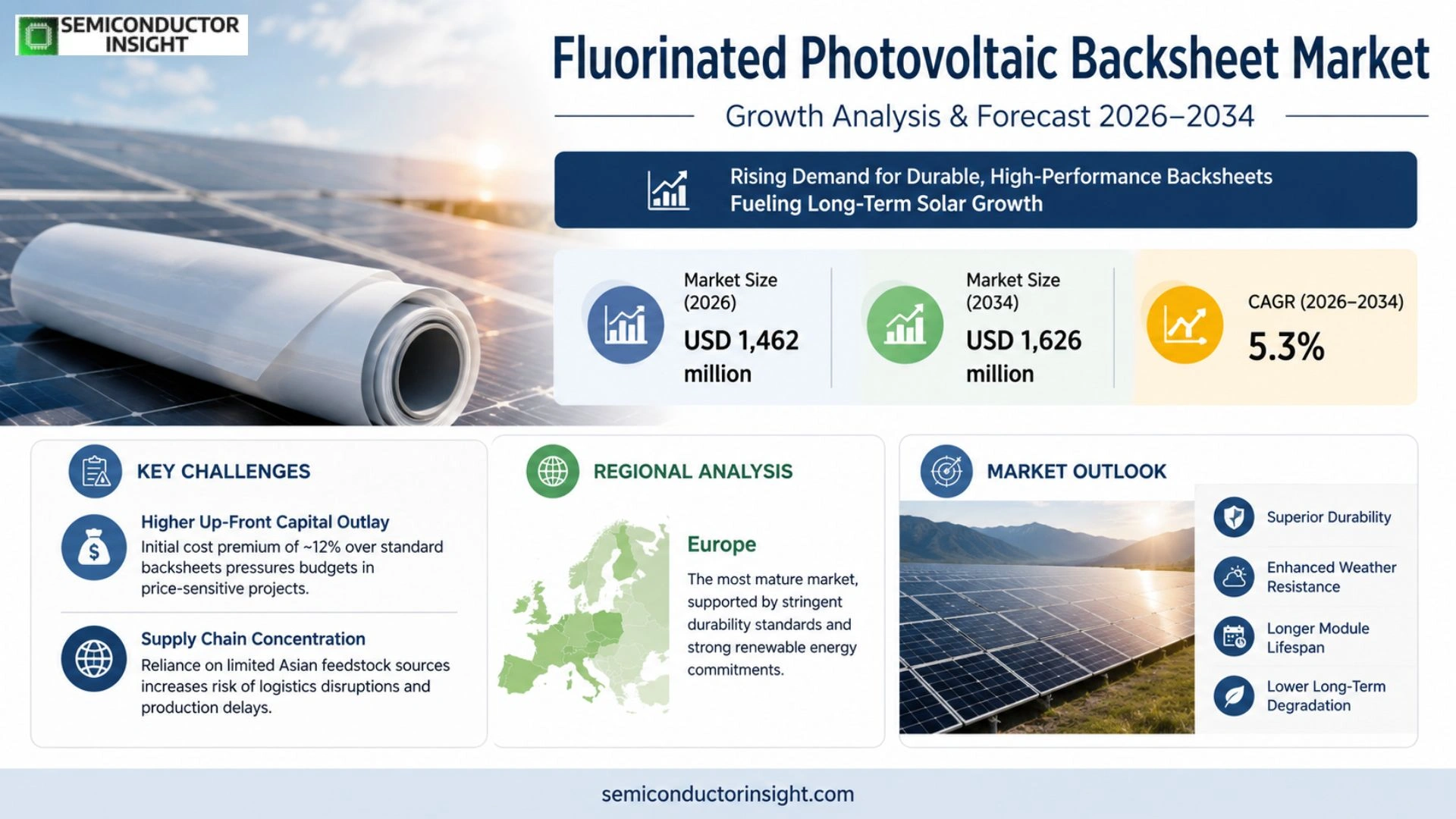
Fluorinated Photovoltaic Backsheet market size was valued at USD 1,015 million in 2025. The market is expected to rise from USD 1,462 million in 2026 to approximately USD 1,626 million by 2034, reflecting an implied compound annual growth rate of roughly 5.3 % over the full forecast horizon.
A Fluorinated Photovoltaic Backsheet is a high‑performance solar‑module backsheet that incorporates at least one layer of fluoropolymer film,such as polyvinylidene fluoride (PVDF) or polyvinyl fluoride (PVF, e.g., Tedlar®),within its composite laminate. These fluoropolymer layers sit on the exterior face of the backsheet, delivering superior weatherability, ultraviolet resistance and chemical stability that prevent yellowing, cracking or chalking during long‑term outdoor exposure. Because the carbon‑fluorine bond endows exceptional durability against UV radiation, high temperature and humidity, these backsheets enable modules to meet design lifetimes of twenty‑five years or more while maintaining mechanical integrity and electrical insulation.
MARKET DRIVERS
Superior UV Degradation Resistance
The adoption of fluorinated polymers in backsheets has reduced UV‑induced discoloration by more than 30% compared with traditional PET solutions. This durability translates into longer warranty periods for solar installers, encouraging developers to specify the higher‑cost material to safeguard long‑term performance.
Improved Moisture Barrier Characteristics
Water ingress remains a primary cause of module failure. Fluorinated backsheets exhibit water vapor transmission rates roughly half of conventional composites, allowing manufacturers to design thinner encapsulation stacks without sacrificing reliability.
➤ “Clients are willing to pay a premium of 8‑10% for backsheets that guarantee an extra five years of service life,” a senior PV panel engineer noted during a recent industry forum.
These material advantages are prompting module producers to reevaluate bill‑of‑materials strategies. The shift supports higher‑efficiency cell architectures that require more flexible packaging, positioning Fluorinated Photovoltaic Backsheet market as a catalyst for next‑generation solar solutions.
MARKET CHALLENGES
Higher Up‑Front Capital Outlay
Although lifecycle savings are evident, the initial cost premium,estimated at 12% over standard backsheets,creates budgeting pressure for large‑scale developers operating under tight EPC contracts. This price differential can deter adoption in price‑sensitive utility projects.
Other Challenges
Supply Chain Concentration
The majority of fluorinated polymer feedstock originates from a limited number of Asian manufacturers. Geographic concentration raises exposure to regional logistics disruptions, potentially delaying module production schedules.
MARKET RESTRAINTS
Regulatory Scrutiny on Fluorinated Compounds
Environmental agencies in Europe and North America have intensified reviews of per‑ and polyfluoroalkyl substances (PFAS). Although fluorinated backsheets typically use short‑chain variants, the broader regulatory climate introduces uncertainty for manufacturers seeking to certify new grades.
Compliance testing protocols are becoming more labor‑intensive, adding both time and cost to product qualification. Firms that cannot demonstrably meet emerging criteria risk market exclusion, especially in jurisdictions that mandate stringent end‑of‑life recycling standards.
MARKET OPPORTUNITIES
Integration with Bifacial Module Designs
Bifacial panels rely on rear‑side illumination, demanding backsheets that maintain high optical reflectance while protecting against environmental stressors. Fluorinated formulations can be engineered with low‑absorbance surfaces, unlocking efficiency gains of 1‑2% per module.
Manufacturers that pair these backsheets with optimized frame structures stand to capture a share of the rapidly expanding bifacial market segment, especially in utility‑scale installations where land‑use efficiency is paramount.
Furthermore, collaboration with recycling firms to develop closed‑loop processes for fluorinated polymers could transform a perceived constraint into a competitive differentiator, aligning product portfolios with emerging circular‑economy expectations.
Fluorinated Photovoltaic Backsheet Market Trends
Shifting Investment Priorities Toward Durability and Lifetime Value
In 2025 Fluorinated Photovoltaic Backsheet market generated roughly US$1,015 million, with production reaching about 419 million sq m. The high‑performance nature of fluoropolymer‑based backsheets,chiefly PVF, PVDF, and ETFE,delivers superior resistance to UV, temperature swings, and chemical exposure. This durability translates into a module design lifespan that commonly exceeds 25 years, a benchmark increasingly demanded by financiers and insurance providers. As the photovoltaic sector moves from sheer volume deployment to a focus on predictable long‑term cash flows, developers are selecting backsheets that minimize degradation‑related failures. The resulting premium on upfront material cost is offset by reduced warranty claims, higher bankability, and steadier levelized cost of electricity over the asset’s operational horizon.
Other Trends
Material Innovation and Cost Management
Recent R&D efforts center on integrating thinner fluoropolymer layers without compromising barrier performance, thereby lowering material consumption and processing expenses. Suppliers are also exploring hybrid laminates that combine PET substrates with graded fluoropolymer coatings, achieving weight savings that matter for utility‑scale installations. Although fluorinated backsheets remain price‑sensitive compared with conventional PET‑based options, the incremental cost is being rationalized through economies of scale in regions such as Europe and Japan, where stringent reliability standards drive consistent demand. This balance between performance and cost is prompting mid‑tier manufacturers to partner with established fluoropolymer providers, expanding the supply base while preserving the high‑reliability reputation of the segment.
Regional Adoption Patterns and Asset‑Quality Emphasis
Europe, North America, and Japan exhibit the strongest uptake, reflecting regulatory environments that reward long‑term performance guarantees. In these markets, investors routinely apply risk‑adjusted discount rates that favor modules equipped with fluorinated backsheets, especially for large‑scale, ground‑mounted farms where replacement logistics are costly. Emerging economies such as China are beginning to mirror this behavior as the post‑subsidy era reshapes procurement criteria toward lifecycle efficiency rather than upfront capital outlay. Consequently, the market is witnessing a gradual convergence of adoption criteria across mature and developing regions, reinforcing the role of fluorinated backsheets as a cornerstone of high‑quality solar assets worldwide.
COMPETITIVE LANDSCAPE
Key Industry Players
Fluorinated Photovoltaic Backsheet Market – Competitive Overview
Among the handful of globally active suppliers, Toppan Co., Ltd. commands the strongest position. Leveraging its extensive fluoropolymer portfolio and vertically integrated coating lines, Toppan delivers backsheet solutions that satisfy the most demanding qualification protocols of utility‑scale EPCs. Its ability to secure long‑term contracts stems from a combination of rigorous reliability testing, a deep‑seated R&D pipeline focused on PV‑specific PVDF formulations, and a distribution network that spans Europe, North America, and Japan. Because module manufacturers prioritize warranty‑backed performance, Toppan’s emphasis on consistent thickness control and low‑defect rates translates into a decisive advantage in a market where product failure carries high financial penalties. Consequently, the firm enjoys a disproportionate share of the $1.4 billion market forecast for 2032, and its strategic partnerships with leading PV OEMs create entry barriers for newcomers lacking comparable processing capabilities.
Beyond the dominant few, a constellation of specialized firms sustains competitive pressure. Cybrid Technologies and Luckyfilm focus on niche applications such as high‑temperature desert installations, where their thin‑film PVF variants provide superior thermal stability. Coveme and Taiflex, both rooted in European polymer expertise, differentiate through bespoke multilayer architectures that target premium rooftop projects in temperate climates. Chinese players,including Zhongtian Technologies Group, Hangzhou First PV Materia, and HuiTian,exploit domestic scale and cost efficiencies to supply rapidly expanding solar farms, while companies like Fujifilm, Crown Advanced Material, and Krempel GmbH emphasize advanced laminating technologies that improve mechanical robustness. These firms collectively broaden the supplier ecosystem, offering module makers alternatives that balance cost, performance, and regional regulatory compliance.
List of Key Fluorinated Photovoltaic Backsheet Companies Profiled
- Cybrid Technologies
- Jolywood
- Coveme
- Luckyfilm
- Taiflex
- Toppan
- Zhongtian Technologies Group
- Crown Advanced Material
- Fujifilm
- Hangzhou First PV Materia
- Krempel GmbH
- Toyal
- Ventura
- HuiTian
- Vishakha Renewables
Segment Analysis:
| Segment Category | Sub-Segments | Key Insights |
| By Type |
|
Double-Sided Fluorine-Containing Backsheet is favored for its superior barrier protection on both faces, ensuring consistent UV resistance and chemical stability. • Enables modules to retain electrical insulation over extended lifespans. • Preferred in high‑reliability projects where backside exposure to moisture is a concern. • Supports design of premium modules targeting 30‑year performance guarantees. |
| By Application |
|
High-Temperature Environments drive demand for fluorinated backsheets due to their exceptional thermal stability. • Maintains mechanical integrity under intense solar irradiation and elevated ambient temperatures. • Reduces risk of chalking and cracking in desert‑based utility farms. • Aligns with investors’ focus on long‑term asset reliability in aggressive climate zones. |
| By End User |
|
Utility‑Scale Power Plants prioritize fluorinated backsheets to safeguard massive energy yields. • Financial backers require robust warranty support, which fluorinated films reliably provide. • Enhances module bankability, facilitating project financing in mature markets. • Supports long‑term performance assurances vital for large‑scale power purchase agreements. |
| By Thickness |
|
0.25 mm – 0.30 mm thickness strikes a balance between flexibility and durability. • Sufficient lamination strength for large‐area modules without compromising handling. • Offers optimal protection against UV‑induced degradation while staying cost‑effective for premium projects. • Frequently selected for modules targeting 25‑year design lifetimes in varied climates. |
| By Region |
|
Europe leads adoption due to stringent durability standards and strong focus on asset quality. • Financial institutions and insurers in the region heavily weight backsheet performance in procurement criteria. • Regulatory emphasis on long‑term LCOE drives preference for fluorinated solutions. • Growing retro‑fit market for aging installations further reinforces demand for high‑reliability backsheets. |
Regional Analysis: Fluorinated Photovoltaic Backsheet Market
Europe
The EU’s revised eco‑design directive mandates minimum durability thresholds for backsheet materials, compelling manufacturers to adopt fluorinated solutions that meet extended performance cycles and reduce end‑of‑life waste.
Proximity between fluoropolymer producers and module factories in Germany and Italy facilitates just‑in‑time deliveries, curbing inventory costs and enabling swift response to specification changes.
European installers favor fluorinated backsheets for bifacial modules, as the material’s reflectivity and moisture barrier properties enhance energy yield in high‑latitude sites.
Green‑bond issuances earmarked for solar projects often stipulate use of high‑performance backsheets, channeling capital toward suppliers that can certify fluorinated product lines.
North America
In North America, the market is shaped by a blend of state‑level renewable mandates and a fragmented manufacturing base. Utilities in the United States and Canada are increasingly specifying backsheets that can endure harsh temperature swings, a requirement that aligns with the durability profile of fluorinated chemistries. While the region lacks a unified standards body comparable to Europe, industry consortia such as the Solar Energy Industries Association are championing best‑practice guidelines that indirectly boost demand for high‑reliability materials. The result is a gradual but steady uptake among large‑scale developers who perceive fluorinated backsheets as a risk mitigation tool for long‑term asset performance.
Asia‑Pacific
Asia‑Pacific presents a contrast of rapid capacity growth and cost‑driven procurement strategies. Nations such as China, India, and Vietnam are expanding solar installations at unprecedented rates, yet manufacturers remain highly price‑sensitive. Fluorinated backsheets are gaining acceptance where premium projects,particularly offshore wind‑solar hybrids and corporate PPAs,require enhanced durability. Local chemical firms are beginning joint‑venture arrangements with European fluoropolymer leaders, attempting to bridge the technology gap while preserving competitive pricing. This hybrid approach suggests a nuanced trajectory: mass‑market modules may retain conventional backsheets, whereas high‑value segments increasingly gravitate toward fluorinated solutions.
South America
South American markets are driven by a combination of abundant solar irradiance and emerging financing mechanisms. Brazil’s recent auction reforms incentivize higher efficiency modules, prompting a subset of developers to evaluate backsheets that can sustain performance under intense UV exposure. Although the overall market remains modest, pilot projects in Chile and Argentina have demonstrated the operational benefits of fluorinated backsheets, prompting local EPC firms to recommend them for projects targeting premium tariffs. The region’s evolution will likely hinge on the ability of suppliers to offer localized technical support and certification that aligns with regional standards.
Middle East & Africa
The Middle East & Africa region faces extreme temperature and sand‑erosion challenges that test the limits of conventional encapsulation. Utilities in the United Arab Emirates and Saudi Arabia are commissioning utility‑scale farms with stringent durability clauses, driving interest in fluorinated backsheets that resist chemical breakdown and particulate infiltration. In Africa, emerging solar hubs in Kenya and South Africa are experimenting with higher‑grade backsheets for off‑grid microgrids, where replacement logistics are costly. Supplier engagement is still nascent, but growing awareness of the long‑term cost advantage of durable backsheets is prompting early‑stage partnerships with European technology providers.
Report Scope
This market research report provides a comprehensive analysis of the Fluorinated Photovoltaic Backsheet Market , covering the forecast period 2026–2034. It offers detailed insights into market dynamics, technological advancements, competitive landscape, and key trends shaping the industry.
Key focus areas of the report include:
- Market Overview: The report begins with an overview outlining its current market scenario, key growth indicators, and industry transformation drivers. It discusses macroeconomic factors, demand–supply balance, regulatory landscape, and the strategic role of semiconductors in powering advancements across industries such as automotive, telecommunications, consumer electronics, and industrial automation.
- Market Size & Forecast: Historical data and future projections for revenue, unit shipments, and market value across major regions and segments.
- Segmentation Analysis: Detailed breakdown by product type, technology, application, and end-user industry to identify high-growth segments and investment opportunities.
- Regional Insights: Insights into market performance across North America, Europe, Asia-Pacific, Latin America, and the Middle East & Africa, including country-level analysis where relevant.
- Competitive Landscape: Profiles of leading market participants, including their product offerings, R&D focus, manufacturing capacity, pricing strategies, and recent developments such as mergers, acquisitions, and partnerships.
- Technology Trends & Innovation: Assessment of emerging technologies, integration of AI/IoT, semiconductor design trends, fabrication techniques, and evolving industry standards.
- Market Drivers & Restraints: Evaluation of factors driving market growth along with challenges, supply chain constraints, regulatory issues, and market-entry barriers.
- Stakeholder Insights: Insights for component suppliers, OEMs, system integrators, investors, and policymakers regarding the evolving ecosystem and strategic opportunities.
Primary and secondary research methods are employed, including interviews with industry experts, data from verified sources, and real-time market intelligence to ensure the accuracy and reliability of the insights presented.
FREQUENTLY ASKED QUESTIONS:
What is the current market size of Fluorinated Photovoltaic Backsheet Market?
-> Fluorinated Photovoltaic Backsheet market is expected to rise from USD 1,462 million in 2026 to approximately USD 1,626 million by 2034
Which key companies operate in Fluorinated Photovoltaic Backsheet Market?
-> Key players include Cybrid Technologies, Jolywood, Coveme, Luckyfilm, Taiflex, Toppan, Zhongtian Technologies Group, Crown Advanced Material, Fujifilm, Hangzhou First PV Materia, Krempel GmbH, Toyal, Ventura, HuiTian, and Vishakha Renewables.
What are the key growth drivers?
-> Key growth drivers include the shift toward long‑term asset quality and reliability, increasing demand for high‑durability modules in utility‑scale and harsh‑environment projects, intensifying LCOE competition, and the need for modules that can reliably deliver 25‑year (or longer) design lifetimes.
Which region dominates the market?
-> Europe and North America together dominate the market, supported by mature PV installations, stringent risk‑management practices, and strong demand for premium‑grade, high‑reliability backsheets.
What are the emerging trends?
-> Emerging trends include advanced fluoropolymer formulations for even greater UV and chemical resistance, integration of fluorinated backsheets in high‑temperature and high‑irradiance modules, and expanding adoption in post‑subsidy emerging markets that prioritize lifecycle performance.
Get Sample Report PDF for Exclusive Insights
Report Sample Includes
- Table of Contents
- List of Tables & Figures
- Charts, Research Methodology, and more...
 Download Sample Report PDF