
Key Statistics
Key Takeaways
- Rigid modules lead current commercialization because glass-based and metal-substrate formats provide the durability and handling needed for early commercial deployments, while flexible modules represent a longer-term opportunity in buildings, mobility and portable power.
- BIPV is a strategically important application because perovskites can be lightweight, semi-transparent and processed on surfaces that conventional crystalline silicon cannot address as easily, creating demand beyond standard rooftop and utility modules.
- Asia Pacific holds more than 45% of the market according to the source report, supported by China’s manufacturing ecosystem and a growing cluster of perovskite developers; Europe remains central to commercialization through Oxford PV and policy-led local manufacturing ambitions.
- Commercialization risk remains high. Long-term stability, encapsulation, lead management, scale-up yield and bankability must improve before perovskite modules can capture material share from mature silicon technologies.
- Commercial proof points are moving from laboratory records to market transactions. Oxford PV made the first commercial shipment of perovskite-silicon tandem panels in 2024 and signed a China patent licensing agreement with Trinasolar in 2025.
Perovskite Photovoltaic Cell Market Overview
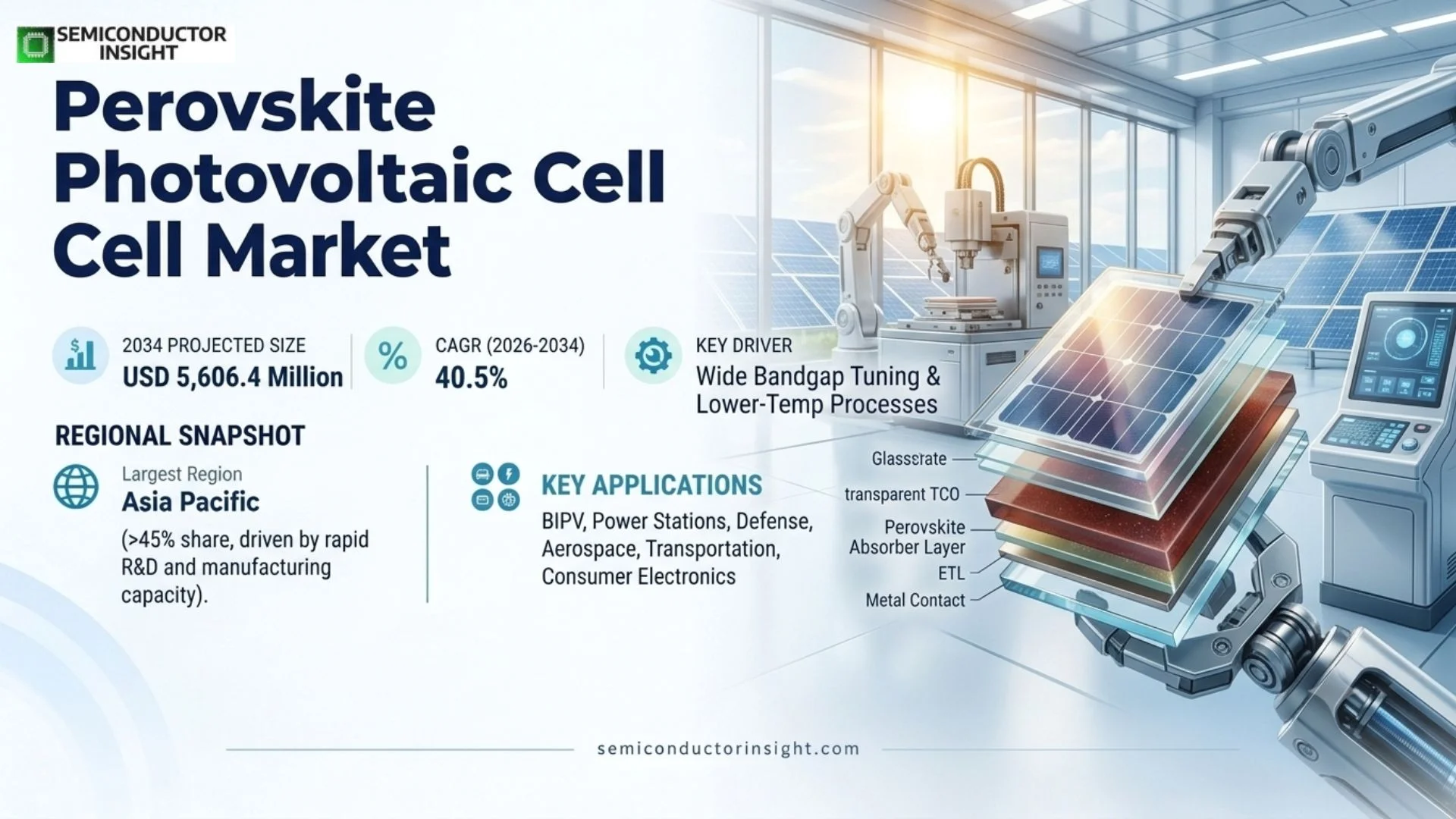
Perovskite Photovoltaic Cell Market was valued at USD 262.7 million in 2025 and is projected to reach USD 5,606.4 million by 2034, expanding at a 40.5% CAGR during 2026–2034. Asia Pacific (>45% share in 2024) is the largest demand center, supported by China-led solar manufacturing, tandem-cell commercialization, high conversion-efficiency potential and expanding interest in lightweight and building-integrated photovoltaics.
Perovskite photovoltaic cells use a perovskite-structured light-absorbing material that can be tuned across a wide bandgap range and deposited through lower-temperature processes than conventional crystalline silicon. The technology is especially attractive as a top cell in silicon tandems because it can capture higher-energy photons while the silicon bottom cell absorbs lower-energy light. This architecture pushes efficiency beyond the practical limits of single-junction silicon without discarding the existing silicon manufacturing base.
The commercial market remains at an early stage relative to silicon PV. Revenue is concentrated in pilot production, specialty modules, licensing, equipment, materials and initial tandem deployments rather than in mass commodity module volumes. That makes the growth curve unusually steep but also more execution-sensitive: a successful scale-up can move revenue rapidly, while delays in durability validation or manufacturing yield can shift commercialization schedules by several years.
Solar demand provides a large addressable platform. The IEA reported more than 600 GW of solar PV additions in 2025 and cumulative global solar capacity of around 2,800 GW. Perovskite technology does not need to replace silicon across this base to create a meaningful market; even selective adoption in high-efficiency tandem modules, space-constrained rooftops, BIPV and lightweight applications can support rapid expansion from a small commercial starting point.
Segment Analysis: By Type
By type, the market is segmented into Rigid Module and Flexible Module. Rigid modules lead near-term commercialization because glass-based formats fit established module handling and encapsulation practices, while flexible modules target new surfaces and weight-constrained applications that are difficult for conventional glass-glass silicon panels.
| Type | Technical role | Market position |
|---|---|---|
| Rigid Module | Glass-based or metal-substrate structures designed for durable module handling and fixed installations. | Largest commercial segment. It benefits from easier integration into conventional PV mounting systems, more established encapsulation approaches and the ability to pair perovskite top cells with silicon bottom cells in tandem modules. |
| Flexible Module | Plastic or thin-film substrates enabling lightweight, bendable and conformal PV. | Higher-risk but high-upside segment for façades, portable electronics, vehicles and non-flat surfaces. Commercial progress depends on barrier films, roll-to-roll yield, moisture stability and durable electrical interconnection. |
Efficiency grade and tandem architecture
The source report also segments the market by efficiency grade into below 15%, 15–20% and above 20%. Commercial momentum is shifting toward the above-20% category as tandem architectures mature. The critical distinction is increasingly not whether perovskite can achieve high laboratory efficiency, but whether that efficiency can be maintained on large-area modules through manufacturing, encapsulation, thermal cycling and long-duration field exposure.
Segment Analysis: By Application
Applications include Building Integrated Photovoltaics, Power Stations, Defense & Aerospace, Transportation, and Consumer Electronics. BIPV stands out because perovskites can add solar generation to windows, façades and lightweight surfaces where conventional modules face aesthetic, weight or form-factor constraints.
| Application | Demand characteristics |
|---|---|
| Building Integrated Photovoltaics (BIPV) | Perovskite films can be semi-transparent, colored and lightweight, making them suitable for façades, windows and architectural surfaces. Commercial demand depends on lifetime, fire and building-code certification, but the application offers a path to value based on design integration rather than pure cost per watt. |
| Power Stations | Utility and commercial solar farms provide the largest ultimate volume opportunity, particularly for perovskite-silicon tandem modules that generate more energy from the same land and balance-of-system footprint. Bankability, degradation guarantees and high-volume manufacturing cost are the decisive adoption gates. |
| Defense & Aerospace | High specific power is valuable where launch mass, mobility and deployable area matter. Perovskite modules can offer a compelling power-to-weight ratio, but radiation tolerance, thermal cycling and operational reliability require extensive validation before broad procurement. |
| Transportation | Vehicle-integrated solar can use lightweight or conformal perovskite modules on roofs and body surfaces. The commercial logic is strongest when incremental energy generation extends range or reduces auxiliary loads without materially increasing vehicle mass. |
| Consumer Electronics | Low-light harvesting and thin form factors create opportunities in IoT devices, sensors and portable electronics. Unit areas are small but potentially high value, and successful products can establish manufacturing experience before utility-scale volumes mature. |
Regional Analysis
Asia Pacific is the largest regional market, with the source report citing more than 45% share in 2024. China anchors manufacturing and pilot-scale capacity, while Europe is a commercialization leader through Oxford PV and policy support for domestic clean-tech manufacturing.
How does regional demand differ across the perovskite photovoltaic cell market?
Perovskite PV regional dynamics reflect a mix of research leadership, manufacturing ecosystems, solar deployment and industrial policy. Asia Pacific has the strongest scale economics and supplier depth; Europe has important intellectual property and tandem commercialization; North America provides R&D funding and a large premium solar market; South America offers high-irradiance demand potential; and Middle East & Africa combine strong solar resources with demanding durability conditions.
| Region | Position | Growth outlook | Demand profile | What decides supplier selection |
|---|---|---|---|---|
| Asia Pacific | Largest >45% | Highest scale-up | Manufacturing + solar deployment | Pilot-to-GW scale, IP access, yield and cost |
| Europe | Commercialization leader | High | Tandem technology + policy | Efficiency, local manufacturing, bankability |
| North America | R&D / early adoption | High | Premium solar + innovation | DOE validation, domestic manufacturing, customer economics |
| South America | Emerging | Long-term | High irradiance + utility PV | Financing, durability, imported technology |
| Middle East & Africa | Emerging | Long-term | Utility solar + lightweight off-grid | Heat/UV durability, financing, local service |
Detailed Regional Analysis
Competitive Landscape
Competition remains innovation-led rather than scale-led. Early leaders combine intellectual property, record efficiencies, pilot manufacturing and partnerships with established PV manufacturers. The market is therefore shaped as much by licensing and process know-how as by current module revenue.
Oxford PV is the clearest commercialization benchmark because it has moved from laboratory records to commercial shipments and licensing. Its perovskite-on-silicon tandem model allows it to leverage the mature silicon industry rather than replace it outright. This approach reduces the technology transition barrier for customers that already understand silicon module manufacturing and project finance.
Chinese developers including Microquanta, GCL-related ventures and Wonder Solar benefit from access to the world’s largest PV equipment and materials ecosystem. Their strategic advantage is the ability to iterate manufacturing processes near suppliers of glass, encapsulants, deposition equipment and conventional solar cells. If durability targets are met, this ecosystem can compress the time between pilot validation and commercial scale.
Flexible and printed perovskite specialists such as Saule Technologies pursue a different route. They target applications where lightweight construction, form factor or appearance creates value that silicon cannot easily match. These niches can support commercialization before perovskite reaches bankable utility-scale lifetimes, providing a path to revenue while core materials and encapsulation continue to improve.
| Competitive tier | Representative companies | Basis of competition |
|---|---|---|
| Commercial tandem leaders | Oxford PV, Trinasolar-linked license ecosystem | Perovskite-silicon tandem IP, certified module efficiency, commercial deployment |
| China scale-up developers | Microquanta, GCL Suzhou, Hubei Wonder Solar, Heiking PV | Pilot/manufacturing scale, domestic supply chain, rapid process iteration |
| Flexible / specialty innovators | Saule Technologies, Greatcell Energy, Swift Solar, Hunt Perovskite Technologies | Flexible formats, specialty applications, materials and process innovation |
Companies profiled in the report
The profiled company set includes Oxford PV, GCL Suzhou Nanotechnology, Hubei Wonder Solar, Microquanta Semiconductor, Heiking PV Technology, Swift Solar, Li Yuan New Energy Technology, Hunt Perovskite Technologies, Greatcell Energy, Saule Technologies. The list is retained from the source report scope; competitive commentary differentiates suppliers by technology depth, qualification track record, regional channel access, and the application requirements they are positioned to serve rather than treating every company as interchangeable.
Production Capacity Analysis
Perovskite capacity is transitioning from laboratory and pilot lines toward commercial tandem and module production. The key bottleneck is not nominal nameplate capacity but repeatable large-area coating, encapsulation, interconnection, yield and lifetime performance.
Perovskite manufacturing can use solution coating, vapor deposition and hybrid methods, creating multiple routes to scale. Each route must control film uniformity, defect density, interfaces and moisture sensitivity over areas far larger than laboratory cells. A line can therefore have meaningful physical throughput while still lacking commercially acceptable yield or stability, which is why process control and in-line metrology are central to true usable capacity.
Tandem production adds another integration challenge because the perovskite top cell must be deposited or assembled without damaging the silicon bottom cell. Equipment compatibility, transparent conductive layers, interconnect design and encapsulation determine whether record cell efficiency survives at module scale. The most valuable capacity investments are therefore those that combine deposition throughput with high yield and validated module reliability.
Market Dynamics
The market is pulled forward by the efficiency advantage of tandems and by the enormous scale of global solar deployment, but constrained by durability, scale-up yield, lead management and project bankability. Commercial progress depends on converting record efficiencies into repeatable, warrantable module output.
Market Drivers
Forces expanding addressable demand
| Driver | Directional impact* | Commercial mechanism |
|---|---|---|
| Higher efficiency than single-junction silicon | High | Tandem architectures produce more power from the same area, improving land and balance-of-system economics. |
| Rapid global solar deployment | High | A very large PV market creates room for premium technologies even at modest penetration. |
| BIPV and lightweight form factors | Medium | New surfaces expand the addressable market beyond conventional glass modules. |
| Licensing and incumbent partnerships | Medium | Deals with established PV manufacturers can accelerate commercialization and manufacturing scale. |
Tandem efficiency changes project economics
Perovskite-silicon tandems can raise module efficiency beyond conventional single-junction silicon, allowing more watts from the same roof, land parcel, racking and grid connection. Oxford PV’s 26.9% residential-size module record and first commercial shipment show why efficiency is becoming a bankable commercial argument rather than only a laboratory metric.
Global solar scale creates a large addressable base
Solar PV additions exceeded 600 GW in 2025, according to the IEA. Perovskite technology does not need dominant market share to create a multi-billion-dollar revenue pool. Even selective adoption in premium rooftops, constrained utility sites, BIPV and tandem retrofits to silicon manufacturing can support steep growth from the current small base.
BIPV expands the market beyond standard panels
Perovskites can be deposited on lightweight, flexible or semi-transparent substrates, opening applications in façades, windows and curved surfaces. These use cases compete on aesthetics, weight and architectural integration rather than solely on module cost per watt, which gives emerging suppliers a chance to commercialize before competing head-on with commodity silicon at utility scale.
Licensing reduces the manufacturing adoption barrier
The 2025 Oxford PV–Trinasolar agreement demonstrates a route in which specialized perovskite intellectual property enters an established PV manufacturer’s production ecosystem. Licensing can accelerate market penetration by avoiding the need for every technology developer to build gigawatt-scale manufacturing independently, while giving incumbents access to higher-efficiency product roadmaps.
Market Restraints
Constraints on adoption and supplier economics
| Restraint | Directional impact* | Commercial mechanism |
|---|---|---|
| Long-term stability and degradation | High | Moisture, heat, UV and ion migration can reduce field lifetime if encapsulation is inadequate. |
| Scale-up yield | High | Large-area uniformity and defect control remain harder than small-cell record demonstrations. |
| Lead management and environmental acceptance | Medium | Lead-containing formulations require containment, recycling and regulatory confidence. |
| Bankability / warranties | High | Utility and rooftop buyers require long-term performance guarantees before broad adoption. |
Durability remains the core commercialization test
Perovskite cells can achieve exceptional efficiency but are more sensitive than silicon to moisture, oxygen, heat, UV exposure and ion migration. Encapsulation can mitigate these mechanisms, yet commercial buyers evaluate decades of field output rather than initial efficiency alone. Until long-duration data supports competitive warranties, bankable project adoption will remain more selective than laboratory performance suggests.
Large-area manufacturing can lose laboratory performance
A record cell may be only a few square centimeters, while a commercial module spans square meters. Coating thickness, crystal formation, interface quality and defect density become harder to control as area and line speed increase. The commercial challenge is therefore to retain efficiency at high yield, not simply to reproduce a best-cell result on occasional samples.
Lead content creates lifecycle obligations
Many high-performing perovskite formulations contain lead. Although the absolute material quantity is small, manufacturers must show robust encapsulation, safe end-of-life handling and credible recycling pathways. Regulatory uncertainty or public concern can slow adoption in building and consumer applications unless the industry establishes clear containment and recovery practices.
Market Opportunities
Perovskite-silicon tandem modules
Tandems offer the most direct route to high-value commercialization because they build on silicon’s mature manufacturing and bankability while adding a perovskite top cell for higher efficiency. Suppliers that can integrate with existing silicon lines have a shorter path to scale than technologies requiring an entirely new balance of system.
Building-integrated photovoltaics
Semi-transparent, colored and lightweight modules can turn windows and façades into generating surfaces. This market rewards design flexibility and power density rather than commodity module price, making it attractive for early commercial products with premium positioning.
Flexible and portable power
Thin substrates can reduce mass and enable rollable or conformal modules for defense, disaster response, IoT and portable electronics. These niches have smaller area requirements and may tolerate higher price per watt, creating a bridge between pilot manufacturing and mass solar deployment.
Technology licensing
Developers with strong patents and process know-how can monetize without funding full gigawatt factories. Licensing to established PV manufacturers can expand geographic reach, validate IP and accelerate adoption while sharing manufacturing risk.
Supply Chain Analysis
Perovskite materials & precursors
Cell deposition & interfaces
Module assembly & encapsulation
Deployment & licensing
Upstream value includes high-purity perovskite precursors, charge-transport materials, transparent conductors and barrier materials. Because device performance is extremely interface-sensitive, material purity and batch consistency can materially affect yield. This gives specialty chemical suppliers and deposition-equipment vendors strategic influence over scale-up even though the finished module captures most end-market visibility.
Midstream manufacturing is the critical bottleneck. Developers must produce uniform films at high speed while controlling crystallization, defects and interfaces. Tandem architectures add the need to align optical and electrical performance between perovskite and silicon subcells. Equipment that supports repeatable large-area deposition, non-destructive metrology and tight environmental control becomes increasingly valuable as lines move toward commercial throughput.
Downstream value depends on application. Utility and rooftop modules require bankability and long warranties; BIPV requires building-code integration and aesthetics; flexible modules need barrier films and mechanical durability. Licensing can bypass part of the manufacturing bottleneck by transferring validated process IP into established PV factories with existing procurement, module assembly and distribution channels.
Recent Developments
Report Scope & Segmentation
| Attribute | Coverage |
|---|---|
| Market | Perovskite Photovoltaic Cell |
| Base year | 2025 |
| Estimated year | 2026 |
| Forecast year | 2034 |
| Forecast period | 2026–2034 |
| 2025 market size | USD 262.7 million |
| 2034 market size | USD 5,606.4 million |
| CAGR | 40.5% |
| By Type | Rigid Module (Glass-based, Metal substrate-based), Flexible Module (Plastic substrate-based, Thin-film) |
| By Application | Building Integrated Photovoltaics (BIPV), Power Stations, Defense & Aerospace, Transportation, Consumer Electronics |
| Additional segmentation | By End User: Residential, Commercial, Industrial, Utility-scale; By Efficiency Grade: <15%, 15–20%, >20% |
| Regions | North America, Europe, Asia Pacific, South America, Middle East & Africa |
| Companies profiled | Oxford PV, GCL Suzhou Nanotechnology, Hubei Wonder Solar, Microquanta Semiconductor, Heiking PV Technology, Swift Solar, Li Yuan New Energy Technology, Hunt Perovskite Technologies, Greatcell Energy, Saule Technologies |
Frequently Asked Questions
What is the size of the Perovskite Photovoltaic Cell Market?
The market is valued at USD 262.7 million in 2025 and is projected to reach USD 5,606.4 million by 2034. The two published headline size anchors imply a 40.5% CAGR for 2026–2034, reflecting a very small current commercial base and the potential for rapid revenue expansion as tandem and specialty modules move from pilots into production.
Which region leads the market?
Asia Pacific leads the market, with the source report citing more than 45% share in 2024. China provides the largest manufacturing ecosystem and solar deployment base, while Japan and South Korea contribute advanced materials and thin-film expertise. Europe remains strategically important because Oxford PV has established commercial tandem manufacturing and licensing activity.
Which product type leads?
Rigid modules lead near-term commercialization because glass-based formats align more closely with established PV handling, encapsulation and mounting practices. Flexible modules have strong long-term potential in BIPV, portable power and vehicle integration, but they face additional barrier-film, mechanical durability and roll-to-roll yield requirements before large-scale adoption.
Why are perovskite-silicon tandems important?
Tandems stack a perovskite top cell on a silicon bottom cell so different parts of the solar spectrum are converted more efficiently. This can raise module power without increasing area, improving rooftop and land-use economics. The architecture also leverages the existing silicon supply chain, making it more commercially practical than replacing silicon manufacturing entirely.
What is the biggest commercialization barrier?
Long-term durability is the biggest barrier because commercial PV buyers expect dependable output over decades. Perovskites can degrade through moisture, heat, UV exposure and ion migration, so encapsulation and material stability must improve alongside efficiency. Manufacturers also need high large-area yield and bankable warranty data before utility-scale adoption can accelerate broadly.
What does the Oxford PV commercial shipment prove?
The 2024 shipment shows that perovskite-silicon tandem technology has crossed an important threshold from laboratory and pilot demonstrations into a customer deployment. It does not by itself prove mass-market bankability, but it demonstrates that certified high-efficiency tandem modules can be produced, sold and deployed using commercial module formats.
How large is the solar platform supporting this market?
The IEA reported more than 600 GW of solar PV capacity additions in 2025, bringing cumulative solar capacity to around 2,800 GW. Perovskite technology can create a large market even with modest penetration because the underlying global PV industry is enormous and continues to add hundreds of gigawatts each year.
What applications are most promising beyond utility solar?
Building-integrated photovoltaics, lightweight portable power, defense, transportation and consumer electronics are attractive because perovskites can offer form factors that conventional glass silicon modules cannot easily match. These applications may accept higher price per watt when lower weight, transparency, flexibility or integrated design creates additional system value.
What is the 2026 estimated market size?
Using the source page’s 2024 value of USD 187 million and 2032 forecast of USD 2.84 billion, the internally consistent 2026 estimate is USD 369.2 million. The same anchor-implied growth factor yields the 2025 base value of USD 262.7 million and the 2034 forecast of USD 5,606.4 million.
Which companies are central to commercialization?
Oxford PV is the clearest commercial tandem benchmark, while Microquanta, GCL Suzhou Nanotechnology, Hubei Wonder Solar and other Chinese developers are pursuing scale-up in the world’s largest PV manufacturing ecosystem. Saule Technologies, Swift Solar, Greatcell Energy and Hunt Perovskite Technologies address flexible, specialty or alternative commercialization paths.
Research Sources & Evidence Base
View research sources used for this overview.
- International Energy Agency. Global Energy Review 2026 – Solar PV and wind, 2025 global and China solar capacity additions.
- Oxford PV. 20% more powerful tandem solar panels enter commercial use, September 2024 first commercial shipment.
- Oxford PV. Oxford PV and Trinasolar patent licensing agreement, April 2025 China commercialization agreement.
- National Renewable Energy Laboratory. NREL Researchers Outline Path Forward for Tandem Solar Cells, commercialization roadmap and tandem technology context.

Get Sample Report PDF for Exclusive Insights
Report Sample Includes
- Table of Contents
- List of Tables & Figures
- Charts, Research Methodology, and more...
 Download Sample Report PDF



