
Zigbee vs. Bluetooth Low Energy Market 2026 Understanding the Best IoT Connectivity Choice
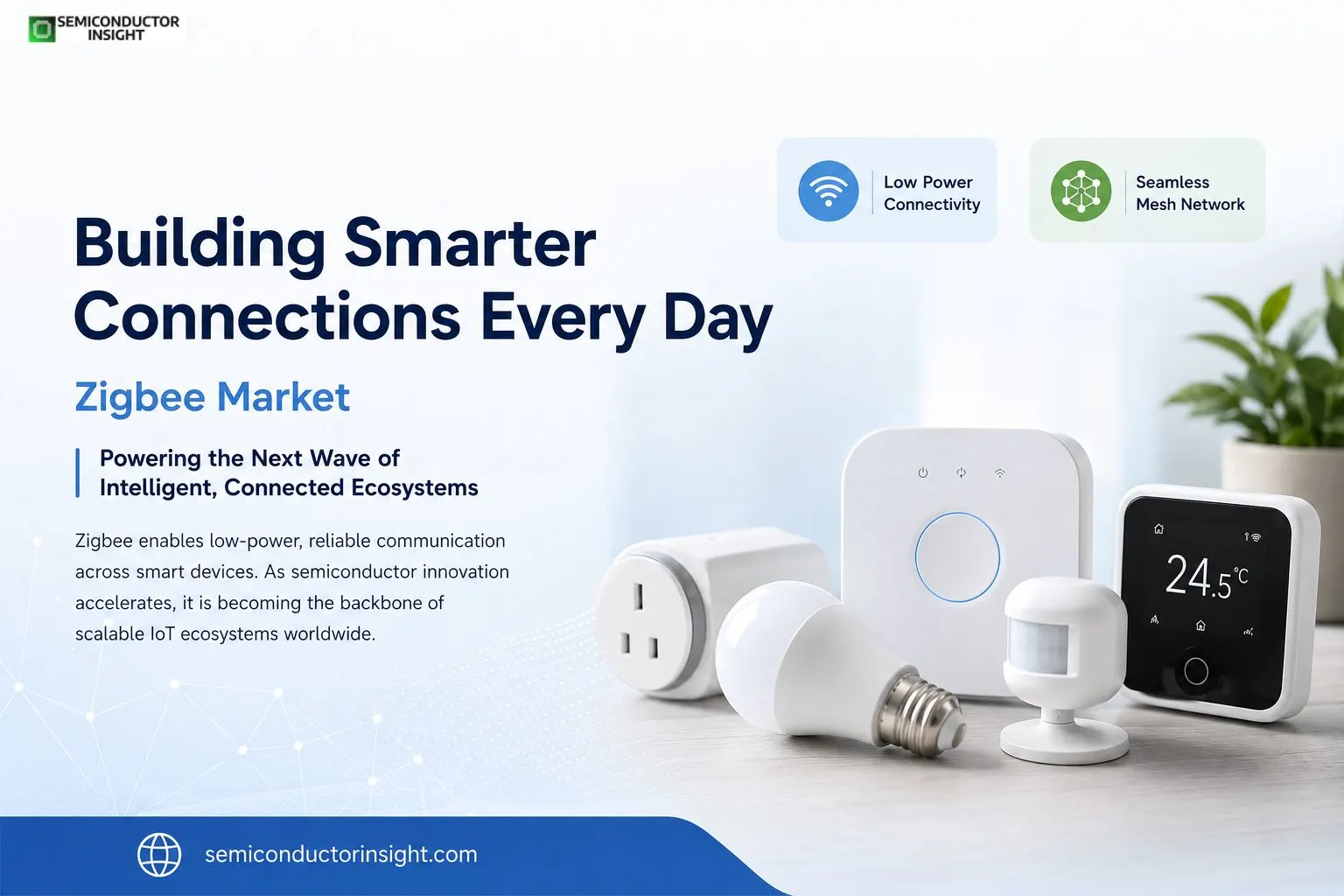
The connected world is no longer defined by individual smart devices but by how seamlessly they communicate with one another. At the center of this transformation, Zigbee Market has established itself as one of the most dependable ecosystems for low-power wireless communication.
- Built on the IEEE 802.15.4 standard, Zigbee enables devices to exchange data through mesh networking, allowing sensors, lighting systems, security equipment, industrial controllers, and healthcare devices to remain connected while consuming minimal energy.
- As semiconductor manufacturers continue developing highly integrated wireless chipsets, Zigbee is becoming an increasingly important technology for scalable Internet of Things (IoT) deployments.
Unlike high-bandwidth communication technologies, Zigbee is optimized for reliability, low latency, and battery efficiency. These characteristics have made it a preferred protocol for applications where devices are expected to operate continuously for years without frequent battery replacement. From intelligent buildings to automated warehouses, Zigbee’s influence now extends well beyond residential automation.
The Connected Device Revolution Is Reaching New Scale
- The International Telecommunication Union (ITU) claims that billions of connected devices across industries are supported by the world’s internet connectivity, which is still growing quickly.
- Industry organizations including the Zigbee Alliance, now operating as the Connectivity Standards Alliance (CSA), estimate that hundreds of millions of Zigbee-enabled chipsets are shipped annually for integration into lighting systems, sensors, smart meters, security products, and consumer electronics.
- The rapid deployment of smart utility infrastructure also contributes to Zigbee adoption. Numerous electricity providers worldwide use Zigbee-enabled smart meters that allow consumers to monitor energy consumption in real time while supporting more efficient grid management.
- These applications demonstrate how semiconductor-enabled wireless communication is becoming part of essential public infrastructure rather than solely consumer technology.
Why Mesh Networking Continues to Stand Out?
One of Zigbee’s defining strengths is its mesh networking architecture. Instead of relying on a single communication path, every compatible device can relay information across the network, improving reliability even when individual nodes become unavailable. This distributed communication model makes Zigbee particularly suitable for hospitals, manufacturing facilities, office complexes, universities, and large residential communities where uninterrupted connectivity is essential.
As buildings become more digitally integrated, facility managers increasingly deploy networks capable of coordinating lighting, occupancy sensors, climate control systems, and access management without placing excessive demands on energy consumption or wireless bandwidth.
Smart Homes Are Becoming Intelligent Ecosystems
- The modern smart home no longer depends on isolated connected products. Consumers increasingly expect lighting, heating, security cameras, smart locks, voice assistants, appliances, and entertainment systems to communicate through unified ecosystems.
- The introduction of the Matter interoperability standard by the Connectivity Standards Alliance has further strengthened Zigbee’s position because several existing Zigbee technologies and member companies contribute to broader cross-platform compatibility.
- Recent smart home installations increasingly combine wireless occupancy sensors, adaptive lighting, automated blinds, indoor air quality monitoring, and energy management systems, creating homes capable of responding dynamically to occupant behavior while improving comfort and energy efficiency.
To find out more, feel free to browse our latest updated relevant report: https://semiconductorinsight.com/report/zigbee-chip-market/
Smart Lighting Ecosystems That Work Seamlessly with Zigbee
For homeowners and commercial property managers, interoperability has become just as important as product performance. Several globally recognized lighting manufacturers have successfully integrated Zigbee technology into their connected lighting ecosystems, allowing users to control illumination through mobile applications, automation routines, and voice-enabled platforms.
Among the most widely recognized examples are Signify Philips Hue, LEDVANCE SMART+, IKEA TRADFRI, Müller Licht Tint, Innr Lighting, and selected professional lighting solutions from Legrand and Schneider Electric. These ecosystems support integration with popular smart home platforms while enabling users to automate schedules, adjust brightness, create lighting scenes, improve energy efficiency, and coordinate lighting with motion sensors and environmental controls. Their compatibility with Zigbee-based hubs also simplifies expansion as households add new connected devices over time.
Semiconductor Innovation Is Reducing Size While Increasing Capability
Advances in semiconductor manufacturing continue making Zigbee chipsets smaller, faster, and more energy efficient. Modern system-on-chip (SoC) platforms increasingly combine wireless communication, processing, memory, cryptographic security, and power management within a single integrated package.
Leading semiconductor suppliers continue introducing highly integrated wireless platforms that support secure boot, hardware encryption, over-the-air firmware updates, and multi-protocol communication, enabling manufacturers to develop compact connected devices without increasing hardware complexity. These innovations are supporting applications ranging from wearable medical devices and environmental sensors to industrial automation controllers.
Security Is Becoming a Core Design Principle
- As connected devices become more deeply integrated into homes and critical infrastructure, cybersecurity has become a design priority rather than an optional feature.
- Zigbee implementations increasingly support AES-128 encryption, secure authentication, device identity management, and protected network commissioning to reduce unauthorized access.
- Governments and regulatory organizations worldwide are simultaneously strengthening cybersecurity expectations for connected consumer products. These developments encourage semiconductor companies and device manufacturers to embed stronger hardware-level security directly into wireless communication chipsets before products reach the market.
Zigbee Market continues evolving as an essential foundation for energy-efficient wireless communication. Supported by semiconductor innovation, interoperable smart home ecosystems, industrial digitalization, and expanding IoT infrastructure, Zigbee remains one of the most practical technologies enabling billions of connected devices to communicate securely, efficiently, and reliably across modern digital environments.

Comments (0)