Biomedical system-on-chip with analog front-end for ECG/PPG Market Insights
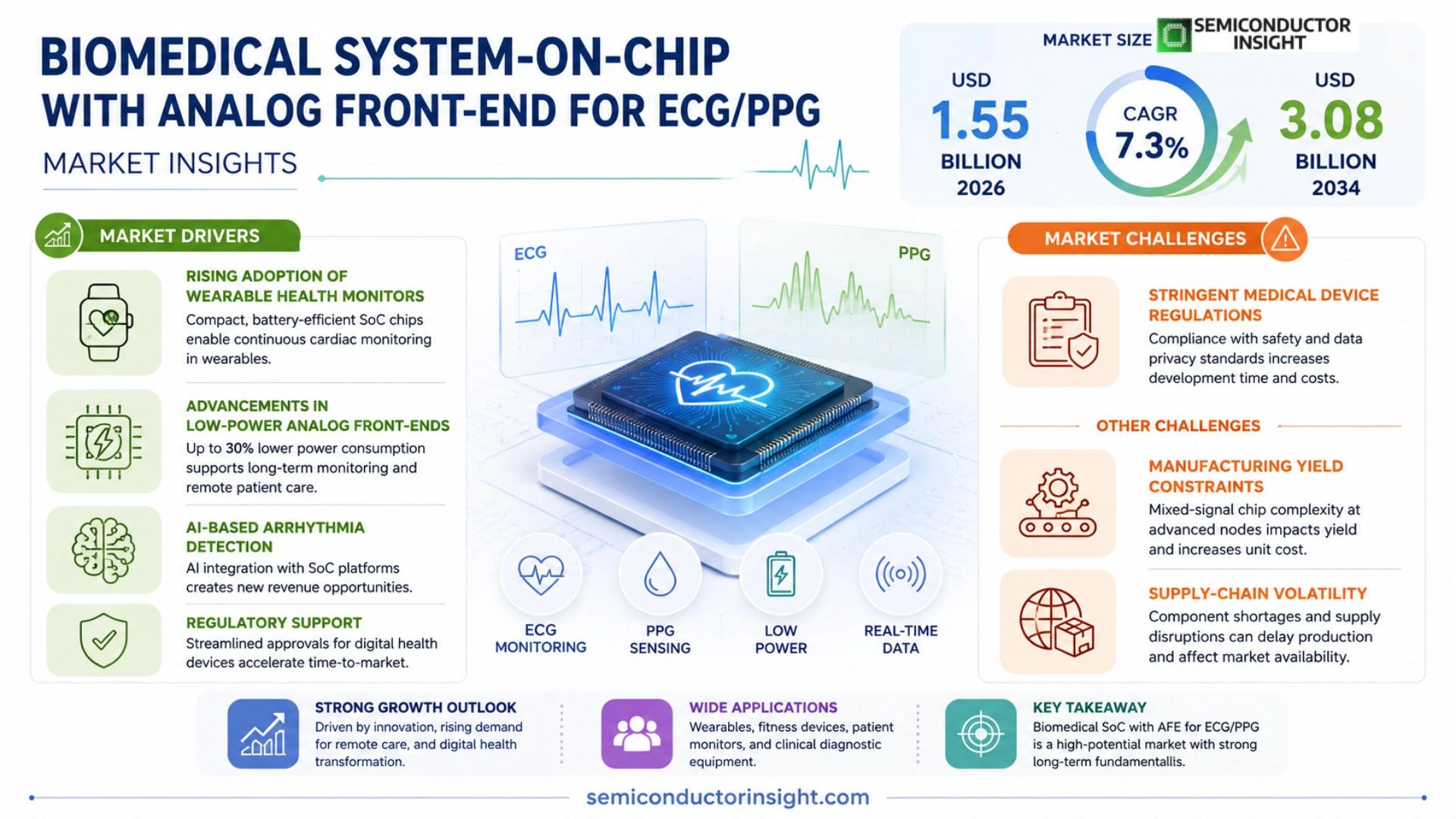
Global Biomedical system‑on‑chip with analog front‑end for ECG/PPG Market size was valued at USD 1.42 billion in 2025. The market is projected to grow from USD 1.55 billion in 2026 to USD 3.08 billion by 2034, exhibiting a CAGR of 7.3% during the forecast period.
These integrated circuits combine a miniature analog front‑end (AFE) that conditions low‑amplitude bio‑signals with digital processing blocks that perform filtering, feature extraction, and wireless communication on a single die. The AFE typically includes instrumentation amplifiers, programmable gain stages, and high‑resolution ADCs optimized for electrocardiogram (ECG) and photoplethysmogram (PPG) waveforms, enabling compact wearable and point‑of‑care devices.
The market is accelerating because consumer demand for continuous health monitoring drives adoption of smart watches and remote patient‑monitoring platforms. Furthermore, advances in low‑power design and AI‑enabled signal analytics reduce battery consumption while improving diagnostic accuracy. Key players such as Texas Instruments, Analog Devices (including Maxim Integrated), STMicroelectronics, NXP Semiconductors, and Silicon Labs are expanding their portfolios through strategic partnerships and new product launches that target the growing wearables ecosystem.
MARKET DRIVERS
Rising Adoption of Wearable Health Monitors
Biomedical system‑on‑chip with analog front‑end for ECG/PPG enables compact, battery‑efficient devices that continuously track cardiac activity. With growing consumer awareness of preventive healthcare, manufacturers are integrating these chips into smartwatches and fitness bands, accelerating market momentum.
Advancements in Low‑Power Analog Front‑Ends
Recent innovations in low‑power analog front‑end architectures have reduced power consumption by up to 30%, making long‑term monitoring feasible for remote patient care. This technical progress drives hospital procurement of portable monitoring solutions, expanding the addressable market.
➤ Integrating AI‑based arrhythmia detection with SoC platforms is creating new revenue streams for device makers.
Regulatory bodies are streamlining approval pathways for digital health devices, allowing faster time‑to‑market for ECG/PPG system‑on‑chip solutions and reinforcing investor confidence in the sector.
MARKET CHALLENGES
Stringent Medical Device Regulations
Compliance with evolving safety standards and data‑privacy regulations increases development costs and extends product validation cycles, posing a barrier for smaller innovators entering the Biomedical system‑on‑chip for ECG/PPG space.
Other Challenges
Manufacturing Yield Constraints
Achieving high yields at sub‑micron process nodes is difficult due to the mixed‑signal nature of the chips, leading to higher unit costs and limiting price competitiveness.
Supply‑chain volatility, especially for specialty analog components, can delay production schedules and affect the ability to meet rising demand from both consumer and clinical segments.
MARKET RESTRAINTS
High Development Expenditure
Designing integrated SoC solutions with precise analog front‑ends requires substantial R&D investment, which can deter entry for companies lacking deep semiconductor expertise.
Limited interoperability between legacy medical equipment and newer SoC platforms creates integration hurdles, slowing adoption in established clinical workflows.
Patient data security concerns necessitate robust encryption and secure firmware updates, adding further complexity and cost to product development.
MARKET OPPORTUNITIES
Expansion into Remote Tele‑Health Services
Tele‑health providers are seeking reliable, low‑latency physiological monitoring solutions. The integration of ECG/PPG front‑ends onto a single chip facilitates seamless data transmission, opening lucrative contracts with healthcare networks.
Emerging markets in Asia‑Pacific and Latin America present untapped demand as regional healthcare systems modernize, offering growth potential for manufacturers that can tailor cost‑effective SoC designs.
Collaborations between semiconductor firms and AI algorithm developers enable value‑added features such as real‑time arrhythmia alerts, creating differentiated product offerings and new revenue models.
Biomedical system-on-chip with analog front-end for ECG/PPG Market Trends
Integration and Power Efficiency Driving Adoption
The market is being reshaped by the convergence of ultra‑low‑power analog front‑ends and highly integrated digital blocks on a single silicon die. Designers are now able to embed instrumentation amplifiers, programmable gain stages and high‑resolution ADCs that are calibrated for both ECG and PPG signals, while maintaining sub‑microwatt consumption. This power‑aware architecture enables continuous health monitoring in battery‑constrained wearables, extending device runtime from days to weeks without compromising signal fidelity. As a result, manufacturers are prioritizing system‑on‑chip solutions that merge signal conditioning, filtering, feature extraction and wireless transmission, thereby reducing board‑level component count and overall bill of materials.
Other Trends
Wearable Health Monitoring Gains Momentum
Consumer demand for real‑time biometric feedback has accelerated the deployment of smart watches, fitness bands and remote‑patient‑monitoring patches. The integrated analog front‑end provides the necessary sensitivity to capture low‑amplitude ECG waveforms and the optical detection required for PPG, while on‑chip digital intelligence extracts heart‑rate variability, arrhythmia indicators and oxygen saturation trends. Companies are leveraging these capabilities to launch subscription‑based health services that combine raw sensor data with cloud‑based analytics, creating a feedback loop that improves algorithm accuracy and drives user engagement.
AI‑Enabled Signal Processing Expands Application Scope
Advancements in on‑chip artificial‑intelligence accelerators are allowing more sophisticated analysis to occur at the edge. By embedding lightweight neural networks within the system‑on‑chip, devices can perform arrhythmia detection, motion artifact suppression and predictive health alerts without relying on continuous cloud connectivity. This edge computing approach reduces latency, preserves user privacy and lowers data‑transfer costs, making the technology attractive for clinical trial devices and tele‑medicine platforms. The combined effect of AI and efficient analog front‑ends is broadening the market beyond consumer wearables into specialized medical diagnostics, where regulatory approval pathways benefit from demonstrated reliability and reduced hardware complexity.
Overall, the trajectory of Biomedical system-on-chip with analog front-end for ECG/PPG Market reflects a shift toward tighter integration, power‑conscious design and intelligent on‑device processing. Industry leaders such as Texas Instruments, Analog Devices, STMicroelectronics, NXP Semiconductors and Silicon Labs are reinforcing their portfolios with new product families that address these trends. The competitive landscape is characterized by strategic collaborations with software firms and healthcare providers, ensuring that hardware innovations translate into actionable health insights. As wearable adoption continues to rise and AI‑driven analytics mature, the sector is poised for sustained growth driven by demand for accurate, low‑power, and always‑on physiological monitoring.
COMPETITIVE LANDSCAPE
Key Industry Players
Competitive Landscape of Biomedical System-on-Chip with Analog Front-End for ECG/PPG
The market is anchored by a few large semiconductor firms that command the majority of revenue share through extensive product portfolios and global distribution networks. Texas Instruments leads with its AFE‑integrated bio‑signal SoCs that combine ultra‑low‑power instrumentation amplifiers, programmable gain stages, and high‑resolution SAR ADCs optimized for both ECG and PPG applications. Analog Devices, incorporating Maxim Integrated’s analog expertise, offers a parallel line of mixed‑signal solutions that emphasize precision front‑end conditioning and on‑chip digital preprocessing for wearable health monitors. Together, these two companies shape pricing benchmarks, drive technology roadmaps, and benefit from deep relationships with OEMs in the remote‑patient‑monitoring and consumer wearables sectors. Their market dominance creates a tiered structure where midsize players must either specialize in niche functionalities or partner with larger firms to gain traction.
Beyond the dominant duopoly, a diverse set of innovators adds depth and differentiation to the ecosystem. STMicroelectronics and NXP Semiconductors focus on integrated connectivity, embedding Bluetooth Low Energy alongside the analog front‑end to simplify system design for IoT‑enabled health devices. Silicon Labs concentrates on ultra‑low‑power wireless modules that extend battery life in continuous monitoring scenarios. Infineon Technologies and Renesas Electronics target automotive and medical-grade safety‑critical applications, offering hardened processes and extended temperature ranges. Smaller specialists such as AMS AG, Microchip Technology, and ON Semiconductor provide application‑specific IP blocks, while emerging entrants like Qualcomm and MediaTek explore AI‑accelerated signal analytics on the same die. This breadth of players ensures healthy competition, rapid innovation, and a range of pricing options for device manufacturers.
List of Key Biomedical System-on-Chip with Analog Front-End for ECG/PPG Companies Profiled
- Texas Instruments
- Analog Devices (including Maxim Integrated)
- STMicroelectronics
- NXP Semiconductors
- Silicon Labs
- Infineon Technologies
- Renesas Electronics
- AMS AG
- Microchip Technology
- ON Semiconductor
- Qualcomm
- MediaTek
- Skyworks Solutions
- Dialog Semiconductor
- Cypress Semiconductor
Segment Analysis:
| Segment Category | Sub-Segments | Key Insights |
| By Type |
|
Integrated SoC is emerging as the preferred architecture because it delivers compact form‑factor, lowers BOM cost and simplifies firmware development. Key qualitative drivers:
|
| By Application |
|
Wearable fitness and wellness devices dominate the adoption curve due to mass‑market acceptance and continuous health tracking demand. Qualitative insights:
|
| By End User |
|
Healthcare providers place high priority on data reliability and regulatory compliance, driving demand for clinically validated SoC solutions. Key observations:
|
| By Integration Level |
|
Full System‑on‑Chip is increasingly favored because it removes inter‑module latency and simplifies mechanical design. Qualitative benefits:
|
| By Target Device |
|
Smart watches and fitness bands lead the market narrative by offering day‑to‑day health visibility combined with lifestyle features. Qualitative observations:
|
Regional Analysis: North America
The United States represents the largest sub-region within North America. Its robust healthcare system and high patient adoption rates contribute significantly to market growth. Increasing focus on preventative healthcare and remote patient monitoring are key drivers.
Canada exhibits steady growth in Biomedical system-on-chip with analog front-end for ECG/PPG Market. Government initiatives supporting healthcare innovation and a well-established healthcare infrastructure are contributing factors.
Mexico presents a growing market opportunity. Rising healthcare awareness and increasing disposable incomes are driving demand for advanced medical devices and technologies, including those utilizing Biomedical system-on-chip with analog front-end for ECG/PPG.
This region is witnessing increasing adoption of cardiac monitoring solutions. Growing access to healthcare and a rising prevalence of cardiovascular conditions are key factors influencing market expansion in Central America and the Caribbean.
Europe
Europe demonstrates a strong and mature market for Biomedical system-on-chip with analog front-end for ECG/PPG. Stringent regulatory standards and a focus on patient data privacy are key considerations. The region’s advanced technological infrastructure and significant R&D investments support continuous innovation. The demand for compact and efficient solutions for point-of-care diagnostics is particularly strong.
Asia-Pacific
Asia-Pacific is projected to be the fastest-growing market. Rising healthcare expenditure, an aging population in several countries, and increasing awareness of heart health are driving demand. Government initiatives promoting healthcare technology adoption are also contributing to this growth.
South America
South America represents a developing market with significant growth potential. Increasing healthcare access and a growing emphasis on preventative medicine are expected to boost market expansion in the coming years. Affordability and ease of use are important factors in this region.
Middle East & Africa
The Middle East & Africa market is characterized by increasing healthcare investments and a growing need for advanced medical devices. Rising rates of cardiovascular diseases and government initiatives to modernize healthcare infrastructure are key factors driving market growth.
Report Scope
This market research report provides a comprehensive analysis of the Biomedical system-on-chip with analog front-end for ECG/PPG Market , covering the forecast period 2026–2034. It offers detailed insights into market dynamics, technological advancements, competitive landscape, and key trends shaping the industry.
Key focus areas of the report include:
- Market Overview: The report begins with an overview outlining its current market scenario, key growth indicators, and industry transformation drivers. It discusses macroeconomic factors, demand–supply balance, regulatory landscape, and the strategic role of semiconductors in powering advancements across industries such as automotive, telecommunications, consumer electronics, and industrial automation.
- Market Size & Forecast: Historical data and future projections for revenue, unit shipments, and market value across major regions and segments.
- Segmentation Analysis: Detailed breakdown by product type, technology, application, and end-user industry to identify high-growth segments and investment opportunities.
- Regional Insights: Insights into market performance across North America, Europe, Asia-Pacific, Latin America, and the Middle East & Africa, including country-level analysis where relevant.
- Competitive Landscape: Profiles of leading market participants, including their product offerings, R&D focus, manufacturing capacity, pricing strategies, and recent developments such as mergers, acquisitions, and partnerships.
- Technology Trends & Innovation: Assessment of emerging technologies, integration of AI/IoT, semiconductor design trends, fabrication techniques, and evolving industry standards.
- Market Drivers & Restraints: Evaluation of factors driving market growth along with challenges, supply chain constraints, regulatory issues, and market-entry barriers.
- Stakeholder Insights: Insights for component suppliers, OEMs, system integrators, investors, and policymakers regarding the evolving ecosystem and strategic opportunities.
Primary and secondary research methods are employed, including interviews with industry experts, data from verified sources, and real-time market intelligence to ensure the accuracy and reliability of the insights presented.
FREQUENTLY ASKED QUESTIONS:
What is the current market size of Biomedical system-on-chip with analog front-end for ECG/PPG Market?
-> Biomedical system-on-chip with analog front-end for ECG/PPG Market was valued at USD 1.42 billion in 2025 and is expected to reach USD 3.08 billion by 2034.
Which key companies operate in Biomedical system-on-chip with analog front-end for ECG/PPG Market?
-> Key players include Texas Instruments, Analog Devices (including Maxim Integrated), STMicroelectronics, NXP Semiconductors, and Silicon Labs, among others.
What are the key growth drivers?
-> Key growth drivers include continuous health‑monitoring demand, wearables adoption, low‑power design advancements, and AI‑enabled signal analytics.
Which region dominates the market?
-> The reference does not specify a dominant region.
What are the emerging trends?
-> Emerging trends include low‑power AFE designs, AI‑driven analytics, and integrated wireless communication for wearable and point‑of‑care devices.
Get Sample Report PDF for Exclusive Insights
Report Sample Includes
- Table of Contents
- List of Tables & Figures
- Charts, Research Methodology, and more...