Market Insights
Global ZigBee Chip Market size was valued at USD 4.72 billion in 2025. The market is projected to grow from USD 5.03 billion in 2026 to USD 7.26 billion by 2034, exhibiting a CAGR of 6.5% during the forecast period.
ZigBee chips are low-power radio frequency integrated circuits designed for wireless communication, based on the IEEE 802.15.4 protocol standard. These chips are widely used in IoT applications, including smart home systems, industrial automation, smart lighting, and energy management solutions. They integrate a radio frequency transceiver, microcontroller (MCU), memory, and protocol stack to enable short-range, multi-node communication with low power consumption and high reliability.
The market growth is driven by increasing adoption of IoT devices, advancements in smart home ecosystems, and the rising demand for energy-efficient wireless solutions. Key players such as Texas Instruments, NXP Semiconductors, and Silicon Labs continue to innovate with multi-protocol compatibility (Thread, BLE) and enhanced security features to meet evolving industry requirements.
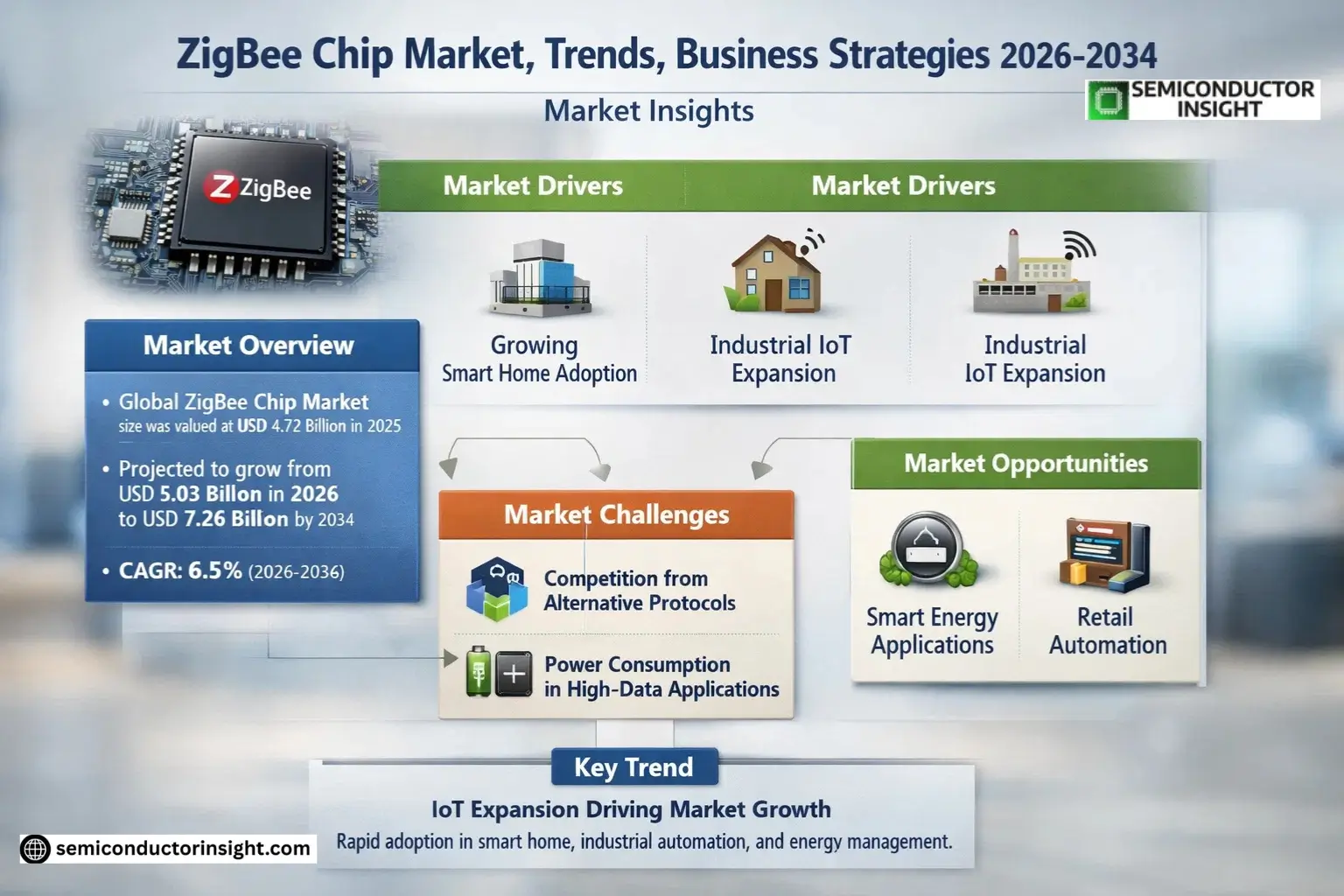
MARKET DRIVERS
Growing Smart Home Adoption
ZigBee Chip Market is experiencing significant growth due to the rapid expansion of smart home ecosystems. With over 300 million smart home devices shipped globally in 2023, ZigBee’s low-power, mesh networking capabilities position it as a preferred connectivity solution. The protocol’s interoperability with major platforms like Amazon Alexa and Google Home further accelerates adoption.
Industrial IoT Expansion
Industrial applications are driving demand for ZigBee chips, particularly in energy management and asset tracking systems. The technology’s reliability in harsh environments and long battery life (up to 10 years in some deployments) makes it ideal for industrial IoT solutions. Factories implementing ZigBee-based monitoring systems have reported 25-30% improvements in operational efficiency.
The standardization of ZigBee 3.0 has further simplified development, reducing time-to-market for new IoT products by approximately 15% compared to proprietary solutions.
MARKET CHALLENGES
Competition from Alternative Protocols
ZigBee Chip Market faces intense competition from emerging protocols like Matter and Thread, which offer similar low-power mesh capabilities. While ZigBee maintains strong market share in industrial applications, consumer segment adoption is being challenged by these newer standards backed by tech giants.
Other Challenges
Power Consumption in High-Data Applications
Although ZigBee excels in low-power scenarios, its throughput limitations (250kbps max) create challenges for data-intensive applications, potentially limiting expansion into video surveillance or high-bandwidth industrial uses.
Regional Fragmentation
Different frequency regulations across markets (2.4GHz vs. sub-GHz implementations) require manufacturers to develop multiple hardware variants, increasing production costs by 5-7%.
MARKET RESTRAINTS
Legacy Infrastructure Limitations
Many manufacturing facilities hesitate to upgrade to ZigBee-enabled systems due to existing investments in wired industrial networks. Retrofitting costs average USD 50,000-USD 75,000 per facility, creating significant adoption barriers despite long-term benefits.
MARKET OPPORTUNITIES
Smart Energy Applications
Global smart meter market, expected to reach 1.5 billion units by 2027, represents a major opportunity for ZigBee chip manufacturers. Over 60% of current smart meter deployments in Europe and North America utilize ZigBee for their HAN (Home Area Network) connectivity.
Retail Automation
ZigBee’s price-performance ratio makes it ideal for retail smart shelving and inventory tracking systems. Pilot deployments have demonstrated 99.8% inventory accuracy and 30% reduction in stockout incidents.
Key Trends in the ZigBee Chip Market
IoT Expansion Driving Market Growth
ZigBee Chip Market is experiencing steady growth due to the rapid expansion of IoT applications, particularly in smart home systems, industrial automation, and energy management. The standardized ZigBee 3.0 protocol has enabled seamless integration across multiple IoT devices, significantly improving interoperability. This standardization is accelerating adoption in both residential and commercial sectors.
Other Trends
Multi-Protocol Integration Gains Momentum
Leading manufacturers are developing ZigBee chips with multi-protocol capabilities, including compatibility with Thread, BLE, and Matter standards. This trend enhances device connectivity across different ecosystems while maintaining the low-power advantages of ZigBee technology. Such integration is becoming critical as smart home ecosystems increasingly demand cross-platform functionality.
Regional Market Developments
North America and Asia-Pacific regions are showing particularly strong growth in ZigBee chip adoption. While established players like Silicon Labs and Texas Instruments dominate in high-end applications, Chinese manufacturers are gaining market share in cost-sensitive mid-range applications through competitive pricing and localized support. Europe continues to see increased adoption in smart energy and building automation sectors.
Other Trends
Focus on Security and Power Efficiency
Recent product developments emphasize enhanced security features and improved power management in ZigBee chips. Manufacturers are implementing advanced encryption standards and power-saving modes to address growing concerns about network security and energy consumption in IoT deployments. These improvements are making ZigBee chips more attractive for mission-critical industrial applications.
Application-Specific Innovations
The market is seeing differentiated product development for specific verticals including smart lighting, healthcare monitoring devices, and industrial control systems. Specialized ZigBee chips optimized for these applications feature tailored communication protocols and interface options while maintaining the core advantages of the technology in terms of reliability and mesh networking capabilities.
COMPETITIVE LANDSCAPE
Key Industry Players
ZigBee Chip Market Dominated by Established Semiconductor Giants
Global ZigBee Chip Market is characterized by the dominance of established semiconductor players with robust R&D capabilities. Texas Instruments leads the market with its CC2652 series, offering multi-protocol support including Zigbee 3.0, Thread, and BLE. Silicon Labs follows closely with its EFR32MG series, recognized for their energy efficiency and security features. NXP Semiconductors has strengthened its position through acquisitions, particularly its JN51xx series widely used in smart lighting applications. These leaders compete on technical parameters like power consumption, protocol flexibility, and security features while maintaining strong distribution networks.
Several niche players are making significant inroads in regional markets. Nordic Semiconductor targets ultra-low-power applications while Telink Semiconductor captures value in the Chinese smart home sector. Chinese manufacturers like Zhiyuan Electronics and Yingtong Telecommunication are gaining traction through cost-competitive solutions for domestic IoT applications. Emerging players such as Feibit and Shuncom focus on specialized mesh networking solutions for industrial automation, creating differentiated offerings in specific vertical markets.
List of Key ZigBee Chip Companies Profiled
- Texas Instruments
- NXP Semiconductors
- Silicon Labs
- Renesas Electronics
- STMicroelectronics
- Microchip Technology
- Nordic Semiconductor
- Qualcomm
- Onsemi
- Telink Semiconductor
- Zhiyuan Electronics
- Yingtong Telecommunication
- Lexin Technology
- Unisoc Technology
- Feibit
Segment Analysis:
| Segment Category | Sub-Segments | Key Insights |
| By Type |
|
2.4GHz Frequency Band dominates the market due to its widespread global regulatory approval and superior balance between range and power consumption.
|
| By Application |
|
Consumer Electronics remains the primary growth driver, particularly in smart home applications:
|
| By End User |
|
Residential Sector demonstrates strongest adoption patterns:
|
| By Protocol Version |
|
ZigBee 3.0/Pro represents the industry standard:
|
| By Chip Complexity |
|
Multi-Protocol Chips show accelerating adoption:
|
Regional Analysis: ZigBee Chip Market
Asia-Pacific
China’s nationwide smart city projects drive extensive ZigBee chip deployment for urban infrastructure monitoring and home automation systems. Municipal governments are integrating ZigBee networks into public services, creating consistent demand from device manufacturers.
Japanese manufacturers utilize ZigBee chips for factory automation and equipment monitoring, favoring its low-power advantages. The aging workforce accelerates adoption of wireless monitoring solutions in industrial environments across manufacturing hubs.
South Korea’s advanced IoT infrastructure and high smartphone penetration create ideal conditions for ZigBee adoption. Major electronics companies incorporate ZigBee chips into premium smart home products for both domestic and export markets.
India’s ZigBee Chip Market is expanding rapidly with affordable smart home solutions gaining traction in urban areas. Real estate developers increasingly include home automation features in new constructions, supported by government digital initiatives.
North America
North America maintains technological leadership in advanced ZigBee applications, particularly in energy management systems. The U.S. leads regional adoption with strong demand from utility companies deploying smart grid solutions. Residential markets show increasing preference for ZigBee-enabled smart thermostats and lighting controls. Established consumer electronics brands continue to drive innovation in interoperable smart home ecosystems. Canada follows closely with growing adoption in commercial building automation systems and smart retail applications.
Europe
European markets emphasize energy-efficient ZigBee solutions aligned with strict regulatory standards. Germany leads industrial IoT applications, while UK consumers favor smart home security systems. The region benefits from mature home automation markets and established smart meter infrastructure. Scandinavian countries demonstrate particularly high adoption rates, driven by environmental awareness and government energy-saving initiatives. EU-wide harmonization of wireless standards supports consistent market growth across member states.
Middle East & Africa
The Middle East shows increasing ZigBee adoption in smart city projects, particularly in Gulf Cooperation Council countries investing in high-tech infrastructure. Africa presents emerging opportunities in urban centers, though market penetration remains limited by infrastructure challenges. South Africa leads regional adoption with growing middle-class interest in home automation. The region benefits from direct sunlight enabling solar-powered ZigBee solutions in remote monitoring applications.
South America
Brazil dominates South America’s ZigBee Chip Market with expanding smart building projects and security system demand. Economic recovery fuels residential automation adoption among upper-middle-class consumers. Argentina and Chile show gradual growth with increasing awareness of energy management benefits. The region benefits from alignment with international standards and availability of affordable smart devices from Asian manufacturers.
Report Scope
This market research report provides a comprehensive analysis of the ZigBee Chip Market, covering the forecast period 2026–2034. It offers detailed insights into market dynamics, technological advancements, competitive landscape, and key trends shaping the industry.
Key focus areas of the report include:
- Market Overview: The report begins with an overview outlining its current market scenario, key growth indicators, and industry transformation drivers. It discusses macroeconomic factors, demand–supply balance, regulatory landscape, and the strategic role of semiconductors in powering advancements across industries such as automotive, telecommunications, consumer electronics, and industrial automation.
- Market Size & Forecast: Historical data and future projections for revenue, unit shipments, and market value across major regions and segments.
- Segmentation Analysis: Detailed breakdown by product type, technology, application, and end-user industry to identify high-growth segments and investment opportunities.
- Regional Insights: Insights into market performance across North America, Europe, Asia-Pacific, Latin America, and the Middle East & Africa, including country-level analysis where relevant.
- Competitive Landscape: Profiles of leading market participants, including their product offerings, R&D focus, manufacturing capacity, pricing strategies, and recent developments such as mergers, acquisitions, and partnerships.
- Technology Trends & Innovation: Assessment of emerging technologies, integration of AI/IoT, semiconductor design trends, fabrication techniques, and evolving industry standards.
- Market Drivers & Restraints: Evaluation of factors driving market growth along with challenges, supply chain constraints, regulatory issues, and market-entry barriers.
- Stakeholder Insights: Insights for component suppliers, OEMs, system integrators, investors, and policymakers regarding the evolving ecosystem and strategic opportunities.
Primary and secondary research methods are employed, including interviews with industry experts, data from verified sources, and real-time market intelligence to ensure the accuracy and reliability of the insights presented.
FREQUENTLY ASKED QUESTIONS:
What is the current market size of ZigBee Chip Market?
-> ZigBee Chip Market size was valued at USD 4.72 billion in 2025. The market is projected to grow from USD 5.03 billion in 2026 to USD 7.26 billion by 2034, exhibiting a CAGR of 6.5% during the forecast period.
Which key companies operate in ZigBee Chip Market?
-> Key players include Texas Instruments, NXP Semiconductors, Silicon Labs, Renesas Electronics, STMicroelectronics, Microchip Technology, Nordic Semiconductor, and Qualcomm, among others.
What are the key applications of ZigBee chips?
-> ZigBee chips are widely used in smart home devices, industrial automation, smart lighting, energy management, consumer electronics, medical devices, and traffic control systems.
What are the main advantages of ZigBee technology?
-> Key advantages include low power consumption, self-organizing networking capability, high reliability, strong anti-interference, and support for multiple network topologies (star, tree, mesh).
Which region dominates the ZigBee Chip Market?
-> Asia currently leads the market, with strong growth driven by China’s smart home and industrial automation sectors, while North America remains a key innovation hub for ZigBee technology.

Get Sample Report PDF for Exclusive Insights
Report Sample Includes
- Table of Contents
- List of Tables & Figures
- Charts, Research Methodology, and more...