
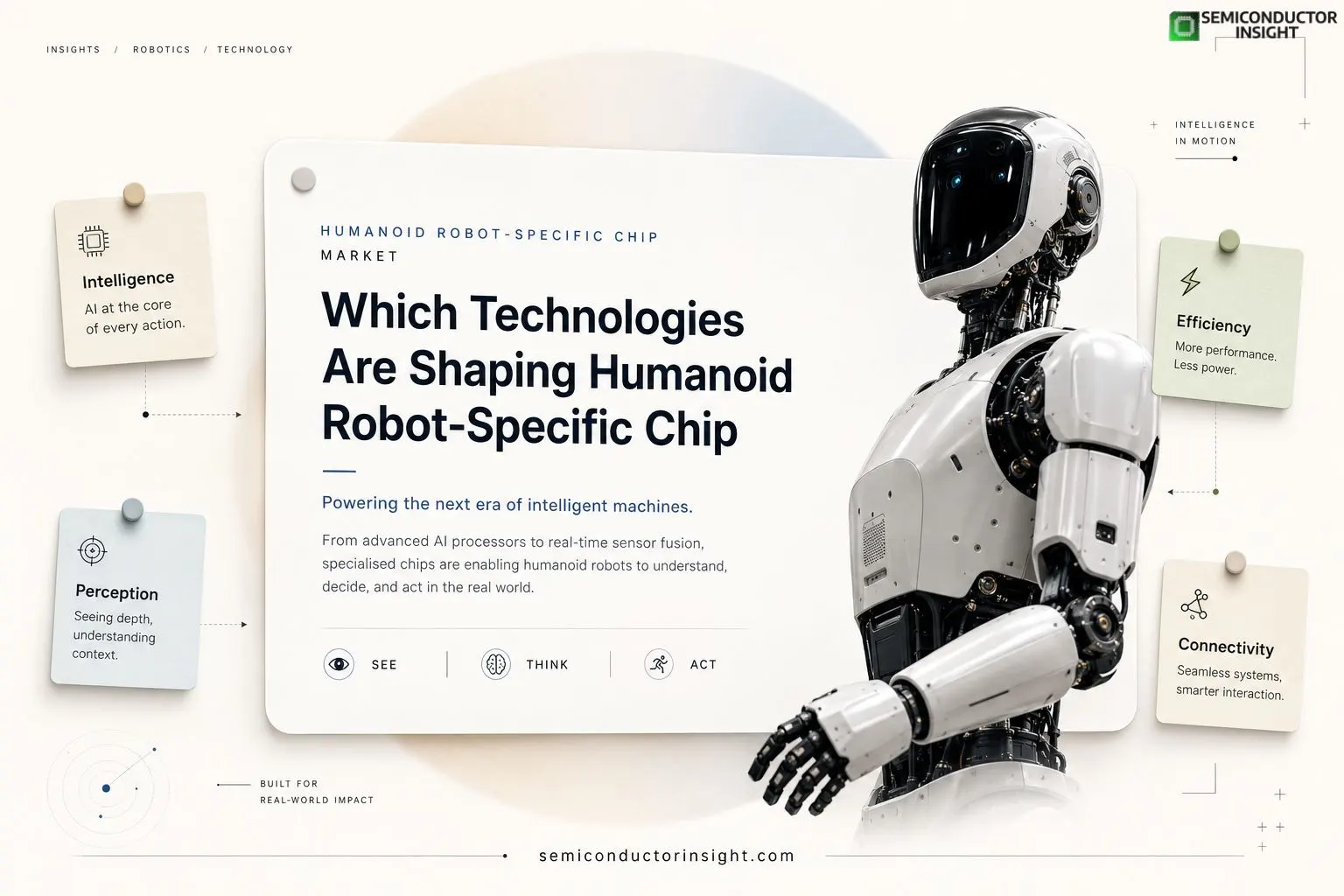
Which Technologies Are Shaping Humanoid Robot-Specific Chip Market in 2026?
The latest generation of humanoid robots is no longer limited to executing pre-programmed motions. Machines are increasingly expected to understand speech, interpret surroundings, make decisions, navigate crowded environments, and interact naturally with people. These capabilities have shifted attention from mechanical engineering to semiconductor innovation, placing Humanoid Robot-Specific Chip Market at the center of robotics development.
From factory floors and logistics centers to healthcare facilities and research laboratories, humanoid robots demand specialised processors capable of handling vast streams of sensory data while maintaining low power consumption and real-time responsiveness.
The Computing Demands That Make Humanoid Robots Different
Humanoid systems work in dynamic situations, in contrast to conventional industrial robots that repeat unchanging operations. Camera feeds, lidar data, microphone inputs, tactile sensors, motor controls, and verbal commands can all be processed concurrently by a single robot.
Modern humanoid robots often contain dozens of sensors and multiple onboard computing modules. Advanced prototypes can generate several gigabytes of sensory information every hour, requiring advanced semiconductor architectures optimised for parallel processing.
This need for continuous perception and decision-making has accelerated the development of robotics-specific silicon designed to balance performance, efficiency, and latency.
What AI Chips Are Used in Humanoid Robots?
The current generation of humanoid robots relies on a combination of specialised AI processors rather than a single chip.
1. Graphics Processing Units
o GPUs remain critical for computer vision, simulation, and large AI model execution.
o Companies developing advanced humanoids frequently use high-performance GPU platforms to process visual information and train robotic intelligence systems.
2. Neural Processing Units
o NPUs are increasingly deployed for inference workloads.
o These chips accelerate deep-learning operations while consuming significantly less power than conventional processors.
3. System-on-Chip Platforms
o Integrated SoCs combine CPUs, GPUs, memory controllers, and AI accelerators into a single package.
o This architecture reduces latency and improves energy efficiency for mobile robotic applications.
4. Edge AI Accelerators
o Dedicated edge processors perform object recognition, speech processing, and navigation tasks directly on the robot without requiring cloud connectivity.
Motion and Motor Control Processors
Specialised controllers manage balance, joint movement, and locomotion. Humanoid robots may contain dozens of actuators that require precise real-time control.
Developers across the robotics industry increasingly combine these processing elements into heterogeneous computing platforms capable of handling both cognitive and physical tasks simultaneously.
The Race to Build a Digital Human Brain
ü Recent developments have intensified competition among semiconductor and robotics companies.
ü In 2025 and 2026, several humanoid robot developers expanded pilot deployments in manufacturing and warehouse environments. These systems increasingly utilise multimodal AI models that combine vision, language, and motion planning.
ü A growing number of robots can recognise objects, understand verbal instructions, and execute complex physical actions within a single workflow. Such capabilities require processors capable of performing trillions of operations per second while maintaining compact form factors.
ü This shift is driving demand for purpose-built semiconductor platforms specifically optimised for embodied AI applications.
Memory Bandwidth Is Emerging as a Key Battleground
Processing power alone is no longer enough. Humanoid robots continuously move large volumes of information between sensors, processors, and memory systems.
Advanced vision models may analyse multiple high-resolution camera streams simultaneously. Real-time navigation algorithms must access environmental maps while coordinating movement decisions.
– As a result, memory bandwidth and data movement efficiency have become major design priorities.
– Semiconductor manufacturers are investing heavily in advanced packaging technologies and high-speed memory integration to eliminate bottlenecks that could slow robotic decision-making.
For a more thorough report, please contact us using our most recent report: https://semiconductorinsight.com/report/humanoid-robot-specific-chip-market/
From Simulation to Physical Intelligence
A significant trend reshaping the industry is the growing use of simulation-driven learning.
Before entering real-world environments, humanoid robots are increasingly trained inside digital environments where millions of movement scenarios can be tested safely. AI chips play a central role in accelerating these simulations and transferring learned behaviours into physical robots.
This approach reduces development time while improving adaptability in unpredictable environments such as factories, hospitals, retail stores, and public spaces.
Energy Efficiency Is Becoming a Competitive Advantage
ü Battery-powered humanoid robots face strict energy constraints. Every watt consumed by computing hardware directly affects operating time.
ü Consequently, semiconductor developers are focusing on performance-per-watt improvements rather than raw computational output.
ü New architectures emphasise intelligent workload distribution, low-power AI inference, and adaptive processing techniques.
ü These innovations are enabling robots to perform increasingly sophisticated tasks without sacrificing mobility or runtime.
Where Semiconductor Innovation Meets Physical Automation
Humanoid robots represent one of the most demanding computing challenges ever attempted. Success depends not only on artificial intelligence algorithms but also on the semiconductor platforms that execute them in real time.
As robots move beyond demonstrations and into practical deployment, demand for specialised AI processors, sensor-fusion engines, edge accelerators, and energy-efficient computing architectures continues to grow. The evolution of humanoid intelligence is therefore becoming inseparable from advances in semiconductor design, making robotics-focused chips one of the most closely watched segments of the global technology landscape.

Comments (0)