
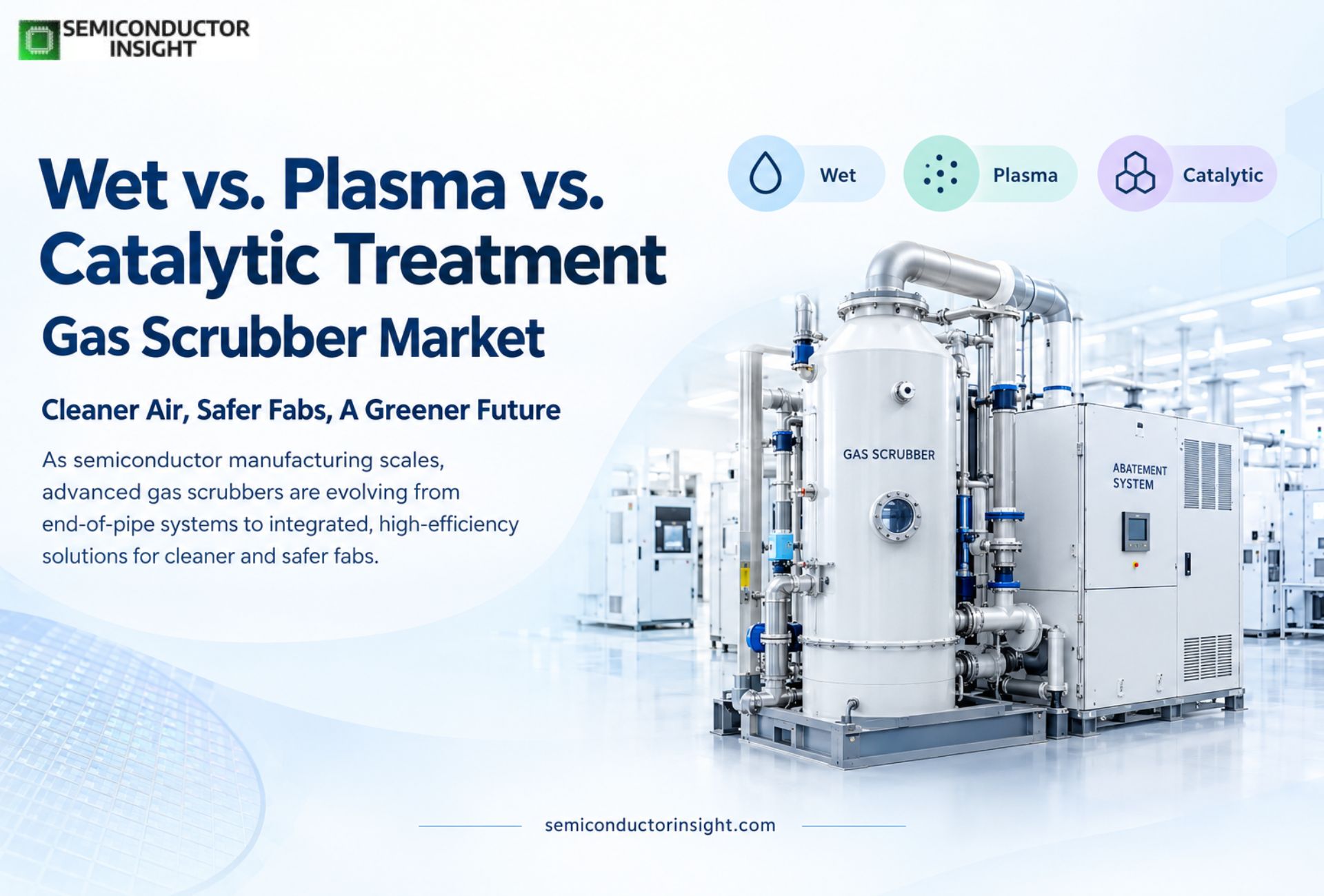
Wet vs. Plasma vs. Catalytic Treatment – Which Technology Fits Gas Scrubbers for Semiconductor Market
Gas scrubbers are becoming an increasingly important part of semiconductor fab infrastructure because wafer processing generates exhaust streams containing fluorinated gases, corrosive compounds, toxic gases, combustible materials and particulate by-products.
The U.S. EPA identifies CF₄, C₂F₆, C₃F₈, CHF₃, NF₃ and SF₆ among the high-global-warming-potential gases used in semiconductor manufacturing. Under normal operating conditions, 10% to 80% of fluorinated gases can pass through process chambers unreacted, making downstream abatement critical.
The Sub-Fab Is Becoming a Technology Zone
- Modern scrubbers are no longer simply end-of-pipe pollution-control equipment.
- They operate alongside dry vacuum pumps, process exhaust systems and point-of-use abatement units in the sub-fab.
- EBARA describes this architecture as a chain in which process gases leave the manufacturing tool through dry vacuum equipment before entering gas-abatement systems and, where required, facility-level scrubbers.
- The importance of this infrastructure is growing with fab scale. TSMC reported 15.0 million 12-inch-equivalent wafer shipments in 2025, while annual capacity across its managed facilities exceeded 17 million 12-inch-equivalent wafers.
- Its manufacturing network spans multiple 12-inch, 8-inch and 6-inch facilities, creating a substantial installed base for exhaust-treatment infrastructure.
One Scrubber Cannot Treat Every Process Stream
The chemistry of the exhaust determines the treatment architecture. Wet scrubbers are suited to water-soluble or water-reactive gases such as HF, HCl, NH₃, TiCl₄ and WF₆. EBARA’s G-WS, for example, is designed for these streams and operates without combustion fuel.
Combustion-plus-wet systems address a broader combination of deposition gases, cleaning gases and etch emissions, while catalytic and plasma systems are increasingly being developed for fluorinated greenhouse gases. EBARA’s catalytic GCR platform is specified for gases including CF₄, C₂F₆, C₃F₈, NF₃ and SF₆, with models supporting inlet flows up to 250 L/min.
2nm and 3nm Production Change the Exhaust Equation
Process scaling is adding another layer of complexity. TSMC entered high-volume manufacturing of 2nm technology in the fourth quarter of 2025, with additional N2P and A16 production scheduled for the second half of 2026. The company is also preparing A14 technology for volume production in 2028.
More sophisticated deposition, etching and chamber-cleaning sequences can mean more demanding exhaust compositions. This is pushing scrubber development toward higher gas-flow handling, stronger resistance to deposits, tighter process control and longer maintenance intervals rather than simply larger equipment footprints.
Want to learn more about the report? Check out our latest updated version for free: https://semiconductorinsight.com/report/gas-scrubbers-for-semiconductor-market/
The 2026 Shift toward Electric Plasma
A notable technology development is EBARA’s new ELF plasma abatement system, scheduled for mass production and sequential release from 2026. The system uses a plasma reactor to decompose PFCs including CF₄ and NF₃ using electricity rather than fossil-fuel combustion, while also targeting lower NOx formation.
This represents a broader direction in the industry: reducing the environmental burden associated not only with untreated process gases but also with the energy required to destroy them.
Maintenance Is Becoming Part of the Abatement Specification
- For advanced fabs, scrubber uptime is directly connected with production continuity.
- Semiconductor exhaust can generate powders and corrosive by-products that accumulate in pumps, forelines and treatment equipment.
- Applied Materials’ pre-pump Aeris-S technology is designed to intercept problematic material before it reaches downstream equipment, helping reduce clogging, pump failure, maintenance exposure and unplanned downtime.
- EBARA’s newer high-flow dry-pump and plasma-abatement products likewise emphasize by-product resistance and predictive functions, reflecting the industry’s shift toward equipment that can operate reliably under increasingly demanding process conditions.
The Next Scrubber Benchmark Is Measured Across the Whole Fab
The emerging opportunity in the Gas Scrubbers for Semiconductor Market is therefore broader than conventional exhaust cleaning. Destruction efficiency, gas-flow capacity, water consumption, fuel demand, NOx generation, footprint, maintenance frequency and digital monitoring are increasingly being evaluated together.
As AI accelerators, advanced memory and leading-edge logic push fabs toward higher production complexity, gas-abatement equipment is moving from a supporting utility into a more strategically engineered part of semiconductor manufacturing infrastructure.

Comments (0)