

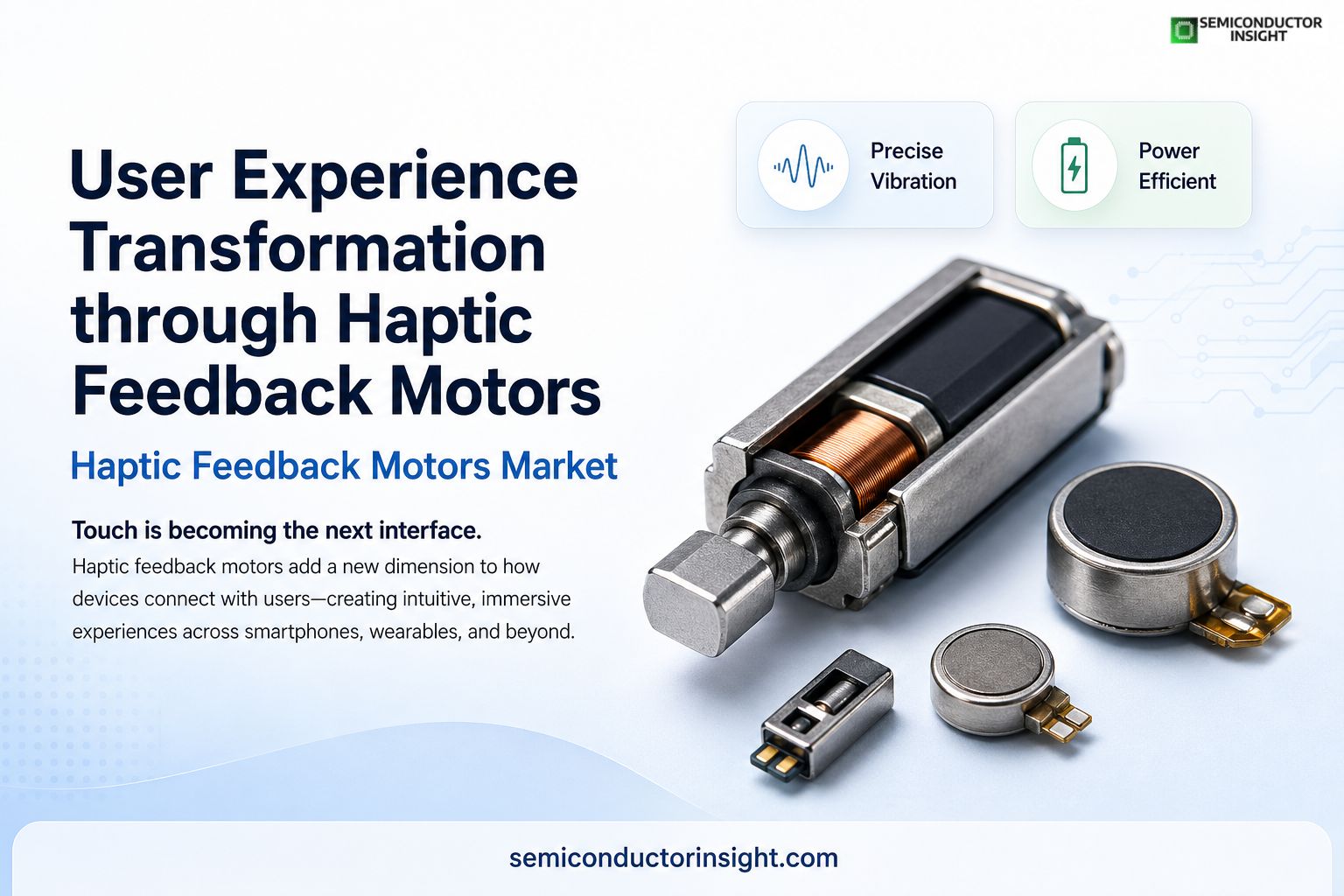
User Experience Transformation through Haptic Feedback Motors Market
Modern electronics are no longer confined to screens and sound. The rise of haptic feedback motors has introduced a new layer of interaction where devices communicate through touch. From smartphones vibrating subtly during notifications to gaming controllers delivering immersive sensations, these compact motors have become essential components in human-machine interfaces. Their evolution is closely tied to semiconductor advancements, particularly in driver integrated circuits and power management systems that precisely control vibration patterns.
Globally, billions of consumer devices incorporate haptic systems. Smartphone production alone exceeds 1.2 billion units annually, and a significant majority now include linear or rotary haptic motors. This widespread adoption reflects how tactile response has shifted from a novelty feature to a standard expectation in device design.
For a more thorough report, please contact us using our most recent report: https://semiconductorinsight.com/report/haptic-feedback-motors-market/
The Micro Mechanics behind Every Pulse
At the core of haptic systems are two primary motor types: eccentric rotating mass motors and linear resonant actuators. While the former relies on rotational imbalance to generate vibration, the latter uses electromagnetic forces to create controlled linear motion. Semiconductor driver ICs play a crucial role here, translating digital signals into precise electrical pulses.
The efficiency of these systems depends heavily on integration. Advanced driver chips can modulate frequency ranges between 150 Hz and 300 Hz, enabling varied tactile sensations from sharp clicks to smooth vibrations. This level of control is what allows devices to simulate real-world feedback such as button presses or surface textures.
Important Types and Traits
- ERM motors, also known as vibration motors, use an imbalanced weight to spin and create vibrations. They are cheap and often used to send simple alerts.
- LRA Motors (Linear Resonant Actuators): These are popular in high-end gadgets because they respond faster and have more subtle effects, including sharp taps or different clicks.
- Piezoelectric actuators are the thinnest and most precise, but they need more voltage.
- Button/Coin Motors: These little, flat motors are great for cell phones and other wearable gadgets.
Semiconductor Intelligence Enabling Precision
The shift toward more refined haptic feedback is largely driven by semiconductor innovation. Dedicated haptic driver ICs now incorporate features like waveform libraries, closed-loop feedback systems, and adaptive voltage scaling. These capabilities ensure consistent performance regardless of battery levels or device conditions.
Key functional improvements include
- Real-time feedback loops that adjust vibration strength dynamically
- Reduced power consumption, often below 100 milliwatts per event
- Integration with system-on-chip architectures for faster response times
Such advancements are particularly critical in compact devices like wearables, where space and energy efficiency are tightly constrained.
Expanding Beyond Smartphones
While smartphones remain the largest application base, the scope of haptic feedback motors has expanded significantly across semiconductor-driven industries. Gaming consoles, automotive interfaces, and virtual reality systems are increasingly incorporating advanced haptics.
In automotive systems, touch-based dashboards now replace mechanical buttons, relying on haptic feedback to confirm user input. In gaming, next-generation controllers use multiple actuators to create directional feedback, enhancing realism. Wearable devices such as smartwatches utilize micro-haptics to deliver notifications discreetly, with unit shipments crossing over 200 million devices annually.
Fabrication Meets Functional Design
- The production of haptic motors involves a combination of precision engineering and semiconductor alignment. Miniaturization has been a defining trend, with actuator thickness in some smartphones reduced to less than 3 millimeters. This reduction is achieved without compromising output force, thanks to improved magnetic materials and optimized coil designs.
- From a semiconductor perspective, the integration process ensures that motor drivers align seamlessly with printed circuit boards and power management units. This tight coupling reduces latency, often enabling response times under 10 milliseconds, which is critical for real-time interaction.
Power Efficiency and Thermal Balance
As devices become more compact, managing energy consumption and heat generation has become critical. Haptic motors, when improperly controlled, can drain battery life and generate unwanted heat. Semiconductor solutions now address this through intelligent power distribution and pulse-width modulation techniques.
Typical operating voltages range between 1.8V and 3.6V, aligning with standard mobile device architectures. Efficient designs ensure that haptic events consume minimal energy while maintaining strong tactile output, a balance that is increasingly important in battery-dependent devices.
The Subtle Science of User Perception
What makes haptic feedback unique is its direct connection to human perception. Unlike visual or audio signals, tactile responses are immediate and instinctive. Engineers now design feedback patterns based on human sensitivity thresholds, ensuring that each vibration feels natural and intuitive.
This intersection of neuroscience and semiconductor engineering is opening new possibilities. Devices are beginning to differentiate between soft alerts and urgent notifications purely through touch, reducing reliance on screens and sound.

Comments (0)