
Haptic Feedback Motors Market Insights
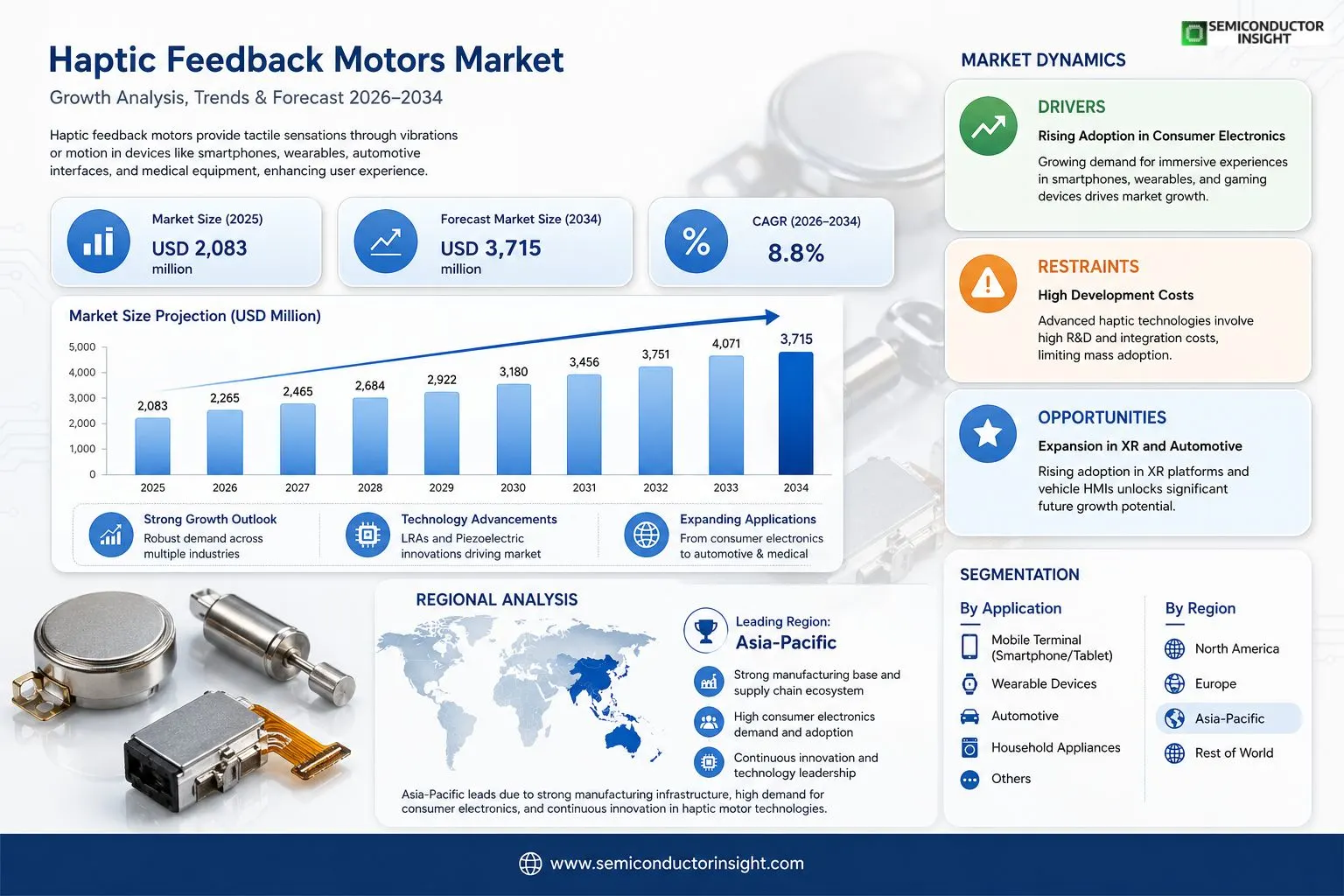
Global Haptic Feedback Motors market size was valued at USD 2,083 million in 2025. The market is projected to grow from USD 2,265 million in 2026 to USD 3,715 million by 2034, exhibiting a CAGR of 8.8% during the forecast period.
Haptic feedback motors are specialized motors used in electronic devices to provide tactile feedback or physical sensations to the user. They are designed to simulate the sense of touch by generating vibrations or other mechanical forces that the user can feel. This feedback is commonly used in devices such as smartphones, game controllers, wearables, and medical devices, enhancing the user’s experience by making interactions more immersive and intuitive. Haptic feedback motors work by converting electrical signals into mechanical vibrations or movements, which are then perceived as touch sensations when the motor is engaged. These motors are commonly small in size, high-performance, and capable of providing different intensities and patterns of feedback, encompassing product types such as Eccentric Rotating Mass (ERM) Actuators and Linear Resonant Actuators (LRAs).
The market is witnessing strong growth driven by rising adoption across mobile terminals, wearable devices, automotive applications, and household appliances. Key manufacturers operating in Haptic Feedback Motors Market include AAC Technologies, Nidec Corporation, TDK Corporation, Johnson Electric Holdings, Parker Hannifin Corporation, Precision Microdrives, and TITAN Haptics, among others, who collectively maintain a significant share of global revenues through diverse and expanding product portfolios.
MARKET DRIVERS
Rising Adoption of Haptic Technology in Consumer Electronics
Haptic Feedback Motors Market is experiencing robust growth, primarily driven by the accelerating integration of haptic technology across consumer electronics. Smartphones, wearables, and gaming controllers increasingly rely on advanced vibration motors to deliver tactile responses that enhance user experience. Manufacturers are investing heavily in miniaturized, energy-efficient motor designs to meet the evolving demands of next-generation devices. The shift from conventional eccentric rotating mass (ERM) motors to more precise linear resonant actuators (LRA) reflects the industry’s commitment to delivering nuanced, programmable feedback sensations.
Expansion of Haptics in Automotive and Healthcare Applications
Beyond consumer devices, Haptic Feedback Motors Market is benefiting significantly from adoption in automotive human-machine interfaces (HMI) and medical simulation equipment. Modern vehicles increasingly incorporate haptic-enabled touchscreens, steering wheel feedback systems, and driver-alert mechanisms, all of which require reliable, high-performance motors. In healthcare, surgical training simulators and rehabilitation devices utilize haptic feedback to replicate realistic tactile sensations, improving procedural outcomes and patient recovery. This cross-industry expansion is broadening the addressable market considerably.
➤ The integration of haptic feedback motors into augmented reality (AR) and virtual reality (VR) platforms represents one of the most transformative growth vectors in the market, enabling immersive tactile experiences that bridge the gap between physical and digital interaction.
The proliferation of 5G-enabled devices is further amplifying demand, as faster data transmission allows for real-time haptic feedback in remote-control applications, telemedicine, and cloud-based gaming. Device OEMs are partnering with haptic motor specialists to co-develop proprietary actuator solutions that offer differentiated user experiences, reinforcing competitive positioning in a crowded electronics landscape.
MARKET CHALLENGES
Technical Limitations in Miniaturization and Power Consumption
Despite strong growth momentum, Haptic Feedback Motors Market faces notable technical challenges, particularly around miniaturization and power efficiency. As wearables and IoT devices shrink in form factor, designing motors that deliver perceptible, high-fidelity feedback within extremely constrained dimensions becomes increasingly difficult. Balancing vibration intensity with battery life remains a persistent engineering hurdle, especially in devices such as smartwatches and hearables where energy budgets are tightly managed. These constraints can limit the performance ceiling of haptic solutions in ultra-compact applications.
Other Challenges
Supply Chain Complexity
Haptic Feedback Motors Market relies on precision-engineered components including rare earth magnets, specialized coils, and micro-mechanical assemblies. Disruptions in the supply of these materials , whether due to geopolitical factors, logistics bottlenecks, or raw material price volatility , can introduce production delays and cost pressures for motor manufacturers, particularly smaller suppliers with limited procurement leverage.
Standardization and Interoperability
The absence of universal haptic feedback standards across platforms and operating systems creates fragmentation in the market. Application developers and hardware manufacturers must often build platform-specific haptic implementations, increasing development costs and reducing the scalability of haptic-enabled solutions across device ecosystems.
MARKET RESTRAINTS
High Development Costs and Integration Complexity
One of the primary restraints facing Haptic Feedback Motors Market is the elevated cost associated with research, development, and integration of advanced actuator technologies. Piezoelectric actuators and LRA motors, while superior in performance to conventional ERM motors, carry higher unit costs that can deter adoption among price-sensitive device manufacturers, particularly in emerging markets. The need for sophisticated driver electronics and firmware to control haptic output adds further layers of cost and engineering complexity to product development cycles.
Consumer Perception and Awareness Barriers
While haptic feedback is well established in flagship smartphones and gaming peripherals, broader consumer awareness of advanced haptic capabilities remains limited outside these segments. Many end-users do not actively seek haptic performance as a primary purchase criterion, reducing the urgency for mid-range device manufacturers to invest in premium motor solutions. This perception gap slows the trickle-down adoption of sophisticated haptic feedback motors into mainstream and value-tier product categories, constraining overall market volume growth in the near term.
MARKET OPPORTUNITIES
Emergence of Advanced Haptics in Extended Reality (XR) Platforms
The rapid development of extended reality platforms , encompassing virtual reality, augmented reality, and mixed reality , presents a compelling opportunity for Haptic Feedback Motors Market. XR headsets, haptic gloves, and full-body feedback suits require highly responsive, multi-point actuator arrays to simulate realistic physical interactions in digital environments. As XR adoption accelerates across gaming, enterprise training, and remote collaboration, demand for specialized haptic motor solutions is expected to rise substantially, opening new revenue streams for motor manufacturers and haptic technology developers alike.
Growth Potential in Emerging Markets and Mid-Range Device Segments
Expanding smartphone penetration across Asia-Pacific, Latin America, and Sub-Saharan Africa is creating a sizeable opportunity for cost-optimized haptic feedback motors tailored to mid-range and affordable device categories. As consumers in these regions upgrade from entry-level handsets, OEMs are incorporating haptic features as a key differentiator at competitive price points. Motor manufacturers that can deliver reliable, scalable haptic solutions at accessible cost structures are well positioned to capture significant market share in these high-growth geographies over the coming years.
Innovation in Soft Actuators and Next-Generation Haptic Technologies
Ongoing research into soft actuators, electroactive polymers, and ultrasonic haptic technologies is poised to redefine performance benchmarks within Haptic Feedback Motors Market. These emerging modalities promise lighter weight, greater flexibility, and richer tactile resolution compared to conventional motor-based solutions. Companies that invest early in these next-generation technologies stand to establish strong intellectual property positions and first-mover advantages as the market transitions toward more sophisticated haptic interaction paradigms across consumer, industrial, and medical applications.
Haptic Feedback Motors Market Trends
Rising Adoption of Haptic Feedback Motors Across Consumer Electronics Drives Market Expansion
Haptic Feedback Motors Market is experiencing robust growth, driven primarily by the accelerating integration of haptic technology in smartphones, tablets, wearable devices, and automotive applications. As consumer expectations for immersive, intuitive digital interactions continue to rise, manufacturers across the electronics ecosystem are increasingly embedding haptic feedback motors into their devices to deliver richer tactile experiences. The shift toward touchscreen-based interfaces, which lack the physical feel of traditional buttons, has made haptic feedback motors an essential component in modern device design. Smartphones and tablets collectively represent the largest application segment, with wearable devices emerging as the fastest-growing category as smartwatches and fitness trackers proliferate globally.
Other Trends
Linear Resonant Actuators (LRAs) Gaining Ground Over Traditional ERM Technology
Within Haptic Feedback Motors Market, a notable technology shift is underway as Linear Resonant Actuators (LRAs) increasingly displace legacy Eccentric Rotating Mass (ERM) actuators in premium device segments. LRAs offer superior precision, faster response times, and lower power consumption compared to ERM motors, making them particularly attractive for high-end smartphones and medical wearables where battery efficiency and feedback quality are critical. Leading manufacturers including AAC Technologies, Nidec Corporation, and TDK Corporation are actively investing in advanced LRA development to capture share in this evolving segment. ERM actuators, however, continue to maintain relevance in cost-sensitive applications and household appliances where price competitiveness outweighs performance differentiation.
Automotive Sector Emerging as a Significant Growth Avenue
The automotive industry is becoming an increasingly important end-market for haptic feedback motors as vehicle interiors transition toward touch-based control panels and advanced driver-assistance interfaces. Automakers are deploying haptic feedback technology in steering wheels, center consoles, and touchscreen infotainment systems to enhance driver safety by enabling tactile confirmation of inputs without requiring visual attention. This trend is particularly prominent among electric vehicle manufacturers, who prioritize seamless human-machine interaction as a key differentiator. The automotive application segment within Haptic Feedback Motors Market is expected to demonstrate above-average growth momentum over the coming years.
Asia-Pacific Consolidating Its Position as the Dominant Regional Market
Asia-Pacific, led by China, Japan, South Korea, and Southeast Asia, remains the dominant regional market for haptic feedback motors, owing to the concentration of major consumer electronics manufacturing hubs and a dense base of component suppliers. China in particular serves as both a leading production center and a significant consumption market, with domestic brands rapidly upgrading device haptics to compete with global counterparts. North America and Europe are also witnessing steady demand, particularly from automotive OEMs and medical device manufacturers integrating advanced haptic solutions. Key global players such as Johnson Electric Holdings, Parker Hannifin Corporation, Precision Microdrives, and TITAN Haptics are continuously innovating to address evolving application requirements and maintain competitive positioning within Global Haptic Feedback Motors Market.
COMPETITIVE LANDSCAPE
Key Industry Players
Global Haptic Feedback Motors Market: Competitive Dynamics, Leading Innovators, and Strategic Positioning (2025–2034)
Global Haptic Feedback Motors market, valued at approximately USD 2,083 million in 2025 and projected to reach USD 3,715 million by 2034 at a CAGR of 8.8%, is characterized by intense competition among a mix of large diversified electronics conglomerates and specialized actuator manufacturers. AAC Technologies and Nidec Corporation collectively command a significant portion of global market revenue, leveraging their vertically integrated manufacturing capabilities, broad product portfolios spanning both Eccentric Rotating Mass (ERM) Actuators and Linear Resonant Actuators (LRAs), and deeply entrenched supply chain relationships with leading smartphone and wearable OEMs. TDK Corporation further strengthens the competitive upper tier through its advanced piezoelectric and electromagnetic haptic solutions, while Johnson Electric Holdings maintains a strong presence across automotive and consumer electronics applications. These top-tier players invest heavily in miniaturization, energy efficiency, and programmable feedback precision to address growing demand from mobile terminals, wearables, and automotive human-machine interface segments.
Beyond the market leaders, a number of specialized and emerging players are actively shaping competitive dynamics within niche segments of the Haptic Feedback Motors industry. Parker Hannifin Corporation brings deep engineering expertise in precision motion and electromechanical systems, targeting industrial and medical device applications. TITAN Haptics is gaining recognition for its advanced LRA-based solutions designed for high-fidelity tactile feedback in gaming peripherals and extended reality (XR) devices. Precision Microdrives has established a strong reputation for its comprehensive catalog of miniature vibration motors serving diverse applications from medical wearables to consumer electronics. Meanwhile, companies such as Sparkfun, OURPCB, and Ineedmotors serve the prototyping, design engineering, and smaller-volume manufacturing segments, providing accessible haptic motor solutions and supporting rapid product development cycles across Global electronics ecosystem.
List of Key Haptic Feedback Motors Companies Profiled
- AAC Technologies
- Nidec Corporation
- TDK Corporation
- Johnson Electric Holdings
- Parker Hannifin Corporation
- TITAN Haptics
- Precision Microdrives
- Sparkfun
- OURPCB
- Ineedmotors
- Leader
Segment Analysis:
| Segment Category | Sub-Segments | Key Insights |
| By Type |
|
Linear Resonant Actuators (LRAs) are emerging as the preferred technology across premium device categories, driven by their ability to deliver precise, nuanced tactile sensations that closely mimic real-world touch experiences.
|
| By Application |
|
Mobile Terminal (Smartphone/Tablet) remains the dominant application segment, underpinned by the massive global proliferation of smartphones and the relentless pursuit of richer, more immersive user interfaces by leading OEMs.
|
| By End User |
|
Consumer Electronics Manufacturers constitute the largest end-user base for haptic feedback motors, as the category spans a vast ecosystem including smartphone brands, gaming peripheral makers, and wearable technology companies that collectively drive consistent, high-volume demand.
|
| By Technology |
|
Piezoelectric Haptics is gaining considerable traction as the leading technology segment, particularly in applications where ultra-thin form factors, rapid response times, and highly granular tactile output are simultaneously required.
|
| By Form Factor |
|
Flat/Pancake Type Motors are increasingly recognized as the leading form factor choice among device designers, reflecting the broader industry trend toward ultra-slim, bezel-free industrial designs in both consumer electronics and wearable categories.
|
Regional Analysis: Haptic Feedback Motors Market
Asia-Pacific
China anchors the Asia-Pacific haptic feedback motors market through its vast electronics manufacturing infrastructure and domestic demand. Home to numerous tier-one component suppliers, China enables rapid prototyping and cost-efficient mass production of haptic actuators. The country’s domestic smartphone giants and gaming hardware brands consistently integrate advanced haptic solutions, sustaining strong internal demand alongside significant export volumes across global supply chains.
Japan and South Korea contribute disproportionately to haptic feedback motors market innovation relative to their geographic size. Japanese precision engineering firms are renowned for miniaturized actuator development, while South Korean conglomerates integrate sophisticated haptic systems into flagship consumer electronics and automotive platforms. Both markets benefit from mature R&D ecosystems, strong patent portfolios, and close collaboration between academia and industry to advance next-generation haptic motor solutions.
India represents one of the most promising emerging opportunities within the Asia-Pacific haptic feedback motors market. Explosive smartphone adoption, a burgeoning gaming culture, and expanding local electronics manufacturing under government incentive programs are collectively elevating demand for haptic-enabled devices. As disposable incomes rise and consumer expectations for immersive digital experiences grow, India is transitioning from a price-sensitive market to one that increasingly values premium haptic user experience.
Southeast Asian nations including Vietnam, Indonesia, Thailand, and Malaysia are experiencing accelerating adoption of haptic feedback motors, supported by rising smartphone penetration and a young, digitally engaged population. The region also benefits from manufacturing diversification trends as global brands seek production alternatives beyond China. This dual role as both a growing consumer base and an emerging production center positions Southeast Asia as a critical pillar within the broader Asia-Pacific haptic feedback motors market landscape.
North America
North America represents one of the most technologically sophisticated regional markets for haptic feedback motors, characterized by strong demand from the consumer electronics, automotive, medical devices, and gaming sectors. The United States leads regional growth, supported by a dense concentration of technology firms that prioritize cutting-edge user interface experiences and immersive interaction design. Significant investment in augmented reality, virtual reality, and extended reality platforms has created substantial upstream demand for advanced haptic actuators and precision motors. The presence of globally influential hardware and software ecosystems accelerates the integration of haptic feedback across both consumer and enterprise applications. Additionally, the North American automotive sector’s ongoing shift toward sophisticated in-vehicle haptic controls for infotainment and driver-assistance systems contributes meaningfully to regional market expansion throughout the 2026 to 2034 forecast period.
Europe
Europe’s haptic feedback motors market is shaped by a combination of premium consumer electronics demand, stringent quality standards, and a strong automotive industry that increasingly incorporates haptic technology into vehicle cockpit design. Germany, the United Kingdom, France, and the Nordic countries are at the forefront of European haptic adoption, with automotive manufacturers embedding haptic interfaces into steering controls, touchscreens, and driver-assistance systems. The European medical devices sector also represents a niche but high-value application area, where haptic feedback is critical for surgical robotics and rehabilitation equipment. Regulatory frameworks promoting human-machine interface safety standards further incentivize manufacturers to invest in reliable and precise haptic motor solutions. Europe’s focus on sustainability and energy-efficient components also influences product development strategies among haptic motor suppliers operating in the region.
South America
South America occupies a developing but gradually expanding position within Global haptic feedback motors market. Brazil serves as the primary market driver across the region, supported by a large consumer base with growing appetite for mid-range and premium smartphones that increasingly feature haptic feedback capabilities. Argentina and Colombia also demonstrate rising adoption of haptic-enabled gaming peripherals and wearable devices among younger demographics. However, economic volatility, import dependency for advanced electronic components, and infrastructure challenges have historically tempered the pace of market growth across the region. Despite these constraints, favorable demographic trends and increasing digital connectivity suggest that South America will progressively contribute to global haptic feedback motors market revenue generation over the forecast horizon extending to 2034.
Middle East & Africa
The Middle East and Africa region presents a long-term growth opportunity for Haptic Feedback Motors Market, driven primarily by rapid urbanization, expanding smartphone adoption, and significant infrastructure investment across Gulf Cooperation Council nations. The UAE and Saudi Arabia lead regional demand, with affluent consumer segments showing strong preference for premium haptic-enabled devices across smartphones, wearables, and gaming hardware. Africa’s expanding young population and accelerating mobile connectivity offer promising future demand potential, particularly as affordable haptic-enabled devices become more accessible. The region’s market development is currently in a nascent stage relative to other global counterparts, but ongoing digital transformation initiatives and rising consumer technology spending are expected to unlock meaningful growth opportunities within Haptic Feedback Motors Market across the 2026 to 2034 forecast period.
Report Scope
This market research report provides a comprehensive analysis of Haptic Feedback Motors Market, covering the forecast period 2026–2034. It offers detailed insights into market dynamics, technological advancements, competitive landscape, and key trends shaping the industry.
Key focus areas of the report include:
- Market Overview: The report begins with an overview outlining its current market scenario, key growth indicators, and industry transformation drivers. It discusses macroeconomic factors, demand–supply balance, regulatory landscape, and the strategic role of haptic technologies in powering advancements across industries such as consumer electronics, automotive, wearables, and medical devices.
- Market Size & Forecast: Historical data and future projections for revenue, unit shipments, and market value across major regions and segments.
- Segmentation Analysis: Detailed breakdown by product type, technology, application, and end-user industry to identify high-growth segments and investment opportunities.
- Regional Insights: Insights into market performance across North America, Europe, Asia-Pacific, Latin America, and the Middle East & Africa, including country-level analysis where relevant.
- Competitive Landscape: Profiles of leading market participants, including their product offerings, R&D focus, manufacturing capacity, pricing strategies, and recent developments such as mergers, acquisitions, and partnerships.
- Technology Trends & Innovation: Assessment of emerging technologies, integration of AI/IoT, haptic motor design trends, fabrication techniques, and evolving industry standards.
- Market Drivers & Restraints: Evaluation of factors driving market growth along with challenges, supply chain constraints, regulatory issues, and market-entry barriers.
- Stakeholder Insights: Insights for component suppliers, OEMs, system integrators, investors, and policymakers regarding the evolving ecosystem and strategic opportunities.
Primary and secondary research methods are employed, including interviews with industry experts, data from verified sources, and real-time market intelligence to ensure the accuracy and reliability of the insights presented.
FREQUENTLY ASKED QUESTIONS:
What is the current market size of Haptic Feedback Motors Market?
-> Global Haptic Feedback Motors Market was valued at USD 2083 million in 2025 and is expected to reach USD 3715 million by 2034, growing at a CAGR of 8.8% during the forecast period.
Which key companies operate in Haptic Feedback Motors Market?
-> Key players include AAC Technologies, Nidec Corporation, TDK Corporation, Johnson Electric Holdings, Parker Hannifin Corporation, Sparkfun, OURPCB, Precision Microdrives, Ineedmotors, and TITAN Haptics, among others.
What are the key growth drivers?
-> Key growth drivers include rising demand for immersive user experiences in smartphones and wearables, expanding adoption of haptic technology in automotive interfaces, growing use in medical devices, and continuous innovation in motor miniaturization and performance.
Which region dominates the market?
-> Asia is a significant and fast-growing region in Haptic Feedback Motors Market, with key contributions from China, Japan, South Korea, and Southeast Asia, while North America also holds a substantial market share driven by advanced consumer electronics and automotive sectors.
What are the emerging trends?
-> Emerging trends include adoption of Linear Resonant Actuators (LRAs) for precision feedback, integration of haptic motors in wearable devices and automotive systems, advancements in Eccentric Rotating Mass (ERM) actuator technology, and increasing use of haptic feedback in household appliances and mobile terminals.

Get Sample Report PDF for Exclusive Insights
Report Sample Includes
- Table of Contents
- List of Tables & Figures
- Charts, Research Methodology, and more...





