
USB C Audio and Wireless Connectivity Expand the Guitar Electronic Amplifiers Market
Behind every powerful guitar performance lies an advanced electronic system that transforms delicate string vibrations into rich, dynamic sound. Modern guitar electronic amplifiers have evolved far beyond simple amplification devices. They now integrate digital signal processors (DSPs), microcontrollers, analog-to-digital converters, power management integrated circuits, wireless communication modules, and semiconductor-based Class D amplification technologies. As musicians increasingly demand studio-quality sound in portable equipment, semiconductor innovation has become one of the most influential forces shaping amplifier design across professional concerts, recording studios, educational institutions, and home music production.
According to international music industry associations and audio equipment manufacturers, more than 16 million guitars are sold globally each year, while millions of electronic amplifiers continue supporting musicians ranging from beginners to professional touring artists.
Inside the Electronic Architecture That Creates Signature Guitar Sounds
Today’s amplifier is essentially a sophisticated electronic platform built around semiconductor technologies. Audio signals travel through multiple integrated circuits before reaching the speaker, enabling precise tone shaping, distortion modeling, equalization, noise suppression, and wireless connectivity.
Modern amplifier platforms typically combine high-performance DSP chips operating at 32-bit or 64-bit audio resolution, low-noise operational amplifiers, MOSFET-based power stages, digital memory for preset storage, Bluetooth modules, and USB audio interfaces. Some premium amplifier systems can process audio with sampling frequencies reaching 96 kHz or even 192 kHz, delivering professional-grade sound fidelity.
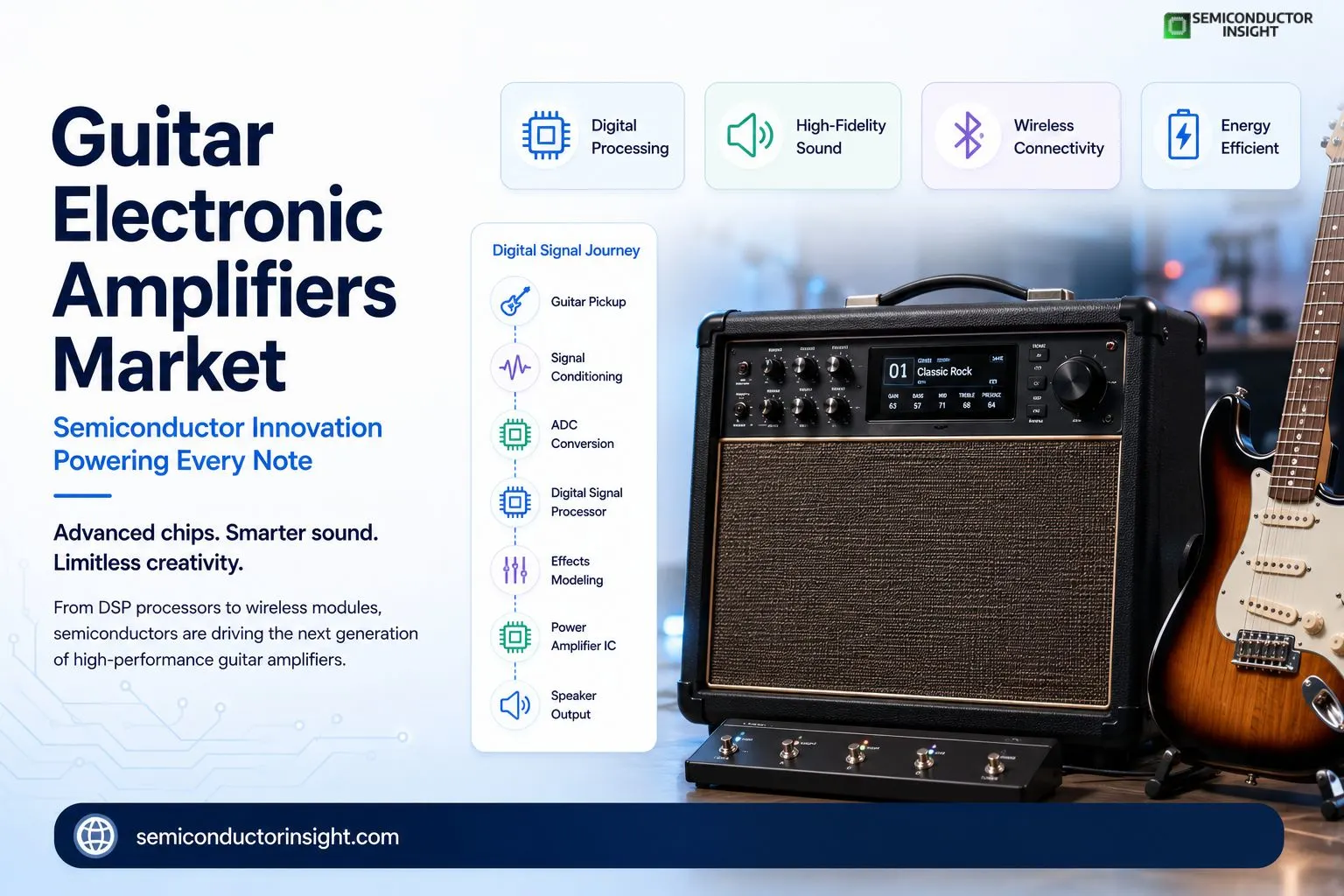
Digital Signal Journey
Guitar Pickup
│
Input Buffer Circuit
│
Analog Signal Conditioning
│
ADC Conversion
│
Digital Signal Processor
│
Effects Modeling
│
Power Amplifier IC
│
Speaker Output
This signal chain demonstrates how semiconductor devices perform nearly every stage of modern audio amplification.
The Statistics Underpinning the Growing Audio Electronics Industry
The growth of guitar electronic amplifiers reflects broader expansion within digital music production and live entertainment technologies.
Interesting industry indicators include:
- Global music streaming now serves more than 700 million paid subscribers, increasing demand for high-quality music production equipment.
- Professional digital amplifier processors commonly store 100-500 programmable presets.
- Compact practice amplifiers today often weigh under 5 kilograms, compared with traditional tube amplifiers exceeding 20 kilograms.
- Many wireless guitar systems now operate with latency below 5 milliseconds, creating nearly real-time performance.
- Premium amplifier modeling software can accurately emulate over 100 classic amplifier configurations within a single device.
Rather than focusing solely on loudness, manufacturers now prioritize processing speed, thermal efficiency, signal purity, and ultra-low distortion through advanced semiconductor integration.
For More Detailed Insights, You Can Surf Our Latest Report Here: https://semiconductorinsight.com/report/guitar-electronic-amplifiers-market/
Miniaturization Is Redefining Professional Music Equipment
One of the most remarkable changes in amplifier development is size reduction without sacrificing performance. Wide-bandgap semiconductor materials, efficient power management ICs, and compact surface-mount components allow manufacturers to build highly portable amplifiers suitable for touring musicians.
Gallium Nitride (GaN) and advanced MOSFET technologies are increasingly supporting lightweight power supplies capable of delivering substantial output while reducing heat generation. These innovations also improve energy efficiency, making amplifiers quieter and more reliable during extended performances.
Instead of carrying multiple large amplifier cabinets, musicians can now perform using compact digital units connected directly to professional sound systems through balanced digital outputs.
Artificial Intelligence Is Entering the Amplifier World
Artificial intelligence is beginning to influence amplifier development in practical ways. Several recent amplifier platforms can automatically analyze a guitar signal and recommend tone settings based on musical style. Others learn user preferences, organize preset libraries, and optimize equalization through embedded software algorithms.
Machine learning is also improving speaker simulation. Digital processors can now reproduce the acoustic behavior of vintage speaker cabinets with remarkable precision, eliminating the need for multiple physical cabinets in recording environments.
These capabilities illustrate how semiconductor processing power continues expanding creative possibilities for musicians worldwide.
Technology Evolution Map
Vacuum Tubes
↓
Solid State Circuits
↓
Integrated Circuits
↓
Digital Signal Processors
↓
Wireless Connectivity
↓
AI Assisted Tone Processing
Rather than replacing traditional amplifier character, modern electronics are enabling musicians to recreate and customize iconic sounds more efficiently.
Connectivity Has Become as Important as Sound Quality
Today’s amplifiers function as intelligent connected devices rather than standalone speakers. USB-C recording interfaces, Bluetooth audio streaming, Wi-Fi firmware updates, MIDI compatibility, and smartphone applications allow musicians to control amplifier settings remotely.
Recent product launches from leading audio manufacturers include cloud-based preset sharing, allowing thousands of guitarists to exchange professionally designed sound profiles through mobile applications. This software ecosystem continues expanding the value of semiconductor-enabled amplifiers beyond hardware alone.
Growing home recording communities, online music education, and livestream performances have further accelerated adoption of integrated recording features, reducing dependence on separate audio equipment.
Semiconductor Innovation Continues Expanding Creative Freedom
The modern guitar electronic amplifier represents one of the most impressive examples of semiconductor technology supporting artistic expression. Every improvement in digital processing, integrated power electronics, wireless communication, memory architecture, and intelligent software translates directly into richer sound, greater portability, and expanded creative possibilities. As audio electronics continue integrating AI capabilities, efficient semiconductor materials, and cloud-connected ecosystems, guitar amplifiers are evolving from traditional musical equipment into intelligent digital performance platforms capable of meeting the expectations of musicians across every stage, studio, and creative environment.

Comments (0)