
US CHIPS Act 2026 Update: Impact on Domestic Semiconductor Manufacturing
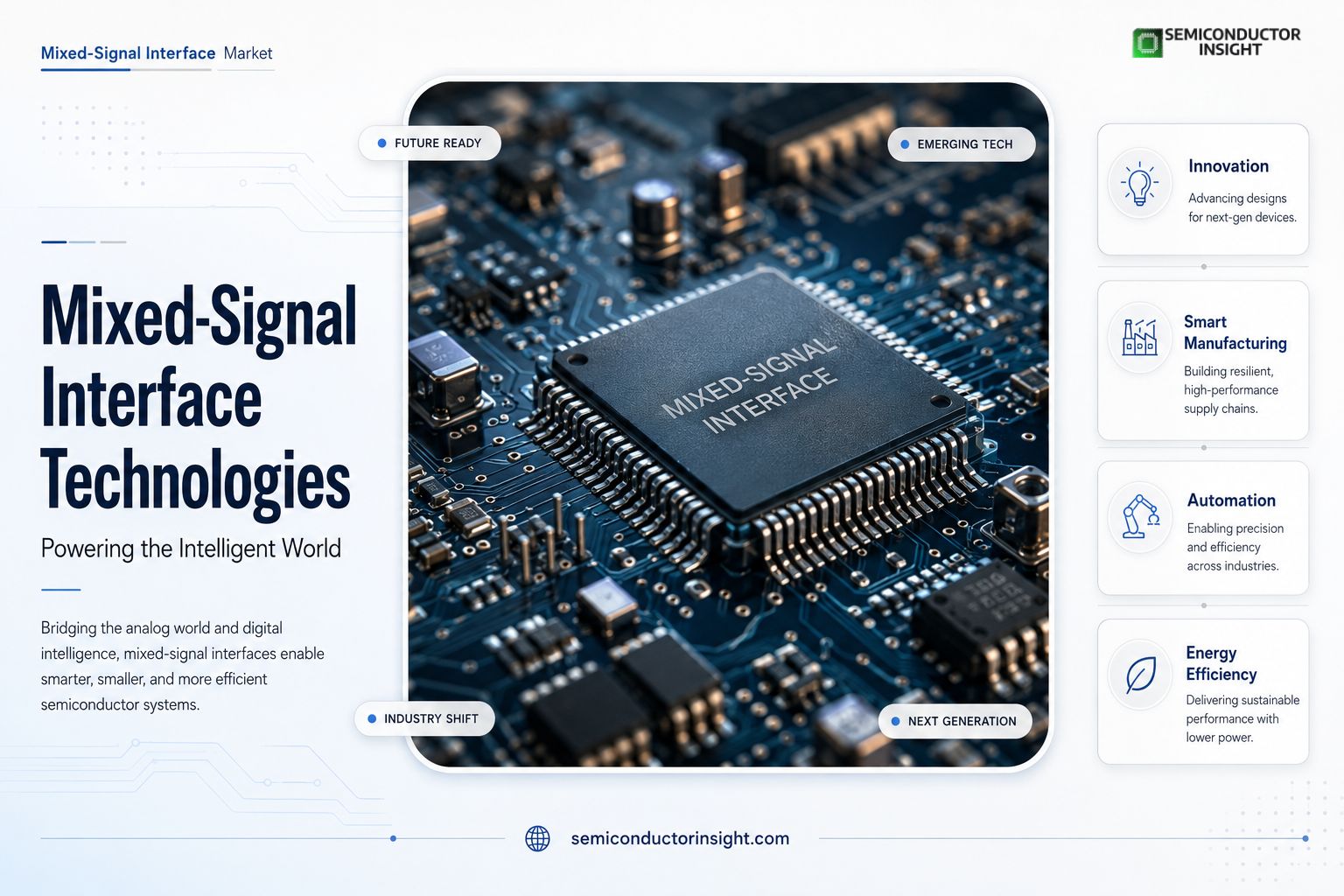
Mixed-signal interface technologies sit at the heart of nearly every smart device we touch today. These circuits gracefully combine analog signals from the physical world think temperature, sound, or light with digital processing that computers understand. Wikipedia explains that a mixed-signal integrated circuit places both analog and digital components on one semiconductor die, enabling efficient real-world interfacing through components like analog-to-digital converters (ADCs) and digital-to-analog converters (DACs).
This blending proves essential because the physical environment operates in continuous analog waves while modern systems run on binary digital logic. Engineers use these interfaces in mobile phones, automotive sensors, medical monitors, and IoT gadgets where seamless translation makes sophisticated functionality possible without bulky separate chips.
Core Building Blocks and Their Everyday Roles
At the foundation, mixed-signal interfaces handle data conversion with remarkable precision. Delta-sigma modulation in ADCs, for instance, delivers high-resolution audio in consumer devices while managing noise effectively. Digitally controlled sound chips and FM tuners in media players rely on these same principles for clear output.
In sensor systems, standardized digital interfaces such as I2C, SPI, or CAN allow easy communication between analog sensors and digital controllers. This setup appears across aerospace electronics, unmanned vehicles, and electric vehicles where reliability under varying conditions matters most.
Common Mixed-Signal Components and Uses
Modern semiconductor systems rely on a range of integrated analog components that perform critical functions within a single chip architecture. ADCs and DACs enable accurate signal conversion for applications such as audio processing systems and imaging sensors. Power Management ICs (PMICs) regulate voltage and improve energy efficiency in battery-powered electronics, electric vehicles, and portable devices. RF CMOS circuits support wireless communication by managing radio frequency signals in technologies such as 5G modems and Wi-Fi modules.
Meanwhile, Clock and Timing ICs ensure precise synchronization across high-speed data links, networking equipment, and advanced computing platforms. By integrating these functions into a single solution, manufacturers can reduce device size, lower production costs, improve power efficiency, and minimize signal interference compared with traditional multi-chip designs.
Government Initiatives Fueling Domestic Capabilities
Public investments play a visible role in strengthening mixed-signal production. The U.S. CHIPS and Science Act has directed substantial funding toward semiconductor manufacturing, including analog and mixed-signal technologies. Over $645 billion in private investments across more than 140 projects in 30 states since 2020 support facility expansions, creating tens of thousands of jobs.
Analog Devices, for example, received incentives to expand R&D and fabrication facilities in Massachusetts, Oregon, and Washington, focusing on mature-node and specialized processes critical for mixed-signal work. Similar efforts appear in Europe through the European Chips Act, which prioritizes analog and sensor components for automotive and industrial uses.
These programs emphasize supply chain resilience, helping bring more production closer to end markets while supporting innovation in power-efficient designs.
Flow of Mixed-Signal Design in Complex Systems
A typical project starts with understanding system requirements sensor inputs, processing needs, and output controls. Designers then create the analog front-end for signal conditioning before integrating digital logic for computation and interfaces. Verification combines waveform analysis for analog parts with digital simulation, often using advanced tools that bridge the two domains for faster iterations.
Unique Flow Pointers in Modern Projects:
- Start with environmental sensor data capture.
- Apply on-chip filtering and amplification.
- Convert to digital domain with minimal latency.
- Process via embedded logic or microcontrollers.
- Output refined signals for actuators or displays.
- Incorporate power optimization loops throughout.
This integrated approach shines in battery-powered wearables or autonomous vehicle radar systems where every milliwatt counts.
Spotlight on Current Global Instances
Recent automotive applications demonstrate the technology’s reach. Electric vehicles use mixed-signal interfaces for precise battery monitoring, motor control, and advanced driver-assistance sensors. In consumer electronics, smartphones integrate these circuits for high-quality cameras, touch interfaces, and audio experiences.
IoT deployments worldwide rely on low-power mixed-signal solutions for smart homes and industrial monitoring. One notable area involves medical devices, where compact interfaces enable portable monitors and implantable sensors that process vital signs accurately in real time.
Telecom infrastructure benefits too, with 5G base stations incorporating mixed-signal front-ends for efficient signal handling at high frequencies. Wikipedia notes applications in software-defined radio and network routers that handle both analog RF and digital packet processing on single chips.
At Last, before Ending, Don’t Forget to Browse Our Recent Exclusive Report for Detailed Insights: https://semiconductorinsight.com/report/mixed-signal-interface-market/
Innovation Pathways and Collaborative Efforts
Designers increasingly adopt programmable mixed-signal platforms that let engineers configure analog blocks alongside digital logic without full custom redesigns. This flexibility speeds development for specialized applications while maintaining performance.
University and industry partnerships, supported by government workforce programs under initiatives like the CHIPS Act, help train the next generation of engineers skilled in both analog and digital domains. Research labs explore ultra-low power techniques and better noise isolation for denser integrations.
- Enhanced integration for edge AI sensor nodes.
- Improved thermal and electromagnetic compatibility in compact packages.
- Support for multi-die systems linking specialized functions.
- Greater emphasis on security features within interfaces.
- Sustainability through reduced material use and energy profiles.
Connecting Technology to Broader Impact
Across industries, mixed-signal interface solutions quietly enable the connectivity and intelligence we expect from modern devices. From government-backed manufacturing expansions creating jobs and resilience to innovative designs powering healthcare and transportation advances, this segment continues bridging physical realities with digital possibilities on a global scale. As projects roll out in 2026 and beyond, these interfaces will remain foundational to technological progress.

Comments (0)