
Mixed-Signal Interface Market Insights
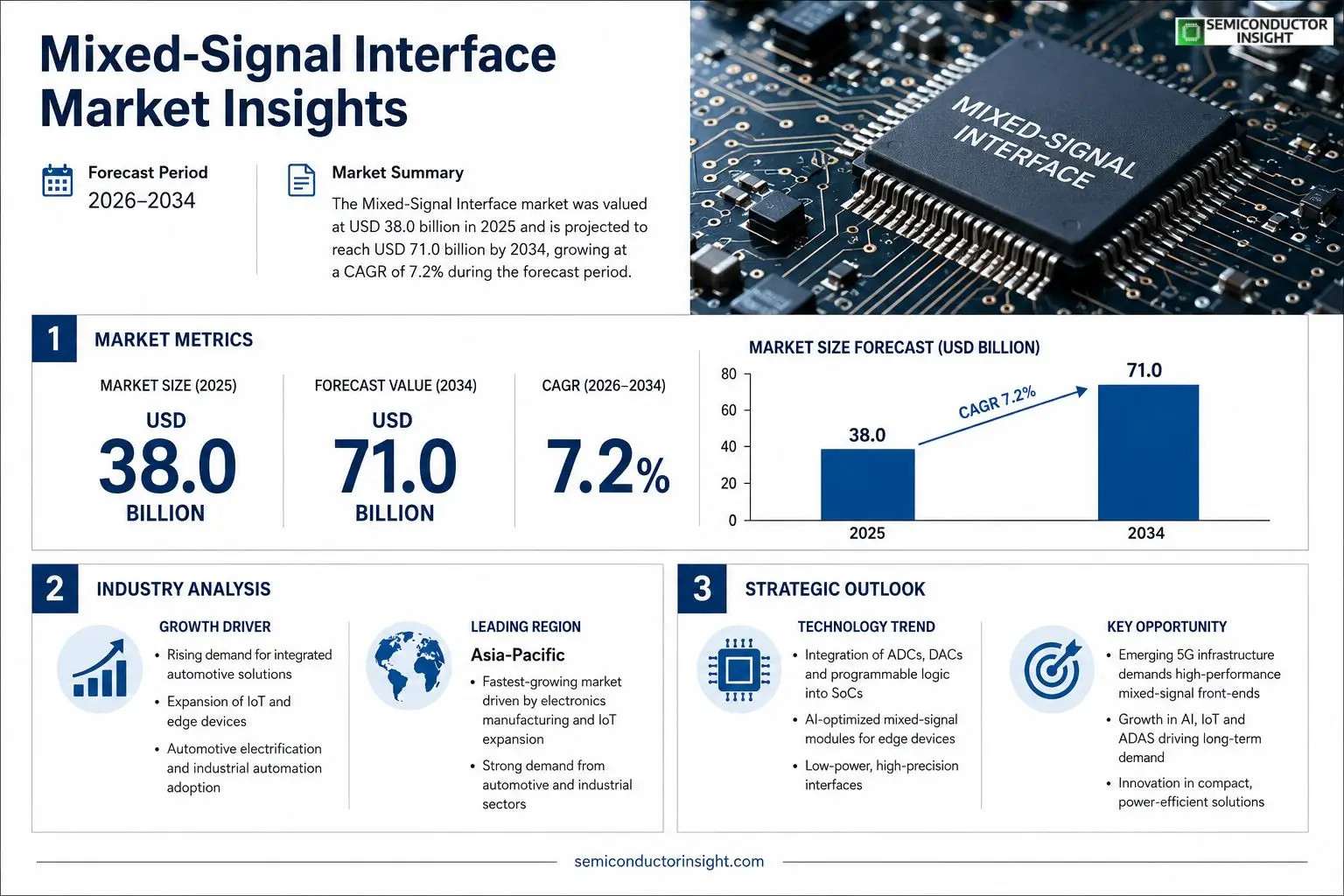
Mixed-Signal Interface market size was valued at USD 38.0 billion in 2025. The market is projected to grow from USD 38.0 billion in 2025 to USD 71.0 billion by 2034, exhibiting a CAGR of 7.2% during the forecast period.
Mixed‑Signal Interfaces combine analog front‑end circuitry with digital processing blocks on a single chip or module, enabling seamless conversion between continuous‑time signals (voltage/current) and discrete‑time data streams used by microcontrollers, processors or communication links.The market is experiencing rapid growth because demand for IoT edge devices, advanced driver‑assistance systems (ADAS) and AI‑enabled wearables continues to rise.
Furthermore, increasing adoption of automotive electrification and industrial automation drives higher integration of ADCs, DACs and programmable logic within compact form factors.
Key players such as Texas Instruments, Analog Devices, NXP Semiconductors and Infineon Technologies are expanding their portfolios; for example, in June 2023 Texas Instruments introduced its TMDS3000 mixed‑signal MCU family targeting low‑power sensor hubs.
MARKET DRIVERS
Rising Demand for Integrated Automotive Solutions
Mixed-Signal Interface Market is experiencing strong growth as automotive manufacturers seek tighter integration of sensor data and control units for advanced driver‑assistance systems (ADAS). Vehicles now require high‑precision analog‑to‑digital conversion to support radar, lidar, and camera modules, which fuels demand for scalable mixed‑signal interfaces that can reduce board space and improve reliability.
Expansion of IoT and Edge Devices
Concurrent growth in IoT and edge computing devices drives Mixed-Signal Interface Market. Edge sensors collect real‑time analog data that must be digitized locally; mixed‑signal chips provide the low‑latency conversion essential for predictive maintenance, smart home automation, and industrial monitoring.
➤ Mixed‑signal interfaces enable seamless analog‑digital integration, lowering bill‑of‑materials costs while improving power efficiency.
Overall, the convergence of automotive electrification, ubiquitous IoT deployment, and tighter power budgets positions Mixed-Signal Interface Market for sustained multi‑year expansion.
MARKET CHALLENGES
Design Complexity and Power Consumption
Designers must balance high precision with low power envelopes, especially in battery‑operated devices. The need for multi‑channel, high‑speed conversion increases circuit complexity, requiring advanced layout techniques that can extend development timelines.
Other Challenges
Regulatory Compliance
Products targeting medical and automotive sectors must meet stringent safety standards, adding verification overhead and potentially limiting rapid market entry for new mixed‑signal solutions.
MARKET RESTRAINTS
High Development Costs
Investing in mixed‑signal R&D requires specialized design tools and skilled engineers. The capital intensity can deter small and medium‑sized enterprises from entering Mixed-Signal Interface Market, consolidating market share among a few large players.
MARKET OPPORTUNITIES
Emerging 5G Infrastructure
The rollout of 5G networks introduces new high‑frequency front‑end modules that rely on precise mixed‑signal conversion to handle massive data streams. This creates a clear opportunity for vendors to innovate low‑latency, high‑bandwidth interfaces, expanding the overall addressable market.
Mixed-Signal Interface Market Trends
Rising Demand from Edge IoT and Automotive
Mixed-Signal Interface Market is experiencing a pronounced shift driven by the expansion of edge‑computing devices in the Internet of Things (IoT) ecosystem and the accelerating adoption of advanced driver‑assistance systems (ADAS) in automotive platforms. As manufacturers seek to reduce bill of materials and board space, they increasingly integrate analog‑to‑digital converters (ADCs), digital‑to‑analog converters (DACs) and programmable logic into single‑chip solutions. This consolidation improves signal integrity and power efficiency, two parameters critical for battery‑operated sensors and vehicle safety modules. The trend is reinforced by the need for high‑resolution data acquisition in wearable health monitors, where AI‑enabled processing requires fast, low‑latency conversion of physiological signals. Consequently, original equipment manufacturers are prioritizing mixed‑signal components that can operate across a broad temperature range while maintaining tight form‑factor constraints.
Other Trends
Integration of ADC/DAC Blocks into System‑on‑Chip Platforms
System‑on‑chip (SoC) architectures now embed high‑precision ADC and DAC blocks alongside microcontroller cores, delivering a unified interface for both analog sensing and digital control. This integration reduces external component count and shortens design cycles, a benefit highlighted by recent product launches from major vendors. For example, a leading semiconductor company introduced a low‑power mixed‑signal MCU family in mid‑2023 that targets sensor hubs for industrial automation and smart home applications. The device series offers 24‑bit ADC resolution and programmable gain amplifiers, enabling accurate measurement of low‑level signals without sacrificing energy efficiency. Industry analysts note that such SoC solutions are becoming the default choice for new product development, especially in sectors where ruggedness and miniaturization are paramount.
Adoption of AI‑Optimized Mixed‑Signal Modules
Another observable pattern is the growing incorporation of AI‑ready mixed‑signal modules in edge devices. These modules feature built‑in preprocessing capabilities that perform filtering, linearization and feature extraction directly on the analog front‑end, thereby offloading compute‑intensive tasks from the central processor. Mixed-Signal Interface Market therefore sees an increase in offerings that combine neural‑network accelerators with high‑speed converters, supporting real‑time inference for applications such as predictive maintenance and autonomous navigation. By delivering analytics at the point of measurement, manufacturers can achieve lower latency and reduced data transmission costs. The convergence of AI workloads with mixed‑signal technology is expected to shape product roadmaps throughout the next decade, reinforcing the market’s trajectory toward more intelligent, compact, and power‑aware solutions.
COMPETITIVE LANDSCAPEKey Industry Players
Mixed‑Signal Interface Market: Competitive Landscape Overview
Mixed‑Signal Interface market is dominated by a handful of large semiconductor firms that leverage deep analog‑digital integration expertise. Texas Instruments leads with its TMDS3000 mixed‑signal MCU family, targeting low‑power sensor hubs for IoT and automotive edge applications. Analog Devices follows closely, expanding its high‑performance ADC/DAC portfolios for ADAS and AI‑enabled wearables. NXP Semiconductors and Infineon Technologies round out the core quartet, each broadening system‑on‑chip (SoC) offerings that embed programmable logic alongside precision converters. These incumbents benefit from sizable R&D pipelines, extensive design‑win programs, and sales networks that enable them to capture the majority of the forecasted USD 71.0 billion market by 2034. Their strategies emphasize modular, scalable architectures that address the rapid electrification of automotive platforms and the proliferation of industrial automation nodes.
Beyond the leading quartet, a diverse set of niche players adds depth and specialization to the ecosystem. STMicroelectronics and Renesas Electronics focus on automotive‑grade mixed‑signal solutions, emphasizing reliability under harsh conditions. Microchip Technology and ON Semiconductor deliver cost‑effective ADC/DAC blocks for consumer and industrial IoT devices. Maxim Integrated (now part of Analog Devices) and Silicon Labs concentrate on ultra‑low‑power sensor interfaces for wearables. Qualcomm and Broadcom extend mixed‑signal functionality into wireless front‑ends, while Skyworks Solutions and Murata Manufacturing provide compact RF‑mixed‑signal modules for 5G and edge connectivity. These firms collectively enrich the market with targeted innovations, fostering competition that accelerates performance improvements and drives price efficiency.
List of Key Mixed‑Signal Interface Companies Profiled
- Texas Instruments
- Analog Devices
- NXP Semiconductors
- Infineon Technologies
- STMicroelectronics
- Renesas Electronics
- Microchip Technology
- ON Semiconductor
- Silicon Labs
- Qualcomm
- Broadcom
- Skyworks Solutions
- Murata Manufacturing
Segment Analysis:
| Segment Category | Sub-Segments | Key Insights |
| By Type |
|
Mixed‑Signal SoCs dominate because they merge conversion, processing and control on a single die, delivering strategic advantages for modern electronic ecosystems:
|
| By Application |
|
Automotive ADAS emerges as the leading application segment, driven by the need for precise sensor fusion and real‑time decision making in modern vehicles:
|
| By End User |
|
Tier‑1 Suppliers play a pivotal role, shaping specification trends and demanding flexible, high‑performance mixed‑signal solutions:
|
Regional Analysis: North America
United States
The proliferation of electric vehicles (EVs) is a major catalyst, demanding advanced power management and control systems relying heavily on mixed-signal interfaces. Similarly, the expansion of industrial IoT necessitates robust and reliable mixed-signal connectivity for sensors and control devices. Furthermore, the consumer electronics sector continues to drive demand through features like advanced audio processing, high-resolution displays, and sophisticated communication capabilities. The competitive landscape is populated by both established semiconductor giants and emerging specialized players, all vying for market share through innovation and strategic partnerships.
The automotive sector is a major consumer of advanced mixed-signal interfaces for applications ranging from engine control and braking systems to infotainment and driver-assistance technologies. The increasing complexity of modern vehicles necessitates highly integrated and reliable mixed-signal solutions.
Industrial automation relies heavily on mixed-signal interfaces for precise control, data acquisition, and communication in various manufacturing and industrial processes. The demand for robust and reliable solutions is driven by the need for increased efficiency and productivity.
Consumer electronics continue to drive demand for mixed-signal interfaces in devices such as smartphones, laptops, and audio equipment, enabling advanced features and functionalities. The focus is on power efficiency and integration in compact form factors.
The aerospace and defense industries utilize mixed-signal interfaces for critical applications requiring high reliability and performance, including communication systems, radar systems, and avionics.
Europe
Europe presents a substantial market for Mixed-Signal Interface Market, driven by strong industrial foundations and a growing focus on technological advancement. The automotive sector in Europe is a significant consumer, particularly with the rapid transition towards electric and autonomous vehicles. The increasing adoption of IoT solutions in industrial and smart city applications also fuels demand. Key trends include a focus on energy efficiency and miniaturization of electronic components. European businesses are actively investing in research and development to maintain a competitive edge. The regulatory landscape, particularly concerning data privacy and security, influences the design and deployment of mixed-signal interface solutions.
Asia-Pacific
Asia-Pacific is emerging as the fastest-growing market for Mixed-Signal Interface Market, propelled by robust economic expansion and increasing electronics manufacturing activity. China, in particular, represents a dominant force, with significant demand from the consumer electronics, automotive, and industrial sectors. The region’s focus on 5G infrastructure and the growth of IoT are further boosting market growth. Businesses in Asia-Pacific are increasingly focused on cost-effective solutions and catering to the specific needs of local industries. The competitive landscape is characterized by a mix of domestic and international players.
South America
South America offers a moderate growth opportunity for Mixed-Signal Interface Market, driven by the expansion of the automotive and industrial sectors. Brazil is the largest market in the region, with increasing demand for electronics in various applications. The growing adoption of telecommunications infrastructure and the expansion of IoT are also contributing to market growth. However, economic uncertainties and varying regulatory environments pose challenges.
Middle East & Africa
The Middle East & Africa represents a relatively nascent market for Mixed-Signal Interface Market, with growth potential linked to infrastructure development and increasing investments in technology. The automotive industry in countries like Saudi Arabia and the UAE is driving demand. The expansion of telecommunications and the growing adoption of smart city initiatives are also creating opportunities. However, the market is characterized by diverse economic conditions and varying levels of technological adoption.
Report Scope
This market research report provides a comprehensive analysis of the Mixed-Signal Interface Market , covering the forecast period 2026–2034. It offers detailed insights into market dynamics, technological advancements, competitive landscape, and key trends shaping the industry.
Key focus areas of the report include:
- Market Overview: The report begins with an overview outlining its current market scenario, key growth indicators, and industry transformation drivers. It discusses macroeconomic factors, demand–supply balance, regulatory landscape, and the strategic role of semiconductors in powering advancements across industries such as automotive, telecommunications, consumer electronics, and industrial automation.
- Market Size & Forecast: Historical data and future projections for revenue, unit shipments, and market value across major regions and segments.
- Segmentation Analysis: Detailed breakdown by product type, technology, application, and end-user industry to identify high-growth segments and investment opportunities.
- Regional Insights: Insights into market performance across North America, Europe, Asia-Pacific, Latin America, and the Middle East & Africa, including country-level analysis where relevant.
- Competitive Landscape: Profiles of leading market participants, including their product offerings, R&D focus, manufacturing capacity, pricing strategies, and recent developments such as mergers, acquisitions, and partnerships.
- Technology Trends & Innovation: Assessment of emerging technologies, integration of AI/IoT, semiconductor design trends, fabrication techniques, and evolving industry standards.
- Market Drivers & Restraints: Evaluation of factors driving market growth along with challenges, supply chain constraints, regulatory issues, and market-entry barriers.
- Stakeholder Insights: Insights for component suppliers, OEMs, system integrators, investors, and policymakers regarding the evolving ecosystem and strategic opportunities.
Primary and secondary research methods are employed, including interviews with industry experts, data from verified sources, and real-time market intelligence to ensure the accuracy and reliability of the insights presented.
FREQUENTLY ASKED QUESTIONS:
What is the current market size of Mixed-Signal Interface Market?
-> Mixed-Signal Interface Market was valued at USD 38.0 billion in 2025 and is expected to reach USD 71.0 billion by 2034, exhibiting a CAGR of 7.2% during the forecast period.
Which key companies operate in Mixed-Signal Interface Market?
-> Key players include Texas Instruments, Analog Devices, NXP Semiconductors, and Infineon Technologies, among others.
What are the key growth drivers?
-> Key growth drivers include rising demand for IoT edge devices, advanced driver‑assistance systems (ADAS), AI‑enabled wearables, automotive electrification, and industrial automation.
Which region dominates the market?
-> The reference data does not specify a single dominant region for Mixed‑Signal Interface market.
What are the emerging trends?
-> Emerging trends include greater integration of ADCs, DACs and programmable logic, increased adoption of AI/IoT‑enabled mixed‑signal solutions, and the push toward compact, low‑power sensor hubs.
Get Sample Report PDF for Exclusive Insights
Report Sample Includes
- Table of Contents
- List of Tables & Figures
- Charts, Research Methodology, and more...
 Download Sample Report PDF



