
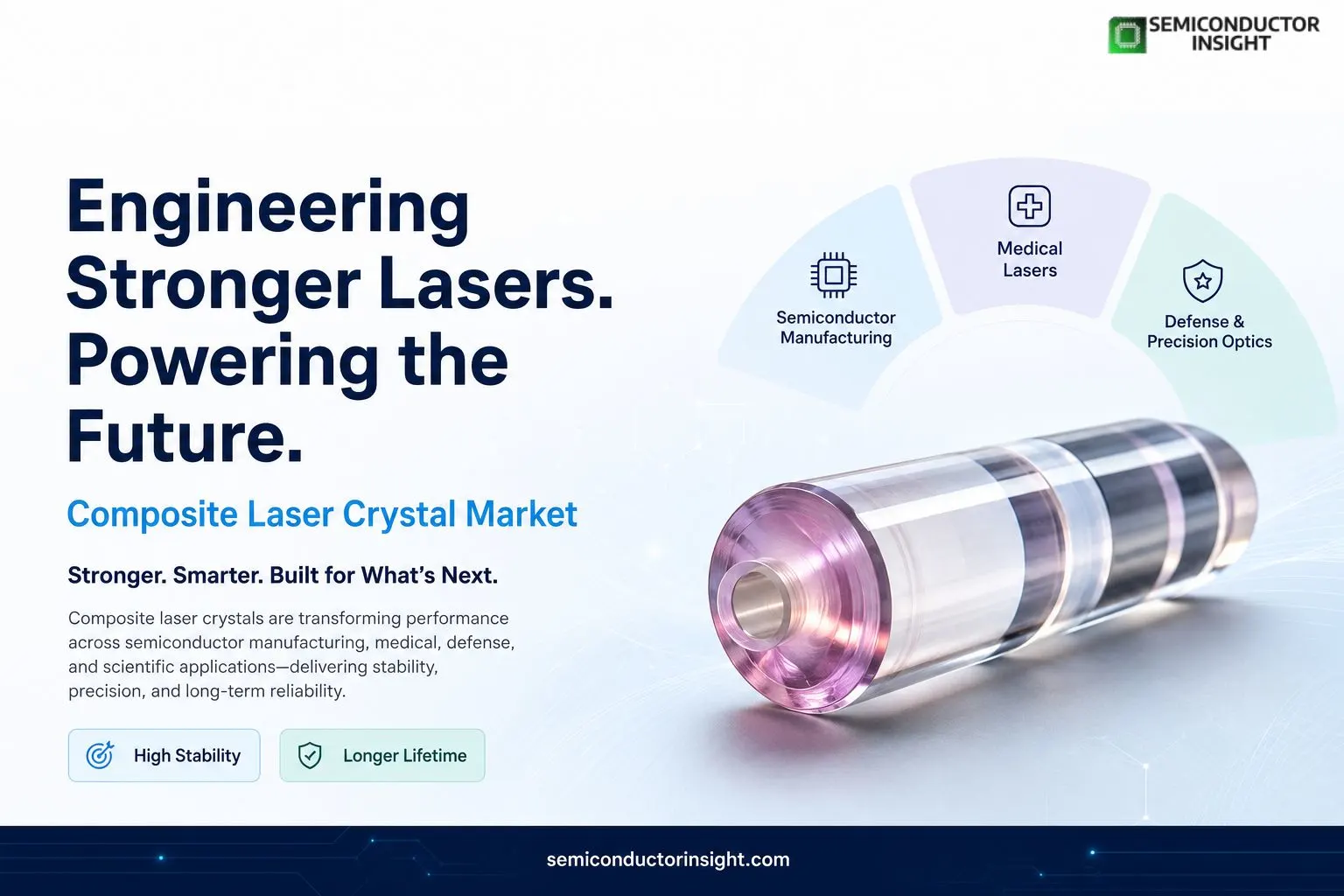
Top Leading Diffusion Bonding Trends Shaping 2026: Composite Laser Crystal Designs
Composite laser crystals have quietly become one of the most influential materials behind modern laser systems. Unlike conventional single-crystal gain media, composite structures combine multiple crystal sections into a single optical component, improving thermal management, beam stability, and operational reliability. These properties make them highly valuable in semiconductor manufacturing, medical lasers, defense optics, precision machining, and scientific instrumentation where consistent laser performance is essential.
The increasing complexity of semiconductor fabrication, especially for advanced nodes and photonic devices, is creating fresh demand for laser sources capable of operating continuously with minimal distortion. Composite laser crystals are emerging as a preferred solution because they extend component lifetime while supporting higher output power and greater efficiency.
Why Composite Crystal Engineering Has Become a Turning Point?
Traditional laser crystals often experience thermal gradients that reduce beam quality during prolonged operation. Composite laser crystals address this issue by bonding undoped and doped crystal sections into a unified structure, allowing heat to dissipate more effectively.
Modern diffusion bonding technologies now produce interfaces with optical losses measured in only a few parts per million. This advancement enables manufacturers to build compact laser modules capable of maintaining excellent beam quality even under demanding industrial operating conditions.
As semiconductor equipment continues moving toward faster processing speeds and tighter manufacturing tolerances, thermal stability has become as important as laser power itself.
Precision Manufacturing Is Creating New Growth Opportunities
- Laser-based semiconductor fabrication depends on exceptional positional accuracy. Composite laser crystals are increasingly integrated into systems used for wafer dicing, laser annealing, micro drilling, and precision marking.
- According to industry publications and semiconductor equipment data, global semiconductor fabrication capacity exceeded 30 million wafer starts per month during 2025, while advanced fabrication facilities continue expanding across Asia, North America, and Europe.
- Every new production line increases demand for reliable industrial laser sources capable of operating around the clock.
- Manufacturers are also adopting composite crystal architectures in picosecond and nanosecond laser platforms where thermal distortion can directly affect manufacturing accuracy.
Research Laboratories Continue Expanding Material Innovation
Universities and national laboratories remain major contributors to composite laser crystal development. Organizations in Japan, Germany, China, France, and the United States are studying new crystal combinations that improve thermal conductivity and optical efficiency.
Recent experimental work has focused on diffusion-bonded Nd:YAG, Yb:YAG, Tm:YAG, and Ho:YAG composite structures designed for higher pulse energy and longer operational lifetimes.
Several laboratories are also exploring ceramic-composite laser materials capable of reducing production complexity while maintaining optical performance comparable to single-crystal alternatives.
Want to learn more about the report? Check out our latest updated version for free: https://semiconductorinsight.com/report/composite-laser-crystal-market/
Medical and Scientific Lasers Are Raising Performance Standards
Healthcare systems increasingly rely on high-quality laser beams for ophthalmology, dermatology, dentistry, and minimally invasive surgery. Composite laser crystals help maintain output stability during continuous operation, reducing maintenance requirements for clinical laser equipment.
Scientific facilities are equally benefiting. High-energy research lasers used for spectroscopy, nonlinear optics, and quantum experiments require exceptional beam consistency that composite crystal architectures can provide.
Worldwide, thousands of research-grade solid-state laser systems operate in universities, government laboratories, and industrial research centers, supporting continuous demand for advanced laser gain materials.
The Semiconductor Industry Is Moving Toward Smarter Laser Platforms
- Artificial intelligence is beginning to optimize industrial laser systems through predictive maintenance and automatic beam calibration. Composite laser crystals complement these intelligent platforms by providing stable optical performance over extended operating cycles.
- Equipment manufacturers are integrating temperature sensors, adaptive cooling systems, and AI-assisted diagnostics that continuously monitor laser health. Stable crystal performance allows these software systems to operate more accurately while reducing unexpected downtime.
- As semiconductor fabs pursue lights-out manufacturing, dependable laser components become increasingly valuable.
Sustainability Is Influencing Crystal Manufacturing
Manufacturers are paying closer attention to material efficiency during crystal growth and finishing processes. Improved diffusion bonding techniques reduce waste while increasing usable crystal yield.
Several production facilities have introduced automated polishing, precision inspection, and recycling systems for crystal processing materials. These improvements not only lower manufacturing waste but also improve consistency across production batches, an important requirement for semiconductor-grade laser equipment.
Energy-efficient solid-state laser systems incorporating composite crystals also contribute to lower operational power consumption compared with older laser architectures in selected industrial applications.
Innovation Is Expanding Beyond Traditional Laser Designs
- Composite laser crystals are no longer limited to improving existing laser architectures.
- Researchers are combining advanced crystal engineering with integrated photonics, ultrafast laser systems, quantum optics, and next-generation semiconductor manufacturing tools.
As chip fabrication becomes increasingly dependent on precision laser processing, composite crystal technologies will continue supporting higher power density, improved thermal performance, and longer operating lifetimes. Rather than serving as a supporting material, composite laser crystals are becoming a strategic building block for the future of photonics and semiconductor innovation.

Comments (0)