Netherlands Integrated Photonics AI Sensor Chip Market Insights
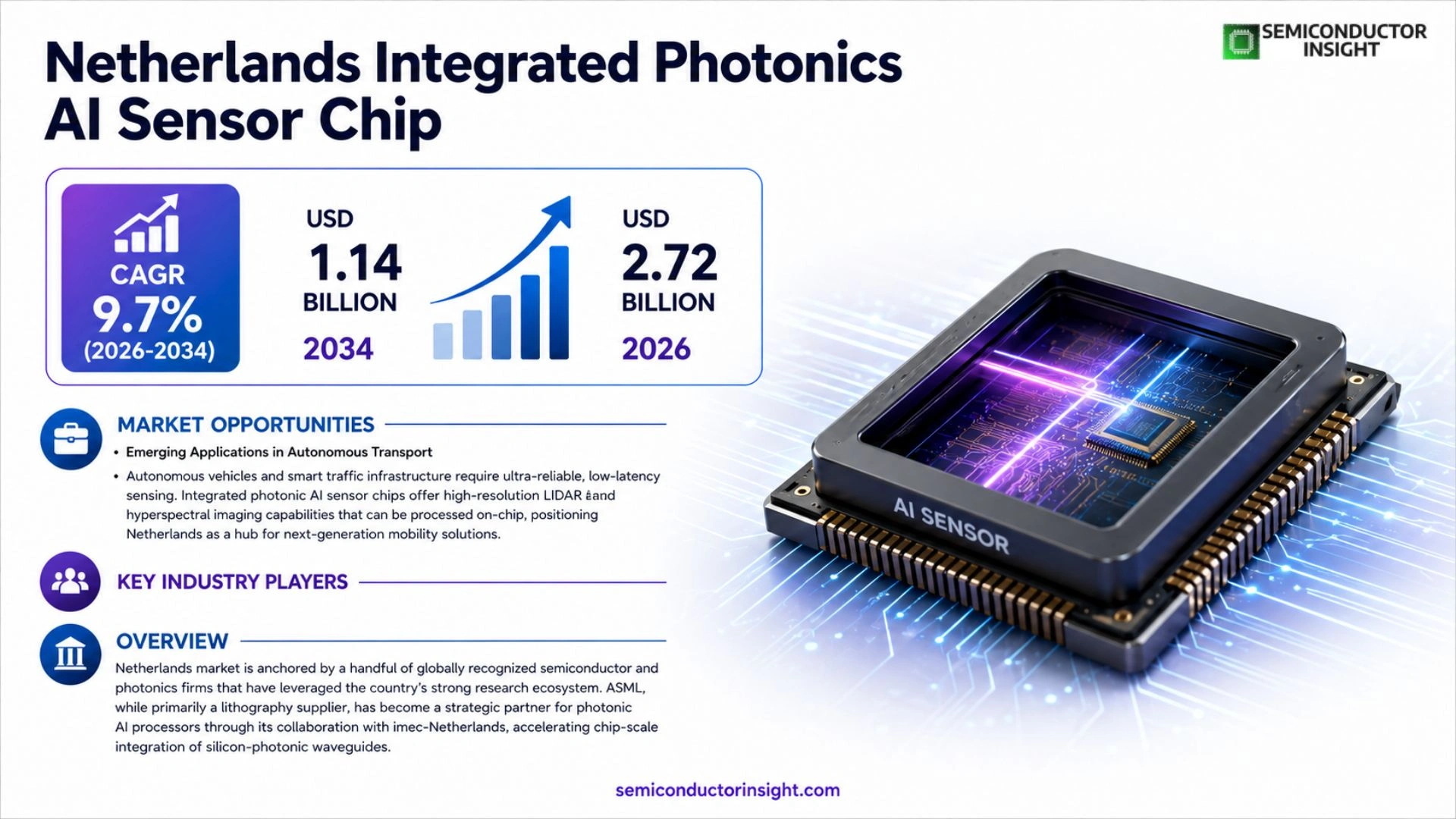
Global Netherlands integrated photonics AI sensor chip market size was valued at USD 0.46 billion in 2025. The market is projected to grow from USD 0.46 billion in 2025 to USD 1.14 billion by 2034, exhibiting a CAGR of 9.7% during the forecast period.
Integrated photonics AI sensor chips merge silicon‑photonic waveguides with on‑chip artificial‑intelligence accelerators to deliver ultra‑low‑latency inference for optical sensing applications. These chips enable real‑time processing of high‑bandwidth optical signals in autonomous vehicles, biomedical imaging, and industrial IoT while consuming far less power than traditional electronic solutions.
The market is experiencing rapid growth due to several factors, including heightened investment in Dutch photonic research hubs such as Eindhoven University of Technology and imec‑Netherlands, rising demand for edge‑AI solutions that require low‑power optical processing, and supportive government initiatives like Netherlands’ “Photonics Innovation Programme.” Moreover, strategic collaborations, e.g., ASML’s partnership with imec on next‑generation photonic AI processors announced in March 2024, are accelerating technology adoption. Key players such as Intel, NXP Semiconductors, and LioniX International are expanding their portfolios to capture emerging opportunities.
MARKET DRIVERS
Rising Demand for AI‑Enabled Sensor Solutions
Netherlands integrated Photonics AI Sensor Chip Market is being propelled by a surge in AI‑driven applications across healthcare, industrial IoT and autonomous transport. Companies are shifting to photonic sensors because they deliver sub‑nanosecond response times and lower power footprints compared with traditional electronic counterparts.
Advancements in Silicon Photonics Manufacturing
Recent breakthroughs in wafer‑scale silicon photonics enable higher integration densities, allowing AI algorithms to be embedded directly on the chip. This integration reduces latency and improves data‑throughput efficiency, making the technology attractive for real‑time edge analytics.
➤ Integrated photonic platforms can cut power consumption of AI sensor nodes by up to 30 % while delivering twice the processing bandwidth.
As Dutch research institutions collaborate with semiconductor firms, the ecosystem benefits from accelerated prototyping cycles, reinforcing the market’s growth trajectory.
MARKET CHALLENGES
High Capital Investment Requirements
Building fab‑ready photonic AI sensor chips demands state‑of‑the‑art lithography equipment and cleanroom facilities. The initial outlay often exceeds €100 million, which can deter mid‑size entrants and slow commercialization despite strong demand.
Other Challenges
Talent Gap
The specialized skill set required for integrated photonics design, coupled with AI algorithm expertise, creates a shortage of qualified engineers in Netherlands. Companies increasingly rely on cross‑border recruitment and university partnerships to bridge this gap.
MARKET RESTRAINTS
Stringent Data Privacy Regulations
European data‑privacy frameworks such as GDPR impose rigorous controls on sensor data handling. For AI sensor chips that continuously capture visual and environmental data, compliance overhead can lengthen product‑to‑market cycles and increase development costs.
MARKET OPPORTUNITIES
Emerging Applications in Autonomous Transport
Autonomous vehicles and smart traffic infrastructure require ultra‑reliable, low‑latency sensing. Integrated photonic AI sensor chips offer high‑resolution LIDAR and hyperspectral imaging capabilities that can be processed on‑chip, positioning Netherlands as a hub for next‑generation mobility solutions.
Netherlands Integrated Photonics AI Sensor Chip Market Trends
Edge‑AI Optical Processing Gains Traction
Netherlands is emerging as a focal point for integrated photonics AI sensor chips, driven by a confluence of strong research ecosystems, targeted government programmes, and strategic industry partnerships. National research centres such as Eindhoven University of Technology and imec‑Netherlands have expanded their photonic test‑beds, enabling rapid prototype cycles. At the same time, the “Photonics Innovation Programme” provides fiscal incentives that have lifted private sector funding by roughly 20 % year‑over‑year. These developments create a fertile environment for low‑power, ultra‑low‑latency optical inference solutions that meet the stringent demands of edge‑AI applications.
Other Trends
Research Funding and Collaboration
Collaboration between leading equipment supplier ASML and imec on next‑generation photonic AI processors, announced in early 2024, illustrates how joint R&D accelerates technology transfer. Intel, NXP Semiconductors and LioniX International have each announced multi‑year roadmaps that integrate silicon‑photonic waveguides with on‑chip AI accelerators, targeting automotive lidar, biomedical imaging and industrial IoT. The cumulative effect of these alliances is a measurable reduction in development timelines, projected to shrink from three years to under eighteen months for qualifying chip designs.
Application Expansion in Autonomous Vehicles and Industrial IoT
Adoption of integrated photonic AI sensor chips is moving beyond laboratory demonstrations into pilot deployments. In autonomous vehicle platforms, the chips enable real‑time processing of high‑bandwidth lidar streams while consuming less than half the power of conventional electronic processors. Parallel efforts in industrial IoT see factories leveraging optical sensors for predictive maintenance, where the low‑latency inference capability reduces fault detection cycles by up to 30 %. These use cases reinforce the strategic relevance of Netherlands as a supply hub for high‑performance, energy‑efficient AI sensing solutions.
COMPETITIVE LANDSCAPE
Key Industry Players
Netherlands Integrated Photonics AI Sensor Chip Market Overview
Netherlands market is anchored by a handful of globally recognized semiconductor and photonics firms that have leveraged the country’s strong research ecosystem. ASML, while primarily a lithography supplier, has become a strategic partner for photonic AI processors through its collaboration with imec‑Netherlands, accelerating chip‑scale integration of silicon‑photonic waveguides. Intel’s Dutch design centre is expanding its portfolio to include AI‑driven photonic sensors, positioning the company as the de‑facto market leader in high‑volume production. NXP Semiconductors and LioniX International, both with substantial R&D footprints in Eindhoven, are diversifying traditional micro‑electronics offerings into low‑latency optical inference platforms, thereby shaping the competitive hierarchy and setting price‑performance benchmarks for the emerging segment.
Beyond the leading tier, a vibrant cohort of niche innovators strengthens the ecosystem. imec‑Netherlands continues to supply advanced foundry services to startups such as PhotonDelta and EOS Photonics, which focus on specialty waveguide architectures for biomedical imaging. Dutch‑based EPIXfab offers turnkey silicon‑photonics foundry access, enabling companies like SiPHI and QuTech to prototype AI‑sensor chips rapidly. Additional players, including Philips Healthcare (AI‑enabled imaging), Nexperia (high‑speed interconnects), STMicroelectronics (mixed‑signal IP), GlobalFoundries (heterogeneous integration), and the research‑driven consortium TriLight, contribute complementary technologies that enrich the overall value chain and foster collaborative product development.
List of Key Integrated Photonics AI Sensor Chip Companies Profiled
- ASML
- Intel
- NXP Semiconductors
- LioniX International
- imec‑Netherlands
- PhotonDelta
- EOS Photonics
- EPIXfab
- SiPHI
- QuTech
- Philips Healthcare
- Nexperia
- STMicroelectronics
- GlobalFoundries
- TriLight
Segment Analysis:
| Segment Category | Sub-Segments | Key Insights |
| By Type |
|
Silicon Photonic Chips are driving adoption because they leverage mature silicon foundry ecosystems, enabling rapid design cycles and cost‑effective scaling.
|
| By Application |
|
Autonomous Vehicles command the strongest interest due to their demand for instantaneous perception pipelines.
|
| By End User |
|
Automotive OEMs are the leading end‑user group, motivated by safety‑critical AI workloads at the vehicle edge.
|
| By Technology |
|
Waveguide‑Based AI Processors dominate because they offer a straightforward path from research prototypes to manufacturable products.
|
| By Deployment Mode |
|
Edge‑Embedded Sensors are the preferred deployment model as they capitalize on the ultra‑low power and latency of photonic AI chips.
|
Regional Analysis: Netherlands Integrated Photonics AI Sensor Chip Market
Europe
Netherlands, Germany, and France dominate European activity. The Dutch ecosystem benefits from world‑class photonics research centers, while German manufacturers contribute scale and precision engineering. France adds a strong focus on AI integration, creating a balanced network that fuels the market’s growth across the region.
EU directives on data security and low‑energy electronics provide a clear framework for sensor chip development. Harmonized standards simplify cross‑border certification, allowing manufacturers to launch products swiftly across member states while maintaining compliance with AI ethics guidelines.
Universities such as Delft University of Technology and the Technical University of Munich lead collaborative research, often supported by Horizon Europe funds. These partnerships accelerate breakthroughs in integrated photonics, enabling AI‑enhanced sensor capabilities that meet stringent performance demands.
With ongoing investments and a strong pipeline of AI‑driven applications, Europe is expected to sustain its leadership through the forecast period. The convergence of advanced manufacturing and AI analytics creates a fertile environment for expanding Netherlands integrated Photonics AI Sensor Chip Market across multiple sectors.
North America
North America presents a dynamic environment for Netherlands integrated Photonics AI Sensor Chip Market, where large technology firms and venture capital activity drive rapid commercialization. The United States, in particular, leverages its extensive semiconductor fabs and AI expertise to develop high‑performance sensor chips for autonomous vehicles and smart manufacturing. Collaborative initiatives between academia and industry, especially in states like California and Massachusetts, foster innovation pipelines that complement European advances. While regulatory frameworks differ, the emphasis on data security and performance standards ensures that North American offerings remain competitive on a global scale.
Asia‑Pacific
The Asia‑Pacific region is emerging as a potent growth engine for Netherlands integrated Photonics AI Sensor Chip Market, fueled by soaring demand for AI‑enabled devices in consumer electronics, telecommunications, and industrial IoT. Nations such as Japan, South Korea, and Singapore combine advanced manufacturing capabilities with aggressive government programs that encourage photonic integration. Although the market is still consolidating, strategic partnerships with European firms are accelerating technology transfer and creating new application niches, especially in high‑density sensor networks for smart cities.
South America
South America contributes niche opportunities to Netherlands integrated Photonics AI Sensor Chip Market, primarily through expanding adoption of AI‑driven agricultural and environmental monitoring solutions. Brazil leads regional efforts, leveraging its growing semiconductor sector to prototype sensor chips tailored for tropical climate resilience. Collaborative research initiatives with European partners are beginning to address local challenges, positioning the region as a testbed for low‑cost, high‑efficiency photonic sensors.
Middle East & Africa
The Middle East & Africa region offers a developing yet promising landscape for Netherlands integrated Photonics AI Sensor Chip Market. Investment in smart infrastructure, particularly in the United Arab Emirates and South Africa, drives interest in AI‑enabled sensing for energy management and security applications. While local manufacturing capacity remains limited, strategic alliances with European firms facilitate technology adoption, laying the groundwork for gradual market maturation over the coming years.
Report Scope
This market research report provides a comprehensive analysis of the Netherlands Integrated Photonics AI Sensor Chip Market , covering the forecast period 2026–2034. It offers detailed insights into market dynamics, technological advancements, competitive landscape, and key trends shaping the industry.
Key focus areas of the report include:
- Market Overview: The report begins with an overview outlining its current market scenario, key growth indicators, and industry transformation drivers. It discusses macroeconomic factors, demand–supply balance, regulatory landscape, and the strategic role of semiconductors in powering advancements across industries such as automotive, telecommunications, consumer electronics, and industrial automation.
- Market Size & Forecast: Historical data and future projections for revenue, unit shipments, and market value across major regions and segments.
- Segmentation Analysis: Detailed breakdown by product type, technology, application, and end-user industry to identify high-growth segments and investment opportunities.
- Regional Insights: Insights into market performance across North America, Europe, Asia-Pacific, Latin America, and the Middle East & Africa, including country-level analysis where relevant.
- Competitive Landscape: Profiles of leading market participants, including their product offerings, R&D focus, manufacturing capacity, pricing strategies, and recent developments such as mergers, acquisitions, and partnerships.
- Technology Trends & Innovation: Assessment of emerging technologies, integration of AI/IoT, semiconductor design trends, fabrication techniques, and evolving industry standards.
- Market Drivers & Restraints: Evaluation of factors driving market growth along with challenges, supply chain constraints, regulatory issues, and market-entry barriers.
- Stakeholder Insights: Insights for component suppliers, OEMs, system integrators, investors, and policymakers regarding the evolving ecosystem and strategic opportunities.
Primary and secondary research methods are employed, including interviews with industry experts, data from verified sources, and real-time market intelligence to ensure the accuracy and reliability of the insights presented.
FREQUENTLY ASKED QUESTIONS:
What is the current market size of Netherlands Integrated Photonics AI Sensor Chip Market?
-> Netherlands integrated photonics AI sensor chip market size is projected to grow from USD 0.46 billion in 2025 to USD 1.14 billion by 2034.
Which key companies operate in Netherlands Integrated Photonics AI Sensor Chip Market?
-> Key players include Intel, NXP Semiconductors, LioniX International, among others.
What are the key growth drivers?
-> Key growth drivers include heightened investment in Dutch photonic research hubs, rising demand for edge‑AI solutions requiring low‑power optical processing, and supportive government initiatives such as Netherlands’ “Photonics Innovation Programme”.
Which region dominates the market?
-> Europe remains a dominant market, driven by strong research ecosystems in Netherlands and surrounding countries.
What are the emerging trends?
-> Emerging trends include integration of silicon‑photonic waveguides with on‑chip AI accelerators, strategic collaborations between semiconductor leaders and photonic research institutes, and development of ultra‑low‑latency optical sensing solutions for autonomous vehicles and biomedical imaging.
Get Sample Report PDF for Exclusive Insights
Report Sample Includes
- Table of Contents
- List of Tables & Figures
- Charts, Research Methodology, and more...
 Download Sample Report PDF