
Top 5 Major Leading Regions for Inertial Measurement Unit Market Expansion in Autonomous Technology
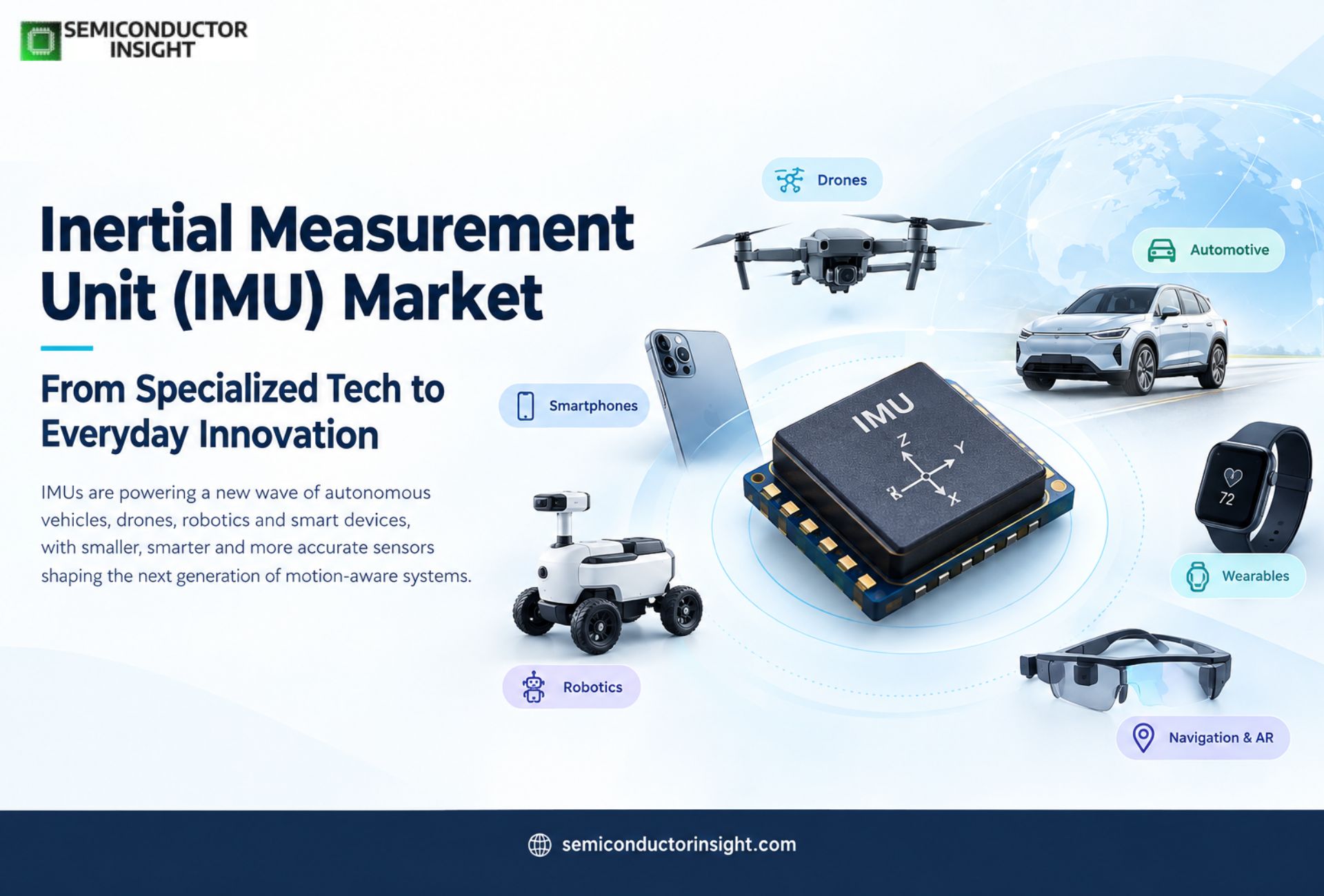
An inertial measurement unit, commonly known as an IMU, has moved from being a specialized aerospace component to becoming an important sensing layer inside vehicles, drones, robots, smartphones, wearables, navigation equipment and augmented reality systems. Modern IMUs combine accelerometers and gyroscopes to measure movement, orientation and changes in motion.
– STMicroelectronics, for example, describes six-axis IMUs combining accelerometer and gyroscope functions for motion tracking, indoor navigation, localization, wearables and AR applications.
The real change in the IMU landscape is coming from machines that must understand their position without depending entirely on satellite signals. Autonomous vehicles, delivery robots, drones, industrial equipment and navigation systems increasingly require continuous motion information. This is pushing IMUs toward smaller packages, lower power consumption, higher accuracy and better integration with other sensors.
Asia Pacific Turns Low-Altitude Technology into a Large IMU Application Base
Asia Pacific stands out because automotive production, consumer electronics, robotics and drone deployment are concentrated across several major manufacturing economies. China alone recorded 3.287 million registered industry drones at the end of 2025, up 51% from the previous year. Drone flight time reached 45.3029 million hours.
The IMU opportunity extends beyond drones. China, Japan, South Korea and India are major locations for vehicle manufacturing, electronics production and robotics development. India’s drone ecosystem also exceeded 38,500 registered drones and 39,890 DGCA-certified remote pilots by February 2026, while drones had been used to survey 3.28 lakh villages under SVAMITVA.
North America Connects IMUs with Aviation, Mobility and Defense Technology
North America remains an important environment for high-performance inertial sensing because of its aerospace, aviation, autonomous mobility and industrial technology base. The scale of aviation alone creates a substantial installed environment for navigation and avionics technologies.
The FAA reported 173,589 equipped U.S. aircraft as of July 1, 2026, including 112,418 general aviation fixed-wing aircraft and 3,290 international air carrier aircraft. IMUs are relevant to navigation, stabilization, flight control and motion reference systems across these types of platforms.
Europe Builds IMU Demand around Electrification and Automated Mobility
Europe’s IMU opportunity is strongly connected with automotive engineering, advanced manufacturing and automated mobility. ACEA reported 260 automobile assembly, engine, electric motor and battery production plants operating across the EU and UK in 2026. Of these, 127 plants assemble battery-electric vehicles.
The installed vehicle base is also substantial. There were 256 million passenger cars on EU roads in 2024, alongside roughly 31.1 million vans, 6.2 million trucks and around 700,000 buses. These vehicles create applications for motion sensing, electronic stability, navigation, advanced driver assistance and increasingly automated driving architectures.
You can freely browse our most recent updated report to learn more about it before scrolling further: https://semiconductorinsight.com/report/inertial-measurement-unit-imu-market/
Latin America Opens New IMU Applications through Agriculture and Drones
Latin America presents a different route for IMU adoption, with agricultural technology, surveying, infrastructure inspection and unmanned aircraft creating practical demand. Brazil has been expanding regulated drone applications, particularly in agriculture. Brazil’s Ministry of Agriculture reported in June 2025 that agricultural drone activity had accelerated following national regulation introduced for the sector.
For agricultural drones, IMUs help maintain flight stability, orientation and movement measurements while aircraft operate over large fields. Brazil’s aviation authority also maintains an official database of registered drones and authorized aircraft projects, including BVLOS drone operations approved in 2025 and 2026.
Middle East and Africa Push IMUs into Autonomous Transport and Smart Infrastructure
The Middle East is developing another important application pathway through autonomous transportation, smart-city infrastructure, aviation and unmanned systems. Saudi Arabia launched the initial operational phase of autonomous vehicles in Riyadh in July 2025 as part of its broader smart transportation program.
Autonomous vehicles depend on continuous movement and orientation information, particularly when positioning systems need additional sensor inputs. This creates opportunities for automotive-grade IMUs in autonomous shuttles, robotaxis, logistics vehicles and connected infrastructure. Across the wider Middle East and Africa, similar applications can emerge around surveying, drones, logistics and infrastructure monitoring.
What Comes Next for IMU Design?
The technology is moving toward compact multi-axis sensing, sensor fusion, improved calibration and application-specific performance. Consumer electronics continue to use IMUs for motion interfaces, optical stabilization, activity monitoring and AR, while industrial and automotive platforms demand greater reliability and precision.
The strongest expansion story is therefore not limited to one device category. IMUs are becoming an underlying sensing component for machines that need to understand movement in real time. From China’s rapidly expanding drone ecosystem to Europe’s automotive manufacturing base and North America’s aviation infrastructure, regional demand is increasingly being shaped by the transition toward autonomous, connected and motion-aware systems.

Comments (0)