
Through Hole Current Sensing Resistor Market Expanding Across Semiconductor Manufacturing
Power management has become one of the most critical aspects of modern semiconductor systems. As electronic devices grow more complex and energy efficiency becomes a priority, accurate current monitoring is essential for maintaining system stability. Within this evolving landscape, Through Hole Current Sensing Resistor Market is gaining attention for its role in providing reliable current measurement across a wide range of electronic circuits.
Through-hole current sensing resistors are designed to measure electrical current by producing a voltage drop proportional to the current flowing through the resistor. These components are widely used in power supplies, motor control units, battery management systems, and industrial electronics. Their durability and ability to handle higher power loads make them particularly valuable in applications where thermal stability and mechanical strength are required.
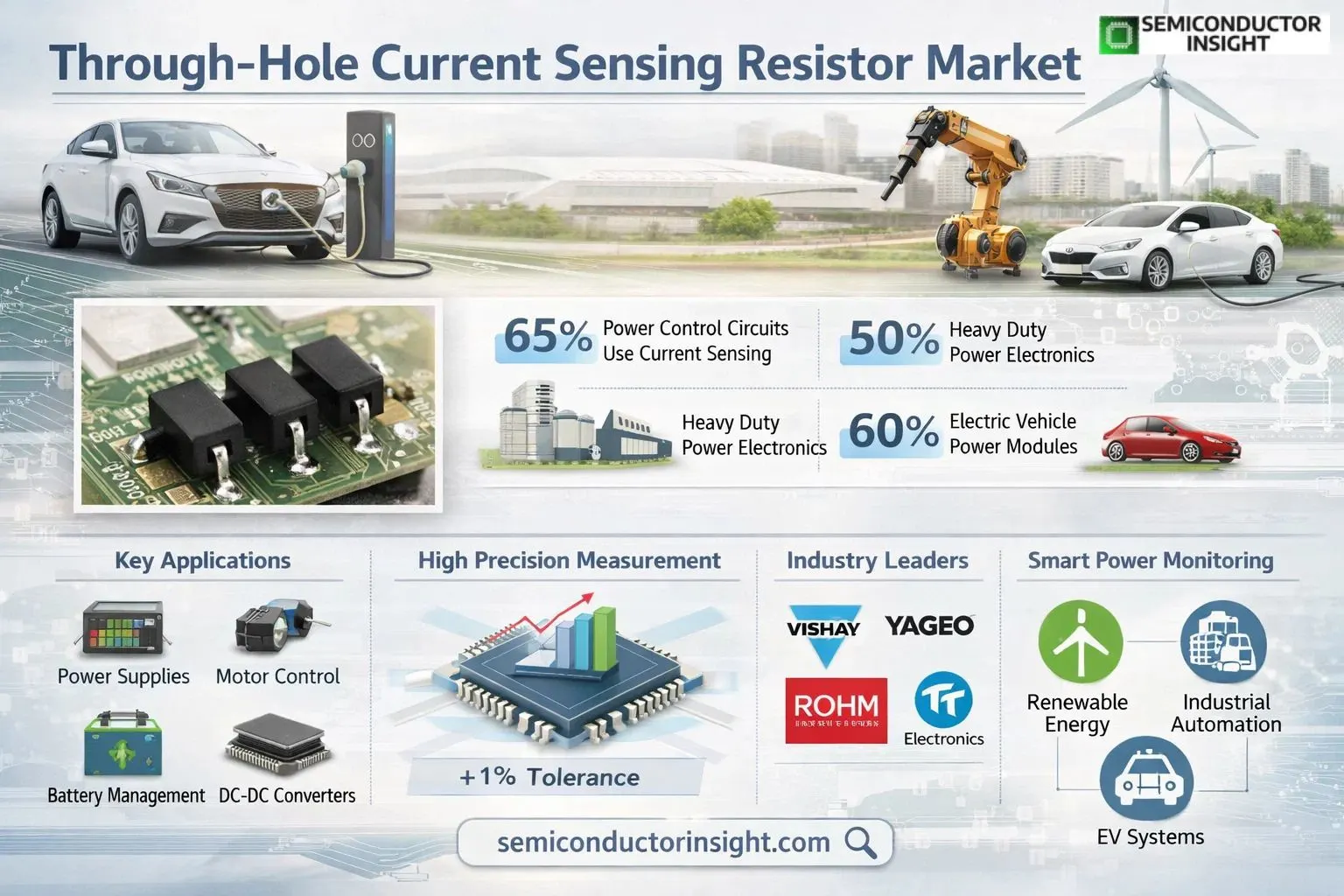
Across global electronics manufacturing, current sensing components are integrated into nearly 65% of power control circuits, reflecting their growing importance in both consumer and industrial electronics.
The Impact of Precision Components on Smart Power Monitoring
In semiconductor-based systems, power efficiency and circuit protection depend heavily on accurate current sensing. Through-hole resistors are specifically designed to deliver stable resistance values even under fluctuating current loads.
Unlike surface-mount alternatives, these resistors offer strong mechanical connections and enhanced heat dissipation. This makes them ideal for applications where electrical loads are high and long-term reliability is essential.
Industrial equipment manufacturers report that more than 50% of heavy-duty power electronics systems still rely on through-hole components due to their robustness and ability to handle higher thermal stress.
The ability to maintain precise measurement under demanding conditions has made current sensing resistors a key element in modern power monitoring architectures.
Power Electronics Driving Semiconductor Demand
- The increasing complexity of semiconductor devices has significantly expanded the role of current sensing technologies. Modern integrated circuits must carefully monitor power consumption to prevent overload, overheating, and energy losses.
- Through-hole sensing resistors are commonly used in voltage regulators, switching power supplies, and DC-DC converters. These components enable engineers to measure current flow and adjust power distribution accordingly.
- In high-performance computing systems and industrial automation equipment, nearly 45% of power regulation circuits incorporate current sensing resistors to maintain energy efficiency and operational stability.
- As semiconductor manufacturers continue to develop advanced power management chips, demand for reliable sensing components continues to rise.
Automotive Electrification Expanding Application Scope
The rapid growth of electric mobility has created new opportunities for sensing components used in battery monitoring and power management. Electric vehicles require continuous monitoring of current flow across battery packs, charging systems, and motor controllers.
Through-hole sensing resistors are widely used in automotive power electronics because they can withstand high current loads and extreme temperature variations. Automotive engineers rely on these components to maintain stable performance in electric drivetrain systems.
Studies show that nearly 60% of electric vehicle power modules include current sensing technology to ensure safe battery operation and efficient energy distribution.
As electric mobility continues to expand globally, sensing resistors are becoming essential elements in vehicle electronics architecture.
You can freely browse our most recent updated report to learn more about it before scrolling further: https://semiconductorinsight.com/report/through-hole-current-sensing-resistor-market/
Semiconductor Manufacturing and Component Integration
Semiconductor fabrication facilities and electronics assembly plants increasingly rely on precise passive components to ensure circuit reliability. Through-hole current sensing resistors are often used during prototyping and testing stages because they are easier to replace and evaluate compared with surface-mount alternatives.
These components also play an important role in industrial equipment used for semiconductor manufacturing itself. Power regulation systems within fabrication plants require precise current monitoring to maintain consistent production conditions.
Across semiconductor manufacturing environments, around 35% of power monitoring modules integrate through-hole sensing resistors during early design and testing phases.
The durability and accuracy of these components make them valuable not only in final electronic products but also within the manufacturing infrastructure that produces semiconductors.
Technology Enhancements Improving Measurement Accuracy
Advancements in materials and resistor design have significantly improved the performance of modern sensing components. Manufacturers are developing alloys and metal strip technologies that deliver lower resistance tolerance and improved temperature stability.
Modern sensing resistors can achieve tolerance levels below 1% variation, allowing engineers to measure electrical current with high precision. This is particularly important in systems where even small fluctuations can affect performance or safety.
Another development is the introduction of high-power metal element resistors capable of handling heavy electrical loads while maintaining accurate current measurement.
These innovations are strengthening the role of power monitoring technologies in advanced electronic systems.
Industry Players Supporting Component Innovation
- Vishay Intertechnology is recognized for its extensive range of precision resistors and power measurement components used in automotive, industrial, and consumer electronics.
- Yageo Corporation manufactures high-reliability resistors designed for power electronics, telecommunications equipment, and computing systems.
- Another important contributor is ROHM Semiconductor, which develops advanced sensing resistors tailored for automotive electronics and battery management systems.
- Meanwhile, TT Electronics focuses on high-performance sensing technologies used in aerospace, industrial automation, and medical electronics.
Expanding Role in Intelligent Electronics Systems
The growth of smart electronics, renewable energy systems, and electrified transportation is placing greater emphasis on accurate current measurement technologies. Power monitoring circuits are now integrated into a wide variety of devices ranging from solar inverters and robotics systems to industrial automation platforms.
As electronics systems continue to demand greater energy efficiency and reliability, the Through Hole Current Sensing Resistor Market is becoming increasingly relevant to semiconductor design and power electronics engineering.
With ongoing innovation in semiconductor components, the expanding need for current sensing resistors, and the rising importance of power monitoring, these specialized components remain fundamental to the performance and safety of modern electronic systems.

Comments (0)