Market Insights
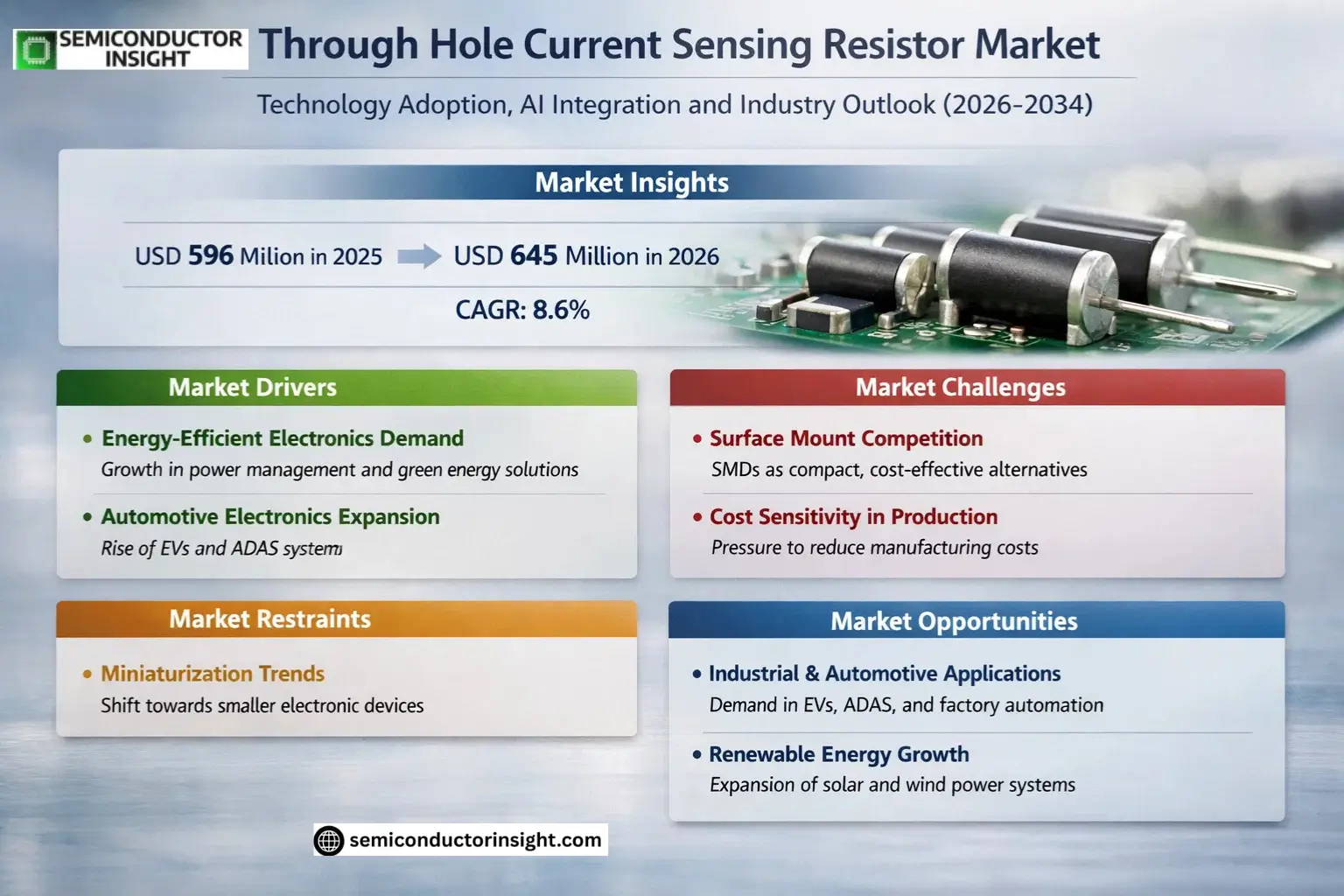
Global Through Hole Current Sensing Resistor Market size was valued at USD 596 million in 2025. The market is projected to grow from USD 645 million in 2026 to USD 1,058 million by 2034, exhibiting a CAGR of 8.6% during the forecast period.
Through Hole Current Sensing Resistors are low-resistance components mounted on circuit boards via through-hole technology, designed to measure current flow accurately in electronic circuits. These resistors play a critical role in applications requiring precise current monitoring, such as power supplies, automotive systems, and industrial controls. Their construction typically involves alloy-based materials like manganese copper, which ensures stability and low temperature coefficient of resistance (TCR).
The market growth is driven by increasing demand for electrification across automotive and industrial sectors, where accurate current measurement is essential for efficiency and safety. Additionally, advancements in power electronics and the rise of renewable energy systems further propel adoption. Key manufacturers focus on enhancing product performance through innovations in material science and precision manufacturing techniques.
MARKET DRIVERS
Growing Demand for Energy-Efficient Electronics
Through Hole Current Sensing Resistor Market is experiencing growth due to increasing demand for energy-efficient power management solutions. These resistors play a crucial role in measuring current flow accurately in applications like power supplies, battery management systems, and industrial automation.
Expansion of Automotive Electronics
With the rise of electric vehicles and advanced driver-assistance systems (ADAS), the automotive sector is driving demand for high-precision through hole current sensing resistors. These components are essential for monitoring battery systems and power distribution in modern vehicles.
The increasing adoption of renewable energy systems and smart grid technologies further contributes to market expansion, requiring reliable current measurement solutions.
MARKET CHALLENGES
Competition from Surface Mount Technology
Through Hole Current Sensing Resistor Market faces significant competition from surface mount devices (SMDs), which offer smaller form factors and better suitability for automated assembly processes in high-volume manufacturing.
Other Challenges
Cost Sensitivity in Mass Production
While through hole resistors offer reliability advantages, price pressure in consumer electronics makes it challenging to compete with lower-cost alternatives.
Technical Limitations
Through hole components inherently have higher parasitic inductance compared to surface mount variants, which can affect performance in high-frequency applications.
MARKET RESTRAINTS
Miniaturization Trends in Electronics
The ongoing trend toward smaller electronic devices is limiting the adoption of through hole current sensing resistors in certain applications where board space is at a premium. Consumer electronics manufacturers increasingly favor SMD alternatives for their compact designs.
MARKET OPPORTUNITIES
Industrial and Automotive Applications
Through hole current sensing resistors continue to find strong demand in industrial and automotive applications where mechanical stability and long-term reliability are prioritized over space constraints. The growth of electric vehicle charging infrastructure presents significant opportunities for market expansion.
Renewable Energy Sector Growth
The increasing adoption of solar power systems and wind energy installations requires robust current measurement solutions, creating new opportunities for through hole current sensing resistors in power conversion and distribution applications.
Through Hole Current Sensing Resistor Market Trends
Electrification Fuels Demand Growth
Through Hole Current Sensing Resistor Market is experiencing significant growth driven by increasing electrification across industries. Automotive electronics, particularly in electric vehicles and energy storage systems, rely heavily on these components for accurate current measurement in battery management systems (BMS) and power conversion units. Industrial automation applications such as servo drives, robotics, and frequency converters are also contributing to market expansion, requiring higher precision and thermal stability from current sensing solutions.
Other Trends
Material Innovation and Product Differentiation
Manufacturers are focusing on advanced alloy formulations and improved Kelvin connection designs to enhance performance characteristics. Preferred materials like manganese copper alloys dominate high-precision applications due to their superior temperature coefficient of resistance (TCR) properties. The industry is seeing increased adoption of 4-terminal designs that minimize measurement errors by separating current and voltage sensing paths.
Regional Market Developments
Asia Pacific maintains dominance in Through Hole Current Sensing Resistor production and consumption, with China, Japan, and South Korea leading in both manufacturing and application development. North America and Europe show strong demand from automotive and industrial sectors, with increasing requirements for certified components meeting stringent quality standards. Emerging markets are seeing growth in consumer electronics applications while gradually adopting higher-end industrial solutions.
Competitive Landscape Shifts
The market features established players like YAGEO, Vishay, and ROHM competing on both volume production and specialized solutions. Smaller manufacturers are carving niches in customized high-power applications through superior thermal management capabilities. Industry consolidation continues as companies seek to expand product portfolios and geographic reach while maintaining profitability amid raw material price volatility.
Technology and Application Evolution
Through Hole Current Sensing Resistor designs are evolving to meet the needs of next-generation power electronics. Higher power density requirements are driving innovations in heat dissipation and structural integration, with some manufacturers offering hybrid solutions combining resistive elements with busbar assemblies. The market continues to value proven through-hole mounting for its mechanical robustness in high-vibration environments compared to surface-mount alternatives.
COMPETITIVE LANDSCAPE
Key Industry Players
Strategic Positioning in the $1.06 Billion Through Hole Current Sensing Resistor Market
Through Hole Current Sensing Resistor Market is dominated by established electronics component manufacturers with specialized alloy material expertise. YAGEO Group leads the global market with approximately 18% revenue share, leveraging its extensive passive component portfolio and manufacturing scale. Vishay Intertechnology and ROHM follow closely, particularly in automotive-grade and industrial applications where precision and reliability are critical. These top players maintain competitive advantage through vertical integration of material processing and advanced calibration capabilities for low-TCR (temperature coefficient of resistance) products.
Niche leaders like Isabellenhütte differentiate through patented alloy formulations and Kelvin connection technology, commanding premium pricing in electric vehicle battery monitoring systems. KOA Speer and TT Electronics have strengthened positions in the medium-power segment (1W-10W), while Ohmite and Stackpole Electronics focus on high-current custom solutions. The market also features specialized European manufacturers like Vitrohm and Danotherm that cater to aerospace and medical applications with ultra-high precision requirements.
List of Key Through Hole Current Sensing Resistor Companies Profiled
- YAGEO Corporation
- Vishay Intertechnology
- ROHM Semiconductor
- Isabellenhütte
- KOA Speer Electronics
- Ohmite Manufacturing
- TT Electronics
- Stackpole Electronics
- TE Connectivity
- Bourns Instruments
- Vishay Precision Group
- Caddock Electronics
- Vitrohm Technology
- Miba AG
- Danotherm Electric
Segment Analysis:
| Segment Category | Sub-Segments | Key Insights |
| By Type |
|
Power Package emerges as the leading segment due to superior heat dissipation and structural stability:
|
| By Application |
|
Automotive Electronics drives significant demand with electrification trends:
|
| By End User |
|
OEMs dominate procurement through integrated system designs:
|
| By Power Rating |
|
Medium-Power resistors show balanced growth across applications:
|
| By Material Technology |
|
Alloy-based technology maintains industry preference:
|
Regional Analysis: Asia-Pacific Through Hole Current Sensing Resistor Market
Chinese industrial zones are accelerating adoption of through hole current sensing resistors for motor control and power distribution monitoring, with manufacturers developing high-temperature resistant variants for harsh factory environments.
Through hole resistor demand grows alongside China’s EV charging station rollout, where precise current measurement ensures safety in high-power DC charging systems using specialized low-ohm, high-power resistors.
Resistor producers are implementing AI-driven predictive maintenance on through hole component lines, reducing defect rates while meeting stringent automotive qualification requirements from domestic EV makers.
Solar inverter manufacturers increasingly specify through hole current sensing resistors with enhanced surge capacity, driving product innovations among Chinese component suppliers serving the solar power sector.
South Korea
South Korea’s through hole current sensing resistor market benefits from strong semiconductor and display manufacturing sectors. Local manufacturers emphasize precision resistors for equipment power monitoring, with increasing adoption in 5G base station power supplies. Technology partnerships between resistor producers and power IC designers yield compact solutions meeting space constraints in industrial automation systems.
Japan
Japanese through hole resistor demand remains steady in automotive and robotics applications, with manufacturers focusing on high-reliability components for hybrid vehicle power systems. Aging factory equipment replacement drives need for robust current sensing solutions in industrial motor drives, where Japanese firms maintain technology leadership.
India
India’s through hole current sensing resistor market grows with expanding electronics manufacturing and renewable energy investments. Domestic producers develop cost-optimized solutions for solar inverters and UPS systems, while import dependency remains for high-precision automotive grade components as local EV production scales up.
ASEAN Countries
Southeast Asian markets show increasing through hole resistor adoption in consumer electronics manufacturing and industrial equipment. Local assembly of power supplies and motor drives creates opportunities for mid-range current sensing components, though technical support limitations constrain high-end applications.
Report Scope
This market research report provides a comprehensive analysis of the Through Hole Current Sensing Resistor Market, covering the forecast period 2025–2034. It offers detailed insights into market dynamics, technological advancements, competitive landscape, and key trends shaping the industry.
Key focus areas of the report include:
- Market Overview: The report begins with an overview outlining its current market scenario, key growth indicators, and industry transformation drivers. It discusses macroeconomic factors, demand-supply balance, regulatory landscape, and the strategic role of current sensing resistors in powering advancements across industries such as automotive electronics, industrial control, consumer electronics, and energy systems.
- Market Size & Forecast: Historical data and future projections for revenue, unit shipments, and market value across major regions and segments.
- Segmentation Analysis: Detailed breakdown by product type, core materials, power rating, and application to identify high-growth segments and investment opportunities.
- Regional Insights: Insights into market performance across North America, Europe, Asia, South America, and the Middle East & Africa, including country-level analysis where relevant.
- Competitive Landscape: Profiles of leading market participants, including their product offerings, R&D focus, manufacturing capacity, pricing strategies, and recent developments such as mergers, acquisitions, and partnerships.
- Technology Trends & Innovation: Assessment of emerging technologies, material advancements, manufacturing techniques, and evolving industry standards.
- Market Drivers & Restraints: Evaluation of factors driving market growth along with challenges, supply chain constraints, regulatory issues, and market-entry barriers.
- Stakeholder Insights: Insights for component suppliers, OEMs, system integrators, investors, and policymakers regarding the evolving ecosystem and strategic opportunities.
Primary and secondary research methods are employed, including interviews with industry experts, data from verified sources, and real-time market intelligence to ensure the accuracy and reliability of the insights presented.
FREQUENTLY ASKED QUESTIONS:
What is the current market size of Through Hole Current Sensing Resistor Market?
-> Through Hole Current Sensing Resistor Market size was valued at USD 596 million in 2025. The market is projected to grow from USD 645 million in 2026 to USD 1,058 million by 2034, exhibiting a CAGR of 8.6% during the forecast period.
Which key companies operate in Through Hole Current Sensing Resistor Market?
-> Key players include YAGEO, Vishay, ROHM, Isabellenhütte, KOA Speer, Ohmite, TT Electronics, Stackpole Electronics, TE Connectivity, Bourns, and Vishay Precision Group, among others.
What are the key growth drivers?
-> Key growth drivers include automotive electrification, industrial automation, energy system upgrades, and increasing power density requirements across various applications. The report also highlights the demand for accurate current measurement in BMS, OBC/DC-DC, and inverters.
Which region dominates the market?
-> Asia is the dominant market, with China, Japan, and South Korea being major contributors. The region accounts for significant production and consumption of through-hole current sensing resistors.
What are the emerging trends?
-> Emerging trends include advancements in alloy materials (such as manganese copper), development of 4-terminal/Kelvin resistors, and increasing demand for high-precision, low-TCR series with better thermal management.
What is the average price of Through Hole Current Sensing Resistors?
-> The average price is approximately USD 2.20 per unit, with variations based on product type, precision requirements, and customization.

Get Sample Report PDF for Exclusive Insights
Report Sample Includes
- Table of Contents
- List of Tables & Figures
- Charts, Research Methodology, and more...
 Download Sample Report PDF