
Three Dimensional Transistor Market 2025: Driving Next-Gen Semiconductor Performance
As semiconductor technology pushes toward smaller nodes, conventional planar transistors are nearing physical limits in terms of power efficiency, leakage current, and switching speed.
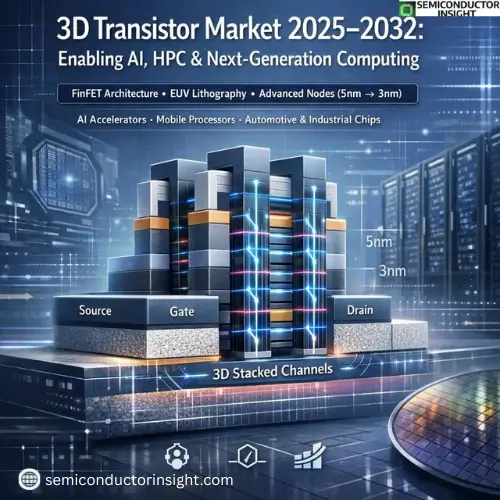
Three-dimensional (3D) transistors, commonly known as FinFETs, overcome these limitations by stacking channels vertically and increasing gate control. This structure allows higher transistor density, lower power consumption, and faster switching, making them a backbone of modern CPUs and GPUs, and also high-performance computing (HPC) systems.
The growing demand for AI, 5G, and edge computing accelerates the adoption of 3D transistors. These chips are no longer luxury enhancements; they are essential for sustaining Moore’s Law in high-performance and mobile devices.
Before Moving Forward, Go through Our Latest Updated Report:
https://semiconductorinsight.com/report/three-dimensional-transistor-market/
Market Growth Drivers
- Miniaturization of Semiconductor Nodes: Traditional planar transistors face short-channel effects at sub-10nm nodes. 3D transistors mitigate these effects.
- High-Performance Computing: Data centres, AI accelerators, and cloud computing rely on fast, energy-efficient transistors.
- Mobile Device Optimization: Smartphones and tablets require low-power, thermally stable transistors to improve battery life and performance.
- Foundry Expansion: Semiconductor manufacturers such as TSMC, Intel, and Samsung are integrating 3D transistors into advanced fabrication nodes like 5nm and 3nm.
- 3D transistor demand is also fuelled by custom chip designs for automotive electronics, IoT, and industrial automation, where reliability and efficiency are paramount.
Technology Trends Driving 3D Transistor Adoption
- FinFET Design Enhancements:
- Thinner fins and optimized gate structures reduce leakage and improve current flow.
- EUV Lithography Integration:
- Enables precise patterning of sub-5nm structures for high-density transistor layouts.
- Heterogeneous Integration:
- Combines logic, memory, and accelerators on a single die, leveraging 3D transistors for space efficiency.
- Thermal and Power Optimization:
- Vertical stacking reduces heat generation in dense integrated circuits.
Additional Insight:
- Research is underway to combine 3D transistors with gate-all-around (GAA) architectures for even higher performance at smaller nodes.
Applications Driving Market Growth
Consumer Electronics:
- Smartphones, tablets, wearable, and gaming consoles rely on 3D transistors for energy-efficient processing.
Data Centres & AI Hardware:
- AI chips and HPC servers demand fast-switching transistors to handle large datasets.
Automotive Electronics:
- Advanced Driver Assistance Systems (ADAS), infotainment, and EV power management systems benefit from low-power, high-speed transistors.
Industrial Automation:
- Robotics, PLCs, and smart factory devices need high-reliability transistors for continuous operations.
Flowchart: 3D Transistor Adoption Process
Innovation Need → Planar Transistor Limitations → 3D Transistor Design → Fabrication → High-Performance Chip Deployment → Consumer & Industrial Applications
Regional Insights
- North America: Dominates due to advanced R&D infrastructure, semiconductor fabs, and AI adoption.
- Asia-Pacific: Rapidly growing with large-scale manufacturing in China, Taiwan, South Korea, and India.
- Europe: Focused on automotive electronics, industrial applications, and research-driven growth.
Observation: Regional adoption depends heavily on local fabrication capacity, technological maturity, and investment in advanced nodes.
Competitive Landscape
- Major players focus on process innovation, custom transistor designs, and low-power solutions.
- Partnerships with semiconductor fabs ensure early adoption in high-performance chips.
- R&D investments target sub-3nm nodes and next-gen architectures to sustain growth and differentiation.
Challenges & Opportunities
Challenges:
- High production costs for advanced 3D transistors.
- Complex fabrication processes requiring skilled workforce and equipment.
Opportunities:
- Rising demand in AI accelerators, IoT edge devices, and automotive electronics.
- Integration of 3D transistors with chiplets and heterogeneous systems for advanced functionality.
- Energy-efficient computing trends driving adoption in data centres and HPC applications.
Final Perspective
3D transistor market is projected to grow steadily over the next decade. As semiconductor fabs adopt EUV lithography, heterogeneous integration, and advanced packaging, 3D transistors will remain pivotal in sustaining Moore’s Law. Beyond traditional computing, applications in AI, automotive, and industrial automation will continue to expand the aimed market’s potential.
Three-dimensional transistors represent a paradigm shift in semiconductor design. By combining efficiency, density, and speed, they are not just technological upgrades they are essential enablers of next-generation computing, ensuring that the semiconductor industry can meet the growing demands of AI, 5G, and beyond.

Comments (0)