MARKET INSIGHTS
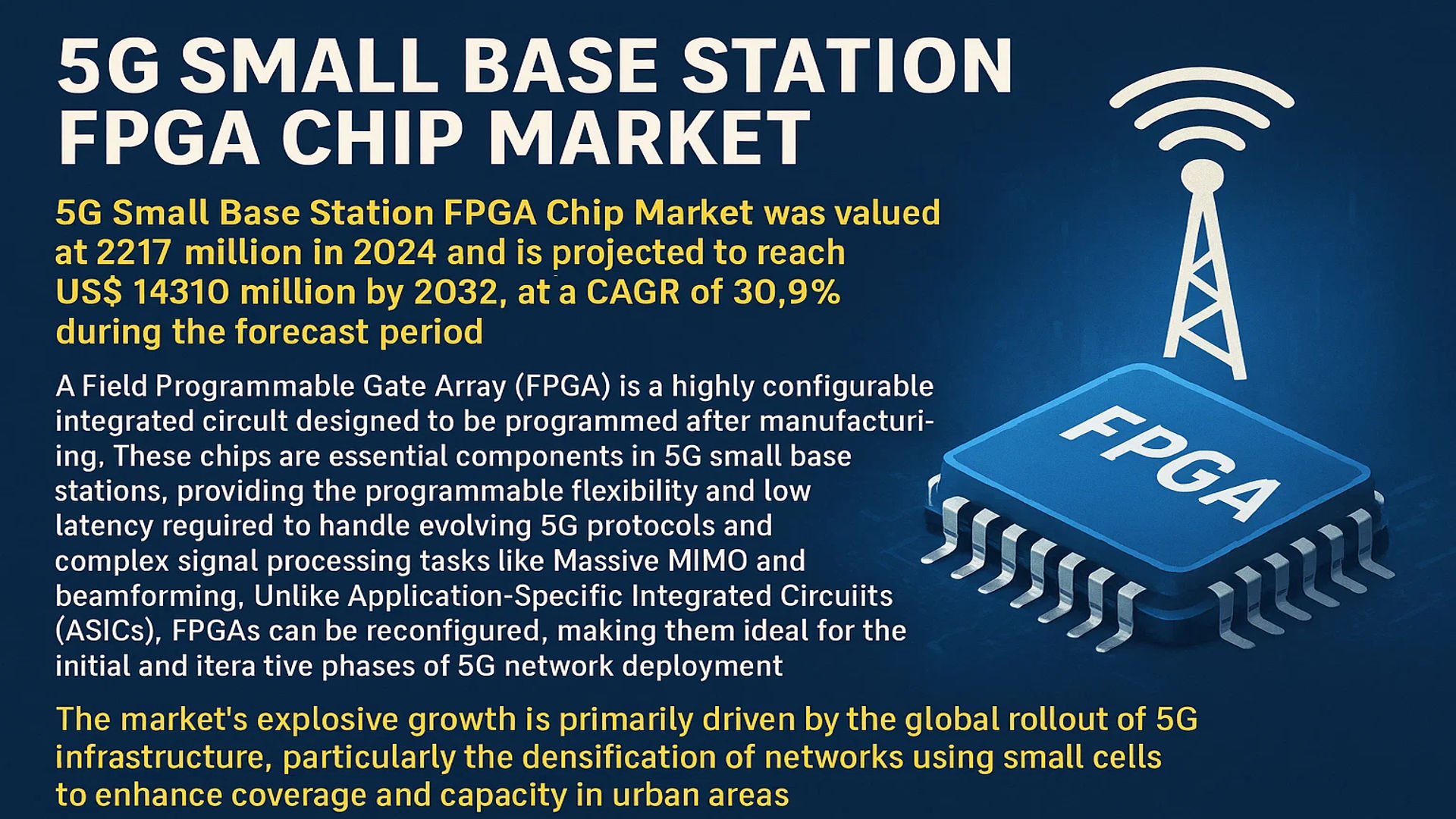
The global 5G Small Base Station FPGA Chip Market was valued at 2217 million in 2024 and is projected to reach US$ 14310 million by 2032, at a CAGR of 30.9% during the forecast period.
A Field Programmable Gate Array (FPGA) is a highly configurable integrated circuit designed to be programmed after manufacturing. These chips are essential components in 5G small base stations, providing the programmable flexibility and low latency required to handle evolving 5G protocols and complex signal processing tasks like Massive MIMO and beamforming. Unlike Application-Specific Integrated Circuits (ASICs), FPGAs can be reconfigured, making them ideal for the initial and iterative phases of 5G network deployment where standards are still maturing.
The market’s explosive growth is primarily driven by the global rollout of 5G infrastructure, particularly the densification of networks using small cells to enhance coverage and capacity in urban areas. China is the dominant market, accounting for approximately 66% of the global share in 2024, due to its aggressive national 5G deployment strategy. While the market is currently dominated by SRAM-based FPGAs, which hold nearly 100% share, the landscape is highly concentrated, with the top three manufacturers—AMD (Xilinx), Intel (Altera), and Lattice—collectively holding about 98% of the market share. However, domestic players in China are making significant strides in developing local solutions to reduce reliance on foreign technology.
MARKET DYNAMICS
MARKET DRIVERS
Accelerated Global 5G Infrastructure Deployment to Drive FPGA Chip Demand
The global rollout of 5G networks is accelerating at an unprecedented pace, driving substantial demand for small base station FPGA chips. With over 300 commercial 5G networks deployed worldwide and more than 1.3 billion 5G subscriptions active, telecommunications providers are investing heavily in network densification to meet growing data traffic demands. Small cells are becoming essential components of 5G infrastructure, particularly in urban environments and high-traffic locations where traditional macro cells face capacity limitations. FPGA chips provide the necessary flexibility for rapid protocol updates and customization, making them ideal for the evolving 5G standards. The programmable nature of FPGAs allows network operators to implement complex signal processing algorithms and support multiple frequency bands without hardware redesign, significantly reducing time-to-market for new network features and enhancements.
Massive MIMO Technology Implementation Fuels FPGA Adoption
The widespread adoption of Massive Multiple-Input Multiple-Output (MIMO) technology in 5G networks represents a significant driver for FPGA chip demand. Massive MIMO systems, which utilize dozens or even hundreds of antennas at base stations, require sophisticated beamforming and signal processing capabilities that traditional ASICs struggle to provide during early deployment phases. FPGAs offer the computational power and flexibility needed to handle complex spatial processing algorithms and adaptive beamforming techniques essential for maximizing spectral efficiency and network capacity. The ability to reprogram FPGAs in the field allows network equipment manufacturers to optimize performance parameters and implement new algorithms as standards evolve, providing a crucial advantage in the competitive 5G equipment market. This technical requirement has positioned FPGAs as the preferred solution for initial 5G small cell deployments, particularly in applications requiring high throughput and low latency performance.
Edge Computing and Network Function Virtualization Expansion
The convergence of 5G with edge computing and network function virtualization (NFV) is creating new opportunities for FPGA deployment in small base stations. As telecommunications networks evolve toward cloud-native architectures, FPGAs provide the hardware acceleration necessary for virtualized radio access network (vRAN) implementations. The programmable nature of FPGAs enables efficient offloading of compute-intensive tasks such as channel coding, encryption, and packet processing, which is crucial for meeting the stringent latency requirements of 5G applications. This capability is particularly valuable for emerging use cases including industrial IoT, autonomous vehicles, and augmented reality, where processing must occur closer to end-users. The flexibility of FPGA solutions allows network operators to dynamically allocate resources based on traffic patterns and service requirements, optimizing both performance and energy efficiency across their network infrastructure.
MARKET CHALLENGES
High Development Costs and Power Consumption Constraints
The 5G small base station FPGA chip market faces significant challenges related to development complexity and power efficiency requirements. FPGA solutions typically consume 30-50% more power than application-specific integrated circuits (ASICs), creating thermal management challenges in space-constrained small cell deployments. This power consumption issue becomes particularly critical in outdoor installations where cooling options are limited and energy efficiency directly impacts operational costs. The development cycle for FPGA-based solutions also requires specialized engineering expertise in both hardware design and software development, leading to higher research and development expenditures compared to standard chip solutions. These factors combine to create substantial barriers for widespread adoption, especially in cost-sensitive market segments where price competition is intense.
Other Challenges
Technical Complexity in System Integration
Integrating FPGA chips into compact 5G small base stations presents numerous technical challenges, including signal integrity issues, electromagnetic interference management, and thermal dissipation constraints. The high-speed serial interfaces required for 5G communications demand careful PCB layout and sophisticated packaging solutions to maintain signal quality, increasing both design complexity and manufacturing costs. Additionally, the need to support multiple frequency bands and comply with diverse regulatory requirements across different regions further complicates system architecture, requiring more sophisticated FPGA configurations and validation processes.
Supply Chain Vulnerabilities and Component Shortages
The global semiconductor supply chain disruptions have significantly impacted FPGA availability and pricing, creating uncertainty for 5G infrastructure deployments. Lead times for high-performance FPGA chips have extended to 40-50 weeks in some cases, forcing equipment manufacturers to redesign products or seek alternative solutions. These supply constraints are particularly challenging for the telecommunications industry, where network rollout schedules are often tied to regulatory requirements and competitive pressures, creating potential delays in 5G service availability and increasing project costs.
MARKET RESTRAINTS
ASIC Migration and Cost Pressure from Competing Technologies
As 5G standards mature and volumes increase, the market is experiencing growing pressure to migrate from FPGA-based solutions to application-specific integrated circuits (ASICs). ASICs offer significantly lower per-unit costs at high production volumes, typically achieving 60-70% cost reduction compared to equivalent FPGA implementations. This cost advantage becomes increasingly compelling as 5G deployment scales beyond initial trial phases into mass commercialization. Major network equipment manufacturers are developing ASIC-based solutions that can replace FPGAs in standardized applications, particularly in cost-sensitive market segments where price competition is intense. This transition is accelerated by the improving performance and flexibility of modern ASIC designs, which increasingly incorporate programmable elements while maintaining the cost benefits of dedicated silicon.
Technical Standardization and Interoperability Requirements
The ongoing standardization of 5G technologies is creating headwinds for FPGA adoption in small base stations. As 3GPP releases become more stable and implementation profiles more clearly defined, the value proposition of FPGA flexibility diminishes relative to the cost advantages of fixed-function solutions. Network operators are increasingly demanding multi-vendor interoperability and standardized interfaces, which reduces the need for the customization capabilities that FPGAs provide. This trend toward standardization is particularly evident in the small cell market, where equipment costs must be minimized to support dense deployments. The development of open RAN standards and reference architectures further accelerates this transition, creating ecosystem-wide pressure for cost-optimized solutions that prioritize interoperability over customization flexibility.
Geopolitical Factors and Export Restrictions
Geopolitical tensions and export control regulations are creating significant restraints for the global 5G small base station FPGA chip market. Restrictions on technology transfers and semiconductor exports affecting certain regions have disrupted supply chains and limited market access for both suppliers and customers. These constraints are particularly impactful given that the three leading FPGA manufacturers control approximately 98% of the market and are subject to various export control regimes. The resulting market fragmentation requires equipment manufacturers to develop region-specific product variants and supply chain strategies, increasing development costs and reducing economies of scale. These geopolitical factors are reshaping global market dynamics and creating uncertainty for long-term investment planning in 5G infrastructure.
MARKET OPPORTUNITIES
Private 5G Networks and Industrial Applications Expansion
The rapid growth of private 5G networks across industrial, enterprise, and specialized vertical markets presents substantial opportunities for FPGA-based small base stations. Unlike public networks, private 5G deployments often require customized features, specialized quality-of-service guarantees, and unique integration with existing industrial systems. FPGAs provide the flexibility needed to implement these custom requirements without the development costs associated with full ASIC design. The market for private 5G networks is projected to grow significantly across manufacturing, logistics, energy, and healthcare sectors, where reliability, low latency, and security requirements exceed what standard network equipment can provide. This diversification of 5G applications beyond traditional mobile broadband creates sustained demand for programmable solutions that can adapt to specialized use cases and evolving technical requirements.
Emerging Millimeter Wave Deployment and Frequency Band Expansion
The ongoing expansion of 5G into millimeter wave frequency bands and the allocation of new spectrum resources worldwide create significant opportunities for FPGA technology. Millimeter wave deployments require sophisticated beamforming and beam management capabilities that benefit from the programmable signal processing capabilities of FPGAs. As regulators continue to auction new spectrum bands and existing bands are repurposed for 5G use, the ability to support multiple frequency ranges through software reconfiguration becomes increasingly valuable. This spectrum flexibility allows network operators to deploy equipment that can be adapted to local regulatory environments and frequency allocations without hardware modifications, reducing inventory costs and simplifying network planning. The programmable nature of FPGAs also facilitates compliance with evolving spectrum sharing regulations and dynamic spectrum access technologies, positioning them ideally for next-generation wireless systems.
Artificial Intelligence Integration and Smart Network Management
The integration of artificial intelligence and machine learning capabilities into 5G networks represents a substantial growth opportunity for FPGA-based solutions. FPGAs provide the parallel processing capabilities and low-latency performance required for real-time AI inference at the network edge, enabling intelligent traffic management, predictive maintenance, and self-organizing network features. The ability to update and enhance AI algorithms through firmware updates allows network operators to continuously improve network performance and adapt to changing traffic patterns and service requirements. This capability is particularly valuable for implementing network slicing and quality-of-service management in complex 5G environments, where different applications may have dramatically different performance requirements. The programmable nature of FPGAs enables equipment manufacturers to differentiate their products through software-defined features and capabilities, creating competitive advantages in increasingly crowded markets.
5G SMALL BASE STATION FPGA CHIP MARKET TRENDS
Accelerated Global 5G Network Densification to Emerge as a Primary Market Driver
The global push for comprehensive 5G coverage is fundamentally driving the demand for FPGA chips in small base stations. While macrocells provide wide-area coverage, they struggle with signal penetration in dense urban environments and indoor settings. This has created an urgent need for network densification through small cells, including picocells and femtocells. The inherent programmability and flexibility of FPGAs make them the ideal solution for these deployments, as they can be reconfigured to handle evolving 5G standards and carrier-specific requirements without a complete hardware overhaul. The market is projected to grow from a valuation of $2217 million in 2024 to over $14310 million by 2032, reflecting a compound annual growth rate of 30.9%. This explosive growth is directly tied to the massive scale of 5G infrastructure rollouts, particularly in leading markets like China, which alone commands approximately 66% of the global market share for these components.
Other Trends
Technological Evolution and Protocol Uncertainty Favor FPGA Adoption
The ongoing evolution of 5G standards, including the transition from Release 15 to future releases, creates a significant period of technological uncertainty where Application-Specific Integrated Circuits (ASICs) are too rigid and costly to develop. FPGAs fill this critical gap perfectly. Their ability to be reprogrammed in the field allows for post-deployment upgrades to support new features, such as enhancements for Massive MIMO configurations or network slicing capabilities. This flexibility is paramount during the early and growth phases of 5G, as it mitigates the risk of hardware obsolescence. Furthermore, the low-latency processing required for real-time signal processing in 5G small cells is a domain where FPGas excel, providing a performance advantage over general-purpose processors. This technical superiority ensures their sustained demand until the 5G protocol stack fully stabilizes and high-volume, cost-optimized ASICs become viable.
Geopolitical Factors and Supply Chain Diversification Reshaping the Competitive Landscape
While the market is currently dominated by a few key players—with Intel (Altera), AMD (Xilinx), and Lattice collectively holding about 98% of the market share—geopolitical tensions and a global emphasis on supply chain resilience are catalyzing a notable shift. National security concerns and trade restrictions have accelerated initiatives in several regions, most notably China, to develop a domestic FPGA ecosystem. This has led to increased investment and policy support for local manufacturers like Shanghai Fudan Microelectronics and Anlu Technology. Although these domestic players currently face challenges related to patent barriers, advanced process node access, and ecosystem maturity, their progress is steadily eroding the near-monopoly of established Western firms. This trend is not just about local sourcing; it’s about fostering innovation and creating a more diversified and competitive global supply chain for a critically important telecommunications component.
COMPETITIVE LANDSCAPE
Key Industry Players
Companies Leverage Technological Innovation and Strategic Alliances to Capture Market Share
The global competitive landscape for 5G Small Base Station FPGA chips is highly concentrated, dominated by a few established American technology giants. This market structure is a direct result of the significant technological barriers and extensive patent portfolios that have been built over decades. AMD (Xilinx) and Intel (Altera) collectively command a dominant position, with their combined market share estimated to be overwhelmingly high. Their leadership is primarily attributed to their advanced, high-performance product families—such as AMD’s Versal ACAP and Intel’s Agilex FPGA series—which are specifically engineered to meet the demanding processing and low-latency requirements of 5G Massive MIMO and beamforming technologies.
Lattice Semiconductor also holds a significant and vital share of the market, particularly for lower-power, cost-sensitive small cell applications. The company’s growth is driven by its focus on power efficiency and its expansive partner ecosystem, which enables faster integration for base station manufacturers. These leading players are continuously strengthening their positions through aggressive research and development initiatives and by forming deep, strategic partnerships with major telecommunications equipment providers and network operators worldwide.
Furthermore, these incumbents are actively pursuing geographical expansions, especially within the Asia-Pacific region, and launching new, optimized product variants to address the specific needs of different small cell form factors (small, pico, femto). These concerted efforts are expected to help them maintain and even grow their substantial market share over the projected period as global 5G deployments accelerate.
Meanwhile, a cohort of emerging players, including Achronix Semiconductor and Microchip (Microsemi), are strengthening their market presence through significant investments in novel architectures like FPGA chiplets and embedded FPGA (eFPGA) technology. They are also engaging in strategic partnerships aimed at providing alternative solutions and fostering competition in specific niches of the market.
In parallel, Chinese companies such as Shanghai Fudan Microelectronics and Shanghai Anlogic Infotech are making notable strides, driven by domestic policy support and the urgent need for supply chain resilience. While they currently cater predominantly to the vast Chinese market, their ongoing technological advancements and capacity expansions are gradually increasing their global profile, aiming to reduce the industry’s historical reliance on Western suppliers.
List of Key Companies Profiled in the 5G Small Base Station FPGA Chip Market
- AMD (Xilinx) (U.S.)
- Intel (Altera) (U.S.)
- Lattice Semiconductor (U.S.)
- Microchip Technology (Microsemi) (U.S.)
- Achronix Semiconductor (U.S.)
- Shanghai Anlogic Infotech (China)
- Guoxin Micro (China)
- Shanghai Fudan Microelectronics (China)
Segment Analysis:
By Type
SRAM-Type FPGA Chips Dominate the Market Due to Superior Performance and Reprogrammability
The market is segmented based on type into:
- SRAM Type
- Flash Type
By Application
Small Cell Segment Leads Due to Massive Deployment in Urban Densification and Network Capacity Enhancement
The market is segmented based on application into:
- Small
- Pico
- Femto
By Architecture
Heterogeneous Architecture Gains Traction for Optimizing Power and Performance in 5G Deployments
The market is segmented based on architecture into:
- Homogeneous FPGA
- Heterogeneous FPGA
By Technology Node
Advanced Node FPGAs Drive Market Growth to Meet Demanding 5G Throughput and Latency Requirements
The market is segmented based on technology node into:
- 16/14/12nm
- 20nm
- 28nm
- Others
Regional Analysis: 5G Small Base Station FPGA Chip Market
Asia-Pacific
The Asia-Pacific region is the undisputed leader in the 5G Small Base Station FPGA Chip market, accounting for approximately 66% of the global market share, with China being the single largest consumer. This dominance is propelled by massive, state-backed 5G infrastructure deployment initiatives. China’s “5G+” strategy has accelerated the construction of hundreds of thousands of base stations, creating immense demand for the flexible processing solutions that FPGAs provide, especially during the initial rollout phase. While the market is currently dominated by foreign FPGA suppliers due to their technological maturity, there is a concerted and well-funded push for domestic self-sufficiency. Companies like Shanghai Fudan Microelectronics and Shanghai Anlogic Infotech are actively developing and deploying homegrown FPGA solutions for 5G small cells, supported by national industrial policies aimed at technological independence. The region’s high population density and rapid urbanization further necessitate the dense network of small cells that FPGAs are crucial for, ensuring long-term growth prospects that outpace other global markets.
North America
Accounting for approximately 9% of the global market, North America represents a highly advanced but more mature segment. Demand is driven by the need for network densification in urban centers and the deployment of private 5G networks across enterprise and industrial campuses. The market is characterized by a strong preference for high-performance, cutting-edge FPGA solutions from leading suppliers like Intel (Altera) and AMD (Xilinx), which are headquartered in the region. These companies work closely with major telecom equipment providers and cloud service providers developing virtualized RAN (vRAN) architectures, where the programmability of FPGAs is essential. However, the market growth is tempered by a more methodical, commercially-driven rollout compared to Asia-Pacific, with a significant focus on developing and eventually transitioning to ASIC-based solutions for cost optimization in high-volume deployments.
Europe
The European market is shaped by a strong regulatory focus on security, interoperability, and sustainability within its 5G ecosystem. While the pace of public 5G rollout varies across the continent, there is significant activity in the industrial IoT and smart city sectors, which leverage small cells for targeted coverage. This creates a steady demand for FPGA chips that can handle specialized, low-latency applications. European network operators and equipment manufacturers often partner with global FPGA leaders but are also actively involved in research initiatives like the O-RAN Alliance, which promotes open and interoperable network architectures. This focus on open standards could influence future FPGA requirements, emphasizing flexibility and vendor-agnostic solutions. The market is advanced but faces competition from alternative chip architectures as the technology matures.
South America
The South American market for 5G Small Base Station FPGA chips is in a nascent stage of development. The primary growth driver is the ongoing auction of 5G spectrum and the initial network build-out by major operators in countries like Brazil and Argentina. The economic landscape presents a challenge, as cost sensitivity often leads to a preference for established, cost-effective technologies over the premium, flexible solutions offered by FPGAs in the early phases. Consequently, the adoption of FPGA chips is currently limited to specific, high-value urban deployment scenarios or pilot projects for enterprise networks. The market potential is significant in the long term as networks expand and require densification, but progress is intrinsically linked to regional economic stability and investment in telecommunications infrastructure.
Middle East & Africa
This region presents a market of emerging opportunities contrasted by significant challenges. Wealthier Gulf Cooperation Council (GCC) nations, such as Saudi Arabia and the UAE, are aggressively deploying 5G networks as part of broader digital transformation and economic diversification plans (e.g., Saudi Vision 2030). In these high-investment markets, there is demand for advanced FPGA chips to support ambitious smart city and industrial projects. Conversely, across much of Africa, the focus remains on expanding basic 4G coverage, with 5G deployments largely confined to major urban centers. The widespread adoption of FPGA-dependent 5G small cells across the broader region is constrained by funding limitations, less developed infrastructure, and a prioritization of more affordable network solutions. The market is therefore highly fragmented, with growth concentrated in specific, high-investment nations.
Report Scope
This market research report provides a comprehensive analysis of the global and regional 5G Small Base Station FPGA Chip markets, covering the forecast period 2025–2032. It offers detailed insights into market dynamics, technological advancements, competitive landscape, and key trends shaping the industry.
Key focus areas of the report include:
- Market Size & Forecast: Historical data and future projections for revenue, unit shipments, and market value across major regions and segments.
- Segmentation Analysis: Detailed breakdown by product type, technology, application, and end-user industry to identify high-growth segments and investment opportunities.
- Regional Outlook: Insights into market performance across North America, Europe, Asia-Pacific, Latin America, and the Middle East & Africa, including country-level analysis where relevant.
- Competitive Landscape: Profiles of leading market participants, including their product offerings, R&D focus, manufacturing capacity, pricing strategies, and recent developments such as mergers, acquisitions, and partnerships.
- Technology Trends & Innovation: Assessment of emerging technologies, integration of AI/IoT, semiconductor design trends, fabrication techniques, and evolving industry standards.
- Market Drivers & Restraints: Evaluation of factors driving market growth along with challenges, supply chain constraints, regulatory issues, and market-entry barriers.
- Stakeholder Analysis: Insights for component suppliers, OEMs, system integrators, investors, and policymakers regarding the evolving ecosystem and strategic opportunities.
Primary and secondary research methods are employed, including interviews with industry experts, data from verified sources, and real-time market intelligence to ensure the accuracy and reliability of the insights presented.
FREQUENTLY ASKED QUESTIONS:
What is the current market size of Global 5G Small Base Station FPGA Chip Market?
-> 5G Small Base Station FPGA Chip Market was valued at 2217 million in 2024 and is projected to reach US$ 14310 million by 2032, at a CAGR of 30.9% during the forecast period.
Which key companies operate in Global 5G Small Base Station FPGA Chip Market?
-> Key players include AMD (Xilinx), Intel (Altera), Lattice, Microchip (Microsemi), Achronix Semiconductor, Shanghai Anlogic Infotech, Guoxin Micro, and Shanghai Fudan Microelectronics, among others.
What are the key growth drivers?
-> Key growth drivers include global 5G infrastructure deployment, demand for low-latency high-bandwidth connectivity, Massive MIMO technology adoption, and the flexibility of FPGA solutions during protocol evolution.
Which region dominates the market?
-> China is the dominant market with approximately 66% global market share, followed by South Korea and North America with 10% and 9% respectively.
What are the emerging trends?
-> Emerging trends include domestic FPGA development in China, integration of AI capabilities, evolution towards cloud RAN architectures, and the transition from FPGA to ASIC solutions as 5G standards mature.

Get Sample Report PDF for Exclusive Insights
Report Sample Includes
- Table of Contents
- List of Tables & Figures
- Charts, Research Methodology, and more...
 Download Sample Report PDF