
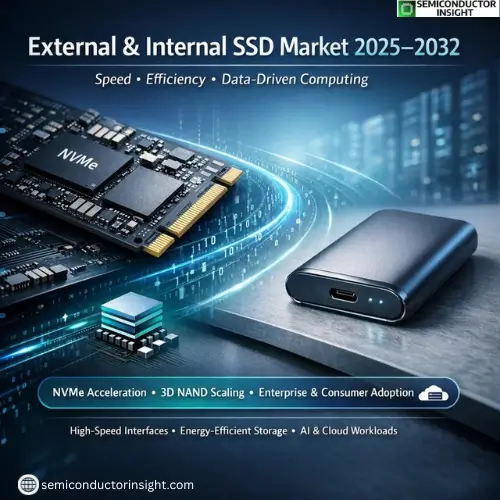
The New Storage Era: External and Internal SSD Market Trends Explained
The New Storage Era: External and Internal SSD Market Trends Explained
External and Internal SSD Market is accelerating rapidly as demand for faster data access, compact storage, and energy-efficient semiconductor solutions reshapes consumer electronics, enterprise infrastructure, and next-generation computing.
A New Storage Reality: Why SSDs Are No Longer Optional
Data creation is exploding from high-resolution video and AI workloads to cloud applications and edge computing. In this environment, traditional hard disk drives are increasingly unable to keep up. This shift has pushed solid-state drives (SSDs) from premium components into core storage infrastructure, making the External and Internal SSD Market one of the most critical growth areas within the semiconductor ecosystem.
What makes SSDs transformative is not just speed, but how semiconductor innovation has redefined storage architecture. With no moving parts, SSDs deliver near-instant data access, lower power consumption, and higher reliability qualities that align perfectly with modern digital behavior.
Internal SSDs: The Performance Engine inside Modern Devices
Internal SSDs sit at the heart of laptops, desktops, gaming consoles, and data centre servers. Their evolution mirrors the broader progress of semiconductor technology itself.
The transition from SATA-based SSDs to NVMe and PCIe interfaces has unlocked dramatic gains in throughput and latency. Today’s internal SSDs can process massive datasets in seconds, enabling real-time analytics, faster boot times, and smoother multitasking across consumer and enterprise systems.
This performance leap is particularly visible in:
- Gaming and content creation, where load times and file transfers directly affect user experience
- Enterprise servers, where internal SSDs support virtualization, databases, and AI workloads
- Ultra books and premium laptops, where compact SSDs allow thinner designs without compromising speed
As semiconductor nodes shrink and controller technology advances, internal SSDs continue to become faster, denser, and more power-efficient key factors driving sustained market demand.
External SSDs: Portability Meets Semiconductor Precision
External SSDs have moved far beyond simple backup devices. They are now essential tools for professionals who work with large files and need speed without physical constraints.
Portable SSDs in contrast to conventional external hard drives, use flash memory and sophisticated controllers to provide fast data transfer over USB-C, Thunderbolt, and other upcoming interfaces. This makes them ideal for on-the-go workflows in video production, software development, and enterprise mobility.
Recent market behavior shows a clear trend: users are willing to pay a premium for compact, shock-resistant, and ultra-fast external storage. This has pushed manufacturers to innovate not just in memory chips, but also in thermal design, firmware optimization, and interface compatibility.
Flash Memory Innovation at the Core of Market Growth
At the semiconductor level, the External and Internal SSD Market is fundamentally driven by advances in NAND flash memory. The shift from planar NAND to 3D NAND architectures has dramatically increased storage density while reducing cost per gigabyte.
Higher layer counts, improved endurance, and better error-correction algorithms are enabling SSDs to handle more write cycles and heavier workloads. These improvements are critical for enterprise adoption, where reliability is just as important as speed.
At the same time, SSD controller chips are becoming smarter. They now manage wear levelling, thermal throttling, and power optimization dynamically ensuring consistent performance even under sustained workloads.
Demand Dynamics across Consumer, Enterprise, and Cloud Verticals
The External and Internal SSD Market benefits from diversified demand, which strengthens its long-term outlook.
In the consumer segment, rising adoption of gaming PCs, high-performance laptops, and personal content creation tools continues to drive SSD upgrades. Users increasingly expect instant responsiveness, and SSDs have become synonymous with premium performance.
Enterprise and cloud environments represent another major growth engine. Data centers are replacing HDD-based storage with SSDs to reduce latency, lower energy costs, and support AI-driven applications. Internal SSDs dominate server deployments, while external SSDs play a growing role in edge computing and portable data processing.
Recent Market Shifts Shaping Competitive Strategy
Recent years have shown how sensitive the SSD market is to supply chain dynamics and semiconductor cycles. Fluctuations in NAND pricing, inventory corrections, and shifts in consumer electronics demand have influenced short-term revenues.
However, these cycles are also pushing manufacturers to focus on value differentiation rather than volume alone. Companies are investing in higher-capacity SSDs, specialized enterprise solutions, and ruggedized external drives to protect margins and expand application reach.
The growing importance of AI workloads and high-speed data access is also encouraging closer collaboration between SSD makers and system integrators.
Don’t Forget to Surf Our Updated Report for More Detailed Analysis:
https://semiconductorinsight.com/report/external-and-internal-ssd-market/
Challenges That Continue to Test the Market
Despite strong momentum, the market faces challenges. Price volatility in flash memory, compatibility issues across interfaces, and thermal management concerns especially in ultra-compact SSDs remain critical considerations.
For external SSDs, maintaining sustained performance without overheating is a key design hurdle. For internal SSDs, balancing speed with durability and power efficiency continues to shape product roadmaps.
External and Internal SSD Market is no longer just about storage it is about enabling modern computing itself. As software becomes more data-intensive and hardware more compact, SSDs will remain central to how systems are designed and experienced.
With ongoing semiconductor innovation, rising data consumption, and expanding use cases across industries, SSDs are positioned as one of the most resilient and strategically important segments of the global storage market.

Comments (0)