
Surface Acoustic Wave Sensors vs. MEMS Sensors Market Which Technology Is Leading Smart Monitoring
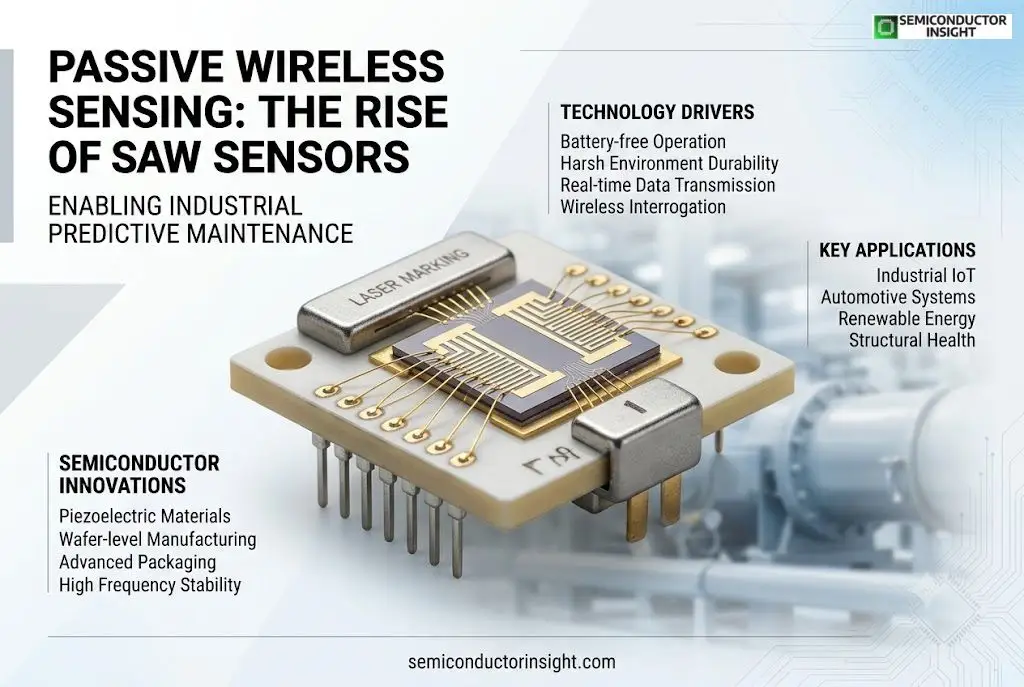
The evolution of connected industries is changing how physical parameters are measured, analyzed, and transmitted. Among the technologies enabling this transition, Surface Acoustic Wave (SAW) sensors have emerged as an attractive semiconductor-based sensing solution because they operate without onboard power, offer excellent reliability, and function efficiently in harsh industrial environments. From aircraft engines and railway infrastructure to wireless tire pressure monitoring and energy pipelines, SAW sensors are becoming an integral part of digital transformation projects worldwide.
SAW devices, in contrast to traditional electrical sensors, sense pressure, temperature, torque, humidity, strain, and chemical changes by means of acoustic waves moving along the surface of a piezoelectric material. Their passive architecture enables long service life while minimizing maintenance requirements, making them particularly valuable for inaccessible or hazardous locations.
Why Passive Wireless Sensing Is Becoming an Industrial Priority?
Industrial operators increasingly require sensors that can transmit reliable data without batteries or complex wiring. SAW sensors satisfy this need by using radio frequency interrogation, allowing measurements to be collected remotely even under extreme temperatures exceeding 300°C in specialized designs. This capability supports continuous asset monitoring in sectors where replacing batteries is expensive or operationally impossible.
The expansion of Industry 4.0 has also accelerated wireless sensing deployments. According to the GSM Association, global IoT connections are expected to surpass 38 billion by 2030, creating substantial demand for durable sensing technologies capable of supporting long operational lifecycles. Manufacturing plants, utilities, logistics hubs, and transportation networks are integrating passive sensing to improve operational efficiency and predictive maintenance.
For a more thorough report, please contact us using our most recent report: https://semiconductorinsight.com/report/surface-acoustic-wave-sensors-market/
Engineering Innovations Expanding Sensor Capabilities
· Recent semiconductor advancements have significantly improved SAW sensor performance through enhanced piezoelectric materials, advanced wafer fabrication, and miniaturized packaging technologies.
· Researchers are developing lithium niobate and lithium tantalate substrates that provide higher frequency stability and greater measurement precision under mechanical stress. Meanwhile, semiconductor packaging innovations are allowing SAW devices to operate across wider environmental conditions while maintaining signal integrity.
· Modern SAW sensors are now capable of simultaneously measuring multiple variables, enabling engineers to collect richer datasets from a single wireless sensing point. These multifunctional devices are particularly valuable for aerospace structures, rotating machinery, and renewable energy equipment.
Surface Acoustic Wave Sensors Market Share
Surface Acoustic Wave Sensors market share continues to expand as industrial automation, connected vehicles, healthcare diagnostics, and infrastructure monitoring generate new deployment opportunities.
Industrial automation represents one of the largest application segments because manufacturers increasingly rely on wireless condition monitoring to reduce equipment downtime and maintenance costs. Automotive applications are also gaining momentum through tire pressure monitoring systems, drivetrain sensing, and electric vehicle component monitoring.
Healthcare is emerging as another promising segment where SAW biosensors are being investigated for rapid pathogen detection, wearable diagnostics, and point-of-care testing. Energy companies are deploying SAW sensing technologies for pipeline integrity monitoring, while aerospace manufacturers utilize them to monitor structural stress without adding significant weight to aircraft components.
The diversification of application areas continues to broaden revenue opportunities, reducing dependence on any single end-use industry.
Real World Deployments Demonstrate Growing Commercial Value
Ø Several global industries have already demonstrated the practical benefits of SAW sensing technologies.
Ø Aircraft manufacturers are integrating passive wireless sensors for structural health monitoring, helping maintenance teams detect fatigue before critical failures occur.
Ø Railway operators are deploying wireless monitoring systems to measure axle temperatures and mechanical stress, thereby improving operational safety while reducing the need for manual inspections.
Ø In renewable energy, wind turbine operators increasingly monitor gearbox vibration and bearing conditions remotely to minimize unexpected outages. Similar wireless monitoring strategies are being adopted in offshore oil platforms where maintenance access remains challenging.
Ø These deployments highlight how semiconductor-enabled sensing is becoming a core component of predictive maintenance strategies.
Critical Market Movements Defining the Next Growth Cycle
The broader sensing ecosystem continues to expand alongside semiconductor innovation.
The global semiconductor industry generated approximately USD 628 billion in sales during 2024, according to the Semiconductor Industry Association, reflecting sustained investment across sensing, communications, AI, and automotive electronics.
More than 1.5 billion vehicles operate globally, creating long-term opportunities for wireless sensing applications ranging from tire monitoring to engine diagnostics.
The International Energy Agency reports that annual additions of renewable electricity capacity exceeded 700 GW in 2024, driving increased demand for intelligent monitoring systems capable of operating reliably across solar farms, wind installations, and grid infrastructure.
These technology trends collectively strengthen long-term demand for advanced sensing platforms such as SAW devices.
Semiconductor Manufacturing Opens New Possibilities
ü Wafer-level manufacturing is making SAW sensors smaller, more accurate, and easier to integrate with wireless communication modules.
ü Foundries are improving fabrication precision while reducing manufacturing defects through advanced lithography and process control.
ü The convergence of SAW sensors with edge computing, AI-enabled diagnostics, and low-power wireless communication protocols is enabling intelligent monitoring platforms capable of detecting anomalies in real time.
ü Instead of simply collecting measurements, future sensing systems will support autonomous maintenance decisions across factories, transportation systems, and smart cities.
As industries continue shifting toward predictive operations and digital infrastructure, semiconductor-enabled acoustic sensing is positioned to become a foundational technology supporting safer, smarter, and more efficient industrial ecosystems.

Comments (0)